
PUBLISHER: Global Market Insights Inc. | PRODUCT CODE: 2101630

PUBLISHER: Global Market Insights Inc. | PRODUCT CODE: 2101630
Europe Automotive Seat Market Opportunity, Growth Drivers, Industry Trend Analysis, and Forecast 2026 - 2035
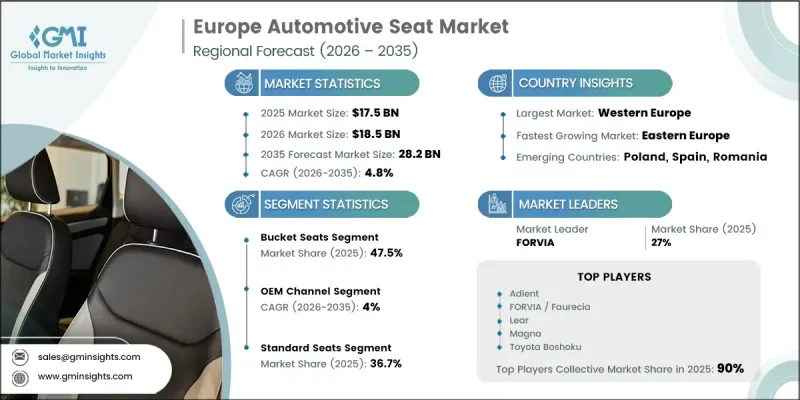
Europe Automotive Seat Market was valued at USD 17.5 billion in 2025 and is estimated to grow at a CAGR of 4.8% to reach USD 28.2 billion by 2035.
Market growth is driven by the rapid adoption of vehicle electrification, increasing consumer demand for enhanced seating comfort, and stricter safety regulations governing seat structures and occupant protection systems. Automotive manufacturers are placing greater emphasis on premium seating features as they seek to improve vehicle value, passenger experience, and interior quality across new vehicle platforms. Although vehicle production volumes across Europe are gradually stabilizing, the increasing integration of advanced seating technologies is enabling market value to grow faster than unit production. Features such as seat heating, ventilation, powered adjustment, and enhanced ergonomic support are becoming increasingly common across mainstream vehicle categories, particularly within the expanding SUV segment. In addition, seating systems are playing a more strategic role during vehicle development as manufacturers prioritize cabin comfort, lightweight design, energy efficiency, and premium interior differentiation, creating higher average revenue opportunities for automotive seat suppliers throughout the region.
| Market Scope | |
|---|---|
| Start Year | 2025 |
| Forecast Year | 2026-2035 |
| Start Value | $17.5 Billion |
| Forecast Value | $28.2 Billion |
| CAGR | 4.8% |
The bucket seat segment generated USD 8,318 million in 2025. Growth is supported by the widespread adoption of individual front-seat configurations across passenger vehicles and SUVs, where manufacturers continue integrating advanced comfort features, ergonomic improvements, powered adjustment systems, and enhanced seating functionality. Ongoing product innovation and increasing consumer preference for premium seating experiences continue to reinforce the segment's leading market position.
The OEM distribution channel accounted for USD 15,518 million in 2025, supported by the growing incorporation of advanced comfort, safety, and electronic technologies into modern vehicle platforms. Original equipment manufacturers continue to prioritize suppliers capable of meeting demanding quality standards, efficient manufacturing schedules, reliable supply chain performance, and seamless integration with evolving vehicle development programs, making OEM partnerships a critical driver of market growth.
Western Europe Automotive Seat Market held 50.4% share, generating USD 4.7 billion in 2025. Regional growth continues to be supported by strong demand for passenger vehicles and SUVs, although automotive production trends across Germany remain varied as manufacturers adapt to evolving market conditions and changing consumer preferences.
Major companies operating in the Europe automotive seat market include Lear, Magna, Adient, Toyota Boshoku, FORVIA/Faurecia, Hyundai Transys, Brose Fahrzeugteile, Grammer, and AUNDE. Companies operating in the Europe automotive seat market are strengthening their competitive position by expanding advanced seating technologies, improving manufacturing efficiency, and developing lightweight, ergonomic seating systems that enhance passenger comfort and vehicle performance. Manufacturers are increasing investments in research and development to introduce innovative features, sustainable materials, and smart seating solutions that align with evolving automotive design trends. Strategic collaborations with vehicle manufacturers enable suppliers to secure long-term OEM contracts while participating in next-generation vehicle platforms. Companies are also expanding regional production capacity, optimizing supply chains, and adopting advanced manufacturing technologies to improve operational flexibility and cost efficiency.
Table of Contents
Chapter 1 Methodology
- 1.1 Research approach
- 1.2 Quality Commitments
- 1.2.1 GMI AI policy & data integrity commitment
- 1.2.1.1 Source consistency protocol
- 1.2.1 GMI AI policy & data integrity commitment
- 1.3 Research Trail & Confidence Scoring
- 1.3.1 Research Trail Components
- 1.3.2 Scoring Components
- 1.4 Data Collection
- 1.4.1 Partial list of primary sources
- 1.5 Data mining sources
- 1.5.1 Paid sources
- 1.5.1.1 Sources, by region
- 1.5.1 Paid sources
- 1.6 Base estimates and calculations
- 1.6.1 Base year calculation
- 1.7 Forecast model
- 1.7.1 Quantified market impact analysis
- 1.7.1.1 Mathematical impact of growth parameters on forecast
- 1.7.1 Quantified market impact analysis
- 1.8 Research transparency addendum
- 1.8.1 Source attribution framework
- 1.8.2 Quality assurance metrics
- 1.8.3 Our commitment to trust
Chapter 2 Executive Summary
- 2.1 Industry 360° synopsis
- 2.2 Key market trends
- 2.2.1 Regional
- 2.2.2 Seat
- 2.2.3 Material
- 2.2.4 Component
- 2.2.5 Vehicle
- 2.2.6 Technology
- 2.2.7 Propulsion
- 2.2.8 Sales channel
- 2.3 TAM analysis, 2026-2035
- 2.4 CXO perspectives: Strategic imperatives
Chapter 3 Industry Insights
- 3.1 Industry ecosystem analysis
- 3.1.1 Supplier landscape
- 3.1.1.1 Raw Material Suppliers (Foam, Steel, Textiles, Electronics)
- 3.1.1.2 Tier 2 & Tier 1 Component Suppliers
- 3.1.1.3 Seat System Assemblers & OEM Seat Manufacturers
- 3.1.1.4 Vehicle OEMs
- 3.1.1.5 Aftermarket Distributors & End-Users
- 3.1.2 Profit margin
- 3.1.3 Cost structure
- 3.1.4 Value addition at each stage
- 3.1.5 Factor affecting the value chain
- 3.1.6 Disruptions
- 3.1.1 Supplier landscape
- 3.2 Industry impact forces
- 3.2.1 Growth drivers
- 3.2.1.1 Rising demand for premium comfort
- 3.2.1.2 EV-driven seat platform redesign
- 3.2.1.3 Premium SUV seat feature adoption
- 3.2.1.4 Stricter vehicle safety regulations
- 3.2.2 Industry pitfalls and challenges
- 3.2.2.1 Supply chain and material disruptions
- 3.2.2.2 High R&D and certification costs
- 3.2.3 Market opportunities
- 3.2.3.1 Sustainable bio-based seat materials
- 3.2.3.2 Smart and connected seating
- 3.2.3.3 Growing aftermarket retrofit demand
- 3.2.3.4 Premium seating for electric LCVs
- 3.2.1 Growth drivers
- 3.3 Growth potential analysis
- 3.4 Technology and innovation landscape
- 3.4.1 Current technological trends
- 3.4.1.1 Evolution of automotive seat technologies in Europe
- 3.4.1.2 Smart seating & sensor integration trends
- 3.4.2 Emerging technologies
- 3.4.2.1 Lightweight seat architecture & advanced materials innovation
- 3.4.2.2 Autonomous vehicle & zero-gravity seat design developments
- 3.4.1 Current technological trends
- 3.5 Regulatory landscape
- 3.5.1 Western Europe
- 3.5.1.1 European Commission - Vehicle Safety & Type Approval Regulations
- 3.5.1.2 UNECE Vehicle Regulations
- 3.5.2 Eastern Europe
- 3.5.2.1 Romanian Automotive Register (RAR) Regulations
- 3.5.2.2 UNECE Vehicle Regulations
- 3.5.3 Northern Europe
- 3.5.3.1 Swedish Transport Agency Vehicle Regulations
- 3.5.3.2 Danish Transport Authority Vehicle Regulations
- 3.5.4 Southern Europe
- 3.5.4.1 Institute for Mobility and Transport (IMT) Regulations
- 3.5.4.2 Ministry of Infrastructure and Transport Vehicle Regulations
- 3.5.1 Western Europe
- 3.6 Porter's analysis
- 3.7 PESTEL analysis
- 3.8 Pricing Analysis (Driven by Primary Research)
- 3.8.1 Historical Price Trend Analysis by Seat Technology tier
- 3.8.2 Pricing Strategy by Player Type (Premium / Value / Cost-plus)
- 3.9 Patent analysis (Driven by Primary Research)
- 3.10 Trade data analysis (Driven by paid database)
- 3.10.1 Import/export volume & value trends
- 3.10.2 Key trade corridors & tariff impact
- 3.11 Capacity & Production Landscape (Driven by Primary Research)
- 3.11.1 Installed seat manufacturing capacity by European Country & Key Producer
- 3.11.2 Capacity Utilization Rates & Expansion Pipelines Across European Plants
- 3.12 Vehicle Fleet (Vehicle Parc) Analysis
- 3.12.1 Passenger car fleet
- 3.12.2 Commercial vehicle fleet
- 3.12.3 Average fleet age
- 3.12.4 EV fleet penetration
- 3.13 Impact of AI & Generative AI on the Market
- 3.13.1 AI-driven disruption of existing business models
- 3.13.2 Gen AI use cases & adoption roadmap by segment
- 3.13.3 Risks, limitations & regulatory considerations
- 3.14 Forecast assumptions & scenario analysis (Driven by primary research)
- 3.14.1 Base Case key macro & industry variables driving CAGR
- 3.14.2 Optimistic Scenarios Favorable macro and industry tailwinds
- 3.14.3 Pessimistic Scenario Macroeconomic slowdown or industry headwinds
Chapter 4 Competitive Landscape, 2025
- 4.1 Introduction
- 4.2 Company market share analysis
- 4.2.1 North America
- 4.2.2 Europe
- 4.2.3 Asia Pacific
- 4.2.4 LATAM
- 4.2.5 MEA
- 4.3 Competitive analysis of major market players
- 4.4 Competitive positioning matrix
- 4.5 Key developments
- 4.5.1 Mergers & acquisitions
- 4.5.2 Partnerships & collaborations
- 4.5.3 New product launches
- 4.5.4 Expansion plans and funding
- 4.6 Company tier benchmarking
- 4.6.1 Tier classification criteria & qualifying thresholds
- 4.6.2 Tier positioning matrix by revenue, geography & innovation
Chapter 5 Market Estimates & Forecast, By Seat, 2022 - 2035 ($Mn, Units)
- 5.1 Key trends
- 5.2 Bucket seat
- 5.3 Bench seat
- 5.4 Split bench seat
- 5.5 Stow-and-go / retractable seat
- 5.6 Others
Chapter 6 Market Estimates & Forecast, By Material, 2022 - 2035 ($Mn, Units)
- 6.1 Key trends
- 6.2 Fabric
- 6.3 Synthetic leather
- 6.4 Genuine leather
- 6.5 Others
Chapter 7 Market Estimates & Forecast, By Component, 2022 - 2035 ($Mn, Units)
- 7.1 Key trends
- 7.2 Frames
- 7.3 Foam padding
- 7.4 Seat adjuster
- 7.5 Headrests
- 7.6 Others
Chapter 8 Market Estimates & Forecast, By Vehicle, 2022 - 2035 ($Mn, Units)
- 8.1 Key trends
- 8.2 Passenger cars
- 8.2.1 Sedan
- 8.2.2 SUV
- 8.2.3 Hatchback
- 8.3 Commercial vehicles
- 8.3.1 LCV
- 8.3.2 MCV
- 8.3.3 HCV
Chapter 9 Market Estimates & Forecast, By Technology, 2022 - 2035 ($Mn, Units)
- 9.1 Key trends
- 9.2 Standard seats
- 9.3 Powered / electric seats
- 9.4 Heated seats
- 9.5 Ventilated / cooled seats
- 9.6 Massage & multi-function seats
- 9.7 Others
Chapter 10 Market Estimates & Forecast, By Propulsion, 2022 - 2035 ($Mn, Units)
- 10.1 Key trends
- 10.2 ICE (Gasoline & Diesel)
- 10.3 EV
- 10.3.1 BEV
- 10.3.2 PHEV
- 10.4 Hybrid EV
Chapter 11 Market Estimates & Forecast, By Sales channel, 2022 - 2035 ($Mn, Units)
- 11.1 Key trends
- 11.2 OEM
- 11.3 Aftermarket
Chapter 12 Market Estimates & Forecast, By Region, 2022 - 2035 ($Mn, Units)
- 12.1 Key trends
- 12.2 Western Europe
- 12.2.1 Germany
- 12.2.2 France
- 12.2.3 UK
- 12.2.4 Netherlands
- 12.2.5 Belgium
- 12.3 Eastern Europe
- 12.3.1 Poland
- 12.3.2 Czech Republic
- 12.3.3 Hungary
- 12.3.4 Romania
- 12.3.5 Slovakia
- 12.4 Northern Europe
- 12.4.1 Sweden
- 12.4.2 Finland
- 12.4.3 Denmark
- 12.4.4 Norway
- 12.4.5 Estonia
- 12.5 Southern Europe
- 12.5.1 Italy
- 12.5.2 Spain
- 12.5.3 Turkey
- 12.5.4 Portugal
- 12.5.5 Greece
- 12.6 Rest of Europe
Chapter 13 Company Profiles
- 13.1 Global players
- 13.1.1 Adient
- 13.1.2 AUNDE
- 13.1.3 FORVIA (Faurecia)
- 13.1.4 Gentherm
- 13.1.5 Grammer
- 13.1.6 Lear
- 13.1.7 Magna
- 13.1.8 Toyota Boshoku
- 13.2 Regional players
- 13.2.1 Brose Fahrzeugteile
- 13.2.2 Brose Sitech
- 13.2.3 Groclin
- 13.2.4 Hyundai Transys Europe
- 13.2.5 Isringhausen (ISRI)
- 13.2.6 Martur Fompak
- 13.2.7 Proseat
- 13.2.8 Tesca
- 13.3 Emerging players
- 13.3.1 I.G. Bauerhin
- 13.3.2 Prevent
- 13.3.3 Recaro Automotive (Proma)
- 13.3.4 Sparco

