PUBLISHER: Global Market Insights Inc. | PRODUCT CODE: 2101635

PUBLISHER: Global Market Insights Inc. | PRODUCT CODE: 2101635
Inhalation Drug Delivery Market Opportunity, Growth Drivers, Industry Trend Analysis, and Forecast 2026 - 2035
The Global Inhalation Drug Delivery Market was valued at USD 46.5 billion in 2025 and is estimated to grow at a CAGR of 6.4% to reach USD 84.9 billion by 2035.
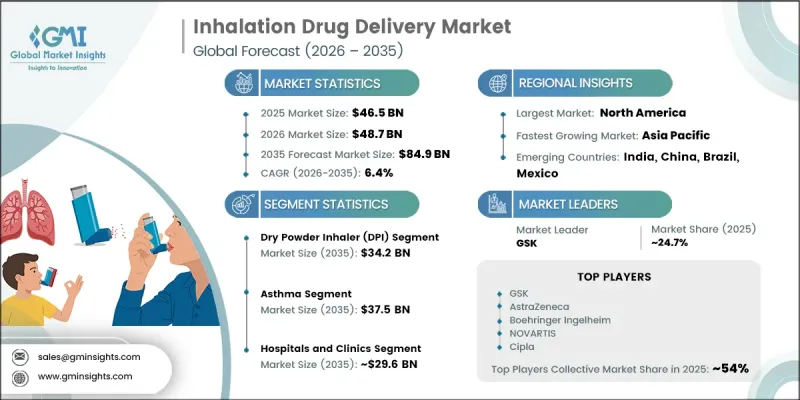
Market growth is supported by the increasing burden of respiratory diseases worldwide, the growing adoption of home-based respiratory care, and continuous advancements in pulmonary drug delivery technologies. The inhalation drug delivery market plays a critical role in modern respiratory disease management by enabling medications to be delivered directly to the lungs, improving therapeutic efficiency while minimizing systemic drug exposure. This targeted approach allows for faster onset of action, lower medication requirements, improved treatment outcomes, and enhanced patient convenience compared with conventional drug administration methods. Rising demand for long-term respiratory care solutions, coupled with increasing acceptance of generic and combination therapies, continues to strengthen market expansion. The growing incidence of chronic respiratory disorders is creating sustained demand for effective inhalation-based treatment options that support both disease control and symptom management. Continuous product innovation, expanding patient awareness, favorable healthcare infrastructure, and increasing access to respiratory therapies are further contributing to the long-term growth of the global inhalation drug delivery market.
| Market Scope | |
|---|---|
| Start Year | 2025 |
| Forecast Year | 2026-2035 |
| Start Value | $46.5 Billion |
| Forecast Value | $84.9 Billion |
| CAGR | 6.4% |
The dry powder inhaler (DPI) segment held 38.2% share in 2025. Market leadership is supported by its propellant-free design, efficient pulmonary drug delivery, convenient administration, and broad acceptance for chronic respiratory disease management. The segment continues to gain momentum as healthcare providers and patients increasingly prefer inhalation systems that offer reliable dose consistency, effective drug deposition, simplified handling, and improved treatment compliance. These performance advantages continue to strengthen the position of dry powder inhalers within the global inhalation drug delivery industry.
The asthma segment is expected to grow at a CAGR of 6.2%, reaching USD 37.5 billion by 2035, supported by the growing prevalence of asthma and the continued reliance on inhalation therapies as the standard approach for disease management. Strong demand for inhalation-based treatment is driven by the need for rapid symptom control, effective long-term disease management, and improved patient outcomes. Increasing diagnosis rates across both pediatric and adult populations continue to support rising utilization of inhalation drug delivery devices for asthma treatment worldwide.
North America Inhalation Drug Delivery Market accounted for 38% share in 2025. Regional market expansion is supported by the increasing prevalence of chronic respiratory diseases, strong healthcare infrastructure, growing adoption of advanced respiratory therapies, and rising demand for long-term pulmonary disease management. Continued investment in respiratory care technologies and expanding patient access to innovative treatment options are expected to further reinforce market growth across the region.
Key companies operating in the global inhalation drug delivery market include 3M, AstraZeneca, Boehringer Ingelheim, Chiesi, Cipla, GSK, Monaghan, Novartis, OMRON Healthcare, OPKO, PARI, Philips, and Teva. Companies active in the inhalation drug delivery market are strengthening their competitive position by investing in advanced inhalation technologies, expanding product portfolios, and improving drug-device integration to enhance treatment effectiveness and patient adherence. Manufacturers are focusing on research and development to introduce innovative delivery platforms that improve dosing accuracy, ease of use, and therapeutic performance. Strategic collaborations, licensing agreements, and manufacturing partnerships are helping companies expand their global footprint while accelerating product commercialization. Businesses are also increasing investments in digital health integration, production capacity, and regulatory compliance to support evolving healthcare requirements.
Table of Contents
Chapter 1 Research Methodology
- 1.1 Research approach
- 1.2 Quality commitments
- 1.2.1 GMI AI policy & data integrity commitment
- 1.2.1.1 Source consistency protocol
- 1.2.1 GMI AI policy & data integrity commitment
- 1.3 Research trail & confidence scoring
- 1.3.1 Research trail components
- 1.3.2 Scoring components
- 1.4 Data collection
- 1.4.1 Partial list of primary sources
- 1.5 Data mining sources
- 1.5.1 Paid sources
- 1.5.1.1 Sources, by region
- 1.5.1 Paid sources
- 1.6 Base estimates and calculations
- 1.6.1 Base year calculation
- 1.7 Forecast model
- 1.7.1 Quantified market impact analysis
- 1.7.1.1 Mathematical impact of growth parameters on forecast
- 1.7.1 Quantified market impact analysis
- 1.8 Research transparency addendum
- 1.8.1 Source attribution framework
- 1.8.2 Quality assurance metrics
- 1.8.3 Our commitment to trust
Chapter 2 Executive Summary
- 2.1 Industry 360° synopsis
- 2.2 Key market trends
- 2.2.1 Regional trends
- 2.2.2 Product type trends
- 2.2.3 Application trends
- 2.2.4 Distribution channel trends
- 2.2.5 End use trends
- 2.3 CXO perspectives: Strategic imperatives
Chapter 3 Industry Insights
- 3.1 Industry ecosystem analysis
- 3.2 Industry impact forces
- 3.2.1 Growth drivers
- 3.2.1.1 Rising global prevalence of respiratory diseases
- 3.2.1.2 Expansion of home-based respiratory care
- 3.2.1.3 Technological advancements in inhaler devices
- 3.2.1.4 Growing adoption of generic and combination therapies
- 3.2.2 Industry pitfalls and challenges
- 3.2.2.1 Stringent regulatory requirements
- 3.2.2.2 High development and manufacturing costs
- 3.2.3 Opportunities
- 3.2.3.1 Growth of smart inhalers and connected healthcare solutions
- 3.2.3.2 Untapped potential in emerging markets
- 3.2.1 Growth drivers
- 3.3 Growth potential analysis
- 3.4 Regulatory landscape
- 3.5 Pricing trend analysis
- 3.6 Technology and innovation landscape (Driven by Primary Research)
- 3.6.1 Current technological trends
- 3.6.2 Emerging technologies
- 3.7 Future market trends (Driven by Primary Research)
- 3.8 Impact of AI & Generative AI on the Market (Driven by Primary Research)
- 3.9 Porter's analysis
- 3.10 PESTEL analysis
Chapter 4 Competitive Landscape, 2025
- 4.1 Introduction
- 4.2 Company matrix analysis
- 4.3 Company market share analysis (Driven by Primary Research)
- 4.3.1 Global
- 4.3.2 North America
- 4.3.3 Europe
- 4.3.4 Asia Pacific
- 4.3.5 LAMEA
- 4.4 Competitive analysis of major market players
- 4.5 Competitive positioning matrix
- 4.6 Key developments
- 4.6.1 Mergers & acquisitions
- 4.6.2 Partnerships & collaborations
- 4.6.3 New product launches
- 4.6.4 Expansion plans
Chapter 5 Market Estimates and Forecast, By Product Type, 2022 - 2035 ($ Mn)
- 5.1 Key trends
- 5.2 Pressurized metered dose inhaler (pMDI)
- 5.3 Dry powder inhaler (DPI)
- 5.3.1 Single-dose
- 5.3.2 Multi-dose
- 5.4 Soft mist inhaler (SMI)
- 5.5 Nebulizer
- 5.5.1 Jet nebulizer
- 5.5.2 Ultrasonic nebulizer
- 5.5.3 Vibrating mesh nebulizer
Chapter 6 Market Estimates and Forecast, By Application, 2022 - 2035 ($ Mn)
- 6.1 Key trends
- 6.2 Asthma
- 6.3 Chronic obstructive pulmonary disease
- 6.4 Cystic fibrosis (CF)
- 6.5 Allergic rhinitis
- 6.6 Other applications
Chapter 7 Market Estimates and Forecast, By Distribution Channel, 2022 - 2035 ($ Mn)
- 7.1 Key trends
- 7.2 Brick and mortar
- 7.3 E-commerce
Chapter 8 Market Estimates and Forecast, By End Use, 2022 - 2035 ($ Mn)
- 8.1 Key trends
- 8.2 Hospitals and clinics
- 8.3 Homecare settings
- 8.4 Other end users
Chapter 9 Market Estimates and Forecast, By Region, 2022 - 2035 ($ Mn)
- 9.1 Key trends
- 9.2 North America
- 9.2.1 U.S.
- 9.2.2 Canada
- 9.3 Europe
- 9.3.1 Germany
- 9.3.2 UK
- 9.3.3 France
- 9.3.4 Spain
- 9.3.5 Italy
- 9.3.6 Netherlands
- 9.4 Asia Pacific
- 9.4.1 China
- 9.4.2 Japan
- 9.4.3 India
- 9.4.4 Australia
- 9.4.5 South Korea
- 9.5 Latin America
- 9.5.1 Brazil
- 9.5.2 Mexico
- 9.5.3 Argentina
- 9.6 MEA
- 9.6.1 South Africa
- 9.6.2 Saudi Arabia
- 9.6.3 UAE
Chapter 10 Company Profiles
- 10.1 3M
- 10.2 AstraZeneca
- 10.3 Boehringer Ingelheim
- 10.4 Chiesi
- 10.5 Cipla
- 10.6 GSK
- 10.7 Monaghan
- 10.8 Novartis
- 10.9 OMRON Healthcare
- 10.10 OPKO
- 10.11 PARI
- 10.12 Philips
- 10.13 Teva

