PUBLISHER: Global Market Insights Inc. | PRODUCT CODE: 2101649

PUBLISHER: Global Market Insights Inc. | PRODUCT CODE: 2101649
Coffee and Cocoa Traceability Market Opportunity, Growth Drivers, Industry Trend Analysis, and Forecast 2026 - 2035
The Global Coffee & Cocoa Traceability Market was valued at USD 488.5 million in 2025 and is estimated to grow at a CAGR of 15.6% to reach USD 2.3 billion by 2035.
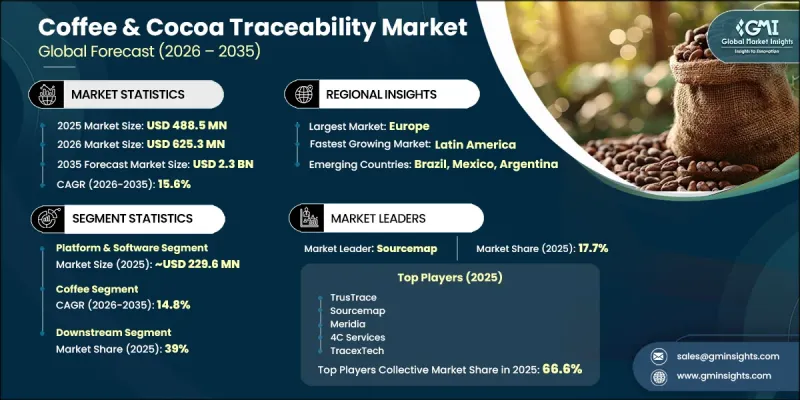
Coffee and cocoa traceability refers to the ecosystem of digital platforms, verification systems, and service frameworks that connect smallholder producers in regions such as West Africa and Latin America with global roasters, traders, and retail buyers. These systems document and validate product origin, custody transitions, and compliance status at each stage of the value chain, using tools that range from mobile-based geolocation mapping to enterprise-grade SaaS platforms and blockchain-enabled certification systems. Market expansion is being strongly influenced by the convergence of regulatory enforcement and premium market positioning. The implementation of strict deforestation compliance requirements in major importing regions has made farm-level traceability a mandatory component of market access. At the same time, rising demand for specialty coffee and fine cocoa products has elevated origin transparency from a compliance requirement to a commercial differentiator, reinforcing adoption even in voluntary markets. As a result, traceability solutions are increasingly integrated across cooperatives, exporters, processors, and global buyers to ensure both regulatory alignment and brand-level sustainability commitments.
| Market Scope | |
|---|---|
| Start Year | 2025 |
| Forecast Year | 2026-2035 |
| Start Value | $488.5 Million |
| Forecast Value | $2.3 Billion |
| CAGR | 15.6% |
The platform & software segment was valued at USD 229.6 million in 2025 and is projected to grow at a CAGR of 17.8% from 2026 to 2035. This segment represents the central digital layer of the traceability ecosystem, integrating data from field-level collection tools, certification databases, and logistics systems into unified reporting structures. These platforms generate compliance documentation, ESG reports, and risk analytics for both corporate users and regulatory bodies. The segment benefits from recurring subscription-based revenue models and scalable cloud infrastructure that enables service delivery across multinational enterprises and smallholder farming networks within a single digital framework.
The coffee segment held a 51% share in 2025 and is projected to grow at a CAGR of 14.8% through 2035. Demand for traceability in coffee spans Arabica, Robusta, and specialty or single-origin categories. In Arabica supply chains, traceability systems are widely used in certified and premium export channels, particularly across Latin America and East Africa, where documentation standards are closely tied to market access requirements. In Robusta-producing regions, adoption is accelerating as compliance obligations expand, especially in major exporting countries such as Vietnam and Indonesia, where large-scale production is increasingly subject to deforestation and due diligence requirements tied to European import standards.
North America Coffee & Cocoa Traceability Market is expected to reach USD 530.8 million by 2035, supported by growing corporate sustainability commitments and evolving supply chain transparency expectations. Demand in the region is primarily driven by food and beverage companies operating across retail and food service networks, which are adopting traceability systems to support deforestation-free sourcing policies, supplier compliance frameworks, and broader ESG reporting requirements. Although regulatory pressure is less direct compared to other regions, increasing stakeholder scrutiny and brand accountability are accelerating adoption across the value chain.
Major players operating in the global coffee & cocoa traceability industry include 4C Services, Agrolinking (AgTrail), Bunachain, Coolx, Corgo, GeoCertify, ICE CoT (IBA), Meridia (Meridia Verify), Monitys, Open Food Chain, Palmyra Ecosystem, Sourcemap, TracexTech, and TrusTrace. Companies in the coffee & cocoa traceability market are focusing on expanding digital platform capabilities that integrate geolocation, certification, and logistics data into unified systems. Many players are investing in blockchain-enabled verification tools to enhance data integrity and strengthen trust across complex supply chains. Strategic partnerships with cooperatives, exporters, and global food brands are being prioritized to expand platform adoption at origin. Firms are also emphasizing SaaS-based subscription models to ensure recurring revenue and scalable deployment across multiple regions. Mobile-first data collection tools are being developed to improve accessibility for smallholder farmers with limited infrastructure. In addition, companies are aligning their solutions with regulatory frameworks and ESG reporting standards to support compliance-driven demand while also targeting premium market segments that require verified origin and sustainability documentation for product differentiation.
Table of Contents
Chapter 1 Methodology & Scope
- 1.1 Market scope and definition
- 1.2 Research design
- 1.2.1 Research approach
- 1.2.2 Data collection methods
- 1.3 Data mining sources
- 1.3.1 Global
- 1.3.2 Regional/Country
- 1.4 Base estimates and calculations
- 1.4.1 Base year calculation
- 1.4.2 Key trends for market estimation
- 1.5 Primary research and validation
- 1.5.1 Primary sources
- 1.6 Forecast model
- 1.7 Research assumptions and limitations
Chapter 2 Executive Summary
- 2.1 Industry 360° synopsis
- 2.2 Key market trends
- 2.2.1 Offering type
- 2.2.2 Commodity
- 2.2.3 End User
- 2.2.4 Regional
- 2.3 TAM Analysis, 2026-2035
- 2.4 CXO perspectives: Strategic imperatives
- 2.5 Future outlook and strategic recommendations
Chapter 3 Industry Insights
- 3.1 Industry ecosystem analysis
- 3.1.1 Supplier landscape
- 3.1.2 Profit margin
- 3.1.3 Value addition at each stage
- 3.1.4 Factor affecting the value chain
- 3.1.5 Disruptions
- 3.2 Industry impact forces
- 3.2.1 Growth drivers
- 3.2.2 Industry pitfalls and challenges
- 3.2.3 Market opportunities
- 3.3 Growth potential analysis
- 3.4 Regulatory landscape
- 3.4.1 North America
- 3.4.2 Europe
- 3.4.3 Asia Pacific
- 3.4.4 Latin America
- 3.4.5 Middle East & Africa
- 3.5 Porter’s analysis
- 3.6 PESTEL analysis
- 3.7 Technology and innovation landscape
- 3.7.1 Current technological trends
- 3.7.2 Emerging technologies
- 3.8 Price trends
- 3.8.1 By region
- 3.8.2 By tag technology
- 3.9 Future market trends
- 3.10 Patent landscape
- 3.11 Trade statistics (HS code)
- 3.11.1 Major importing countries
- 3.11.2 Major exporting countries
- 3.12 Sustainability and environmental aspects
- 3.12.1 Sustainable practices
- 3.12.2 Waste reduction strategies
- 3.12.3 Energy efficiency in production
- 3.12.4 Eco-friendly initiatives
- 3.13 Carbon footprint consideration
Chapter 4 Competitive Landscape, 2025
- 4.1 Introduction
- 4.2 Company market share analysis
- 4.2.1 By region
- 4.2.1.1 North America
- 4.2.1.2 Europe
- 4.2.1.3 Asia Pacific
- 4.2.1.4 LATAM
- 4.2.1.5 MEA
- 4.2.1 By region
- 4.3 Company matrix analysis
- 4.4 Competitive analysis of major market players
- 4.5 Competitive positioning matrix
- 4.6 Key developments
- 4.6.1 Mergers & acquisitions
- 4.6.2 Partnerships & collaborations
- 4.6.3 New product launches
- 4.6.4 Expansion plans
Chapter 5 Market Estimates and Forecast, By Offering Type, 2022–2035 (USD Million)
- 5.1 Key trends
- 5.2 Platform & software
- 5.3 Hardware & sensing devices
- 5.4 Professional services
Chapter 6 Market Estimates and Forecast, By Commodity, 2022–2035 (USD Million)
- 6.1 Key trends
- 6.2 Coffee
- 6.2.1 Arabica
- 6.2.2 Robusta
- 6.2.3 Specialty & single-origin
- 6.3 Cocoa
- 6.3.1 Bulk cocoa
- 6.3.2 Fine flavor & single-origin
- 6.3.3 Certified organic
Chapter 7 Market Estimates and Forecast, By End User, 2022–2035 (USD Million)
- 7.1 Key trends
- 7.2 Upstream
- 7.2.1 Smallholder farmers
- 7.2.2 Cooperatives & farmer groups
- 7.2.3 Wet mills / fermentation centers
- 7.3 Midstream
- 7.3.1 Origin exporters & processors
- 7.3.2 Intl commodity traders
- 7.4 Downstream
- 7.4.1 Roasters & blenders
- 7.4.2 Chocolate & confectionery manufacturers
- 7.4.3 Consumer brands & private label
- 7.4.4 Food service & specialty retailers
- 7.5 Certifiers & regulatory bodies
Chapter 8 Market Estimates and Forecast, By Region, 2022–2035 (USD Million) (Kilo Tons)
- 8.1 Key trends
- 8.2 North America
- 8.2.1 U.S.
- 8.2.2 Canada
- 8.3 Europe
- 8.3.1 Germany
- 8.3.2 UK
- 8.3.3 France
- 8.3.4 Spain
- 8.3.5 Italy
- 8.3.6 Rest of Europe
- 8.4 Asia Pacific
- 8.4.1 China
- 8.4.2 India
- 8.4.3 Japan
- 8.4.4 Australia
- 8.4.5 South Korea
- 8.4.6 Rest of Asia Pacific
- 8.5 Latin America
- 8.5.1 Brazil
- 8.5.2 Mexico
- 8.5.3 Argentina
- 8.5.4 Rest of Latin America
- 8.6 Middle East and Africa
- 8.6.1 Saudi Arabia
- 8.6.2 South Africa
- 8.6.3 UAE
- 8.6.4 Rest of Middle East and Africa
Chapter 9 Company Profiles
- 9.1 4c services
- 9.2 Agrolinking (agtrail)
- 9.3 Bunachain
- 9.4 Coolx
- 9.5 Corgo
- 9.6 Geocertify
- 9.7 Ice cot (iba)
- 9.8 Meridia (meridia verify)
- 9.9 Monitys
- 9.10 Open food chain
- 9.11 Palmyra ecosystem
- 9.12 Sourcemap
- 9.13 Tracextech
- 9.14 Trustrace

