PUBLISHER: Global Market Insights Inc. | PRODUCT CODE: 2101654

PUBLISHER: Global Market Insights Inc. | PRODUCT CODE: 2101654
Electrochemical Ammonia Synthesis (Green NH3) Market Opportunity, Growth Drivers, Industry Trend Analysis, and Forecast 2026 - 2035
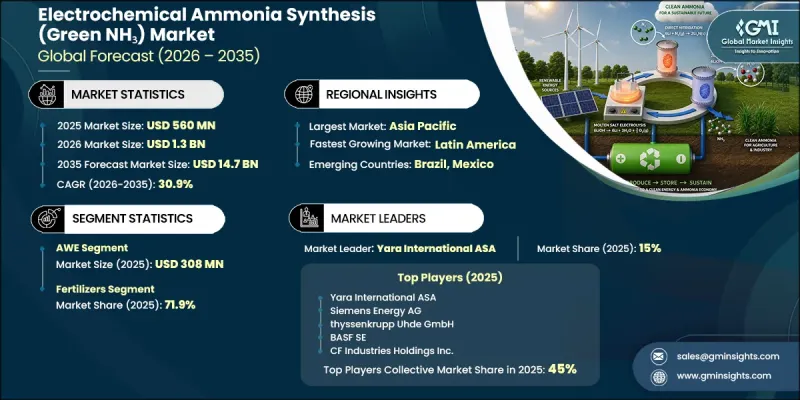
The Global Electrochemical Ammonia Synthesis (Green NH3) Market was valued at USD 560 million in 2025 and is estimated to grow at a CAGR of 30.9% to reach USD 14.7 billion by 2035.
The expansion is shaped by overlapping policy frameworks, including global decarbonization commitments in shipping, renewable hydrogen mandates in Europe, and accelerating industrial electrification targets. At the same time, rapid improvements in electrolyzer efficiency and declining renewable power costs are steadily reducing the green premium versus conventional ammonia production routes. Public funding programs are significantly accelerating commercialization timelines and lowering early-stage project risk. In the United States, federal initiatives supporting clean hydrogen development and electrochemical nitrogen fixation are helping scale demonstration projects, while multi-billion-dollar hydrogen hub investments are strengthening regional production ecosystems. In Europe, long-term renewable hydrogen import and production targets under major energy transition programs are reinforcing demand for ammonia as a hydrogen carrier for long-distance transport. Collectively, these dynamics are pushing electrochemical ammonia synthesis from pilot-scale experimentation toward early commercial deployment, with increasing participation from energy developers, chemical manufacturers, and integrated hydrogen producers.
| Market Scope | |
|---|---|
| Start Year | 2025 |
| Forecast Year | 2026-2035 |
| Start Value | $560 Million |
| Forecast Value | $14.7 Billion |
| CAGR | 30.9% |
Alkaline water electrolysis (AWE) accounted for USD 308 million in 2025, reflecting its strong commercial maturity and bankability compared with alternative electrolysis technologies. AWE systems typically operate within current density ranges of 200-400 mA/cm2 and utilize comparatively low-cost nickel-based electrode materials. Industrial deployments have demonstrated operational lifetimes exceeding 80,000 hours, making the technology more attractive to project financiers due to its proven reliability profile and reduced perceived execution risk relative to newer competing systems.
The fertilizers application segment is expected to grow from USD 403 million in 2025 to USD 7,350 million by 2035. It continues to account for the largest share of total market revenue throughout the forecast period. Demand growth is closely tied to rising adoption of low-carbon agricultural inputs across regulated markets and premium food supply chains, where certified renewable ammonia is increasingly favored to meet sustainability targets and reduce lifecycle emissions in nitrogen-based fertilizer production.
North America Electrochemical Ammonia Synthesis (Green NH3) Market accounted for USD 101 million in 2025, with the United States holding the majority share and Canada contributing through emerging renewable energy-linked ammonia projects. The region's policy landscape has strengthened significantly since 2022, particularly through federal clean hydrogen production incentives that directly reduce hydrogen input costs for electrochemical ammonia synthesis. These incentives effectively improve project economics by lowering production costs per tonne of ammonia, depending on electricity sourcing and carbon intensity.
Major companies operating in the global electrochemical ammonia synthesis (green NH3) market include: BASF SE, FuelPositive Corporation, CF Industries Holdings Inc., Siemens Energy AG, McPhy Energy S.A., Air Products & Chemicals Inc., AM Green (formerly Greenko ZeroC), Fertiglobe, Casale SA, Topsoe A/S, thyssenkrupp Uhde GmbH, First Ammonia, ITM Power plc, Starfire Energy, Uniper SE, ACME Group, Enapter S.r.l., Yara International ASA, Green Hydrogen Systems, Nel ASA, Fortescue Future Industries (FFI), MAN Energy Solutions, and Technip Energies N.V. Electrochemical ammonia synthesis companies are prioritizing long-term offtake agreements with fertilizer producers and industrial gas buyers to secure predictable revenue streams and reduce project financing risk. Many players are integrating vertically with renewable energy developers to ensure low-cost green electricity supply, which is critical for improving production economics. Strategic partnerships with electrolyzer manufacturers are also being formed to optimize system efficiency and scale up capacity. Firms are investing heavily in pilot and demonstration plants to validate technology performance under real operating conditions and build bankability.
Table of Contents
Chapter 1 Methodology & Scope
- 1.1 Research approach
- 1.2 Quality Commitments
- 1.2.1 GMI AI policy & data integrity commitment
- 1.2.1.1 Source consistency protocol
- 1.2.1 GMI AI policy & data integrity commitment
- 1.3 Research Trail & Confidence Scoring
- 1.3.1 Research Trail Components
- 1.3.2 Scoring Components
- 1.4 Data Collection
- 1.4.1 Partial list of primary sources
- 1.5 Data mining sources
- 1.5.1 Paid sources
- 1.5.1.1 Sources, by region
- 1.5.1 Paid sources
- 1.6 Base estimates and calculations
- 1.6.1 Base year calculation for any one approach
- 1.7 Forecast model
- 1.7.1 Quantified market impact analysis
- 1.7.1.1 Mathematical impact of growth parameters on forecast
- 1.7.1 Quantified market impact analysis
- 1.8 Research transparency addendum
- 1.8.1 Source attribution framework
- 1.8.2 Quality assurance metrics
- 1.8.3 Our commitment to trust
Chapter 2 Executive Summary
- 2.1 Industry 360° synopsis
- 2.2 Key market trends
- 2.2.1 Regional
- 2.2.2 Electrolysis Technology
- 2.2.3 Production Scale
- 2.2.4 Application
- 2.2.5 End-User Industry
- 2.3 TAM Analysis, 2026-2035
- 2.4 CXO perspectives: Strategic imperatives
Chapter 3 Industry Insights
- 3.1 Industry ecosystem analysis
- 3.1.1 Supplier landscape
- 3.1.2 Profit margin
- 3.1.3 Value addition at each stage
- 3.1.4 Factor affecting the value chain
- 3.1.5 Disruptions
- 3.2 Industry impact forces
- 3.2.1 Growth drivers
- 3.2.2 Industry pitfalls and challenges
- 3.2.3 Market opportunities
- 3.3 Growth potential analysis
- 3.4 Regulatory landscape
- 3.4.1 North America
- 3.4.2 Europe
- 3.4.3 Asia Pacific
- 3.4.4 Latin America
- 3.4.5 Middle East & Africa
- 3.5 Porter’s analysis
- 3.6 PESTEL analysis
- 3.7 Price trends
- 3.7.1 By region
- 3.7.2 By product type
- 3.8 Future market trends
- 3.9 Technology and Innovation landscape
- 3.9.1 Current technological trends
- 3.9.2 Emerging technologies
- 3.10 Patent Landscape
- 3.11 Trade statistics (HS code)
- 3.11.1 Major importing countries
- 3.11.2 Major exporting countries
- 3.12 Sustainability and environmental aspects
- 3.12.1 Sustainable practices
- 3.12.2 Waste reduction strategies
- 3.12.3 Energy efficiency in production
- 3.12.4 Eco-friendly initiatives
- 3.13 Carbon footprint consideration
Chapter 4 Competitive Landscape, 2025
- 4.1 Introduction
- 4.2 Company market share analysis
- 4.2.1 By region
- 4.2.1.1 North America
- 4.2.1.2 Europe
- 4.2.1.3 Asia Pacific
- 4.2.1.4 LATAM
- 4.2.1.5 MEA
- 4.2.1 By region
- 4.3 Company matrix analysis
- 4.4 Competitive analysis of major market players
- 4.5 Competitive positioning matrix
- 4.6 Key developments
- 4.6.1 Mergers & acquisitions
- 4.6.2 Partnerships & collaborations
- 4.6.3 New Product Launches
- 4.6.4 Expansion Plans
Chapter 5 Market Estimates and Forecast, By Electrolysis Technology, 2022–2035 (USD Million)
- 5.1 Key trends
- 5.2 Alkaline Water Electrolysis (AWE)
- 5.3 Proton Exchange Membrane (PEM) Electrolysis
- 5.4 Solid Oxide Electrolyzer Cells (SOEC)
- 5.5 Others
Chapter 6 Market Estimates and Forecast, By Production Scale, 2022–2035 (USD Million)
- 6.1 Key trends
- 6.2 Large-Scale Stick-Built Plants (>600 MTPD)
- 6.3 Small-to-Medium Modular Plants (≤ 600 MTPD)
Chapter 7 Market Estimates and Forecast, By Application, 2022–2035 (USD Million)
- 7.1 Key trends
- 7.2 Fertilizers
- 7.3 Energy Storage & Hydrogen Carrier
- 7.4 Transportation Fuel
- 7.5 Industrial Feedstock
- 7.6 Power Generation & Fuel Cells
- 7.7 Others
Chapter 8 Market Estimates and Forecast, By End-User Industry, 2022–2035 (USD Million)
- 8.1 Key trends
- 8.2 Agriculture
- 8.3 Energy & Power
- 8.4 Transportation & Marine
- 8.5 Chemicals & Petrochemicals
- 8.6 Industrial Manufacturing
- 8.7 Others
Chapter 9 Market Estimates and Forecast, By Region, 2022–2035 (USD Million)
- 9.1 Key trends
- 9.2 North America
- 9.2.1 U.S.
- 9.2.2 Canada
- 9.3 Europe
- 9.3.1 Germany
- 9.3.2 UK
- 9.3.3 France
- 9.3.4 Spain
- 9.3.5 Italy
- 9.3.6 Rest of Europe
- 9.4 Asia Pacific
- 9.4.1 China
- 9.4.2 India
- 9.4.3 Japan
- 9.4.4 Australia
- 9.4.5 South Korea
- 9.4.6 Rest of Asia Pacific
- 9.5 Latin America
- 9.5.1 Brazil
- 9.5.2 Mexico
- 9.5.3 Argentina
- 9.5.4 Rest of Latin America
- 9.6 Middle East and Africa
- 9.6.1 Saudi Arabia
- 9.6.2 South Africa
- 9.6.3 UAE
- 9.6.4 Rest of Middle East and Africa
Chapter 10 Company Profiles
- 10.1 Yara International ASA
- 10.2 Siemens Energy AG
- 10.3 thyssenkrupp Uhde GmbH
- 10.4 BASF SE
- 10.5 CF Industries Holdings Inc.
- 10.6 Topsoe A/S
- 10.7 Nel ASA
- 10.8 Air Products & Chemicals Inc.
- 10.9 Fertiglobe
- 10.10 Uniper SE
- 10.11 ITM Power plc
- 10.12 ACME Group
- 10.13 AM Green (formerly Greenko ZeroC)
- 10.14 Fortescue Future Industries (FFI)
- 10.15 First Ammonia
- 10.16 Starfire Energy
- 10.17 FuelPositive Corporation
- 10.18 Casale SA
- 10.19 Green Hydrogen Systems
- 10.20 McPhy Energy S.A.
- 10.21 Enapter S.r.l.
- 10.22 Technip Energies N.V.
- 10.23 MAN Energy Solutions

