PUBLISHER: Global Market Insights Inc. | PRODUCT CODE: 2101655

PUBLISHER: Global Market Insights Inc. | PRODUCT CODE: 2101655
Asia-Pacific Nonwoven Baby Diaper Market Opportunity, Growth Drivers, Industry Trend Analysis, and Forecast 2026 - 2035
Asia-Pacific Nonwoven Baby Diaper Market was valued at USD 11.3 billion in 2025 and is estimated to grow at a CAGR of 5.9% to reach USD 19.9 billion by 2035.
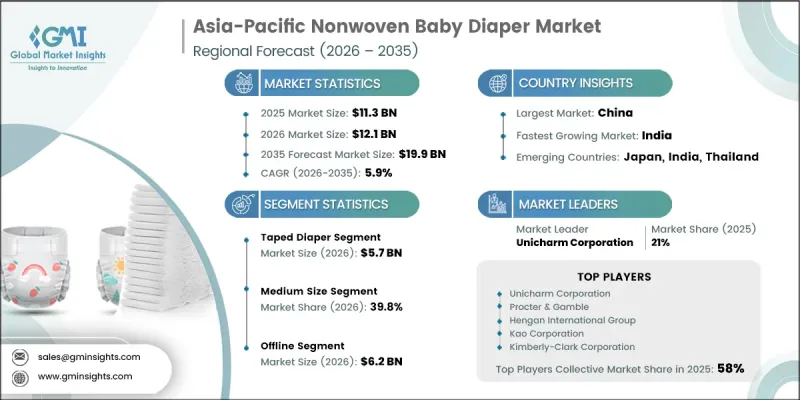
Asia-Pacific nonwoven baby diaper market continues to expand as improving birth rates in several economies, rising household incomes, and increasing awareness of infant hygiene encourage higher adoption of disposable baby care products. Consumers are increasingly choosing nonwoven diapers because they offer superior softness, comfort, breathability, and moisture management, helping reduce the likelihood of skin irritation while improving overall infant care. Compared with conventional textile materials, nonwoven fabrics provide enhanced hygiene, lightweight construction, and better performance, making them the preferred material for modern baby diapers. Growing health awareness among parents, combined with increasing demand for premium baby care products, is supporting continued market expansion across the region. Manufacturers are also adopting advanced production technologies and improving manufacturing efficiency to meet rising demand while maintaining product quality. In addition, the rapid growth of digital retail platforms and evolving distribution networks are improving product accessibility and strengthening consumer engagement. Continuous innovation in diaper design, material performance, and manufacturing processes is expected to support long-term market growth as demand for high-quality infant hygiene products continues to rise throughout the Asia-Pacific region.
| Market Scope | |
|---|---|
| Start Year | 2025 |
| Forecast Year | 2026-2035 |
| Start Value | $11.3 Billion |
| Forecast Value | $19.9 Billion |
| CAGR | 5.9% |
Young parents are increasingly selecting nonwoven baby diapers over traditional diaper products because they provide greater comfort, improved breathability, superior absorbency, and enhanced flexibility for infants. Continuous advancements in manufacturing technologies are enabling producers to improve production efficiency, optimize product quality, and support large-scale manufacturing operations. At the same time, the rapid expansion of digital commerce and modern retail channels is transforming product distribution, making nonwoven baby diapers more accessible to consumers while strengthening sales opportunities across the Asia-Pacific market.
The taped diaper segment was valued at USD 5.7 billion in 2025. This segment continues to maintain its leadership due to its broad acceptance among caregivers and its suitability for newborns and smaller infants. Taped diapers offer an effective balance of affordability, reliable performance, secure fit, and high absorbency, making them a preferred choice across a wide range of consumer groups. Continuous product improvements focused on comfort, leak protection, and ease of use are expected to sustain demand throughout the forecast period.
The medium diaper size segment accounted for 39.8% share in 2025, representing the largest revenue share among size categories. This segment benefits from strong consumer demand because it aligns with one of the longest stages of infant diaper usage. Broad product availability across retail channels and consistently high consumption volumes continue to support market growth. Manufacturers are also expanding product offerings within this size category to improve comfort, fit, and performance while addressing evolving consumer preferences.
Asia-Pacific Nonwoven Baby Diaper Market held 35.3% share in 2025. Regional growth is supported by rapid urbanization, expanding infant populations, rising disposable incomes, and increasing demand for premium hygiene products. Continuous improvements in manufacturing capabilities, expanding retail infrastructure, and growing consumer awareness regarding infant health and hygiene are expected to further strengthen market development across the region.
Major companies operating in the Asia-Pacific nonwoven baby diaper market include Anpers Industries Sdn. Bhd., Daio Paper Corporation, DSG International (Thailand) PCL, Foshan HuiYingLe Sanitary Products Co., Ltd., Fujian Chiaus Industrial Development Co., Fujian Leo Paper (Liao Paper) Co., Ltd., Fujian Panda Diaper Co., Ltd., Hengan International Group, Kao Corporation, Kimberly-Clark Corporation, New Yifa Group Co., Ltd., Nobel Hygiene Pvt. Ltd., NTPM Holdings Berhad, Oji Holdings Corporation, Pigeon Corporation, Procter & Gamble, Swara Baby Products Pvt. Ltd., Taisun Vietnam Co., Ltd., Unicharm Corporation, Uniclan Healthcare Pvt. Ltd., and Wipro Consumer Care & Lighting. Companies operating in the Asia-Pacific nonwoven baby diaper market are strengthening their competitive position through continuous product innovation, manufacturing expansion, and investment in premium diaper technologies. Market participants are developing advanced nonwoven materials that improve softness, absorbency, breathability, and skin protection while enhancing overall product performance. Businesses are also expanding production facilities, optimizing supply chains, and increasing distribution through both modern retail and digital commerce platforms to improve market reach. Strategic partnerships, regional expansion, and investments in advanced manufacturing technologies remain key priorities for supporting long-term growth.
Table of Contents
Chapter 1 Methodology & Scope
- 1.1 Research approach
- 1.2 Quality Commitments
- 1.2.1 GMI AI policy & data integrity commitment
- 1.2.1.1 Source consistency protocol
- 1.2.1 GMI AI policy & data integrity commitment
- 1.3 Research Trail & Confidence Scoring
- 1.3.1 Research Trail Components
- 1.3.2 Scoring Components
- 1.4 Data Collection
- 1.4.1 Partial list of primary sources
- 1.5 Data mining sources
- 1.5.1 Paid sources
- 1.5.1.1 Sources, by region
- 1.5.1 Paid sources
- 1.6 Base estimates and calculations
- 1.6.1 Base year calculation for any one approach
- 1.7 Forecast model
- 1.7.1 Quantified market impact analysis
- 1.7.1.1 Mathematical impact of growth parameters on forecast
- 1.7.1 Quantified market impact analysis
- 1.8 Research transparency addendum
- 1.8.1 Source attribution framework
- 1.8.2 Quality assurance metrics
- 1.8.3 Our commitment to trust
Chapter 2 Executive Summary
- 2.1 Industry 360° synopsis
- 2.2 Key market trends
- 2.2.1 Type
- 2.2.2 Category
- 2.2.3 Diaper Size
- 2.2.4 Pack Size
- 2.2.5 Absorption Level
- 2.2.6 Age Group
- 2.2.7 Price
- 2.2.8 Distribution Channel
Chapter 3 Industry Insights
- 3.1 Industry ecosystem analysis
- 3.1.1 Supplier landscape
- 3.1.2 Profit margin
- 3.1.3 Value addition at each stage
- 3.1.4 Factor affecting the value chain
- 3.2 Industry impact forces
- 3.2.1 Growth drivers
- 3.2.2 Industry pitfalls & challenges
- 3.2.3 Opportunities
- 3.3 Growth potential analysis
- 3.4 Future market trends
- 3.5 Technology and innovation landscape
- 3.5.1 Current technological trends
- 3.5.2 Emerging technologies
- 3.6 Regulatory landscape
- 3.6.1 Standards and compliance requirements
- 3.6.2 Regional regulatory frameworks
- 3.6.3 Certification standards
- 3.7 Porter's analysis
- 3.8 PESTEL analysis
- 3.9 Price trends
- 3.9.1 Historical Price Trend Analysis (Driven by Primary Research)
- 3.9.2 Pricing Strategy by Player Type (Driven by Primary Research)
- 3.10 Trade data analysis (driven by paid database)
- 3.10.1 Import/Export Volume & Value Trends (Driven by Primary Research)
- 3.10.2 Key Trade Corridors & Tariff Impact (Driven by Primary Research)
- 3.11 Impact of AI & Generative AI on the Market
- 3.11.1 AI-Driven Disruption of Existing Business Models
- 3.11.2 GenAI Use Cases & Adoption Roadmap by Segment
- 3.11.3 Risks, Limitations & Regulatory Considerations
- 3.12 Distribution Infrastructure & Channel Penetration Landscape (Driven by Primary Research)
- 3.12.1 Channel Coverage by Region & Format (Modern vs. Traditional Trade) (Driven by Primary Research)
- 3.12.2 Last-Mile Infrastructure Gaps & Emerging Channel Shifts (Driven by Primary Research)
Chapter 4 Competitive Landscape, 2025
- 4.1 Introduction
- 4.2 Company market share analysis
- 4.3 Company matrix analysis
- 4.4 Competitive analysis of major market players
- 4.5 Competitive positioning matrix
- 4.6 Key developments
- 4.6.1 Mergers & acquisitions
- 4.6.2 Partnerships & collaborations
- 4.6.3 New product launches
- 4.6.4 Expansion plans
Chapter 5 Market Estimates and Forecast, By type, 2022 - 2035 (USD Billion, Thousand Units)
- 5.1 Key trends
- 5.2 Disposable
- 5.3 Reusable
Chapter 6 Market Estimates and Forecast, By Category, 2022 - 2035 (USD Billion, Thousand Units)
- 6.1 Key trends
- 6.2 Pant
- 6.3 Taped
Chapter 7 Market Estimates and Forecast, By Diaper Size, 2022 - 2035(USD Billion, Thousand Units)
- 7.1 Key trends
- 7.2 Small/Extra small
- 7.3 Medium
- 7.4 Large
- 7.5 Extra large
Chapter 8 Market Estimates and Forecast, By Pack Size, 2022 - 2035 (USD Billion, Thousand Units)
- 8.1 Key trends
- 8.2 0-20 count
- 8.3 20-40 count
- 8.4 40-60 count
- 8.5 Above 60 count
Chapter 9 Market Estimates and Forecast, By Absorption Level, 2022 - 2035 (USD Billion, Thousand Units)
- 9.1 Key trends
- 9.2 Low
- 9.3 High
Chapter 10 Market Estimates and Forecast, By Age Group, 2022 - 2035 (USD Billion, Thousand Units)
- 10.1 Key trends
- 10.2 0-6 months
- 10.3 6-18 months
- 10.4 18-24 months
- 10.5 Above 2 years
Chapter 11 Market Estimates and Forecast, By Price, 2022 - 2035 (USD Billion, Thousand Units)
- 11.1 Key trends
- 11.2 Low
- 11.3 Medium
- 11.4 High
Chapter 12 Market Estimates and Forecast, By Distribution Channel, 2022 - 2035 (USD Billion, Thousand Units)
- 12.1 Key trends
- 12.2 Online
- 12.2.1 E-Commerce website
- 12.2.2 Company's website
- 12.3 Offline
- 12.3.1 Hypermarkets & supermarkets
- 12.3.2 Specialty store
- 12.3.3 Pharmacies/Drug stores
- 12.3.4 Other retail stores
Chapter 13 Market Estimates and Forecast, By Country, 2022 - 2035 (USD Million) (Thousand Units)
- 13.1 Key trends
- 13.2 China
- 13.3 India
- 13.4 Japan
- 13.5 South Korea
- 13.6 Taiwan
- 13.7 Indonesia
- 13.8 Thailand
- 13.9 Singapore
- 13.10 Australia
Chapter 14 Company Profiles
- 14.1 Top Global Player
- 14.1.1 Procter & Gamble
- 14.1.2 Kimberly-Clark Corporation
- 14.1.3 Unicharm Corporation
- 14.1.4 Kao Corporation
- 14.1.5 Hengan International Group
- 14.1.6 Daio Paper Corporation
- 14.1.7 Oji Holdings Corporation
- 14.2 Regional Player
- 14.2.1 Nobel Hygiene Pvt. Ltd.
- 14.2.2 NTPM Holdings Berhad
- 14.2.3 Fujian Chiaus Industrial Development Co.
- 14.2.4 New Yifa Group Co., Ltd.
- 14.2.5 Swara Baby Products Pvt. Ltd.
- 14.2.6 Taisun Vietnam Co., Ltd.
- 14.2.7 Anpers Industries Sdn. Bhd.
- 14.2.8 DSG International (Thailand) PCL
- 14.3 Emerging Players
- 14.3.1 Uniclan Healthcare Pvt. Ltd.
- 14.3.2 Fujian Panda Diaper Co., Ltd.
- 14.3.3 Wipro Consumer Care & Lighting
- 14.3.4 Foshan HuiYingLe Sanitary Products Co., Ltd.
- 14.3.5 Pigeon Corporation
- 14.3.6 Fujian Leo Paper (Liao Paper) Co., Ltd.

