PUBLISHER: Global Market Insights Inc. | PRODUCT CODE: 2101658

PUBLISHER: Global Market Insights Inc. | PRODUCT CODE: 2101658
Intravascular Lithotripsy (IVL) Market Opportunity, Growth Drivers, Industry Trend Analysis, and Forecast 2026 - 2035
The Global Intravascular Lithotripsy (IVL) Market was valued at USD 954.3 million in 2025 and is estimated to grow at a CAGR of 15.8% to reach USD 4 billion by 2035.
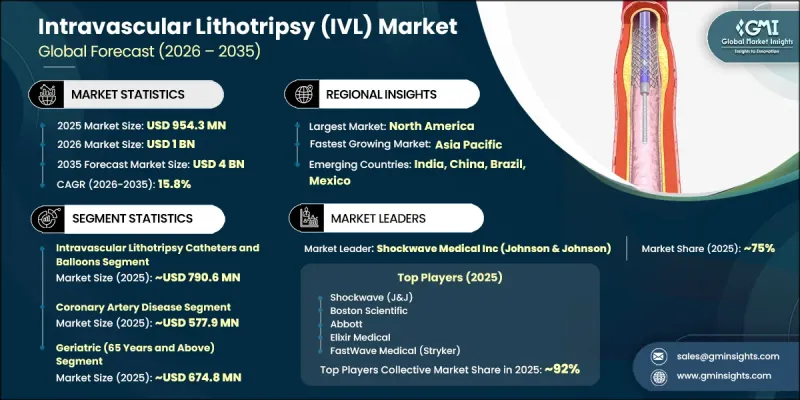
The intravascular lithotripsy (IVL) market is witnessing rapid expansion as demand rises for minimally invasive technologies that improve the treatment of calcified vascular disease. The increasing prevalence of arterial calcification, driven by aging populations and the growing incidence of cardiometabolic disorders, continues to create favorable conditions for market growth. Healthcare providers are increasingly adopting advanced vessel preparation technologies to improve procedural success and optimize patient outcomes during interventional cardiovascular procedures. Continued clinical validation, expanding reimbursement support across major healthcare markets, and ongoing technological advancements are accelerating the transition of IVL from an emerging treatment option to a widely accepted clinical solution. As the global elderly population continues to increase, the number of patients requiring treatment for complex calcified vascular lesions is also expanding. Since vascular calcification becomes more common with advancing age, long-term demand for intravascular lithotripsy technologies is expected to remain structurally strong, supported by sustained clinical need rather than temporary adoption trends. These factors continue to reinforce favorable growth prospects for the global intravascular lithotripsy (IVL) market.
| Market Scope | |
|---|---|
| Start Year | 2025 |
| Forecast Year | 2026-2035 |
| Start Value | $954.3 Million |
| Forecast Value | $4 Billion |
| CAGR | 15.8% |
Intravascular lithotripsy catheters and balloons accounted for 82.84% share in 2025, representing USD 790.6 million. This product category maintains its leading position because every IVL procedure requires the use of a new catheter, creating recurring demand for consumable products. In contrast, capital equipment is utilized across multiple procedures over an extended period. The consistent need for single-use devices continues to support strong revenue generation and reinforces the dominance of the catheter and balloon segment throughout the forecast period.
The hospitals segment held 72.2% share in 2025, generating USD 688.5 million. Hospitals remain the primary end users because IVL procedures require specialized cardiovascular treatment facilities, dedicated procedural equipment, and highly trained multidisciplinary clinical teams. Advanced cardiac catheterization laboratories and vascular intervention centers continue to perform many procedures, supported by a comprehensive patient care infrastructure and established reimbursement pathways that encourage continued adoption of IVL technology.
North America Intravascular Lithotripsy (IVL) Market accounted for 41.6% share in 2025, representing USD 397 million. The United States continues to contribute most of the regional demand, supported by favorable reimbursement policies, advanced healthcare infrastructure, growing physician adoption, and increasing utilization of minimally invasive cardiovascular procedures. Continued expansion of clinical applications and supportive healthcare policies is expected to sustain strong market growth across the region throughout the forecast period.
Major companies operating in the global intravascular lithotripsy (IVL) market include Boston Scientific, Abbott, Philips, Shockwave Medical Inc. (Johnson & Johnson), Stryker (Amplitude Vascular Systems, Inc.), Elixir Medical, FastWave Medical, Cagent Vascular, LEPU Medical, and MicroPort. Companies operating in the intravascular lithotripsy (IVL) market are strengthening their competitive position by investing in research and development to enhance device performance, improve procedural efficiency, and expand clinical applications. Manufacturers continue to focus on product innovation, technological advancement, and the development of next-generation treatment solutions that address increasingly complex vascular conditions. Strategic collaborations with healthcare institutions, clinical research organizations, and distribution partners are supporting broader commercial adoption and market expansion. Companies are also increasing investments in regulatory approvals, manufacturing capacity, physician training, and global geographic expansion to improve market access.
Table of Contents
Chapter 1 Research Methodology
- 1.1 Market definitions and scope
- 1.2 Research approach
- 1.3 Quality commitments
- 1.3.1 GMI AI policy & data integrity commitment
- 1.3.1.1 Source consistency protocol
- 1.3.1 GMI AI policy & data integrity commitment
- 1.4 Research trail & confidence scoring
- 1.4.1 Research trail components
- 1.4.2 Scoring components
- 1.5 Data collection
- 1.5.1 Partial list of primary sources
- 1.6 Data mining sources
- 1.6.1 Paid sources
- 1.6.1.1 Sources, by region
- 1.6.1 Paid sources
- 1.7 Base estimates and calculations
- 1.7.1 Base year calculation
- 1.8 Forecast model
- 1.8.1 Quantified market impact analysis
- 1.8.1.1 Mathematical impact of growth parameters on forecast
- 1.8.1 Quantified market impact analysis
- 1.9 Research transparency addendum
- 1.9.1 Source attribution framework
- 1.9.2 Quality assurance metrics
- 1.9.3 Our commitment to trust
Chapter 2 Executive Summary
- 2.1 Industry 360° synopsis
- 2.2 Key market trends
- 2.2.1 Regional trends
- 2.2.2 Product type trends
- 2.2.3 Application trends
- 2.2.4 Age group trends
- 2.2.5 End use trends
- 2.3 CXO perspectives: Strategic imperatives
Chapter 3 Industry Insights
- 3.1 Industry ecosystem analysis
- 3.2 Industry impact forces
- 3.2.1 Growth drivers
- 3.2.1.1 Rising prevalence of cardiovascular diseases
- 3.2.1.2 Advancements in minimally invasive technologies
- 3.2.1.3 Growing awareness and adoption of IVL
- 3.2.1.4 Increasing aging global population
- 3.2.2 Industry pitfalls and challenges
- 3.2.2.1 High cost of procedures
- 3.2.2.2 Risk of complications
- 3.2.2.3 Reimbursement challenges
- 3.2.3 Opportunities
- 3.2.3.1 Integration of AI-driven precision technologies
- 3.2.3.2 Growing access in emerging markets
- 3.2.1 Growth drivers
- 3.3 Growth potential analysis
- 3.4 Regulatory landscape
- 3.5 Pricing trend analysis
- 3.6 Technology and innovation landscape (Driven by Primary Research)
- 3.6.1 Current technological trends
- 3.6.2 Emerging technologies
- 3.7 Future market trends (Driven by Primary Research)
- 3.8 Patent analysis
- 3.9 Pricing analysis
- 3.10 IVL procedure volume trends & calcified lesion treatment pipeline (Driven by Primary Research)
- 3.11 Impact of AI & Generative AI on the Market (Driven by Primary Research)
- 3.12 Porter's analysis
- 3.13 PESTEL analysis
Chapter 4 Competitive Landscape, 2025
- 4.1 Introduction
- 4.2 Company matrix analysis
- 4.3 Company market share analysis (Driven by Primary Research)
- 4.3.1 Global
- 4.3.2 North America
- 4.3.3 Europe
- 4.3.4 Asia Pacific
- 4.3.5 LAMEA
- 4.4 Competitive analysis of major market players
- 4.5 Competitive positioning matrix
- 4.6 Key developments
- 4.6.1 Mergers & acquisitions
- 4.6.2 Partnerships & collaborations
- 4.6.3 New product launches
- 4.6.4 Expansion plans
Chapter 5 Market Estimates and Forecast, By Product Type, 2022 - 2035 ($ Mn)
- 5.1 Key trends
- 5.2 Intravascular lithotripsy catheters and balloons
- 5.2.1 Coronary IVL balloons
- 5.2.2 Peripheral IVL balloons
- 5.3 IVL generators / consoles
- 5.4 Accessories & connector cables
Chapter 6 Market Estimates and Forecast, By Application, 2022 - 2035 ($ Mn)
- 6.1 Key trends
- 6.2 Coronary artery disease (cad)
- 6.2.1 Calcified coronary lesions
- 6.2.2 Left main coronary artery disease
- 6.2.3 In-stent restenosis
- 6.3 Peripheral artery disease (PAD)
- 6.3.1 Iliac artery lesions
- 6.3.2 Femoral-popliteal lesions
- 6.3.3 Infrapopliteal lesions
- 6.4 Other vascular applications
Chapter 7 Market Estimates and Forecast, By Age Group, 2022 - 2035 ($ Mn)
- 7.1 Key trends
- 7.2 Adult (18–64 Years)
- 7.3 Geriatric (65+ Years)
Chapter 8 Market Estimates and Forecast, By End Use, 2022 - 2035 ($ Mn)
- 8.1 Key trends
- 8.2 Hospitals
- 8.3 Ambulatory surgical centers
- 8.4 Others
Chapter 9 Market Estimates and Forecast, By Region, 2022 - 2035 ($ Mn)
- 9.1 Key trends
- 9.2 North America
- 9.2.1 U.S.
- 9.2.2 Canada
- 9.3 Europe
- 9.3.1 Germany
- 9.3.2 UK
- 9.3.3 France
- 9.3.4 Spain
- 9.3.5 Italy
- 9.3.6 Netherlands
- 9.4 Asia Pacific
- 9.4.1 China
- 9.4.2 Japan
- 9.4.3 India
- 9.4.4 Australia
- 9.4.5 South Korea
- 9.5 Latin America
- 9.5.1 Brazil
- 9.5.2 Mexico
- 9.5.3 Argentina
- 9.6 MEA
- 9.6.1 South Africa
- 9.6.2 Saudi Arabia
- 9.6.3 UAE
Chapter 10 Company Profiles
- 10.1 Shockwave Medical Inc (Johnson & Johnson)
- 10.2 Boston Scientific
- 10.3 ABBOTT
- 10.4 ELIXIR
- 10.5 FASTWAVE MEDICAL
- 10.6 Stryker (Amplitude Vascular Systems, Inc)
- 10.7 PHILIPS
- 10.8 MicroPort
- 10.9 LEPU MEDICAL
- 10.10 CAGENT VASCULAR

