PUBLISHER: Global Market Insights Inc. | PRODUCT CODE: 2101661

PUBLISHER: Global Market Insights Inc. | PRODUCT CODE: 2101661
Automotive USB Power Delivery System Market Opportunity, Growth Drivers, Industry Trend Analysis, and Forecast 2026 - 2035
The Global Automotive USB Power Delivery System Market was valued at USD 2 billion in 2025 and estimated to grow at a CAGR of 9.7% to reach USD 5.1 billion by 2035.
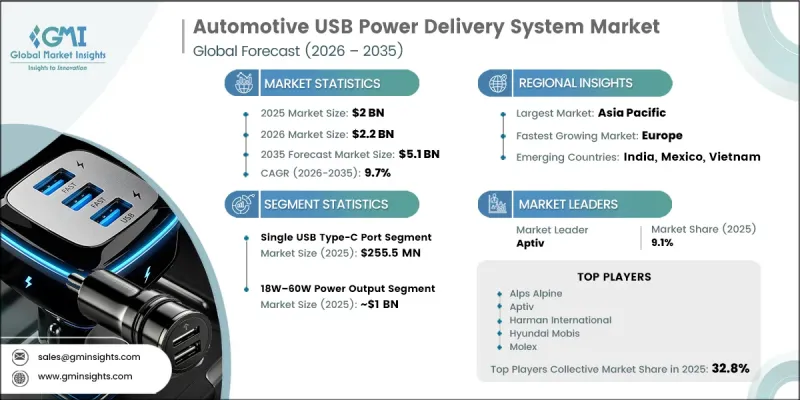
Growth is reinforced by the global shift toward battery electric vehicles (BEVs) and plug-in hybrid electric vehicles (PHEVs), which is creating sustained demand for high-output USB charging architectures within vehicle cabins. As EV penetration approaches the 20-25% range in major automotive markets, OEMs are increasingly adopting USB Power Delivery (PD) 3.1-compliant multi-port systems capable of supporting 60W-140W output per port, accelerating demand in higher wattage segments such as 60W-100W and above 100W categories. The alignment between EV platform expansion and advanced USB PD integration is a primary growth catalyst for the market. At the same time, consumer expectations for fast in-vehicle charging are converging with smartphone charging standards, where modern devices require 45W-65W for efficient fast charging during travel. This is prompting Tier-1 suppliers to embed USB PD controller ICs into infotainment architectures, enabling stable multi-device charging without thermal power limitations and improving overall cabin power distribution efficiency.
| Market Scope | |
|---|---|
| Start Year | 2025 |
| Forecast Year | 2026-2035 |
| Start Value | $2 Billion |
| Forecast Value | $5.1 Billion |
| CAGR | 9.7% |
The single USB Type-C port segment generated USD 255.5 million in 2025. Its growth reflects early adoption in premium vehicle platforms and electric vehicle architectures, where Type-C interfaces are increasingly used as primary charging points in front-row seating configurations. In many designs, wired high-power delivery is being complemented by wireless charging systems rather than replaced, reinforcing the relevance of Type-C deployment in modern cabin ecosystems.
The 60W-100W power output segment captured USD 266.9 million in 2025, reflecting a CAGR of 18.4% through 2035. This performance is driven by early OEM integration of mid-to-high power USB charging systems in premium vehicles, electric vehicles with extended in-cabin usage time, and enhanced rear-seat entertainment configurations designed for long-distance travel comfort and connectivity.
North America Automotive USB Power Delivery System Market reached USD 459 million in 2025 and is expected to grow at a CAGR of 10.5% through 2026-2035, reaching USD 1.24 billion by 2035. Market growth in the region is supported by rapid EV adoption, higher USB port density per vehicle, and increasing deployment of electrified fleet vehicles across ride-hailing, logistics, and commercial transport applications. These structural factors continue to reinforce demand for advanced in-vehicle power delivery systems across both passenger and commercial vehicle categories.
Key companies operating in the global automotive USB power delivery system market include Aptiv, Molex, Hyundai Mobis, Harman International, Alps Alpine, Texas Instruments, Monolithic Power Systems, Diodes Incorporated, Panasonic, Casco, LTSCT, MD ELEKTRONIK, Alfatronix, PRO CAR, Wieson Automotive, Keboda, MinebeaMitsumi, Zhejiang Teme Science and Technology, Hebei First Light, and Aerpro. Companies operating in the automotive USB power delivery system market are focusing on enhancing product performance through higher wattage output capabilities, improved thermal management, and compact integrated circuit designs. Many firms are investing in advanced USB Power Delivery controller technologies to support multi-port high-speed charging architectures in electric and connected vehicles. Strategic partnerships with automotive OEMs and Tier-1 suppliers are being used to ensure early integration into next-generation vehicle platforms. Companies are also prioritizing semiconductor innovation to improve power efficiency and reduce energy loss during high-load charging cycles.
Table of Contents
Chapter 1 Methodology
- 1.1 Research approach
- 1.2 Quality Commitments
- 1.2.1 GMI AI policy & data integrity commitment
- 1.3 Research Trail & Confidence Scoring
- 1.3.1 Research Trail Components
- 1.3.2 Scoring Components
- 1.4 Data Collection
- 1.5 Data mining sources
- 1.5.1 Paid sources
- 1.6 Base estimates and calculations
- 1.6.1 Base year calculation
- 1.7 Forecast model
- 1.7.1 Quantified market impact analysis
- 1.8 Research transparency addendum
- 1.8.1 Source attribution framework
- 1.8.2 Quality assurance metrics
- 1.8.3 Our commitment to trust
Chapter 2 Executive Summary
- 2.1 Industry 360° synopsis
- 2.2 Key market trends
- 2.2.1 Regional
- 2.2.2 Connector
- 2.2.3 Power Output
- 2.2.4 Application
- 2.2.5 Vehicle
- 2.2.6 Vehicle Propulsion
- 2.2.7 Distribution Channel
- 2.3 TAM analysis, 2026-2035
- 2.4 CXO perspectives: Strategic imperatives
Chapter 3 Industry Insights
- 3.1 Industry ecosystem analysis
- 3.1.1 Supplier landscape
- 3.1.2 Profit margin
- 3.1.3 Cost structure
- 3.1.4 Value addition at each stage
- 3.1.5 Factor affecting the value chain
- 3.1.6 Disruptions
- 3.2 Industry impact forces
- 3.2.1 Growth drivers
- 3.2.1.1 Rising EV Adoption Driving Demand for High-Wattage USB PD Systems
- 3.2.1.2 Increasing Consumer Demand for In-Vehicle Device Connectivity & Fast Charging
- 3.2.1.3 Regulatory Mandates for USB-C Standardization (EU Common Charger Directive)
- 3.2.1.4 Growing Integration of Infotainment & ADAS Systems Requiring High-Bandwidth USB Interfaces
- 3.2.2 Industry pitfalls and challenges
- 3.2.2.1 High Cost of USB PD Controller ICs & Thermal Management Components
- 3.2.2.2 Compatibility Fragmentation Across Legacy USB Standards in Existing Vehicle Fleets
- 3.2.3 Market opportunities
- 3.2.3.1 Vehicle-to-Load (V2L) Capability Expansion Creating Demand for 100W+ USB PD Ports
- 3.2.3.2 Aftermarket Retrofit Demand in Aging Vehicle Fleets Across Emerging Markets
- 3.2.3.3 USB4 & USB PD 3.1 Adoption Creating Premium Upgrade Cycles
- 3.2.1 Growth drivers
- 3.3 Technology and innovation landscape
- 3.3.1 Current technological trends
- 3.3.1.1 USB Power Delivery 3.0
- 3.3.1.2 Programmable Power Supply (PPS) Technology
- 3.3.1.3 12V/24V DC-DC Step-Down Converters
- 3.3.2 Emerging technologies
- 3.3.2.1 USB Power Delivery 3.1
- 3.3.2.2 Bidirectional USB Power Delivery
- 3.3.1 Current technological trends
- 3.4 Growth potential analysis
- 3.5 Pricing Analysis (Driven by Primary Research)
- 3.5.1 Historical Price Trend Analysis
- 3.5.2 Pricing Strategy by Player Type (Premium / Value / Cost-plus)
- 3.6 Regulatory landscape
- 3.6.1 North America
- 3.6.1.1 US - NHTSA (National Highway Traffic Safety Administration)
- 3.6.1.2 Canada - ISED (Innovation, Science and Economic Development)
- 3.6.2 Europe
- 3.6.2.1 EU - European Commission (EC)
- 3.6.2.2 Germany - KBA (Kraftfahrt-Bundesamt)
- 3.6.3 Asia Pacific
- 3.6.3.1 China - MIIT (Ministry of Industry and Information Technology)
- 3.6.3.2 India - BIS (Bureau of Indian Standards / Department of Transport)
- 3.6.4 LATAM
- 3.6.4.1 Brazil - INMETRO
- 3.6.4.2 Brazil - ANATEL
- 3.6.5 MEA
- 3.6.5.1 South Africa - South African Bureau of Standards
- 3.6.5.2 Saudi Arabia - SASO (Saudi Standards, Metrology and Quality Organization)
- 3.6.1 North America
- 3.7 Porter's analysis
- 3.8 PESTEL analysis
- 3.9 Trade Data Analysis (Driven by Paid Database)
- 3.9.1 Import/Export Volume & Value Trends
- 3.9.2 Key Trade Corridors & Tariff Impact
- 3.10 Capacity & Production Landscape (Driven by Primary Research)
- 3.10.1 Installed Capacity by Region & Key Producer
- 3.10.2 Capacity Utilization Rates & Expansion Pipelines
- 3.11 Cost breakdown analysis
- 3.12 Patent analysis (Driven by Primary Research)
- 3.13 Connector & Interface Evolution Analysis
- 3.13.1 USB 2.0 to USB4 Migration Roadmap in Automotive Platforms
- 3.13.2 USB PD 3.0 to 3.1 (EPR) Transition
- 3.14 Reliability & Failure Mode Analysis
- 3.15 Impact of AI & generative AI on the market
- 3.15.1 AI-driven disruption of existing business models
- 3.15.2 GenAI use cases & adoption roadmap by segment
- 3.15.3 Risks, limitations & regulatory considerations
- 3.16 Forecast assumptions & scenario analysis (Driven by Primary Research)
- 3.16.1 Base Case- Key Macro & Industry Variables Driving CAGR
- 3.16.2 Optimistic Scenarios- Favorable macro and industry tailwinds
- 3.16.3 Pessimistic Scenario - Macroeconomic slowdown or industry headwinds
Chapter 4 Competitive Landscape, 2025
- 4.1 Introduction
- 4.2 Company market share analysis
- 4.2.1 North America
- 4.2.2 Europe
- 4.2.3 Asia Pacific
- 4.2.4 LATAM
- 4.2.5 MEA
- 4.3 Competitive analysis of major market players
- 4.4 Competitive positioning matrix
- 4.5 Key developments
- 4.5.1 Mergers & acquisitions
- 4.5.2 Partnerships & collaborations
- 4.5.3 New product launches
- 4.5.4 Expansion plans and funding
- 4.6 Company tier benchmarking
- 4.6.1 Tier classification criteria & qualifying thresholds
- 4.6.2 Tier positioning matrix by revenue, geography & innovation
Chapter 5 Market Estimates and Forecast, By Connector, 2022 - 2035 ($ Mn, Thousand Units)
- 5.1 Key trends
- 5.2 Single USB Type-A Port
- 5.3 Single USB Type-C Port
- 5.4 Combination (Type-A + Type-C Multi-Port)
- 5.5 Others
Chapter 6 Market Estimates and Forecast, By Power Output, 2022 - 2035 ($ Mn, Thousand Units)
- 6.1 Key trends
- 6.2 Up to 18W
- 6.3 18W-60W
- 6.4 60W-100W
- 6.5 Above 100W
Chapter 7 Market Estimates and Forecast, By Application, 2022 - 2035 ($ Mn, Thousand Units)
- 7.1 Key trends
- 7.2 Head Units / Infotainment Integration
- 7.3 Rear-Seat Entertainment Systems
- 7.4 Rear-Seat Chargers / Car Charger Ports
- 7.5 Others
Chapter 8 Market Estimates and Forecast, By Vehicle, 2022 - 2035 ($ Mn, Thousand Units)
- 8.1 Key trends
- 8.2 Passenger cars
- 8.2.1 Sedan
- 8.2.2 SUV & Crossover
- 8.2.3 Hatchback
- 8.2.4 Others
- 8.3 Commercial vehicles
- 8.3.1 LCV
- 8.3.2 MCV
- 8.3.3 HCV
- 8.4 Two-Wheelers
Chapter 9 Market Estimates and Forecast, By Vehicle Propulsion, 2022 - 2035 ($ Mn, Thousand Units)
- 9.1 Key trends
- 9.2 ICE
- 9.3 Electric
- 9.4 Hybrid
Chapter 10 Market Estimates and Forecast, By Distribution Channel, 2022 - 2035 ($ Mn, Thousand Units)
- 10.1 Key trends
- 10.2 OEM/Factory Installed
- 10.3 Aftermarket
- 10.3.1 Online Aftermarket
- 10.3.2 Offline Aftermarket
Chapter 11 Market Estimates & Forecast, By Region, 2022 - 2035 ($ Mn, Thousand Units)
- 11.1 Key trends
- 11.2 North America
- 11.2.1 US
- 11.2.2 Canada
- 11.3 Europe
- 11.3.1 Germany
- 11.3.2 UK
- 11.3.3 France
- 11.3.4 Italy
- 11.3.5 Spain
- 11.3.6 Netherlands
- 11.3.7 Switzerland
- 11.3.8 Poland
- 11.4 Asia Pacific
- 11.4.1 China
- 11.4.2 India
- 11.4.3 Japan
- 11.4.4 South Korea
- 11.4.5 Thailand
- 11.4.6 Vietnam
- 11.4.7 Indonesia
- 11.4.8 Malaysia
- 11.5 Latin America
- 11.5.1 Brazil
- 11.5.2 Mexico
- 11.5.3 Argentina
- 11.5.4 Chile
- 11.6 MEA
- 11.6.1 South Africa
- 11.6.2 Saudi Arabia
- 11.6.3 UAE
Chapter 12 Company Profiles
- 12.1 Global players
- 12.1.1 Molex
- 12.1.2 Aptiv
- 12.1.3 Harman International
- 12.1.4 Monolithic Power Systems
- 12.1.5 Alps Alpine
- 12.1.6 Hyundai Mobis
- 12.1.7 Diodes Incorporated
- 12.1.8 Panasonic
- 12.1.9 Casco
- 12.1.10 Texas Instruments
- 12.1.11 LTSCT
- 12.2 Regional players
- 12.2.1 Alfatronix
- 12.2.2 PRO CAR
- 12.2.3 MD ELEKTRONIK
- 12.2.4 Wieson Automotive
- 12.2.5 Keboda
- 12.2.6 MinebeaMitsumi
- 12.3 Emerging players
- 12.3.1 Zhejiang Teme Science and Technology
- 12.3.2 Hebei First Light
- 12.3.3 Aerpro

