
PUBLISHER: Global Market Insights Inc. | PRODUCT CODE: 2101674

PUBLISHER: Global Market Insights Inc. | PRODUCT CODE: 2101674
Europe Cloth Drying Machine Market Opportunity, Growth Drivers, Industry Trend Analysis, and Forecast 2026 - 2035
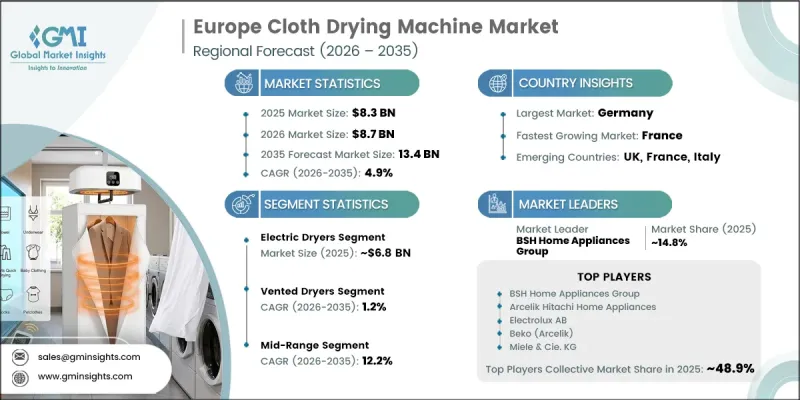
Europe Cloth Drying Machine Market was valued at USD 8.3 billion in 2025 and is estimated to grow at a CAGR of 4.9% to reach USD 13.4 billion by 2035.
Ongoing growth in urban populations and evolving residential development patterns are reducing the availability of outdoor drying areas, encouraging greater adoption of cloth drying machines for indoor laundry care. The growing preference for apartment living and compact residential spaces is further driving demand for appliances that maximize convenience while minimizing space requirements. Consumers are increasingly seeking drying solutions that deliver faster performance, improved fabric protection, and greater energy efficiency. Manufacturers continue to introduce compact, technologically advanced models designed to meet the needs of modern households. In addition, the steady rise in dual-income families and increasingly busy lifestyles are strengthening demand for automated home appliances that reduce manual effort and save time. These changing consumer preferences continue to support long-term expansion across the Europe cloth drying machine market.
| Market Scope | |
|---|---|
| Start Year | 2025 |
| Forecast Year | 2026-2035 |
| Start Value | $8.3 Billion |
| Forecast Value | $13.4 Billion |
| CAGR | 4.9% |
The electric dryers segment generated USD 6.8 billion in 2025 and is anticipated to grow at a CAGR of 5.6% from 2026 to 2035. This segment maintains its leadership due to widespread access to residential electrical infrastructure, increasing consumer preference for energy-efficient appliances, and continued technological advancements in electric drying systems. Broad product availability across multiple pricing categories allows electric dryers to appeal to a wide range of households. Rising replacement demand, growing interest in connected home appliances, and continued emphasis on energy-efficient technologies are expected to sustain long-term growth within the electric dryers segment.
The vented dryers segment accounted for 41.1% share in 2025 and is projected to grow at a CAGR of 1.2% through 2035. At the same time, heat pump dryers continue to experience strong market momentum due to their superior energy efficiency and lower operating costs compared with conventional drying technologies. Increasing consumer awareness of energy savings, higher electricity costs, and stricter efficiency standards continue to accelerate demand for advanced drying systems. Expanding product availability across different price ranges is also making energy-efficient drying machines more accessible to a broader consumer base, further supporting market growth.
Germany Cloth Drying Machine Market reached USD 1.82 billion in 2025 and is forecast to grow at a CAGR of 4.7% from 2026 to 2035. Market growth is supported by strong household appliance adoption, increasing consumer demand for energy-efficient home products, and continued preference for advanced drying technologies that reduce electricity consumption while maintaining high performance. Growing urban residential development, smaller living spaces, and greater focus on environmentally sustainable appliances continue to strengthen demand for compact and efficient cloth drying machines throughout the country.
Major companies operating in the Europe cloth drying machine market include Samsung Electronics, Whirlpool Corporation, Miele & Cie. KG, V-ZUG AG, Electrolux AB, Panasonic Corporation, BSH Home Appliances Group, Asko Appliances, Fisher & Paykel, Crosslee plc, LG Electronics, Candy Hoover Group, Gorenje, Arcelik Hitachi Home Appliances, Primus, Speed Queen (Alliance Laundry Systems), Smeg S.p.A., Vestel, Midea Group, Beko (Arcelik), and Schulthess Maschinen AG. Companies operating in the Europe cloth drying machine market are strengthening their market position by investing in energy-efficient technologies, expanding smart appliance portfolios, and introducing compact products designed for modern residential environments. Manufacturers continue to focus on product innovation, incorporating advanced connectivity, intelligent drying programs, and enhanced fabric care features to improve user experience. Strategic partnerships with retail networks, investments in research and development, and expansion of manufacturing capabilities are supporting broader market reach. Companies are also emphasizing sustainability through improved energy performance and environmentally responsible product development.
Table of Contents
Chapter 1 Methodology & Scope
- 1.1 Market scope and definition
- 1.2 Research design
- 1.2.1 Research approach
- 1.2.2 Data collection methods
- 1.3 Data mining sources
- 1.3.1 Global
- 1.3.2 Regional/Country
- 1.4 Base estimates and calculations
- 1.4.1 Base year calculation
- 1.4.2 Key trends for market estimation
- 1.5 Primary research and validation
- 1.5.1 Primary sources
- 1.6 Forecast model
- 1.7 Research assumptions and limitations
Chapter 2 Executive Summary
- 2.1 Industry 360° synopsis
- 2.2 Key market trends
- 2.2.1 Country
- 2.2.2 Type
- 2.2.3 Capacity
- 2.2.4 Technology
- 2.2.5 Price range
- 2.2.6 End use
- 2.2.7 Distribution channel
Chapter 3 Industry Insights
- 3.1 Industry ecosystem analysis
- 3.1.1 Supplier landscape
- 3.1.2 Profit margin
- 3.1.3 Value addition at each stage
- 3.1.4 Factor affecting the value chain
- 3.2 Industry impact forces
- 3.2.1 Growth drivers
- 3.2.1.1 Rising adoption of heat pump dryers driven by energy efficiency regulations and growing eco-awareness among consumers
- 3.2.1.2 Increasing urbanization and dual-income households expanding demand for time-saving laundry solutions
- 3.2.1.3 Rapid growth of commercial laundry infrastructure in healthcare, hospitality, and wellness sectors
- 3.2.2 Pitfalls & Challenges
- 3.2.2.1 High upfront costs and long replacement cycles limiting market penetration in price-sensitive regions
- 3.2.2.2 Competition from outdoor drying traditions and energy cost concerns in emerging economies
- 3.2.3 Opportunities
- 3.2.3.1 Integration of smart connectivity and IoT features enabling remote monitoring and energy optimization
- 3.2.3.2 Expansion of compact and stackable dryer formats for urban apartments and space-constrained markets
- 3.2.1 Growth drivers
- 3.3 Growth potential analysis
- 3.4 Future market trends
- 3.5 Technology and innovation landscape
- 3.5.1 Current technological trends
- 3.5.2 Emerging technologies
- 3.6 Regulatory landscape
- 3.6.1 Standards and compliance requirements
- 3.6.2 Regional regulatory frameworks
- 3.6.3 Certification standards
- 3.7 Porter's analysis
- 3.8 PESTEL analysis
- 3.9 Pricing analysis (driven by primary research)
- 3.9.1 Historical price trend analysis (driven by primary research)
- 3.9.2 Pricing strategy by player type (premium/value/cost-plus) (driven by primary research)
- 3.9.3 Regional price variations
- 3.10 Trade data analysis (HS code 84211200) (driven by paid database)
- 3.10.1 Import/export volume and value trends (driven by paid database)
- 3.10.2 Key trade corridors and tariff impact (driven by paid database)
- 3.11 Impact of AI and generative AI on the market
- 3.11.1 AI-driven predictive maintenance
- 3.11.2 Smart home integration and GenAI use cases
- 3.11.3 Risks, limitations and regulatory considerations
- 3.12 Capacity and production landscape (driven by primary research)
- 3.12.1 Installed capacity by region and key producer (driven by primary research)
- 3.12.2 Capacity utilization rates and expansion pipelines (driven by primary research)
Chapter 4 Competitive Landscape, 2025
- 4.1 Introduction
- 4.2 Company market share analysis
- 4.2.1 By Country
- 4.2.1.1 Germany
- 4.2.1.2 UK
- 4.2.1.3 France
- 4.2.1.4 Italy
- 4.2.1.5 Spain
- 4.2.1.6 Russia
- 4.2.1.7 Netherlands
- 4.2.1.8 Belgium
- 4.2.1 By Country
- 4.3 Company matrix analysis
- 4.4 Competitive analysis of major market players
- 4.5 Competitive positioning matrix
- 4.6 Key developments
- 4.6.1 Mergers & acquisitions
- 4.6.2 Partnerships & collaborations
- 4.6.3 New product launches
- 4.6.4 Expansion plans
Chapter 5 Market Estimates & Forecast, By Type, 2022 - 2035, (USD Billion) (Thousand Units)
- 5.1 Key trends
- 5.2 Gas dryers
- 5.3 Electric dryers
Chapter 6 Market Estimates & Forecast, By Capacity, 2022 - 2035, (USD Billion) (Thousand Units)
- 6.1 Key trends
- 6.2 Up to 8 kg
- 6.3 8 kg to 15 kg
- 6.4 Above 15 kg
Chapter 7 Market Estimates & Forecast, By Technology, 2022 - 2035, (USD Billion) (Thousand Units)
- 7.1 Key trends
- 7.2 Vented dryers
- 7.3 Condenser dryers
- 7.4 Heat pump dryers
Chapter 8 Market Estimates & Forecast, By Price Range, 2022 - 2035, (USD Billion) (Thousand Units)
- 8.1 Key trends
- 8.2 Economy
- 8.3 Mid-range
- 8.4 High/premium
Chapter 9 Market Estimates & Forecast, By End Use, 2022 - 2035, (USD Billion) (Thousand Units)
- 9.1 Key trends
- 9.2 Residential
- 9.3 Commercial
- 9.3.1 Hotels & restaurants
- 9.3.2 Healthcare facilities
- 9.3.3 Spas & wellness centers
- 9.3.4 Others (gyms, coin-operated laundries, etc.)
Chapter 10 Market Estimates & Forecast, By Distribution Channel, 2022 - 2035, (USD Billion) (Thousand Units)
- 10.1 Key trends
- 10.2 Online
- 10.3 Offline
Chapter 11 Market Estimates & Forecast, By Country, 2022 - 2035, (USD Billion) (Thousand Units)
- 11.1 Key trends
- 11.2 Germany
- 11.3 UK
- 11.4 France
- 11.5 Italy
- 11.6 Spain
- 11.7 Russia
- 11.8 Netherlands
- 11.9 Belgium
Chapter 12 Company Profiles
- 12.1 Top Global Players
- 12.1.1 BSH Home Appliances Group
- 12.1.2 Electrolux AB
- 12.1.3 LG Electronics
- 12.1.4 Samsung Electronics
- 12.1.5 Midea Group
- 12.1.6 Whirlpool Corporation
- 12.1.7 Arcelik Hitachi Home Appliances
- 12.2 Regional Champions
- 12.2.1 Miele & Cie. KG
- 12.2.2 Beko (Arcelik)
- 12.2.3 Candy Hoover Group
- 12.2.4 Speed Queen (Alliance Laundry Systems)
- 12.2.5 Gorenje
- 12.2.6 Primus
- 12.2.7 Smeg S.p.A.
- 12.3 Emerging & Specialized Players
- 12.3.1 Schulthess Maschinen AG
- 12.3.2 V-ZUG AG
- 12.3.3 Fisher & Paykel
- 12.3.4 Vestel
- 12.3.5 Asko Appliances
- 12.3.6 Crosslee plc
- 12.3.7 Panasonic Corporation

