
PUBLISHER: Global Market Insights Inc. | PRODUCT CODE: 2101675

PUBLISHER: Global Market Insights Inc. | PRODUCT CODE: 2101675
Iridium Supply Chain and Substitution Market Opportunity, Growth Drivers, Industry Trend Analysis, and Forecast 2026 - 2035
The Global Iridium Supply Chain and Substitution Market was valued at USD 1.45 billion in 2025 and is estimated to grow at a CAGR of 5.90% to reach USD 2.43 billion by 2035.
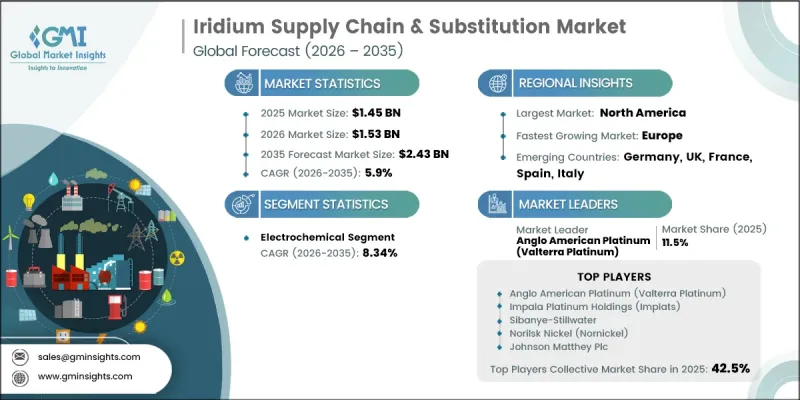
Market growth is supported by increasing adoption of proton exchange membrane (PEM) electrolyzers, evolving critical mineral strategies, and expanding investments in catalyst optimization and secondary recovery technologies. The industry is also undergoing a fundamental transformation as the traditional mine-dependent supply structure gradually evolves into a more circular ecosystem where recycling, material efficiency, and substitution technologies play an increasingly important role in maintaining long-term supply security. Expanding investment in clean energy infrastructure and growing demand for advanced electrochemical systems continue to strengthen the long-term outlook for the global iridium supply chain and substitution market.
| Market Scope | |
|---|---|
| Start Year | 2025 |
| Forecast Year | 2026-2035 |
| Start Value | $1.45 Billion |
| Forecast Value | $2.43 Billion |
| CAGR | 5.9% |
The secondary supply segment is expected to grow at a CAGR of 9.27% through 2035. Rising investments in recycling technologies and material recovery capabilities are increasing the importance of secondary sources within the overall supply chain. As aging electrochemical equipment reaches the end of its operating life during the forecast period, greater volumes of recoverable iridium are expected to enter recycling streams, improving supply availability and supporting circular resource management. Companies operating across refining, recycling, and material processing continue to strengthen their capabilities to recover iridium at multiple stages of the product lifecycle, enhancing resource efficiency while reducing dependence on primary production.
The electrochemical application segment accounted for 44% share in 2025 and is expected to grow at a CAGR of 8.34% through 2035. This segment includes applications such as proton exchange membrane electrolysis, chlor-alkali processing, water treatment, electroplating, and electrowinning. Growing demand for advanced electrochemical technologies continues to drive market expansion as industries increase investments in efficient energy conversion systems, industrial processing technologies, and sustainable production methods. Rising deployment of electrochemical infrastructure is expected to remain a key contributor to long-term iridium consumption.
North America Iridium Supply Chain and Substitution Market accounted for 21% share in 2025. The regional market continues to benefit from supportive policy initiatives, increasing investments in downstream processing capabilities, and expanding development of secondary supply networks. These factors are strengthening regional participation across the iridium value chain while improving domestic processing capacity and enhancing long-term supply resilience.
Major companies operating in the global iridium supply chain and substitution market include Anglo American Platinum (Valterra Platinum), Impala Platinum Holdings (Implats), Sibanye-Stillwater, Norilsk Nickel (Nornickel), and Johnson Matthey Plc. Companies participating in the iridium supply chain and substitution market are focusing on expanding recycling capacity, improving material recovery efficiency, and developing advanced catalyst technologies to strengthen their competitive position. Market participants continue to invest in research and development aimed at reducing iridium consumption through catalyst optimization and material substitution while maintaining high performance. Strategic collaborations, long-term supply agreements, and investments in downstream processing capabilities are helping companies improve supply security and operational flexibility. Businesses are also strengthening refining infrastructure, enhancing resource utilization, and expanding technological expertise to support growing demand from advanced industrial applications.
Table of Contents
Chapter 1 Methodology & Scope
- 1.1 Market scope and definition
- 1.2 Research design
- 1.2.1 Research approach
- 1.2.2 Data collection methods
- 1.3 Data mining sources
- 1.3.1 Global
- 1.3.2 Regional/Country
- 1.4 Base estimates and calculations
- 1.4.1 Base year calculation
- 1.4.2 Key trends for market estimation
- 1.5 Primary research and validation
- 1.5.1 Primary sources
- 1.6 Forecast model
- 1.7 Research assumptions and limitations
Chapter 2 Executive Summary
- 2.1 Industry 360° synopsis
- 2.2 Key market trends
- 2.2.1 Supply Source
- 2.2.2 Substitution Strategy
- 2.2.3 End Use
- 2.2.4 Regional
- 2.3 TAM Analysis, 2026-2035
- 2.4 CXO perspectives: Strategic imperatives
- 2.5 Future outlook and strategic recommendations
Chapter 3 Industry Insights
- 3.1 Industry ecosystem analysis
- 3.1.1 Supplier landscape
- 3.1.2 Profit margin
- 3.1.3 Value addition at each stage
- 3.1.4 Factor affecting the value chain
- 3.1.5 Disruptions
- 3.2 Industry impact forces
- 3.2.1 Growth drivers
- 3.2.1.1 Rising demand for iridium applications
- 3.2.1.2 Limited primary supply availability
- 3.2.1.3 Expansion of clean energy projects
- 3.2.2 Industry pitfalls and challenges
- 3.2.2.1 Supply concentration in few regions
- 3.2.2.2 High material cost volatility
- 3.2.3 Market opportunities
- 3.2.3.1 Development of alternative catalysts
- 3.2.3.2 Growth in recycling infrastructure
- 3.2.3.3 Advancements in material efficiency
- 3.2.1 Growth drivers
- 3.3 Growth potential analysis
- 3.4 Regulatory landscape
- 3.4.1 North America
- 3.4.2 Europe
- 3.4.3 Asia Pacific
- 3.4.4 Latin America
- 3.4.5 Middle East & Africa
- 3.5 Porter's analysis
- 3.6 PESTEL analysis
- 3.7 Technology and innovation landscape
- 3.7.1 Current technological trends
- 3.7.2 Emerging technologies
- 3.8 Price trends
- 3.8.1 By region
- 3.8.2 By Supply Source
- 3.9 Future market trends
- 3.10 Patent landscape
- 3.11 Trade statistics (HS code)
- 3.11.1 Major importing countries
- 3.11.2 Major exporting countries
- 3.12 Sustainability and environmental aspects
- 3.12.1 Sustainable practices
- 3.12.2 Waste reduction strategies
- 3.12.3 Energy efficiency in production
- 3.12.4 Eco-friendly initiatives
- 3.13 Carbon footprint consideration
Chapter 4 Competitive Landscape, 2025
- 4.1 Introduction
- 4.2 Company market share analysis
- 4.2.1 By region
- 4.2.1.1 North America
- 4.2.1.2 Europe
- 4.2.1.3 Asia Pacific
- 4.2.1.4 LATAM
- 4.2.1.5 MEA
- 4.2.1 By region
- 4.3 Company matrix analysis
- 4.4 Competitive analysis of major market players
- 4.5 Competitive positioning matrix
- 4.6 Key developments
- 4.6.1 Mergers & acquisitions
- 4.6.2 Partnerships & collaborations
- 4.6.3 New product launches
- 4.6.4 Expansion plans
Chapter 5 Market Estimates and Forecast, By Supply source, 2022-2035 (USD Million)
- 5.1 Key trends
- 5.2 Primary Supply (Mine-Derived)
- 5.3 Secondary Supply (Recycled/Recovered)
Chapter 6 Market Estimates and Forecast, By Substitution Strategy, 2022-2035 (USD Million)
- 6.1 Key trends
- 6.2 Material Substitution
- 6.3 Catalyst Loading Reduction (Thrifting)
- 6.4 Process & Technology Substitution
- 6.5 Recycling & Circular Supply Enhancement
- 6.6 Others
Chapter 7 Market Estimates and Forecast, By End Use, 2022-2035 (USD Million)
- 7.1 Key trends
- 7.2 Electrochemical
- 7.3 Chemical Catalysis
- 7.4 Electrical & Electronics
- 7.5 Medical & Other Specialty
- 7.6 Others
Chapter 8 Market Estimates and Forecast, By Region, 2022-2035 (USD Million)
- 8.1 Key trends
- 8.2 North America
- 8.2.1 U.S.
- 8.2.2 Canada
- 8.3 Europe
- 8.3.1 Germany
- 8.3.2 UK
- 8.3.3 France
- 8.3.4 Spain
- 8.3.5 Italy
- 8.3.6 Rest of Europe
- 8.4 Asia Pacific
- 8.4.1 China
- 8.4.2 India
- 8.4.3 Japan
- 8.4.4 Australia
- 8.4.5 South Korea
- 8.4.6 Rest of Asia Pacific
- 8.5 Latin America
- 8.5.1 Brazil
- 8.5.2 Mexico
- 8.5.3 Argentina
- 8.5.4 Rest of Latin America
- 8.6 Middle East and Africa
- 8.6.1 Saudi Arabia
- 8.6.2 South Africa
- 8.6.3 UAE
- 8.6.4 Rest of Middle East and Africa
Chapter 9 Company Profiles
- 9.1 Anglo American Platinum (Valterra Platinum)
- 9.2 Impala Platinum Holdings (Implats)
- 9.3 Sibanye-Stillwater
- 9.4 Norilsk Nickel (Nornickel)
- 9.5 Johnson Matthey Plc
- 9.6 Heraeus Precious Metals GmbH & Co. KG
- 9.7 Umicore N.V.
- 9.8 Northam Platinum Limited
- 9.9 African Rainbow Minerals (ARM)
- 9.10 Tanaka Precious Metal
- 9.11 Furuya Metal Co. Ltd.
- 9.12 Zimplats Holdings Limited

