PUBLISHER: Global Market Insights Inc. | PRODUCT CODE: 2101679

PUBLISHER: Global Market Insights Inc. | PRODUCT CODE: 2101679
Iron Supplements Market Opportunity, Growth Drivers, Industry Trend Analysis, and Forecast 2026 - 2035
The Global Iron Supplements Market was valued at USD 6.8 billion in 2025 and is estimated to grow at a CAGR of 5.7% to reach USD 11.9 billion by 2035.
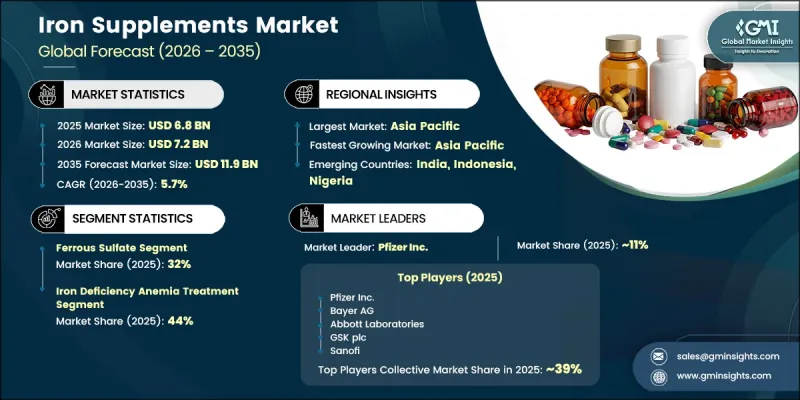
Growth is shaped by a dual-structure demand environment that combines high disease prevalence with expanding wellness consumption patterns. Iron deficiency anemia remains one of the most widespread nutritional disorders globally, with the World Health Organization identifying iron deficiency as the leading contributor to anemia cases, particularly among women of reproductive age and children in South Asia, Southeast Asia, and Sub-Saharan Africa. This creates a sustained therapeutic demand base across pharmaceutical and nutraceutical channels. In parallel, developed economies are experiencing stronger uptake of preventive supplementation, supported by rising health awareness and direct-to-consumer nutrition models. Market evolution is further reinforced by product innovation, including growing adoption of liposomal and chelated iron formulations across major pharmacy and retail channels in the United States, the United Kingdom, and Germany. At the same time, national public health interventions such as India's expanded anemia control initiatives are widening access to micronutrient supplementation in both rural and urban populations. Online distribution continues to strengthen its role as subscription-based supplement brands expand their iron-focused product offerings, improving accessibility and recurring consumption patterns across global markets.
| Market Scope | |
|---|---|
| Start Year | 2025 |
| Forecast Year | 2026-2035 |
| Start Value | $6.8 Billion |
| Forecast Value | $11.9 Billion |
| CAGR | 5.7% |
The iron deficiency anemia treatment segment held 44% share in 2025, growing at a CAGR of 6.2% through 2035. This dominance reflects the persistent global burden of iron deficiency, which continues to account for nearly half of all anemia cases worldwide according to World Health Organization estimates. The condition is most concentrated in South Asia and Sub-Saharan Africa, sustaining long-term clinical demand for therapeutic iron supplementation across healthcare systems.
The powder and sachet-based formulations segment held 14% share in 2025 and is projected to grow at a CAGR of 7.4% through 2035. This format is increasingly adopted in public health and institutional distribution programs, particularly in regions such as India and Indonesia, where micronutrient sachets align effectively with maternal and child nutrition delivery systems and large-scale supplementation initiatives.
North America Iron Supplements Market accounted for 27% share in 2025 and is projected to grow at a CAGR of 6.2% through 2035. The United States represents the largest share within the region, supported by a well-established over-the-counter supplement industry, strong consumer awareness of preventive healthcare, and an extensive pharmacy and retail distribution network. The regulatory framework under the Dietary Supplement Health and Education Act provides a structured environment for product commercialization, enabling rapid introduction of new formulations while maintaining labeling and safety standards.
Major players operating in the North America Iron Supplements Market are Bayer AG, Pfizer Inc., Abbott Laboratories, GSK plc, Sanofi, Amway, DSM Nutritional Products, Himalaya Wellness, NOW Foods, Nature Made (Pharmavite), Rainbow Light, Garden of Life, MegaFood, Solgar, Feroglobin (Vitabiotics). Companies operating in the iron supplements market are focusing on formulation innovation, particularly the development of advanced delivery systems such as liposomal, chelated, and slow-release iron to improve absorption rates and reduce gastrointestinal side effects. Market participants are expanding omnichannel distribution strategies, combining pharmacy, retail, and e-commerce platforms to strengthen consumer reach. Strategic partnerships with healthcare providers and public health programs are helping companies secure institutional demand and improve product penetration in anemia-prone regions. Branding efforts are increasingly centered on clean-label positioning and preventive wellness messaging to attract health-conscious consumers in developed markets.
Table of Contents
Chapter 1 Methodology & Scope
- 1.1 Market scope and definition
- 1.2 Research design
- 1.2.1 Research approach
- 1.2.2 Data collection methods
- 1.3 Data mining sources
- 1.3.1 Global
- 1.3.2 Regional/Country
- 1.4 Base estimates and calculations
- 1.4.1 Base year calculation
- 1.4.2 Key trends for market estimation
- 1.5 Primary research and validation
- 1.5.1 Primary sources
- 1.6 Forecast model
- 1.7 Research assumptions and limitations
Chapter 2 Executive Summary
- 2.1 Industry 360° synopsis
- 2.2 Key market trends
- 2.2.1 Regional
- 2.2.2 Product Type
- 2.2.3 Formulation
- 2.2.4 Application
- 2.2.5 End-User
- 2.3 TAM Analysis, 2026-2035
- 2.4 CXO perspectives: Strategic imperatives
- 2.4.1 Executive decision points
Chapter 3 Industry Insights
- 3.1 Industry ecosystem analysis
- 3.1.1 Supplier landscape
- 3.1.2 Profit margin
- 3.1.3 Value addition at each stage
- 3.1.4 Factor affecting the value chain
- 3.1.5 Disruptions
- 3.2 Industry impact forces
- 3.2.1 Growth drivers
- 3.2.2 Industry pitfalls and challenges
- 3.2.3 Market opportunities
- 3.3 Growth potential analysis
- 3.4 Regulatory landscape
- 3.4.1 North America
- 3.4.2 Europe
- 3.4.3 Asia Pacific
- 3.4.4 Latin America
- 3.4.5 Middle East & Africa
- 3.5 Porter's analysis
- 3.6 PESTEL analysis
- 3.7 Price trends
- 3.7.1 By region
- 3.7.2 By Product Type
- 3.8 Future market trends
- 3.9 Technology and Innovation landscape
- 3.9.1 Current technological trends
- 3.9.2 Emerging technologies
- 3.10 Patent Landscape
- 3.11 Trade statistics (HS code)
- 3.11.1 Major importing countries
- 3.11.2 Major exporting countries
- 3.12 Sustainability and environmental aspects
- 3.12.1 Sustainable practices
- 3.12.2 Waste reduction strategies
- 3.12.3 Energy efficiency in production
- 3.12.4 Eco-friendly initiatives
- 3.13 Carbon footprint consideration
Chapter 4 Competitive Landscape, 2025
- 4.1 Introduction
- 4.2 Company market share analysis
- 4.2.1 By region
- 4.2.1.1 North America
- 4.2.1.2 Europe
- 4.2.1.3 Asia Pacific
- 4.2.1.4 LATAM
- 4.2.1.5 MEA
- 4.2.1 By region
- 4.3 Company matrix analysis
- 4.4 Competitive analysis of major market players
- 4.5 Competitive positioning matrix
- 4.6 Key developments
- 4.6.1 Mergers & acquisitions
- 4.6.2 Partnerships & collaborations
- 4.6.3 New Product Launches
- 4.6.4 Expansion Plans
Chapter 5 Market Estimates and Forecast, By Product Type, 2022-2035 (USD Billion)
- 5.1 Key trends
- 5.2 Ferrous Sulfate
- 5.3 Ferrous Gluconate
- 5.4 Ferrous Fumarate
- 5.5 Carbonyl Iron
- 5.6 Polysaccharide-Iron Complex
- 5.7 Others
Chapter 6 Market Estimates and Forecast, By Formulation, 2022-2035 (USD Billion)
- 6.1 Key trends
- 6.2 Tablets & Capsules
- 6.3 Liquids & Syrups
- 6.4 Powder & Sachets
Chapter 7 Market Estimates and Forecast, By Application, 2022-2035 (USD Billion)
- 7.1 Key trends
- 7.2 Iron Deficiency Anemia Treatment
- 7.3 Pregnancy & Prenatal
- 7.4 General Health & Wellness
- 7.5 Pediatric Nutrition
- 7.6 Sports Nutrition
Chapter 8 Market Estimates and Forecast, By End-User, 2022-2035 (USD Billion)
- 8.1 Key trends
- 8.2 Hospitals & Clinics
- 8.3 Retail Consumers
- 8.4 Pharmacies
Chapter 9 Market Estimates and Forecast, By Region, 2022-2035 (USD Billion)
- 9.1 Key trends
- 9.2 North America
- 9.2.1 U.S.
- 9.2.2 Canada
- 9.3 Europe
- 9.3.1 Germany
- 9.3.2 UK
- 9.3.3 France
- 9.3.4 Spain
- 9.3.5 Italy
- 9.3.6 Rest of Europe
- 9.4 Asia Pacific
- 9.4.1 China
- 9.4.2 India
- 9.4.3 Japan
- 9.4.4 Australia
- 9.4.5 South Korea
- 9.4.6 Rest of Asia Pacific
- 9.5 Latin America
- 9.5.1 Brazil
- 9.5.2 Mexico
- 9.5.3 Argentina
- 9.5.4 Rest of Latin America
- 9.6 Middle East and Africa
- 9.6.1 Saudi Arabia
- 9.6.2 South Africa
- 9.6.3 UAE
- 9.6.4 Rest of Middle East and Africa
Chapter 10 Company Profiles
- 10.1 Pfizer Inc.
- 10.2 Bayer AG
- 10.3 Abbott Laboratories
- 10.4 GSK plc
- 10.5 Sanofi
- 10.6 Amway
- 10.7 Himalaya Wellness
- 10.8 NOW Foods
- 10.9 Nature Made (Pharmavite)
- 10.10 Rainbow Light
- 10.11 Garden of Life
- 10.12 MegaFood
- 10.13 Solgar
- 10.14 Vitabiotics (Feroglobin)
- 10.15 DSM Nutritional Products

