PUBLISHER: Global Market Insights Inc. | PRODUCT CODE: 2101685

PUBLISHER: Global Market Insights Inc. | PRODUCT CODE: 2101685
North America Smart Luggage Market Opportunity, Growth Drivers, Industry Trend Analysis, and Forecast 2026 - 2035
North America Smart Luggage Market was valued at USD 886.6 million in 2025 and is estimated to grow at a CAGR of 9.5% to reach USD 2.2 billion by 2035.
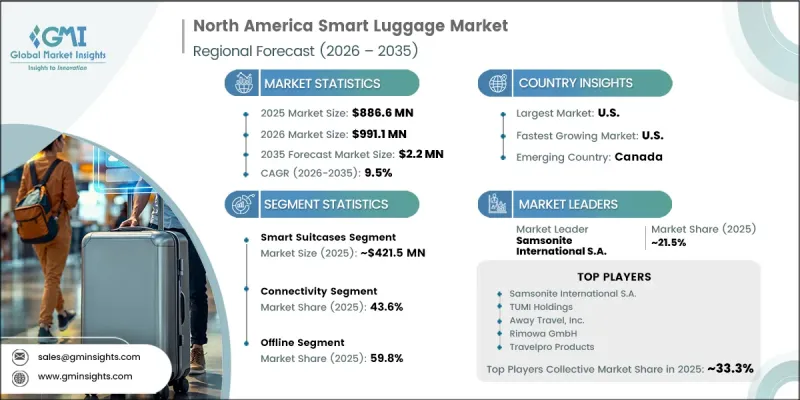
Market growth is driven by increasing air travel, rising consumer demand for connected travel accessories, and continuous advancements in smart mobility technologies. The region continues to witness strong adoption of technologically advanced luggage equipped with digital tracking, integrated charging capabilities, electronic locking systems, and mobile connectivity features that enhance convenience and travel security. Regulatory requirements surrounding battery safety and luggage compliance have also encouraged manufacturers to develop products that meet commercial aviation standards while maintaining functionality and ease of use. At the same time, declining component costs and broader adoption of wireless communication technologies have made smart luggage more accessible across multiple price categories, expanding the consumer base. Continuous innovation in connectivity, battery management, location tracking, and user-friendly travel solutions is further strengthening market demand. Supported by evolving traveler preferences, increasing technology integration, and ongoing product innovation, the North America smart luggage market is expected to maintain steady growth throughout the forecast period.
| Market Scope | |
|---|---|
| Start Year | 2025 |
| Forecast Year | 2026-2035 |
| Start Value | $886.6 Million |
| Forecast Value | $2.2 Billion |
| CAGR | 9.5% |
The United States remains the largest contributor to the North America smart luggage market, supported by one of the world's most extensive commercial aviation networks and a highly developed travel ecosystem. The regional regulatory landscape requires power-equipped luggage to feature removable lithium batteries for checked baggage, while security standards also encourage compatibility with approved locking systems for commercial air travel. These regulatory requirements have guided manufacturers toward designing compliant products that combine convenience, safety, and enhanced traveler experience. The increasing affordability of satellite positioning technologies and Bluetooth connectivity has also enabled manufacturers to introduce smart luggage with advanced tracking capabilities across broader pricing segments, supporting wider adoption throughout North America.
The smart suitcases segment generated USD 421.5 million in 2025 and is expected to grow at a CAGR of 9% from 2026 to 2035. Smart suitcases continue to represent the leading product category within the North America smart luggage market, driven by strong consumer preference for connected carry-on solutions that improve travel convenience and baggage management. Growing demand for lightweight luggage with integrated digital features, electronic weight monitoring, location tracking, and enhanced security functions continues to support segment growth. Compact carry-on models remain the most popular configuration, reflecting increasing consumer preference for efficient cabin travel and technologically advanced travel accessories.
The connectivity segment accounted for 43.6% share in 2025. Connected luggage solutions have gained widespread acceptance as travelers increasingly expect real-time visibility of their belongings throughout their journey. The growing adoption of wireless communication technologies, digital tracking platforms, and intelligent baggage monitoring systems continues to strengthen demand for connected luggage products. Ongoing innovation in connectivity features is further enhancing user experience while supporting broader market adoption across both leisure and business travel segments.
U.S. Smart Luggage Market generated USD 667.3 million in 2025 and is projected to register a CAGR of 9.6% from 2026 to 2035. The country remains the largest national market within North America, supported by high consumer spending on travel technology, strong commercial aviation activity, and increasing demand for premium luggage solutions. Continued adoption of connected travel products, expanding retail availability, and growing interest in smart travel accessories are expected to sustain long-term market growth across the United States.
Major companies operating in the North America smart luggage market include Samsonite International S.A., TUMI Holdings, Inc., Rimowa GmbH, Delsey Paris, Briggs & Riley Travelware LLC, Victorinox AG, Horizn Studios GmbH, Away Travel, Inc., Travelpro Products, Inc., Monos, Eagle Creek (VF Corporation), Arlo Skye Inc., ROAM Luggage, Beis (BEIS Travel), Samsara Luggage, Inc., Modobag, G-RO, LLC, Kabuto, Planet Traveler USA, Neit Luggage, and Barracuda Luggage. Companies operating in the North America smart luggage market are strengthening their competitive position through continuous product innovation, advanced technology integration, and expansion of premium travel product portfolios. Manufacturers are investing in research and development to improve connectivity features, battery efficiency, digital security, and mobile application compatibility while enhancing product durability and user convenience. Strategic partnerships, omnichannel retail expansion, and direct-to-consumer sales initiatives are helping companies broaden market reach and improve customer engagement. Businesses are also focusing on lightweight materials, sustainable manufacturing practices, customized product offerings, and enhanced after-sales services to differentiate their brands.
Table of Contents
Chapter 1 Methodology and Scope
- 1.1 Market scope and definition
- 1.2 Research design
- 1.2.1 Research approach
- 1.2.2 Data collection methods
- 1.3 Data mining sources
- 1.3.1 Global
- 1.3.2 Regional/Country
- 1.4 Base estimates and calculations
- 1.4.1 Base year calculation
- 1.4.2 Key trends for market estimation
- 1.5 Primary research and validation
- 1.5.1 Primary sources
- 1.6 Forecast model
- 1.7 Research assumptions and limitations
Chapter 2 Executive Summary
- 2.1 Industry 360° synopsis
- 2.2 Key market trends
- 2.3 Country
- 2.4 Product type
- 2.5 Technology
- 2.6 Application
- 2.7 End user
- 2.8 Distribution channel
Chapter 3 Industry Insights
- 3.1 Industry ecosystem analysis
- 3.1.1 Raw material & component suppliers
- 3.1.2 Smart luggage OEMS & assemblers
- 3.1.3 Software & app platform providers
- 3.1.4 Distribution & retail layer
- 3.1.5 End-user segment mapping
- 3.1.6 Factor affecting the value chain
- 3.1.7 Profit margin analysis by value chain stage
- 3.1.8 Disruptions
- 3.1.9 Future outlook
- 3.2 Industry impact forces
- 3.2.1 Growth drivers
- 3.2.1.1 U.S. domestic aviation network expansion and airport capex
- 3.2.1.2 FAA removable battery compliance as a competitive moat
- 3.2.1.3 Apple & Google ecosystem integration driving smart luggage conversion across North America
- 3.2.2 Pitfalls & Challenges
- 3.2.2.1 Three-layer compliance burden
- 3.2.2.2 Airport concession cost margin pressure for mid-tier brands
- 3.2.3 Opportunities
- 3.2.3.1 U.S. airline loyalty program marketing partnership
- 3.2.3.2 Sustainability-driven premiumization
- 3.2.1 Growth drivers
- 3.3 Growth potential analysis
- 3.4 Future market trends
- 3.5 Technology and innovation landscape
- 3.5.1 Current technological trends
- 3.5.2 Emerging technologies
- 3.5.3 GPS vs. bluetooth vs. UWB tracking
- 3.5.4 Removable vs. integrated battery design evolution
- 3.5.5 Next-generation smart features pipeline
- 3.6 Pricing analysis (driven by primary research)
- 3.6.1 Historical price trend analysis
- 3.6.2 Pricing strategy by player type (premium / value / cost-plus)
- 3.7 Regulatory landscape
- 3.7.1 FAA regulation 49 CFR 175.10
- 3.7.2 IATA smart baggage guidance
- 3.7.3 TSA lock standards & baggage security compliance
- 3.8 Trade data analysis (driven by paid database) (HS Code- 4202)
- 3.8.1 Key trade corridors & tariff impact
- 3.8.2 Trade policy changes & regional trade agreements
- 3.9 Supply chain analysis
- 3.9.1 Critical component sourcing
- 3.9.2 Supply chain risks
- 3.9.3 Nearshoring & manufacturing footprint shifts
- 3.10 Distribution infrastructure & channel penetration landscape (driven by primary research)
- 3.10.1 Channel coverage by region & format
- 3.10.2 Last-mile infrastructure gaps & emerging channel shifts
- 3.11 Impact of AI & generative AI on the market
- 3.11.1 AI-driven disruption of existing business models
- 3.11.2 GenAI use cases & adoption roadmap by segment
- 3.11.3 Risks, limitations & regulatory considerations
- 3.12 Porter's five forces analysis
- 3.13 PESTEL analysis
- 3.14 Consumer buying behaviour analysis (driven by primary research)
- 3.14.1 Consumer buying behavior analysis
- 3.14.2 Demographic trends
- 3.14.3 Factors Affecting Buying Decision
- 3.14.4 Consumer Product Adoption
- 3.14.5 Preferred Distribution Channel
- 3.14.6 Preferred Price Range
Chapter 4 Competitive Landscape, 2025
- 4.1 Introduction
- 4.2 Company market share analysis
- 4.2.1 By country
- 4.2.1.1 U.S.
- 4.2.1.2 Canada
- 4.2.1 By country
- 4.3 Company matrix analysis
- 4.4 Competitive analysis of major market players
- 4.5 Competitive positioning matrix
- 4.6 Key developments
- 4.6.1 Mergers & acquisitions
- 4.6.2 Partnerships & collaborations
- 4.6.3 New product launches
- 4.6.4 Expansion plans
Chapter 5 Market Estimates & Forecast, By Product Type, 2022-2035 (USD Million) (Thousand Units)
- 5.1 Key trends
- 5.2 Smart suitcases
- 5.2.1 Carry-on (cabin size)
- 5.2.2 Check-in (checked baggage size)
- 5.3 Smart backpacks
- 5.3.1 Travel backpacks
- 5.3.2 Laptop & daily commute backpacks
- 5.4 Smart duffel bags
- 5.4.1 Sports & short-trip duffel bags
- 5.4.2 Convertible duffel backpacks
- 5.5 Others
- 5.5.1 Smart travel strollers (rideable luggage)
- 5.5.2 Smart tote & hybrid carry cases
Chapter 6 Market Estimates & Forecast, By Technology, 2022-2035 (USD Million) (Thousand Units)
- 6.1 Key trends
- 6.2 Connectivity
- 6.2.1 GPS-enabled
- 6.2.2 Bluetooth-enabled
- 6.2.3 Wi-Fi enabled
- 6.2.4 RFID-enabled
- 6.3 Sensors
- 6.3.1 Weight sensors (digital scale integration)
- 6.3.2 Proximity & motion sensors
- 6.4 Sim cards (cellular connectivity)
- 6.4.1 GSM/LTE sim-integrated luggage
- 6.4.2 eSIM-enabled luggage
- 6.5 USB charging
- 6.5.1 USB-A charging port
- 6.5.2 USB-C & wireless charging
Chapter 7 Market Estimates & Forecast, By Application, 2022-2035 (USD Million) (Thousand Units)
- 7.1 Key trends
- 7.2 Real-time tracking
- 7.3 Remote locking
- 7.4 Digital scaling
- 7.5 Proximity alerts
- 7.6 Others
- 7.6.1 Biometric security (fingerprint & facial recognition locks)
- 7.6.2 Smart packing assistants (AI-guided weight & volume optimization)
Chapter 8 Market Estimates & Forecast, By End User, 2022-2035 (USD Million) (Thousand Units)
- 8.1 Key trends
- 8.2 Personal/leisure travelers
- 8.3 Business travelers
Chapter 9 Market Estimates & Forecast, By Distribution Channel, 2022-2035 (USD Million) (Thousand Units)
- 9.1 Key trends
- 9.2 Online
- 9.2.1 Brand websites & direct-to-consumer (DTC)
- 9.2.2 E-commerce platforms
- 9.3 Offline
- 9.3.1 Specialty travel stores
- 9.3.2 Brand-owned stores
- 9.3.3 Supermarkets & hypermarkets
- 9.3.4 Airport retail & duty-free outlets
- 9.3.5 Factory outlets
Chapter 10 Market Estimates & Forecast, By Country, 2022-2035 (USD Million) (Thousand Units)
- 10.1 Key trends
- 10.2 North America
- 10.2.1 U.S.
- 10.2.2 Canada
Chapter 11 Company Profiles
- 11.1 Global Players
- 11.1.1 Samsonite International S.A.
- 11.1.2 TUMI Holdings, Inc.
- 11.1.3 Rimowa GmbH
- 11.1.4 Delsey Paris
- 11.1.5 Briggs & Riley Travelware LLC
- 11.1.6 Victorinox AG
- 11.1.7 Horizn Studios GmbH
- 11.2 Regional Players
- 11.2.1 Away Travel, Inc.
- 11.2.2 Travelpro Products, Inc.
- 11.2.3 Monos
- 11.2.4 Eagle Creek (VF Corporation)
- 11.2.5 Arlo Skye Inc.
- 11.2.6 ROAM Luggage
- 11.2.7 Beis (BEIS Travel)
- 11.2.8 Samsara Luggage, Inc.
- 11.2.9 Modobag
- 11.2.10 G-RO, LLC
- 11.3 Emerging Players
- 11.3.1 Kabuto
- 11.3.2 Planet Traveler USA
- 11.3.3 Neit Luggage
- 11.3.4 Barracuda Luggage

