PUBLISHER: Global Market Insights Inc. | PRODUCT CODE: 2101686

PUBLISHER: Global Market Insights Inc. | PRODUCT CODE: 2101686
Hypersonic Vehicle Thermal Protection Materials Market Opportunity, Growth Drivers, Industry Trend Analysis, and Forecast 2026 - 2035
The Global Hypersonic Vehicle Thermal Protection Materials Market was valued at USD 625 million in 2025 and is estimated to grow at a CAGR of 12.6% to reach USD 2 billion by 2035.
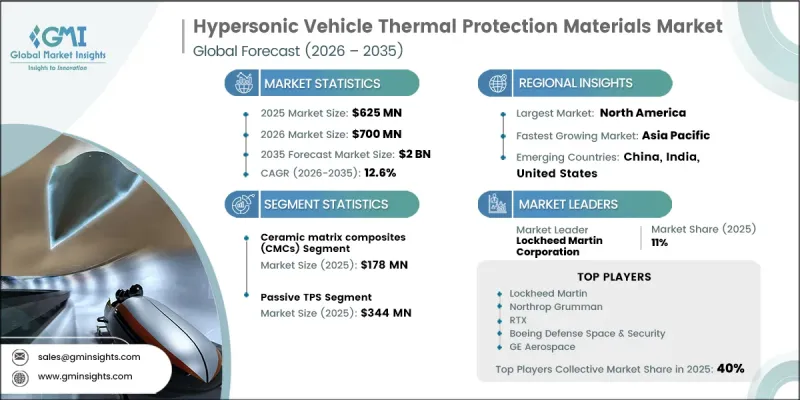
The hypersonic vehicle thermal protection materials industry is experiencing growth as investments in advanced defense technologies and next-generation space platforms continue to increase. Growing strategic importance of hypersonic capabilities among major defense nations is accelerating procurement activities, expanding research programs, and creating stronger demand for advanced thermal protection solutions capable of handling extreme operating conditions. The United States remains a leading contributor to market growth due to extensive aerospace and defense development programs. Over the forecast period, market expansion is expected to accelerate as hypersonic systems progress from research and testing phases toward broader deployment and production. Increasing opportunities in commercial hypersonic aviation and reusable space technologies are also creating additional demand for high-performance thermal protection materials. Furthermore, expanding participation from international defense markets is strengthening the global customer base. The growing adoption of advanced material technologies, particularly Ceramic Matrix Composites (CMCs) and Ultra-High-Temperature Ceramics (UHTCs), remains a key trend shaping the industry.
| Market Scope | |
|---|---|
| Start Year | 2025 |
| Forecast Year | 2026-2035 |
| Start Value | $625 Million |
| Forecast Value | $2 Billion |
| CAGR | 12.6% |
The ceramic matrix composites (CMCs) segment reached USD 178 million in 2025. CMCs have gained significant importance in the hypersonic vehicle thermal protection materials market due to their combination of lightweight properties, excellent resistance to extreme temperatures, strong thermal stability, and improved resistance to thermal shock. Continuous advancements in manufacturing capabilities are further supporting the wider adoption of these materials across hypersonic applications.
Passive Thermal Protection Systems (TPS) accounted for USD 344 million in 2025. Passive TPS solutions maintain a leading position in the hypersonic vehicle thermal protection materials industry because of their proven performance, design simplicity, and established use across aerospace and defense applications. Materials such as ceramic-based protection systems, carbon-carbon composites, and advanced insulation structures continue to be preferred for surfaces exposed to controlled thermal conditions due to their reliability and durability.
North America Hypersonic Vehicle Thermal Protection Materials Market is expected to grow from USD 338 million in 2025 to USD 895 million in 2035. North America continues to represent the leading regional market, supported by the strong presence of the United States in hypersonic weapons development, missile technology programs, and advanced space initiatives. High defense spending, expanding testing capabilities, and accelerated procurement activities are expected to maintain demand for advanced TPS materials throughout the forecast period. The region also benefits from an established supply chain, strong collaboration between defense agencies, major contractors, and advanced materials manufacturers, supporting continued innovation and commercialization.
Major players operating in the global hypersonic vehicle thermal protection materials industry include: Safran S.A., Northrop Grumman Corporation, CoorsTek Inc., Lockheed Martin Corporation, CeramTec GmbH, Boeing Defense, Space & Security, Ultramet Inc., General Electric Aerospace, Axiom Materials Inc., Raytheon Technologies (RTX Corporation), Morgan Advanced Materials plc, Canopy Aerospace, SGL Carbon SE, and Starfire Systems Inc. Companies operating in the hypersonic vehicle thermal protection materials market are strengthening their market position through continuous investment in advanced material research, strategic partnerships, and expansion of manufacturing capabilities. Key players are focusing on developing lightweight, heat-resistant, and durable thermal protection solutions to meet evolving aerospace and defense requirements. Many companies are also increasing collaboration with government agencies, research institutions, and aerospace manufacturers to accelerate technology development and improve product performance.
Table of Contents
Chapter 1 Methodology & Scope
- 1.1 Market scope and definition
- 1.2 Research design
- 1.2.1 Research approach
- 1.2.2 Data collection methods
- 1.3 Data mining sources
- 1.3.1 Global
- 1.3.2 Regional/Country
- 1.4 Base estimates and calculations
- 1.4.1 Base year calculation
- 1.4.2 Key trends for market estimation
- 1.5 Primary research and validation
- 1.5.1 Primary sources
- 1.6 Forecast model
- 1.7 Research assumptions and limitations
Chapter 2 Executive Summary
- 2.1 Industry 360° synopsis
- 2.2 Key market trends
- 2.2.1 Material Type
- 2.2.2 Protection Mechanism
- 2.2.3 Vehicle/Application Type
- 2.2.4 Regional
- 2.3 TAM Analysis, 2026-2035
- 2.4 CXO perspectives: Strategic imperatives
- 2.5 Future outlook and strategic recommendations
Chapter 3 Industry Insights
- 3.1 Industry ecosystem analysis
- 3.1.1 Supplier landscape
- 3.1.2 Profit margin
- 3.1.3 Value addition at each stage
- 3.1.4 Factor affecting the value chain
- 3.1.5 Disruptions
- 3.2 Industry impact forces
- 3.2.1 Growth drivers
- 3.2.1.1 Accelerating Global Hypersonic Weapons Development Programs
- 3.2.1.2 Rising Demand for Reusable TPS in Commercial Space & Next-Generation Spaceplanes
- 3.2.1.3 Advancements in UHTC & CMC Processing Enabling Higher Mach Capability
- 3.2.2 Industry pitfalls and challenges
- 3.2.2.1 Extreme Technical Complexity & High Cost of UHTC & CMC Material Production
- 3.2.2.2 ITAR & Export Control Restrictions Limiting International Supply Chain Optionality
- 3.2.3 Market opportunities
- 3.2.3.1 Commercial Hypersonic Aviation TPS
- 3.2.3.2 Active & Transpiration-Cooled TPS
- 3.2.1 Growth drivers
- 3.3 Growth potential analysis
- 3.4 Regulatory landscape
- 3.4.1 North America
- 3.4.2 Europe
- 3.4.3 Asia Pacific
- 3.4.4 Latin America
- 3.4.5 Middle East & Africa
- 3.5 Porter's analysis
- 3.6 PESTEL analysis
- 3.7 Technology and innovation landscape
- 3.7.1 Current technological trends
- 3.7.2 Emerging technologies
- 3.8 Price trends
- 3.8.1 By region
- 3.8.2 By material type
- 3.9 Future market trends
- 3.10 Patent landscape
- 3.11 Trade statistics (HS code)
- 3.11.1 Major importing countries
- 3.11.2 Major exporting countries
- 3.12 Sustainability and environmental aspects
- 3.12.1 Sustainable practices
- 3.12.2 Waste reduction strategies
- 3.12.3 Energy efficiency in production
- 3.12.4 Eco-friendly initiatives
- 3.13 Carbon footprint consideration
Chapter 4 Competitive Landscape, 2025
- 4.1 Introduction
- 4.2 Company market share analysis
- 4.2.1 By region
- 4.2.1.1 North America
- 4.2.1.2 Europe
- 4.2.1.3 Asia Pacific
- 4.2.1.4 LATAM
- 4.2.1.5 MEA
- 4.2.1 By region
- 4.3 Company matrix analysis
- 4.4 Competitive analysis of major market players
- 4.5 Competitive positioning matrix
- 4.6 Key developments
- 4.6.1 Mergers & acquisitions
- 4.6.2 Partnerships & collaborations
- 4.6.3 New product launches
- 4.6.4 Expansion plans
Chapter 5 Market Estimates and Forecast, By Material Type, 2022-2035 (USD Million) (Kilo Tons)
- 5.1 Key trends
- 5.2 Ultra-High Temperature Ceramics (UHTCs)
- 5.3 Ceramic Matrix Composites (CMCs)
- 5.4 Carbon-Carbon (C/C) Composites
- 5.5 Ablative Materials
- 5.6 Refractory Metal Alloys
- 5.7 Aerogel & Advanced Insulating Materials
- 5.8 Others (Emerging & Advanced Materials)
Chapter 6 Market Estimates and Forecast, By Protection Mechanism, 2022-2035 (USD Million) (Kilo Tons)
- 6.1 Key trends
- 6.2 Passive TPS
- 6.3 Ablative TPS
- 6.4 Active & Semi-Active TPS
Chapter 7 Market Estimates and Forecast, By Vehicle/Application Type, 2022-2035 (USD Million) (Kilo Tons)
- 7.1 Key trends
- 7.2 Hypersonic Glide Vehicles (HGVs)
- 7.3 Hypersonic Cruise Missiles
- 7.4 Hypersonic Aircraft & Spaceplanes
- 7.5 RLVs & Atmospheric Re-Entry Vehicles
Chapter 8 Market Estimates and Forecast, By Region, 2022-2035 (USD Million) (Kilo Tons)
- 8.1 Key trends
- 8.2 North America
- 8.2.1 U.S.
- 8.2.2 Canada
- 8.3 Europe
- 8.3.1 Germany
- 8.3.2 UK
- 8.3.3 France
- 8.3.4 Spain
- 8.3.5 Italy
- 8.3.6 Rest of Europe
- 8.4 Asia Pacific
- 8.4.1 China
- 8.4.2 India
- 8.4.3 Japan
- 8.4.4 Australia
- 8.4.5 South Korea
- 8.4.6 Rest of Asia Pacific
- 8.5 Latin America
- 8.5.1 Brazil
- 8.5.2 Mexico
- 8.5.3 Argentina
- 8.5.4 Rest of Latin America
- 8.6 Middle East and Africa
- 8.6.1 Saudi Arabia
- 8.6.2 South Africa
- 8.6.3 UAE
- 8.6.4 Rest of Middle East and Africa
Chapter 9 Company Profiles
- 9.1 Lockheed Martin Corporation
- 9.2 Northrop Grumman Corporation
- 9.3 Raytheon Technologies (RTX Corporation)
- 9.4 Boeing Defense, Space & Security
- 9.5 General Electric Aerospace
- 9.6 CoorsTek Inc.
- 9.7 Morgan Advanced Materials plc
- 9.8 SGL Carbon SE
- 9.9 CeramTec GmbH
- 9.10 Safran S.A.
- 9.11 Ultramet Inc.
- 9.12 Axiom Materials Inc.
- 9.13 Canopy Aerospace
- 9.14 Starfire Systems Inc.

