
PUBLISHER: Global Market Insights Inc. | PRODUCT CODE: 2101875

PUBLISHER: Global Market Insights Inc. | PRODUCT CODE: 2101875
Foam Packaging Market Opportunity, Growth Drivers, Industry Trend Analysis, and Forecast 2026 - 2035
The Global Foam Packaging Market was valued at USD 20.1 billion in 2025 and is estimated to grow at a CAGR of 6% to reach USD 35.6 billion by 2035.
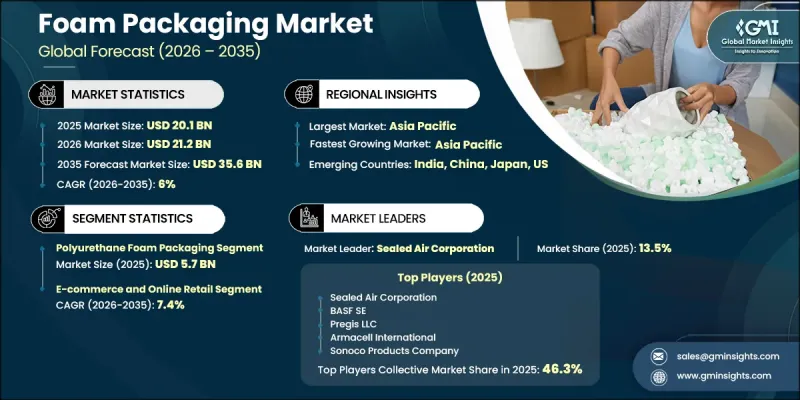
Growth is driven by the rapid expansion of online retail, which has significantly increased demand for protective and insulated packaging formats used in parcel delivery. At the same time, rising global consumption of temperature-sensitive goods in healthcare and food delivery channels is reinforcing the need for high-performance insulation solutions. Regulatory restrictions on expanded polystyrene-based materials are reshaping production strategies and accelerating the transition toward recyclable, bio-based, and engineered foam alternatives. Foam packaging continues to play a critical role in safeguarding fragile and perishable products, offering cushioning, shock absorption, and thermal stability across logistics networks. Increasing urbanization and the shift toward direct-to-consumer supply chains are further strengthening adoption across multiple industries. However, environmental regulations targeting single-use plastic foam products are encouraging material innovation and sustainability-focused product redesigns across the value chain.
| Market Scope | |
|---|---|
| Start Year | 2025 |
| Forecast Year | 2026-2035 |
| Start Value | $20.1 Billion |
| Forecast Value | $35.6 Billion |
| CAGR | 6% |
The polyurethane foam packaging segment generated USD 5.7 billion, accounting for 28.3% share, supported by its adaptability across cushioning, insulation, and custom-molded packaging applications. Its ability to be engineered across a wide density range enables use in both lightweight protective packaging and high-precision industrial applications, ensuring continued demand despite increasing regulatory pressure on certain foam-based materials.
The e-commerce and online retail segment reached USD 6.8 billion in 2025. This growth reflects rising parcel volumes and increasing demand for protective packaging in high-value shipments, particularly across electronics, personal care products, and perishable goods. Foam-based protective systems remain widely adopted in fulfillment operations due to their cushioning efficiency and reliability in reducing transit damage.
North America Foam Packaging Market captured USD 5.3 billion in 2025 and is projected to reach USD 9.1 billion by 2035, expanding at a CAGR of 5.7%. The United States accounts for the majority of regional demand, supported by highly developed e-commerce logistics networks and large-scale pharmaceutical and retail distribution systems.
Major players operating in the global foam packaging industry include Sealed Air Corporation, BASF SE, Pregis LLC, Armacell International, Sonoco Products Company, Zotefoams PLC, Rogers Corporation, Storopack Hans Reichenecker GmbH, UFP Technologies, Recticel NV/SA, JSP Corporation, and Kaneka Corporation, along with Kaneka Belgium NV. Companies in the foam packaging market are prioritizing material innovation to develop recyclable and bio-based alternatives that comply with tightening environmental regulations. Many players are expanding production capabilities for advanced polyurethane and engineered foam solutions to meet rising demand from e-commerce and cold chain logistics. Strategic partnerships with logistics providers and retailers are helping improve integration into supply chains. Firms are also investing in lightweight and high-performance packaging designs that reduce material usage while maintaining protection standards. Geographic expansion into fast-growing emerging markets is supporting revenue diversification.
Table of Contents
Chapter 1 Methodology & Scope
- 1.1 Research approach
- 1.2 Quality commitments
- 1.2.1 GMI AI policy & data integrity commitment
- 1.2.1.1 Source consistency protocol
- 1.2.1 GMI AI policy & data integrity commitment
- 1.3 Research trail & confidence scoring
- 1.3.1 Research trail components
- 1.3.2 Scoring components
- 1.4 Data collection
- 1.4.1 Partial list of primary sources
- 1.5 Data mining sources
- 1.5.1 Paid sources
- 1.5.1.1 Sources, by region
- 1.5.1 Paid sources
- 1.6 Base estimates and calculations
- 1.6.1 Base year calculation for any one approach
- 1.7 Market estimates & forecasts parameters
- 1.8 Forecast model
- 1.8.1 Quantified market impact analysis
- 1.8.1.1 Mathematical impact of growth parameters on forecast
- 1.8.1 Quantified market impact analysis
- 1.9 Research transparency addendum
- 1.9.1 Source attribution framework
- 1.9.2 Quality assurance metrics
- 1.9.3 Our commitment to trust
- 1.10 Market definitions
Chapter 2 Executive Summary
- 2.1 Industry synopsis, 2022 - 2035
- 2.1.1 Material Type trends
- 2.1.2 Packaging Format trends
- 2.1.3 End-User Industry trends
- 2.1.4 Regional trends
Chapter 3 Industry Insights
- 3.1 Industry ecosystem analysis
- 3.2 Industry impact forces
- 3.2.1 Growth drivers
- 3.2.1.1 Expansion of E-commerce and Parcel Delivery Services
- 3.2.1.2 Rising Demand from Food & Beverage Industry
- 3.2.1.3 Growing Pharmaceutical and Healthcare Logistics
- 3.2.1.4 Increasing Industrial and Electronics Manufacturing
- 3.2.2 Industry pitfalls and challenges
- 3.2.2.1 Stringent Environmental Regulations on Plastic Foam
- 3.2.2.2 Volatility in Petrochemical Raw Material Prices
- 3.2.3 Market opportunities
- 3.2.3.1 Development of Bio-based and Recyclable Foam Packaging Solutions
- 3.2.3.2 Growing Demand from Cold Chain and Pharmaceutical Logistics
- 3.2.1 Growth drivers
- 3.3 Growth potential analysis
- 3.4 Regulatory landscape (Driven by primary research)
- 3.4.1 North America
- 3.4.2 Europe
- 3.4.3 Asia Pacific
- 3.4.4 Latin America
- 3.4.5 MEA
- 3.5 Technology landscape
- 3.5.1 Current technological trends
- 3.5.2 Emerging technologies
- 3.6 Pricing trend analysis (Driven by primary research)
- 3.7 Future market trends
- 3.8 Patent analysis
- 3.9 Porter's analysis
- 3.10 PESTEL analysis
- 3.11 Impact of AI and Generative AI on the market (Driven by primary research)
- 3.12 Value chain analysis (Driven by primary research)
- 3.13 Investment & funding analysis (Driven by primary research)
- 3.14 Consumer insights (Driven by primary research)
Chapter 4 Competitive Landscape, 2025
- 4.1 Introduction
- 4.2 Company market share analysis, by region, 2025
- 4.2.1 North America
- 4.2.2 Europe
- 4.2.3 Asia Pacific
- 4.2.4 Middle East & Africa
- 4.2.5 Latin America
- 4.3 Key developments
- 4.3.1 Key partnerships & collaborations
- 4.3.2 Major M&A activities
- 4.3.3 Product innovations & launches
- 4.3.4 Market expansion strategies
- 4.4 Competitive positioning matrix
Chapter 5 Market Size and Forecast, By Material Type, 2022 - 2035 (USD Million & Kilo Tons)
- 5.1 Key trends
- 5.2 Polyurethane (PU) Foam Packaging
- 5.3 Polystyrene Foam Packaging
- 5.3.1 Expanded Polystyrene (EPS)
- 5.3.2 Extruded Polystyrene (XPS)
- 5.4 Polyethylene (PE) Foam Packaging
- 5.5 Polypropylene (PP) Foam Packaging
- 5.6 Bio-based and Sustainable Foam Packaging
- 5.6.1 PLA-based foams
- 5.6.2 Starch-based foams
- 5.6.3 Mycelium and novel bio-materials
- 5.6.4 Recycled content foams
- 5.7 Other Specialty Foams
Chapter 6 Market Size and Forecast, By Packaging format, 2022 - 2035 (USD Million & Kilo Tons)
- 6.1 Key trends
- 6.2 Cushioning and Void Fill
- 6.3 Molded Foam Inserts
- 6.4 Insulated Containers and Boxes
- 6.5 Trays and Clamshells
- 6.6 Cups, Plates, and Foodservice Items
- 6.7 Pouches and Sleeves
Chapter 7 Market Size and Forecast, By End-user industry, 2022 - 2035 (USD Million & Kilo Tons)
- 7.1 Key trends
- 7.2 E-commerce and Online Retail
- 7.3 Food and Beverage Industry
- 7.4 Electronics and Electrical Equipment
- 7.5 Pharmaceutical and Healthcare
- 7.6 Automotive
- 7.7 Industrial and Manufacturing
- 7.8 Consumer Goods and Retail
- 7.9 Others
Chapter 8 Market Size and Forecast, By Region, 2022 - 2035 (USD Million & Kilo Tons)
- 8.1 Key trends
- 8.2 North America
- 8.2.1 U.S.
- 8.2.2 Canada
- 8.3 Europe
- 8.3.1 Germany
- 8.3.2 France
- 8.3.3 UK
- 8.3.4 Netherlands
- 8.3.5 Spain
- 8.3.6 Italy
- 8.4 Asia Pacific
- 8.4.1 China
- 8.4.2 Japan
- 8.4.3 South Korea
- 8.4.4 India
- 8.4.5 Australia
- 8.5 Middle East & Africa
- 8.5.1 Saudi Arabia
- 8.5.2 UAE
- 8.5.3 South Africa
- 8.6 Latin America
- 8.6.1 Brazil
- 8.6.2 Argentina
- 8.6.3 Mexico
Chapter 9 Company Profiles
- 9.1 Sealed Air Corporation
- 9.2 BASF SE
- 9.3 Pregis LLC
- 9.4 Armacell International
- 9.5 Sonoco Products Company
- 9.6 Storopack Hans Reichenecker GmbH
- 9.7 Zotefoams PLC
- 9.8 Rogers Corporation
- 9.9 UFP Technologies
- 9.10 Recticel NV/SA
- 9.11 Foam Fabricators Inc.
- 9.12 Wisconsin Foam Products
- 9.13 Polyfoam Corporation
- 9.14 Nomaco
- 9.15 FoamPartner Group
- 9.16 Sekisui Alveo
- 9.17 Kaneka Belgium NV
- 9.18 Furukawa Electric
- 9.19 Plastazote
- 9.20 Cellpack Packaging
- 9.21 JSP Corporation
- 9.22 Toray Plastics
- 9.23 Jiangsu Zhongda New Material Group
- 9.24 Dongguan City Lvheng Foam Plastic
- 9.25 Supreme Industries

