PUBLISHER: Global Market Insights Inc. | PRODUCT CODE: 2101887

PUBLISHER: Global Market Insights Inc. | PRODUCT CODE: 2101887
Embedded Systems Market Opportunity, Growth Drivers, Industry Trend Analysis, and Forecast 2026 - 2035
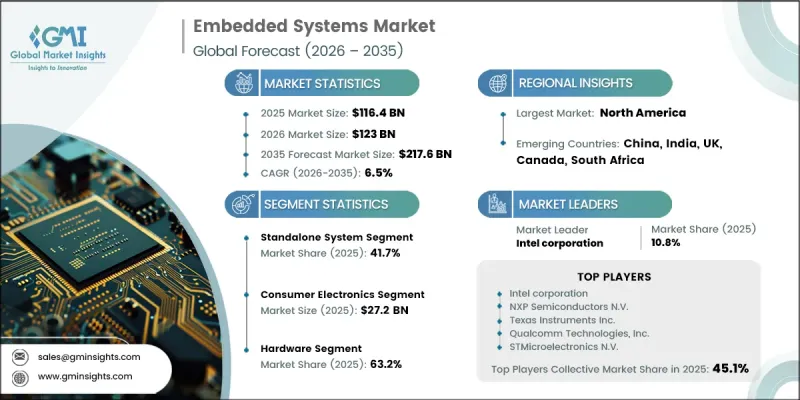
The Global Embedded Systems Market was valued at USD 116.4 billion in 2025 and is estimated to grow at a CAGR of 6.5% to reach USD 217.6 billion by 2035.
The embedded systems market is experiencing steady growth as industries increasingly integrate intelligent computing capabilities into devices and equipment across automotive, healthcare, industrial, and consumer electronics applications. The rising adoption of embedded artificial intelligence (AI), edge computing, and connected technologies is enabling faster decision-making, reduced processing delays, and improved operational efficiency while decreasing dependence on centralized cloud infrastructure. The expansion of Industry 4.0 and smart manufacturing initiatives is further accelerating demand for embedded processors, controllers, sensors, and cyber-physical systems that support advanced automation. Modern industrial environments are increasingly relying on embedded technologies to create interconnected and efficient ecosystems. Growing investments in automation, digital transformation, and intelligent device development are creating strong opportunities for embedded system manufacturers. As businesses continue to prioritize real-time processing, energy efficiency, and enhanced functionality, embedded systems are becoming essential components across multiple industries, supporting long-term market expansion throughout the forecast period.
| Market Scope | |
|---|---|
| Start Year | 2025 |
| Forecast Year | 2026-2035 |
| Start Value | $116.4 Billion |
| Forecast Value | $217.6 Billion |
| CAGR | 6.5% |
The standalone system segment held 41.7% share in 2025. This segment maintains its leading position due to its widespread use across consumer electronics, industrial equipment, healthcare devices, household appliances, and automotive systems that require dedicated functionality without continuous network connectivity. Standalone embedded systems offer advantages such as improved reliability, lower energy consumption, cost efficiency, and simplified operation. Increasing deployment of these systems in industrial automation applications and electronic control units (ECUs) is further supporting segment growth.
The consumer electronics segment generated USD 27.2 billion in 2025. Increasing demand for smartphones, wearable devices, smart televisions, gaming systems, intelligent home appliances, and connected household technologies is driving the integration of embedded processors and controllers. Consumers' growing preference for intelligent, connected, and energy-efficient electronic products is encouraging manufacturers to adopt advanced embedded technologies. The integration of artificial intelligence, Internet of Things (IoT), and edge computing capabilities is enhancing the performance, flexibility, and functionality of consumer electronics products, further strengthening segment expansion.
North America Embedded Systems Market accounted for 31.4% share in 2025 and is expected to maintain its leading position throughout the forecast period. The region's dominance is supported by its established semiconductor ecosystem, increasing investments in domestic chip development, and strong adoption of advanced technologies across artificial intelligence, industrial automation, aerospace, defense, and connected infrastructure applications. The presence of major semiconductor companies, advanced research institutions, and technology innovators continues to accelerate the adoption of embedded systems across automotive, healthcare, telecommunications, consumer electronics, and industrial sectors.
Prominent players operating in the global embedded systems market include Qualcomm Technologies Inc., ARM Holdings plc, Broadcom Inc., Intel Corporation, NXP Semiconductors N.V., STMicroelectronics N.V., Texas Instruments Inc., Analog Devices, Inc., Infineon Technologies AG, MediaTek Inc., Microchip Technology Inc., Renesas Electronics Corp., Esperanto Technologies, GreenWaves Technologies, SiFive Inc., Syntiant Corporation, and Untether AI. Companies operating in the embedded systems market are strengthening their market position through continuous innovation, strategic collaborations, product development, and investments in advanced semiconductor technologies. Industry participants are focusing on improving processor performance, enhancing AI capabilities, and developing energy-efficient embedded solutions for next-generation applications. Companies are also expanding their technology portfolios through partnerships, acquisitions, and investments in research and development to address rising demand across automotive, industrial, healthcare, and consumer electronics sectors. Businesses are prioritizing edge computing, connectivity solutions, and customized embedded platforms to improve product differentiation and customer value.
Table of Contents
Chapter 1 Methodology and Scope
- 1.1 Market scope and definition
- 1.2 Research design
- 1.2.1 Research approach
- 1.2.2 Data collection methods
- 1.3 Data mining sources
- 1.3.1 Global
- 1.3.2 Regional/Country
- 1.4 Base estimates and calculations
- 1.4.1 Base year calculation
- 1.4.2 Key trends for market estimation
- 1.5 Primary research and validation
- 1.5.1 Primary sources
- 1.6 Forecast model
- 1.7 Research assumptions and limitations
Chapter 2 Executive Summary
- 2.1 Industry 360° synopsis, 2022 - 2035
- 2.2 Key market trends
- 2.2.1 System trends
- 2.2.2 System size trends
- 2.2.3 Function trends
- 2.2.4 Application trends
- 2.2.5 Regional trends
- 2.3 TAM Analysis, 2026-2035
- 2.4 CXO perspectives: Strategic imperatives
Chapter 3 Industry Insights
- 3.1 Industry ecosystem analysis
- 3.1.1 Supplier Landscape
- 3.1.2 Profit Margin
- 3.1.3 Cost structure
- 3.1.4 Value addition at each stage
- 3.1.5 Factor affecting the value chain
- 3.1.6 Disruptions
- 3.2 Industry impact forces
- 3.2.1 Growth drivers
- 3.2.1.1 Growing adoption of edge ai and embedded intelligence
- 3.2.1.2 Expansion of industry 4.0 and smart manufacturing
- 3.2.1.3 Rapid growth of internet of things (IOT) ecosystems
- 3.2.1.4 Increasing focus on cybersecurity and resilient digital infrastructure
- 3.2.1.5 Rising government support for semiconductor and electronics innovation
- 3.2.2 Industry pitfalls and challenges
- 3.2.2.1 Increasing cybersecurity and data protection requirements
- 3.2.2.2 Complex hardware-software integration and design challenges
- 3.2.3 Market opportunities
- 3.2.3.1 Expansion of edge ai and intelligent embedded devices
- 3.2.3.2 Growth of smart cities and connected infrastructure
- 3.2.1 Growth drivers
- 3.3 Growth potential analysis
- 3.4 Regulatory landscape
- 3.4.1 North America
- 3.4.2 Europe
- 3.4.3 Asia Pacific
- 3.4.4 Latin America
- 3.4.5 Middle East & Africa
- 3.5 Porter's analysis
- 3.6 PESTEL analysis
- 3.7 Technology and Innovation landscape
- 3.7.1 Current technological trends
- 3.7.2 Emerging technologies
- 3.8 Price trends
- 3.8.1 By region
- 3.8.2 By product
- 3.9 Pricing Strategies
- 3.10 Emerging Business Models
- 3.11 Compliance Requirements
- 3.12 Patent and IP analysis
Chapter 4 Competitive Landscape, 2025
- 4.1 Introduction
- 4.2 Company market share analysis
- 4.2.1 By region
- 4.2.1.1 North America
- 4.2.1.2 Europe
- 4.2.1.3 Asia Pacific
- 4.2.1.4 Latin America
- 4.2.1.5 Middle East & Africa
- 4.2.2 Market concentration analysis
- 4.2.1 By region
- 4.3 Competitive benchmarking of key players
- 4.3.1 Financial performance comparison
- 4.3.1.1 Revenue
- 4.3.1.2 Profit margin
- 4.3.1.3 R&D
- 4.3.2 Product portfolio comparison
- 4.3.2.1 Product range breadth
- 4.3.2.2 Technology
- 4.3.2.3 Innovation
- 4.3.3 Geographic presence comparison
- 4.3.3.1 Global footprint analysis
- 4.3.3.2 Service network coverage
- 4.3.3.3 Market penetration by region
- 4.3.4 Competitive positioning matrix
- 4.3.4.1 Leaders
- 4.3.4.2 Challengers
- 4.3.4.3 Followers
- 4.3.4.4 Niche players
- 4.3.5 Strategic outlook matrix
- 4.3.1 Financial performance comparison
- 4.4 Key developments
- 4.4.1 Mergers and acquisitions
- 4.4.2 Partnerships and collaborations
- 4.4.3 Technological advancements
- 4.4.4 Expansion and investment strategies
- 4.4.5 Digital transformation initiatives
- 4.5 Emerging/ startup competitors landscape
Chapter 5 Market Estimates and Forecast, By System, 2022 - 2035 (USD Billion)
- 5.1 Key trends
- 5.2 Hardware
- 5.2.1 ASIC & ASSP
- 5.2.2 Microcontroller (MCU)
- 5.2.3 Microprocessor (MPU)
- 5.2.4 Power management integrated circuit (PMIC)
- 5.2.5 Field processing gate arrays (FPGA)
- 5.2.6 Digital signal processor (DSP)
- 5.2.7 Memory
- 5.3 Software
- 5.3.1 OS
- 5.3.2 Middleware
Chapter 6 Market Estimates and Forecast, By System Size, 2022 - 2035 (USD Billion)
- 6.1 Key trends
- 6.2 small-scale embedded system (8-bit)
- 6.3 Medium-scale embedded system (16-32-bit)
- 6.4 Large-scale embedded system (Above 32-bit)
Chapter 7 Market Estimates and Forecast, By Function, 2022 - 2035 (USD Billion)
- 7.1 Key trends
- 7.2 Standalone system
- 7.3 Real-time system
- 7.4 Network system
- 7.5 Mobile system
Chapter 8 Market Estimates and Forecast, By Application, 2022 - 2035 (USD Billion)
- 8.1 Key trends
- 8.2 Automotive
- 8.3 Consumer electronics
- 8.4 Manufacturing
- 8.5 Retail
- 8.6 Media & entertainment
- 8.7 Military & defense
- 8.8 Telecommunication
- 8.9 Other
Chapter 9 Market Estimates and Forecast, By Region, 2022 - 2035 (USD Billion)
- 9.1 Key trends
- 9.2 North America
- 9.2.1 U.S.
- 9.2.2 Canada
- 9.3 Europe
- 9.3.1 Germany
- 9.3.2 UK
- 9.3.3 France
- 9.3.4 Spain
- 9.3.5 Italy
- 9.4 Asia Pacific
- 9.4.1 China
- 9.4.2 India
- 9.4.3 Japan
- 9.4.4 Australia
- 9.4.5 South Korea
- 9.5 Latin America
- 9.5.1 Brazil
- 9.5.2 Mexico
- 9.5.3 Argentina
- 9.6 Middle East and Africa
- 9.6.1 South Africa
- 9.6.2 Saudi Arabia
- 9.6.3 UAE
Chapter 10 Company Profiles
- 10.1 Global Key Players
- 10.1.1 ARM Holdings plc
- 10.1.2 Broadcom Inc.
- 10.1.3 Intel Corporation
- 10.1.4 NXP Semiconductors N.V.
- 10.1.5 Qualcomm Technologies, Inc.
- 10.1.6 STMicroelectronics N.V.
- 10.2 Regional key players
- 10.2.1 North America
- 10.2.1.1 Texas Instruments Inc.
- 10.2.1.2 Analog Devices, Inc.
- 10.2.1.3 Microchip Technology Inc.
- 10.2.2 Asia Pacific
- 10.2.2.1 MediaTek Inc.
- 10.2.2.2 Renesas Electronics Corp.
- 10.2.3 Europe
- 10.2.3.1 Infineon Technologies AG
- 10.2.1 North America
- 10.3 Niche Players/Disruptors
- 10.3.1 Untether AI
- 10.3.2 Syntiant Corporation
- 10.3.3 Esperanto Technologies
- 10.3.4 GreenWaves Technologies
- 10.3.5 SiFive Inc.

