PUBLISHER: Global Market Insights Inc. | PRODUCT CODE: 2101893

PUBLISHER: Global Market Insights Inc. | PRODUCT CODE: 2101893
AI Governance Market Opportunity, Growth Drivers, Industry Trend Analysis, and Forecast 2026 - 2035
The Global AI Governance Market was valued at USD 839.2 million in 2025 and is estimated to grow at a CAGR of 31.4% to reach USD 13.1 billion by 2035.
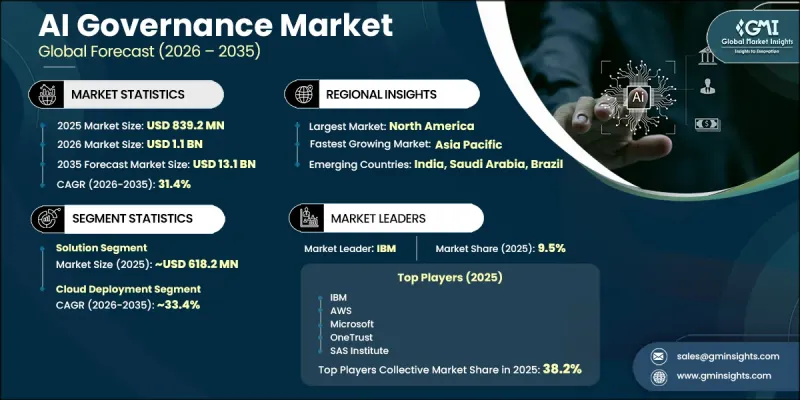
Growth in this market is fundamentally structural, driven by the widening gap between AI adoption and governance readiness as organizations embed machine learning systems into high-impact domains such as credit assessment, medical diagnostics, logistics optimization, and workforce analytics. Regulatory enforcement has transitioned from optional guidelines to enforceable compliance mandates, significantly increasing enterprise demand for governance frameworks. Financial penalties reaching up to USD 35 million or 7% of global turnover have made AI oversight a board-level priority for multinational organizations operating in regulated jurisdictions. At the same time, enterprises are rapidly formalizing AI governance programs as adoption scales faster than internal control systems can mature. Industry surveys indicate that a large majority of organizations are actively building governance capabilities, particularly among those already deploying AI at scale. As AI becomes embedded in critical decision-making systems, organizations face rising exposure to regulatory, operational, and reputational risks without structured governance mechanisms in place.
| Market Scope | |
|---|---|
| Start Year | 2025 |
| Forecast Year | 2026-2035 |
| Start Value | $839.2 Million |
| Forecast Value | $13.1 Billion |
| CAGR | 31.4% |
The solutions segment generated USD 618.2 million in 2025, representing 74% share. This strong dominance reflects enterprise preference for technology-driven governance systems capable of continuously monitoring AI models in real time, ensuring oversight keeps pace with rapid model deployment cycles. Organizations are increasingly shifting away from manual and periodic review processes toward automated, always-on governance infrastructures that integrate directly into AI development pipelines.
The cloud deployment segment accounted for USD 454.4 million in 2025, capturing 54.1% share. Cloud-based dominance is primarily driven by integration efficiency, as most enterprise AI workloads are already developed and deployed within cloud ecosystems. As a result, governance platforms embedded within cloud-native environments reduce operational complexity, enable seamless integration with machine learning workflows, and accelerate compliance implementation across distributed AI systems.
North America AI Governance Market reached USD 392.9 million in 2025. The region's leadership is supported by a layered regulatory structure combining federal directives and rapidly expanding state-level legislation. This evolving compliance landscape has created a multi-jurisdiction governance environment that significantly increases enterprise demand for standardized AI oversight frameworks across industries.
Major players operating in the global AI governance market include Microsoft, IBM, Amazon Web Services, Google, Oracle, SAP, Salesforce, ServiceNow, SAS Institute, Collibra, OneTrust, NTT DATA, Optro, Credo AI, Holistic AI, Trustible, ValidMind, Saidot Oy, Modulos, and 2021.AI. Companies in the AI governance market are prioritizing platform unification strategies that consolidate model monitoring, compliance tracking, and risk assessment into single integrated solutions. Many vendors are strengthening partnerships with cloud service providers to ensure seamless embedding of governance tools within AI development environments. Product innovation is focused on automated explainability, bias detection, and real-time audit capabilities that reduce manual intervention. Firms are also expanding their regulatory intelligence features to adapt quickly to evolving global AI laws. Strategic acquisitions are being used to broaden capability stacks, while enterprise-focused customization and API-first architectures are improving integration flexibility.
Table of Contents
Chapter 1 Methodology
- 1.1 Research approach
- 1.2 Quality Commitments
- 1.2.1 GMI AI policy & data integrity commitment
- 1.3 Research Trail & Confidence Scoring
- 1.3.1 Research Trail Components
- 1.3.2 Scoring Components
- 1.4 Data Collection
- 1.5 Data mining sources
- 1.5.1 Paid sources
- 1.6 Base estimates and calculations
- 1.6.1 Base year calculation
- 1.7 Forecast model
- 1.7.1 Quantified market impact analysis
- 1.8 Research transparency addendum
- 1.8.1 Source attribution framework
- 1.8.2 Quality assurance metrics
- 1.8.3 Our commitment to trust
Chapter 2 Executive Summary
- 2.1 Industry 360° synopsis
- 2.2 Key market trends
- 2.2.1 Regional
- 2.2.2 Offering
- 2.2.3 Deployment Mode
- 2.2.4 Organization Size
- 2.2.5 End-Use
- 2.3 TAM analysis, 2026-2035
- 2.4 CXO perspectives: Strategic imperatives
Chapter 3 Industry Insights
- 3.1 Industry ecosystem analysis
- 3.1.1 Supplier landscape
- 3.1.2 Profit margin
- 3.1.3 Cost structure
- 3.1.4 Value addition at each stage
- 3.1.5 Factor affecting the value chain
- 3.1.6 Disruptions
- 3.2 Industry impact forces
- 3.2.1 Growth drivers
- 3.2.1.1 Rapid Global Expansion of AI-Specific Regulations Driving Mandatory Compliance Adoption
- 3.2.1.2 Surging Enterprise AI Deployment Creating Critical Governance Gaps Across Industries
- 3.2.1.3 Rising AI-Related Incidents, Bias Events & Regulatory Penalties Accelerating Proactive Governance Investment
- 3.2.1.4 Generative AI Proliferation Amplifying Demand for LLM-Specific Governance & Guardrail Tools
- 3.2.2 Industry pitfalls and challenges
- 3.2.2.1 High Implementation Complexity & Total Cost of Ownership Limiting Adoption Among Mid-Market Organizations
- 3.2.2.2 Critical Shortage of AI Governance Expertise & Certified Professionals Constraining Deployment Speed
- 3.2.3 Market opportunities
- 3.2.3.1 Underpenetrated SME Segment Presenting Scalable SaaS-Based Governance Growth Opportunity
- 3.2.3.2 Industry Expansion into Manufacturing, Retail & Telecommunications
- 3.2.3.3 Agentic AI Proliferation Creating Demand for Next-Generation Autonomous AI Governance Capabilities
- 3.2.1 Growth drivers
- 3.3 Technology and innovation landscape
- 3.3.1 Current technological trends
- 3.3.1.1 Model Risk Management (MRM) Platforms
- 3.3.1.2 Bias Detection & Fairness Monitoring
- 3.3.2 Emerging technologies
- 3.3.2.1 Generative AI Governance Platforms
- 3.3.2.2 Automated AI Policy Enforcement Systems
- 3.3.1 Current technological trends
- 3.4 Growth potential analysis
- 3.5 Regulatory landscape
- 3.5.1 North America
- 3.5.1.1 US - NIST AI Safety Institute
- 3.5.1.2 US - Federal Trade Commission (FTC)
- 3.5.1.3 Canada - Artificial Intelligence and Data Act (AIDA)
- 3.5.2 Europe
- 3.5.2.1 EU - European AI Office
- 3.5.2.2 EU - European Artificial Intelligence Board (EU)
- 3.5.2.3 UK - AI Security Institute (AISI)
- 3.5.3 Asia Pacific
- 3.5.3.1 China - Cyberspace Administration of China (CAC)
- 3.5.3.2 Singapore - Infocomm Media Development Authority (IMDA)
- 3.5.3.3 Japan - Personal Information Protection Commission (PPC)
- 3.5.4 LATAM
- 3.5.4.1 Brazil - Data Protection Authority (ANPD)
- 3.5.4.2 Colombia - Superintendency of Industry and Commerce (SIC)
- 3.5.5 MEA
- 3.5.5.1 Saudi Arabia - Saudi Data and AI Authority
- 3.5.5.2 UAE - Artificial Intelligence and Advanced Technology Council (AIATC)
- 3.5.1 North America
- 3.6 Porter’s analysis
- 3.7 PESTEL analysis
- 3.8 Patent analysis (Driven by Primary Research)
- 3.9 Agentic AI Governance
- 3.9.1 Governance Frameworks for Autonomous & Multi-Agent AI Systems
- 3.9.2 Risk, Accountability & Liability Challenges in Agentic AI Deployments
- 3.9.3 Emerging Standards & Industry Approaches for Agentic AI Oversight
- 3.10 Case studies
- 3.11 Impact of AI & generative AI on the market
- 3.11.1 AI-driven disruption of existing business models
- 3.11.2 GenAI use cases & adoption roadmap by segment
- 3.11.3 Risks, limitations & regulatory considerations
- 3.12 Forecast assumptions & scenario analysis (Driven by Primary Research)
- 3.12.1 Base Case- Key Macro & Industry Variables Driving CAGR
- 3.12.2 Optimistic Scenarios- Favorable macro and industry tailwinds
- 3.12.3 Pessimistic Scenario - Macroeconomic slowdown or industry headwinds
Chapter 4 Competitive Landscape, 2025
- 4.1 Introduction
- 4.2 Company market share analysis
- 4.2.1 North America
- 4.2.2 Europe
- 4.2.3 Asia Pacific
- 4.2.4 LATAM
- 4.2.5 MEA
- 4.3 Competitive analysis of major market players
- 4.4 Competitive positioning matrix
- 4.5 Key developments
- 4.5.1 Mergers & acquisitions
- 4.5.2 Partnerships & collaborations
- 4.5.3 New product launches
- 4.5.4 Expansion plans and funding
- 4.6 Company tier benchmarking
- 4.6.1 Tier classification criteria & qualifying thresholds
- 4.6.2 Tier positioning matrix by revenue, geography & innovation
Chapter 5 Market Estimates and Forecast, By Offering, 2022 – 2035 ($ Mn)
- 5.1 Key trends
- 5.2 Solution
- 5.2.1 AI Risk & Compliance Management Software
- 5.2.2 AI Audit & Assurance Software
- 5.2.3 AI Model Monitoring & Observability Software
- 5.2.4 AI Explainability & Bias Management Software
- 5.2.5 Generative AI & LLM Governance Software
- 5.3 Service
- 5.3.1 Professional Services
- 5.3.1.1 Consulting & Advisory
- 5.3.1.2 System Integration
- 5.3.1.3 Training & Education Programs
- 5.3.1.4 Regulatory & Audit Services
- 5.3.2 Managed Services
- 5.3.1 Professional Services
Chapter 6 Market Estimates and Forecast, By Deployment Mode, 2022 – 2035 ($ Mn)
- 6.1 Key trends
- 6.2 Cloud
- 6.3 On-Premises
- 6.4 Hybrid
Chapter 7 Market Estimates and Forecast, By Organization Size, 2022 – 2035 ($ Mn)
- 7.1 Key trends
- 7.2 Large Enterprises
- 7.3 SMEs
Chapter 8 Market Estimates and Forecast, By End-Use, 2022 – 2035 ($ Mn)
- 8.1 Key trends
- 8.2 BFSI
- 8.2.1 Banking
- 8.2.2 Financial Services
- 8.2.3 Insurance
- 8.3 Healthcare & Life Sciences
- 8.4 Government & Defense
- 8.5 Retail & Consumer Goods
- 8.6 Automotive
- 8.7 Telecommunications
- 8.8 Manufacturing
- 8.9 Others
Chapter 9 Market Estimates & Forecast, By Region, 2022 - 2035 ($ Mn)
- 9.1 Key trends
- 9.2 North America
- 9.2.1 US
- 9.2.2 Canada
- 9.3 Europe
- 9.3.1 Germany
- 9.3.2 UK
- 9.3.3 France
- 9.3.4 Italy
- 9.3.5 Spain
- 9.3.6 Netherlands
- 9.3.7 Sweden
- 9.3.8 Switzerland
- 9.4 Asia Pacific
- 9.4.1 China
- 9.4.2 India
- 9.4.3 Japan
- 9.4.4 Australia
- 9.4.5 South Korea
- 9.4.6 Singapore
- 9.4.7 Indonesia
- 9.5 Latin America
- 9.5.1 Brazil
- 9.5.2 Mexico
- 9.5.3 Argentina
- 9.6 MEA
- 9.6.1 South Africa
- 9.6.2 Saudi Arabia
- 9.6.3 UAE
Chapter 10 Company Profiles
- 10.1 Global players
- 10.1.1 IBM
- 10.1.2 Microsoft
- 10.1.3 Google
- 10.1.4 Amazon Web Services
- 10.1.5 SAP
- 10.1.6 Salesforce
- 10.1.7 ServiceNow
- 10.1.8 OneTrust
- 10.1.9 SAS Institute
- 10.1.10 Oracle
- 10.1.11 Collibra
- 10.1.12 Optro
- 10.2 Regional players
- 10.2.1 2021.AI
- 10.2.2 Saidot Oy
- 10.2.3 Modulos
- 10.2.4 ValidMind
- 10.2.5 NTT DATA
- 10.3 Emerging players
- 10.3.1 Credo
- 10.3.2 Holistic AI
- 10.3.3 Trustible

