PUBLISHER: Global Market Insights Inc. | PRODUCT CODE: 2101894

PUBLISHER: Global Market Insights Inc. | PRODUCT CODE: 2101894
Wireless Microphone Market Opportunity, Growth Drivers, Industry Trend Analysis, and Forecast 2026 - 2035
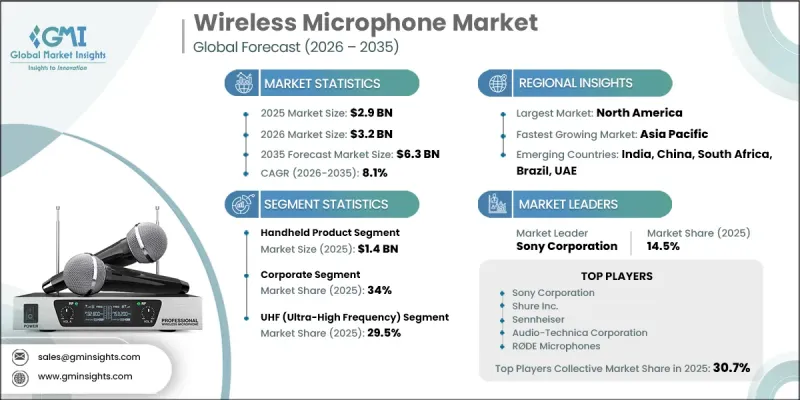
The Global Wireless Microphone Market was valued at USD 2.9 billion in 2025 and is estimated to grow at a CAGR of 8.1% to reach USD 6.3 billion by 2035.
Growth in this market is driven by the increasing need for mobility-driven audio solutions that allow presenters, performers, and speakers to operate without physical cable constraints. Expanding adoption in business communication environments, training centers, and hybrid meeting setups is further strengthening demand. The shift toward digital content creation and live streaming platforms is also contributing to higher usage across professional and semi-professional applications. Wireless microphones are increasingly preferred due to their flexibility, ease of deployment, and improved sound clarity in dynamic environments. Rising demand for portable and compact audio devices is reshaping product development trends, with manufacturers focusing on lightweight designs and enhanced connectivity features. At the same time, integration with modern audio-visual ecosystems is improving performance consistency in large-scale events and corporate environments. Continuous advancements in signal stability, battery efficiency, and noise reduction technologies are further supporting long-term market expansion across global end-use industries.
| Market Scope | |
|---|---|
| Start Year | 2025 |
| Forecast Year | 2026-2035 |
| Start Value | $2.9 Billion |
| Forecast Value | $6.3 Billion |
| CAGR | 8.1% |
The handheld wireless microphone segment generated USD 1.4 billion in 2025, driven by increasing adoption of digital wireless systems and improvements in frequency management technologies. This segment remains widely preferred due to its ease of handling, affordability, and compatibility with modern wireless communication systems. Handheld designs continue to gain traction across professional audio environments where portability and reliable performance are essential, making them a core component of the wireless microphone industry landscape.
The corporate application segment accounted for 34% share in 2025. Demand in this segment is primarily driven by widespread use in boardrooms, training sessions, conferences, and hybrid meeting environments where seamless communication and high-quality audio transmission are essential. Wireless microphones are increasingly integrated with advanced conferencing systems and digital communication platforms, enabling uninterrupted collaboration and improved speech clarity in both small and large organizational settings.
North America Wireless Microphone Market held a 36.1% share in 2025, supported by strong technological infrastructure and widespread adoption of advanced audio systems. The region continues to benefit from high usage across entertainment production, broadcasting, corporate communication, and content creation industries. Strong investments in digital media ecosystems and live production capabilities are further reinforcing regional market expansion, while continuous technological advancements are improving audio quality and operational reliability across professional applications.
Key companies operating in the global wireless microphone market include Audio-Technica Corporation, RODE Microphones, Harman International Industries, Incorporated, Samson Technologies Corp., Saramonic, Hollyland Technology, Azden Corporation, Electro-Voice (EV), Mipro Electronics Co., Ltd., Peavey Electronics Corporation, Phonic Corporation, and AKG Acoustics. Companies operating in the wireless microphone market are strengthening their competitive position by focusing on product innovation, wireless connectivity improvements, and enhanced audio performance capabilities. Manufacturers are investing in advanced digital transmission technologies to improve signal stability, reduce interference, and expand operating range. Continuous development of lightweight, compact, and energy-efficient microphone systems is helping companies address the growing demand for portable audio solutions. Strategic collaborations with entertainment production houses, broadcasting networks, and corporate communication providers are expanding market reach and strengthening brand presence. Firms are also enhancing product compatibility with modern AV and conferencing platforms to support integrated communication environments.
Table of Contents
Chapter 1 Methodology and Scope
- 1.1 Market scope and definition
- 1.2 Research design
- 1.2.1 Research approach
- 1.2.2 Data collection methods
- 1.3 Data mining sources
- 1.3.1 Global
- 1.3.2 Regional/Country
- 1.4 Base estimates and calculations
- 1.4.1 Base year calculation
- 1.4.2 Key trends for market estimation
- 1.5 Primary research and validation
- 1.5.1 Primary sources
- 1.6 Forecast model
- 1.7 Research assumptions and limitations
Chapter 2 Executive Summary
- 2.1 Industry 360° synopsis, 2022 – 2035
- 2.2 Key market trends
- 2.2.1 Product trends
- 2.2.2 Technology trends
- 2.2.3 Radio frequency channel trends
- 2.2.4 End use trends
- 2.2.5 Regional trends
- 2.3 TAM Analysis, 2026-2035
- 2.4 CXO perspectives: Strategic imperatives
Chapter 3 Industry Insights
- 3.1 Industry ecosystem analysis
- 3.1.1 Supplier Landscape
- 3.1.2 Profit Margin
- 3.1.3 Cost structure
- 3.1.4 Value addition at each stage
- 3.1.5 Factor affecting the value chain
- 3.1.6 Disruptions
- 3.2 Industry impact forces
- 3.2.1 Growth drivers
- 3.2.1.1 Rapid growth of the entertainment and event industry.
- 3.2.1.2 Emerging use in corporate and educational sectors.
- 3.2.1.3 Surge in demand for wireless audio equipment.
- 3.2.1.4 Increasing technological developments.
- 3.2.1.5 Growth of content creation and streaming ecosystem.
- 3.2.2 Industry pitfalls and challenges
- 3.2.2.1 Complexities associated with interference and spectrum availability.
- 3.2.2.2 High cost of advanced microphone technology.
- 3.2.3 Market opportunities
- 3.2.3.1 Rising adoption in OTT platforms and digital content production.
- 3.2.3.2 Expansion of hybrid events and virtual conferencing.
- 3.2.1 Growth drivers
- 3.3 Growth potential analysis
- 3.4 Regulatory landscape
- 3.4.1 North America
- 3.4.2 Europe
- 3.4.3 Asia Pacific
- 3.4.4 Latin America
- 3.4.5 Middle East & Africa
- 3.5 Porter’s analysis
- 3.6 PESTEL analysis
- 3.7 Technology and Innovation landscape
- 3.7.1 Current technological trends
- 3.7.2 Emerging technologies
- 3.8 Pricing Analysis (Driven by Primary Research)
- 3.8.1 Historical Price Trend Analysis
- 3.8.2 Pricing Strategy by Player Type (Premium / Value / Cost-plus)
- 3.9 Trade Data Analysis (Based on Paid Database)
- 3.9.1 Import/Export Volume & Value Trends
- 3.9.2 Key Trade Corridors & Tariff Impact
- 3.10 Impact of AI & Generative AI on the Market (Driven by Primary Research)
- 3.10.1 AI-Driven Disruption of Existing Business Models
- 3.10.2 GenAI Use Cases & Adoption Roadmap by Segment
- 3.10.3 Risks, Limitations & Regulatory Considerations
Chapter 4 Competitive Landscape, 2025
- 4.1 Introduction
- 4.2 Company market share analysis
- 4.2.1 By Region
- 4.2.1.1 North America
- 4.2.1.2 Europe
- 4.2.1.3 Asia-Pacific
- 4.2.1.4 Latin America
- 4.2.1.5 Middle East and Africa
- 4.2.2 Market Concentration Analysis
- 4.2.1 By Region
- 4.3 Competitive analysis of major market players
- 4.4 Competitive positioning matrix
- 4.5 Key developments
- 4.5.1 Mergers & acquisitions
- 4.5.2 Partnerships & collaborations
- 4.5.3 New product launches
- 4.5.4 Expansion plans and funding
- 4.6 Company tier benchmarking
- 4.6.1 Tier classification criteria & qualifying thresholds
- 4.6.2 Tier positioning matrix by revenue, geography & innovation
Chapter 5 Market Estimates and Forecast, By Product, 2022 – 2035 (USD Million)
- 5.1 Key trends
- 5.2 Handheld
- 5.3 Clip-on
- 5.4 Others
Chapter 6 Market Estimates and Forecast, By Technology, 2022 – 2035 (USD Million)
- 6.1 Key trends
- 6.2 UHF (Ultra-High Frequency)
- 6.2.1 Analog UHF
- 6.2.2 Digital UHF
- 6.3 VHF (Very High Frequency)
- 6.4 2.4 GHz
- 6.5 5 GHz
- 6.6 DECT
- 6.7 Others
Chapter 7 Market Estimates and Forecast, By Radio Frequency Channel, 2022 – 2035 (USD Million)
- 7.1 Key trends
- 7.2 Single channel
- 7.3 Dual channel
- 7.4 Multi-channel
Chapter 8 Market Estimates and Forecast, By End Use, 2022 – 2035 (USD Million)
- 8.1 Key trends
- 8.2 Corporate
- 8.3 Education
- 8.4 Hospitality
- 8.5 Sporting events
- 8.6 Others
Chapter 9 Market Estimates and Forecast, By Region, 2022 – 2035 (USD Million)
- 9.1 Key trends
- 9.2 North America
- 9.2.1 U.S.
- 9.2.2 Canada
- 9.3 Europe
- 9.3.1 Germany
- 9.3.2 UK
- 9.3.3 France
- 9.3.4 Spain
- 9.3.5 Italy
- 9.3.6 Netherlands
- 9.3.7 Rest of Europe
- 9.4 Asia Pacific
- 9.4.1 China
- 9.4.2 India
- 9.4.3 Japan
- 9.4.4 Australia
- 9.4.5 South Korea
- 9.4.6 Rest of Asia Pacific
- 9.5 Latin America
- 9.5.1 Brazil
- 9.5.2 Mexico
- 9.5.3 Argentina
- 9.5.4 Rest of Latin America
- 9.6 Middle East and Africa
- 9.6.1 South Africa
- 9.6.2 Saudi Arabia
- 9.6.3 UAE
- 9.6.4 Rest of MEA
Chapter 10 Company Profiles
- 10.1 Global Players
- 10.1.1 Shure Inc.
- 10.1.2 Sony Corporation
- 10.1.3 Audio-Technica Corporation
- 10.1.4 Sennheiser
- 10.1.5 Harman International Industries, Incorporated
- 10.1.6 RØDE Microphones
- 10.1.7 Yamaha Corporation
- 10.1.8 Electro-Voice (EV)
- 10.1.9 Tascam
- 10.2 Regional Champions
- 10.2.1 TOA Corporation
- 10.2.2 Mipro Electronics Co., Ltd.
- 10.2.3 Samson Technologies Corp.
- 10.2.4 Azden Corporation
- 10.2.5 Phonic Corporation
- 10.2.6 Peavey Electronics Corporation
- 10.2.7 AKG Acoustics
- 10.2.8 Taiden Industrial Co., Ltd.
- 10.3 Emerging Players
- 10.3.1 Hollyland Technology
- 10.3.2 Saramonic

