PUBLISHER: Global Market Insights Inc. | PRODUCT CODE: 2101901

PUBLISHER: Global Market Insights Inc. | PRODUCT CODE: 2101901
Carpet and Rug Market Opportunity, Growth Drivers, Industry Trend Analysis, and Forecast 2026 - 2035
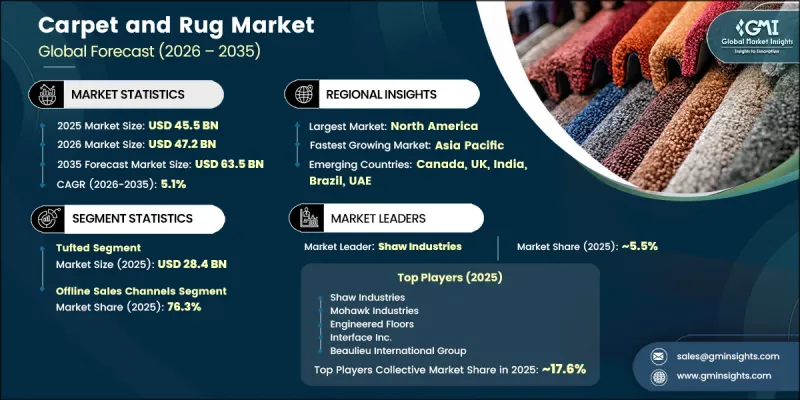
The Global Carpet and Rug Market was valued at USD 45.5 billion in 2025 and is estimated to grow at a CAGR of 5.1% to reach USD 63.5 billion by 2035.
The market continues to expand due to consistent demand from residential, commercial, and hospitality applications, supported by increasing urban development and rising household formation across developing economies. Growth is also being reinforced by ongoing renovation activities in established markets alongside growing adoption of flooring products in rapidly urbanizing regions. Consumer interest in aesthetically appealing, durable, and functional flooring solutions is encouraging manufacturers to introduce advanced materials and innovative product designs that cater to evolving interior preferences. Sustainable manufacturing practices, improved fiber technologies, and product customization capabilities are further enhancing market competitiveness and creating new opportunities across premium product categories. In addition, growing investments in housing projects, commercial infrastructure, and hospitality developments are contributing to stable long-term demand. Replacement purchases remain an important source of revenue in mature economies, while expanding construction activity continues to create opportunities in emerging markets. The combination of technological advancements, product innovation, broader distribution networks, and changing consumer lifestyle preferences is expected to support the steady expansion of the global carpet and rug market throughout the forecast period.
| Market Scope | |
|---|---|
| Start Year | 2025 |
| Forecast Year | 2026-2035 |
| Start Value | $45.5 Billion |
| Forecast Value | $63.5 Billion |
| CAGR | 5.1% |
Offline distribution channels accounted for 76.3% share in 2025 and is projected to grow at a CAGR of 3.4% during 2026-2035. Physical retail continues to represent the leading sales channel because many buyers prefer evaluating product quality, texture, appearance, and overall finish before making a purchase decision. Personalized customer assistance, professional installation services, and direct product demonstrations further strengthen the appeal of offline purchasing. The availability of extensive product selections and value-added services continues to support the long-term dominance of brick-and-mortar retail channels.
The tufted segment generated USD 28.4 billion in 2025 and is expected to register a CAGR of 3.3% through 2035. The segment maintains its leadership position due to its efficient manufacturing process, broad material compatibility, and ability to serve multiple price categories. Its versatility allows manufacturers to develop products for both residential and commercial applications while maintaining competitive production costs. Continuous improvements in fiber technology, backing materials, and manufacturing efficiency are expected to further strengthen the segment's market position over the coming years.
North America Carpet and Rug Market reached USD 13.3 billion in 2025, and is anticipated to grow at a CAGR of 3.4% through 2035. Market growth is supported by sustained residential renovation activity, increasing investments in commercial building modernization, and a well-established flooring distribution network. Rising consumer spending on home improvement projects, strong demand for premium flooring products, and continuous refurbishment across commercial spaces continue to create favorable opportunities for manufacturers and distributors throughout the region.
Major companies operating in the global carpet and rug market include Victoria PLC, Mohawk Industries, Inc., Interface, Inc., Oriental Weavers Group, Milliken & Company, Kleen-Tex Industries, Shaw Industries Group, Inc., Tarkett S.A., Bolon AB, Balta Group, The Dixie Group, Tai Ping Carpets International, Ege Carpets, Brintons Carpets, and Beaulieu International Group. Companies operating in the carpet and rug market are strengthening their competitive position by investing in sustainable materials, innovative manufacturing technologies, and premium product development. Many manufacturers are expanding environmentally responsible product portfolios while improving product durability, stain resistance, and design flexibility to address changing consumer preferences. Businesses are also increasing investments in digital visualization tools, customization capabilities, and omnichannel sales strategies to enhance customer engagement and simplify purchasing decisions. Strategic partnerships with distributors, architects, interior designers, and commercial contractors are helping companies expand market reach and strengthen brand recognition.
Table of Contents
Chapter 1 Methodology & Scope
- 1.1 Market scope and definition
- 1.2 Research design
- 1.2.1 Research approach
- 1.2.2 Data collection methods
- 1.3 Data mining sources
- 1.3.1 Global
- 1.3.2 Regional/Country
- 1.4 Base estimates and calculations
- 1.4.1 Base year calculation
- 1.4.2 Key trends for market estimation
- 1.5 Primary research and validation
- 1.5.1 Primary sources
- 1.6 Forecast model
- 1.7 Research assumptions and limitations
Chapter 2 Executive Summary
- 2.1 Industry 360° synopsis
- 2.2 Key market trends
- 2.2.1 Regional
- 2.2.2 Product type
- 2.2.3 Material
- 2.2.4 Size
- 2.2.5 Price
- 2.2.6 End-use
- 2.2.7 Distribution channel
Chapter 3 Industry Insights
- 3.1 Industry ecosystem analysis
- 3.1.1 Supplier landscape
- 3.1.2 Profit margin
- 3.1.3 Value addition at each stage
- 3.1.4 Factor affecting the value chain
- 3.2 Industry impact forces
- 3.2.1 Growth drivers
- 3.2.1.1 Rising residential renovation & remodeling activity globally
- 3.2.1.2 Expanding hospitality & commercial construction sector
- 3.2.1.3 Growing urbanization & rising disposable incomes in emerging economies
- 3.2.1.4 Proliferation of e-commerce enabling wider consumer access to premium products
- 3.2.2 Industry pitfalls & challenges
- 3.2.2.1 Complex recycling & end-of-life disposal infrastructure gaps
- 3.2.2.2 Trade disruptions & tariff uncertainty affecting import-dependent markets
- 3.2.2.3 Skill shortage in handcrafted & artisan knotting segment
- 3.2.2.4 Price competition from low-cost Asian manufacturers pressuring margins
- 3.2.3 Opportunities
- 3.2.3.1 Growing demand for sustainable, recycled & bio-based fiber carpets
- 3.2.3.2 Smart carpet integration with IoT for commercial & healthcare applications
- 3.2.3.3 Emerging market penetration in Asia Pacific, MEA & Latin America
- 3.2.3.4 AI-powered customization & digital-first consumer experience platforms
- 3.2.1 Growth drivers
- 3.3 Growth potential analysis
- 3.4 Future market trends
- 3.5 Technology and innovation landscape
- 3.5.1 Current technological trends
- 3.5.2 Emerging technologies
- 3.6 Regulatory landscape
- 3.6.1 Standards and compliance requirements
- 3.6.2 Regional regulatory frameworks
- 3.6.3 Certification standards
- 3.7 Trade data analysis (HS Code 5701)
- 3.7.1 Import/export volume & value trends
- 3.7.2 Key trade corridors & tariff impact
- 3.8 Pricing analysis
- 3.8.1 Historical price trend analysis (driven by primary research)
- 3.8.2 Pricing strategy by player type (premium / value / mass market)
- 3.9 Impact of AI & generative AI on the market
- 3.9.1 AI-driven disruption of existing business models
- 3.9.2 GenAI use cases & adoption roadmap by segment
- 3.9.3 Risks, limitations & regulatory considerations
- 3.10 Porter’s analysis
- 3.11 PESTEL analysis
Chapter 4 Competitive Landscape, 2025
- 4.1 Introduction
- 4.2 Company market share analysis
- 4.2.1 By Region
- 4.2.1.1 North America
- 4.2.1.2 Europe
- 4.2.1.3 Asia Pacific
- 4.2.1.4 Latin America
- 4.2.1.5 Middle East & Africa
- 4.2.1 By Region
- 4.3 Company matrix analysis
- 4.4 Competitive analysis of major market players
- 4.5 Competitive positioning matrix
- 4.6 Key developments
- 4.6.1 Mergers & acquisitions
- 4.6.2 Partnerships & collaborations
- 4.6.3 New product launches
- 4.6.4 Expansion plans
Chapter 5 Market Estimates & Forecast, By Product Type, 2022 – 2035, (USD Billion) (Million Units)
- 5.1 Key trends
- 5.2 Tufted
- 5.3 Woven
- 5.4 Knotted
- 5.5 Needle-punched
- 5.6 Flat weave
- 5.7 Others (hooked, braided, hybrid)
Chapter 6 Market Estimates & Forecast, By Material, 2022 – 2035, (USD Billion) (Million Units)
- 6.1 Key trends
- 6.2 Synthetic Fibers
- 6.2.1 Nylon
- 6.2.2 Polyester (PET / PTT)
- 6.2.3 Polypropylene (Olefin)
- 6.2.4 Acrylic
- 6.3 Natural Fibers
- 6.3.1 Wool
- 6.3.2 Cotton
- 6.3.3 Jute
- 6.3.4 Sisal / seagrass
- 6.3.5 Silk
- 6.4 Recycled & bio-based fibers
- 6.4.1 Recycled PET
- 6.4.2 Bio-based nylon & polyester
- 6.5 Blended fibers
Chapter 7 Market Estimates & Forecast, By Size, 2022 – 2035, (USD Billion) (Million Units)
- 7.1 Key trends
- 7.2 Small (Up to 4×6 ft)
- 7.3 Medium (5×8 ft to 8×10 ft)
- 7.4 Large (9×12 ft and Above)
Chapter 8 Market Estimates & Forecast, By Price, 2022 – 2035, (USD Billion) (Million Units)
- 8.1 Key trends
- 8.2 Low
- 8.3 Medium
- 8.4 High
Chapter 9 Market Estimates & Forecast, By End-Use, 2022 – 2035, (USD Billion) (Million Units)
- 9.1 Key trends
- 9.2 Residential
- 9.3 Commercial
Chapter 10 Market Estimates & Forecast, By Distribution Channel, 2022 – 2035, (USD Billion) (Million Units)
- 10.1 Key trends
- 10.2 Online
- 10.2.1 E-commerce websites
- 10.2.2 Company-owned websites
- 10.3 Offline
- 10.3.1 Supermarkets and hypermarkets
- 10.3.2 Specialty stores
- 10.3.3 Others
Chapter 11 Market Estimates & Forecast, By Region, 2022 – 2035, (USD Billion) (Million Units)
- 11.1 Key trends
- 11.2 North America
- 11.2.1 U.S.
- 11.2.2 Canada
- 11.3 Europe
- 11.3.1 Germany
- 11.3.2 UK
- 11.3.3 France
- 11.3.4 Italy
- 11.3.5 Spain
- 11.4 Asia Pacific
- 11.4.1 China
- 11.4.2 India
- 11.4.3 Japan
- 11.4.4 South Korea
- 11.4.5 Australia
- 11.4.6 Indonesia
- 11.4.7 Malaysia
- 11.5 Latin America
- 11.5.1 Brazil
- 11.5.2 Mexico
- 11.5.3 Argentina
- 11.6 MEA
- 11.6.1 Saudi Arabia
- 11.6.2 UAE
- 11.6.3 South Africa
Chapter 12 Company Profiles
- 12.1 Top Global Players
- 12.1.1 Mohawk Industries, Inc.
- 12.1.2 Shaw Industries Group, Inc.
- 12.1.3 Interface, Inc.
- 12.1.4 Beaulieu International Group
- 12.1.5 Tarkett S.A.
- 12.2 Regional Champions
- 12.2.1 Oriental Weavers Group
- 12.2.2 Balta Group
- 12.2.3 Victoria PLC
- 12.2.4 Tai Ping Carpets International
- 12.2.5 Brintons Carpets
- 12.3 Emerging Players
- 12.3.1 Milliken & Company
- 12.3.2 The Dixie Group
- 12.3.3 Ege Carpets
- 12.3.4 Bolon AB
- 12.3.5 Kleen-Tex Industries

