PUBLISHER: Global Market Insights Inc. | PRODUCT CODE: 2101912

PUBLISHER: Global Market Insights Inc. | PRODUCT CODE: 2101912
Sleep Tech Devices Market Opportunity, Growth Drivers, Industry Trend Analysis, and Forecast 2026 - 2035
The Global Sleep Tech Devices Market was valued at USD 29.3 billion in 2025 and is estimated to grow at a CAGR of 18.6% to reach USD 160.6 billion by 2035.
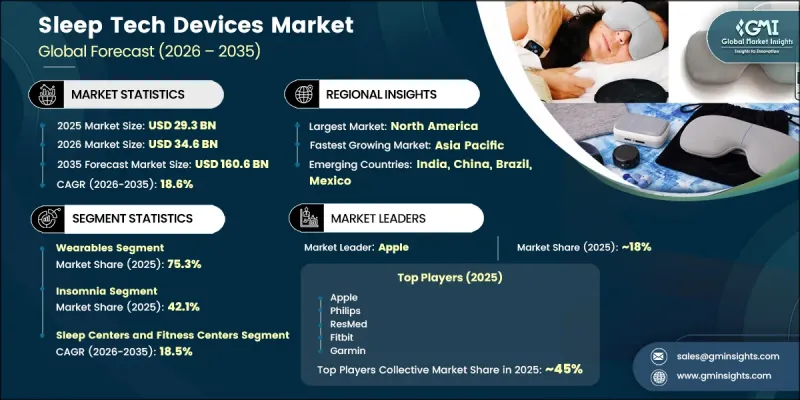
The market is witnessing strong growth due to rapid technological progress in sleep monitoring solutions, increasing awareness of sleep health, and the rising number of elderly individuals worldwide. Sleep tech devices are advanced consumer electronics designed to evaluate, track, and improve sleep patterns by measuring various physiological and environmental factors, including sleep cycles, heart activity, breathing behavior, movement patterns, and surrounding conditions such as temperature, lighting, and sound levels. The growing aging population and increasing occurrence of sleep-related health issues are significantly contributing to market expansion. As the number of older adults continues to rise globally, demand is increasing for convenient, technology-driven solutions that support sleep monitoring, analysis, and personalized improvement strategies.
| Market Scope | |
|---|---|
| Start Year | 2025 |
| Forecast Year | 2026-2035 |
| Start Value | $29.3 Billion |
| Forecast Value | $160.6 Billion |
| CAGR | 18.6% |
The increasing prevalence of sleep disorders is another major factor contributing to the adoption of sleep tech devices. Aging individuals are more likely to experience challenges such as disrupted sleep patterns, insomnia, and breathing-related sleep conditions, creating a greater requirement for continuous monitoring and effective sleep management technologies. Consumers are increasingly seeking accessible solutions that allow them to better understand their sleep behavior and improve overall wellness through digital health tools.
The wearables segment accounted for 75.3% share in 2025, supported by growing acceptance of connected health devices, increasing consumer focus on sleep quality, and advancements in artificial intelligence-powered sensors and digital healthcare platforms. Wearable sleep technology remains highly preferred due to its ability to provide continuous tracking of important sleep and health indicators, including sleep duration, sleep phases, heart rate, oxygen saturation levels, breathing rate, skin temperature, stress indicators, and heart rate variability. Compared with traditional clinical sleep evaluation approaches, wearable devices allow users to monitor their sleep patterns in everyday environments while connecting easily with smartphones and digital wellness applications.
The sleep centers and fitness centers segment held 35.1% share in 2025 growing at a CAGR of 18.5% throughout 2035. Growth in this segment is supported by increasing consumer interest in professional sleep evaluations, customized recommendations, and complete wellness-focused solutions. Customers investing in premium sleep technologies often prefer access to expert guidance, product demonstrations, and consultations before selecting advanced solutions such as sleep monitoring devices, smart sleep systems, and other technology-enabled products. The availability of professional support through specialized centers is helping increase consumer confidence and encourage wider adoption of sleep technology products.
North America Sleep Tech Devices Market captured 42.5% share in 2025. Strong market growth in North America is supported by the widespread presence of sleep disorders, increasing consumer investment in preventive healthcare, and strong adoption of digital wellness technologies. Growing awareness about the connection between inadequate sleep and long-term health concerns is encouraging consumers to adopt advanced sleep monitoring and improvement solutions. Rising interest in proactive health management and personalized wellness technologies continues to accelerate demand for sleep tech devices across the region.
Major players operating in the global sleep tech devices industry are Apple, Eight Sleep, Garmin, Philips, Oura Health, Fitbit, BedJet, ResMed, Xiaomi, Withings, Huawei, ChiliSleep, Fisher & Paykel Healthcare, Itamar Medical, Somnox, SleepScore Labs, Emfit, Smart Nora, Balluga, ReST, Pulsetto, and Somnofy. Companies operating in the sleep tech devices market are strengthening their competitive position through product innovation, artificial intelligence integration, strategic partnerships, and expansion of digital health ecosystems. Manufacturers are focusing on developing smarter devices with improved sensor accuracy, advanced analytics, and personalized recommendations to enhance user experiences. Businesses are also investing in software platforms, mobile applications, and cloud-based solutions to provide deeper sleep insights and improve customer engagement. Collaborations with healthcare providers, wellness organizations, and technology companies are helping brands expand their reach and improve credibility.
Table of Contents
Chapter 1 Research Methodology
- 1.1 Research approach
- 1.2 Quality commitments
- 1.2.1 GMI AI policy & data integrity commitment
- 1.2.1.1 Source consistency protocol
- 1.2.1 GMI AI policy & data integrity commitment
- 1.3 Research trail & confidence scoring
- 1.3.1 Research trail components
- 1.3.2 Scoring components
- 1.4 Data collection
- 1.4.1 Partial list of primary sources
- 1.5 Data mining sources
- 1.5.1 Paid sources
- 1.5.1.1 Sources, by region
- 1.5.1 Paid sources
- 1.6 Base estimates and calculations
- 1.6.1 Base year calculation
- 1.7 Forecast model
- 1.7.1 Quantified market impact analysis
- 1.7.1.1 Mathematical impact of growth parameters on forecast
- 1.7.1 Quantified market impact analysis
- 1.8 Research transparency addendum
- 1.8.1 Source attribution framework
- 1.8.2 Quality assurance metrics
- 1.8.3 Our commitment to trust
Chapter 2 Executive Summary
- 2.1 Industry 360° synopsis
- 2.2 Key market trends
- 2.2.1 Regional trends
- 2.2.2 Product trends
- 2.2.3 Application trends
- 2.2.4 Distribution channel trends
- 2.3 CXO perspectives: Strategic imperatives
Chapter 3 Industry Insights
- 3.1 Industry ecosystem analysis
- 3.2 Industry impact forces
- 3.2.1 Growth drivers
- 3.2.1.1 Technological advancements in sleep tech devices
- 3.2.1.2 Increasing awareness regarding the availability of sleep tech devices
- 3.2.1.3 Rising geriatric population
- 3.2.1.4 Surging demand for portable, efficient, and superior sleep tech devices
- 3.2.1.5 Product innovation and adoption of different strategies by key market participants
- 3.2.2 Industry pitfalls and challenges
- 3.2.2.1 High cost of sleep tech devices
- 3.2.2.2 Stringent regulatory framework
- 3.2.3 Opportunities
- 3.2.3.1 Integration with telehealth and remote patient monitoring
- 3.2.3.2 Expansion into mental health and wellness segments
- 3.2.1 Growth drivers
- 3.3 Growth potential analysis
- 3.4 Regulatory landscape
- 3.4.1 North America
- 3.4.2 Europe
- 3.4.3 Asia Pacific
- 3.4.4 Latin America
- 3.4.5 MEA
- 3.5 Pricing trend analysis
- 3.6 Technology and innovation landscape (Driven by Primary Research)
- 3.6.1 Current technological trends
- 3.6.2 Emerging technologies
- 3.7 Future market trends (Driven by Primary Research)
- 3.8 Patent analysis (Driven by Primary Research)
- 3.9 Consumer behaviour trend (Driven by Primary Research)
- 3.10 Go-to-market strategy analysis
- 3.11 Impact of AI & Generative AI on the Market (Driven by Primary Research)
- 3.12 Porter's analysis
- 3.13 PESTEL analysis
Chapter 4 Competitive Landscape, 2025
- 4.1 Introduction
- 4.2 Company matrix analysis
- 4.3 Company market share analysis (Driven by Primary Research)
- 4.3.1 Global
- 4.3.2 North America
- 4.3.3 Europe
- 4.4 Competitive analysis of major market players
- 4.5 Competitive positioning matrix
- 4.6 Key developments
- 4.6.1 Mergers & acquisitions
- 4.6.2 Partnerships & collaborations
- 4.6.3 New product launches
- 4.6.4 Expansion plans
Chapter 5 Market Estimates and Forecast, By Product, 2022 - 2035 ($ Mn)
- 5.1 Key trends
- 5.2 Wearables
- 5.2.1 Smart watches and bands
- 5.2.2 Other wearables
- 5.3 Non-Wearables
- 5.3.1 Sleep monitors
- 5.3.2 Smart beds
Chapter 6 Market Estimates and Forecast, By Application, 2022 - 2035 ($ Mn)
- 6.1 Key trends
- 6.2 Insomnia
- 6.3 Obstructive sleep apnea
- 6.4 Narcolepsy
- 6.5 Other applications
Chapter 7 Market Estimates and Forecast, By Distribution Channel, 2022 - 2035 ($ Mn)
- 7.1 Key trends
- 7.2 Sleep centers and fitness centers
- 7.3 Hypermarkets and supermarkets
- 7.4 E-commerce
- 7.5 Pharmacy and retail stores
- 7.6 Other distribution channels
Chapter 8 Market Estimates and Forecast, By Region, 2022 - 2035 ($ Mn)
- 8.1 Key trends
- 8.2 North America
- 8.2.1 U.S.
- 8.2.2 Canada
- 8.3 Europe
- 8.3.1 Germany
- 8.3.2 UK
- 8.3.3 France
- 8.3.4 Spain
- 8.3.5 Italy
- 8.3.6 Netherlands
- 8.4 Asia Pacific
- 8.4.1 China
- 8.4.2 Japan
- 8.4.3 India
- 8.4.4 Australia
- 8.4.5 South Korea
- 8.5 Latin America
- 8.5.1 Brazil
- 8.5.2 Mexico
- 8.5.3 Argentina
- 8.6 MEA
- 8.6.1 South Africa
- 8.6.2 Saudi Arabia
- 8.6.3 UAE
Chapter 9 Company Profiles
- 9.1 Apple
- 9.2 Balluga
- 9.3 BedJet
- 9.4 ChiliSleep
- 9.5 Eight Sleep
- 9.6 Emfit
- 9.7 Fisher & Paykel Healthcare
- 9.8 Fitbit
- 9.9 Garmin
- 9.10 Huawei
- 9.11 Itamar Medical
- 9.12 Ōura Health
- 9.13 Philips
- 9.14 Pulsetto
- 9.15 ResMed
- 9.16 ReST
- 9.17 SleepScore Labs
- 9.18 Smart Nora
- 9.19 Somnofy
- 9.20 Somnox
- 9.21 Withings
- 9.22 Xiaomi

