PUBLISHER: Global Market Insights Inc. | PRODUCT CODE: 2101921

PUBLISHER: Global Market Insights Inc. | PRODUCT CODE: 2101921
Semiconductor ICP-MS Systems Market Opportunity, Growth Drivers, Industry Trend Analysis, and Forecast 2026 - 2035
The Global Semiconductor ICP-MS Systems Market was valued at USD 195.5 million in 2025 and is estimated to grow at a CAGR of 5.7% to reach USD 335.5 million by 2035.
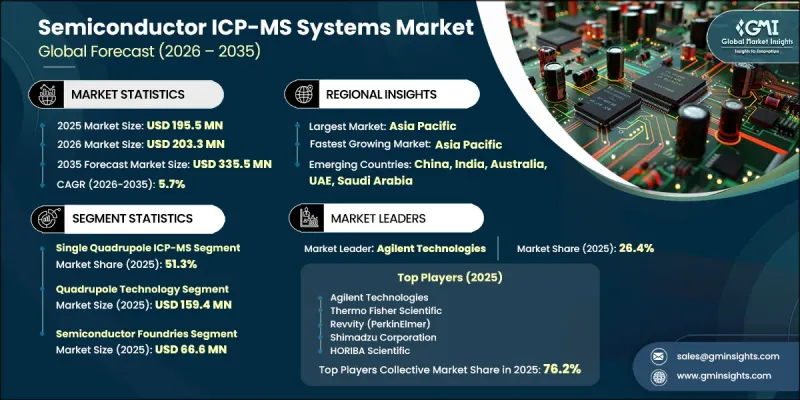
The global semiconductor ICP-MS systems market is expanding as demand for ultra-trace elemental analysis continues to increase across semiconductor manufacturing facilities. Growing investments in semiconductor fabrication capacity, combined with supportive government initiatives aimed at strengthening domestic semiconductor production, are driving the need for highly accurate analytical instrumentation. As semiconductor technologies continue to evolve toward increasingly advanced manufacturing processes, producers require sophisticated contamination monitoring systems capable of detecting extremely low concentrations of metallic impurities. Rising demand for high-purity process chemicals, ultrapure water, silicon wafers, and other electronic materials further supports market growth by increasing the need for reliable analytical testing throughout semiconductor production. Manufacturers also continue to strengthen quality assurance and process control capabilities to improve production efficiency, maximize product reliability, and reduce contamination risks. Continuous expansion of semiconductor manufacturing infrastructure, together with increasing adoption of precision analytical technologies, is expected to sustain long-term growth across the global semiconductor ICP-MS systems market throughout the forecast period.
| Market Scope | |
|---|---|
| Start Year | 2025 |
| Forecast Year | 2026-2035 |
| Start Value | $195.5 Million |
| Forecast Value | $335.5 Million |
| CAGR | 5.7% |
The single quadrupole ICP-MS segment accounted for 51.3% share in 2025. The segment maintains its dominant position because it offers an effective balance of analytical performance, cost efficiency, and high sample throughput for routine elemental analysis. Its ability to deliver highly accurate measurements while maintaining lower operating costs continues to support widespread adoption across semiconductor quality control laboratories. Consistent performance, operational reliability, and suitability for ultra-trace contamination analysis continue to strengthen demand for single quadrupole ICP-MS systems across semiconductor manufacturing facilities.
The semiconductor foundries segment reached USD 66.6 million in 2025. Semiconductor foundries continue to represent the largest application segment because high-volume semiconductor manufacturing requires continuous monitoring of elemental contamination throughout the production process. ICP-MS systems play a critical role in maintaining product quality by supporting precise analysis of semiconductor materials, manufacturing chemicals, process water, wafers, and controlled production environments. Growing demand for higher manufacturing yields and stricter quality standards continues to reinforce adoption across semiconductor foundry operations worldwide.
North America Semiconductor ICP-MS Systems Market accounted for 26.5% share in 2025. Regional market growth is supported by expanding semiconductor manufacturing capacity, increasing investments in advanced fabrication facilities, and continued government support for strengthening domestic semiconductor production. Rising demand for contamination analysis, process monitoring, and quality assurance solutions continues to encourage wider deployment of ICP-MS systems throughout semiconductor manufacturing operations across North America. Ongoing investments in advanced semiconductor infrastructure further reinforce the region's long-term market growth.
Major companies operating in the global semiconductor ICP-MS systems market include Thermo Fisher Scientific, Agilent Technologies, Shimadzu Corporation, HORIBA Scientific, Revvity Inc. (formerly PerkinElmer), Nu Instruments (AMETEK), SPECTRO Analytical Instruments (AMETEK), Aurora Biomed, EXPEC Technology (Focused Photonics Inc.), Skyray Instruments, Analytik Jena GmbH (Xylem Brand), GBC Scientific Equipment, and LabTech (Beijing Laibotaike Instrument Co.). Companies operating in the global semiconductor ICP-MS systems market focus on continuous technology innovation, product performance enhancement, and strategic market expansion to strengthen their competitive position. Manufacturers invest significantly in research and development to improve analytical sensitivity, detection accuracy, operational efficiency, and instrument reliability. Many companies expand their product portfolios by introducing advanced systems that address evolving semiconductor manufacturing requirements and increasingly stringent quality standards. Strategic collaborations with semiconductor manufacturers, research institutions, and distribution partners help broaden market reach and accelerate product adoption. Businesses also prioritize software enhancements, automation capabilities, customer support services, and application-specific solutions to improve user experience.
Table of Contents
Chapter 1 Methodology and Scope
- 1.1 Market scope and definition
- 1.2 Research design
- 1.2.1 Research approach
- 1.2.2 Data collection methods
- 1.3 Data mining sources
- 1.3.1 Global
- 1.3.2 Regional/Country
- 1.4 Base estimates and calculations
- 1.4.1 Base year calculation
- 1.4.2 Key trends for market estimation
- 1.5 Primary research and validation
- 1.5.1 Primary sources
- 1.6 Forecast model
- 1.7 Research assumptions and limitations
Chapter 2 Executive Summary
- 2.1 Industry 360° synopsis, 2022 - 2035
- 2.2 Key market trends
- 2.2.1 Product type trends
- 2.2.2 Technology trends
- 2.2.3 Application trends
- 2.2.4 End-user trends
- 2.2.5 Regional trends
- 2.3 TAM Analysis, 2026-2035
- 2.4 CXO perspectives: Strategic imperatives
Chapter 3 Industry Insights
- 3.1 Industry ecosystem analysis
- 3.1.1 Supplier Landscape
- 3.1.2 Profit Margin
- 3.1.3 Cost structure
- 3.1.4 Value addition at each stage
- 3.1.5 Factor affecting the value chain
- 3.1.6 Disruptions
- 3.2 Industry impact forces
- 3.2.1 Growth drivers
- 3.2.1.1 Expansion of advanced semiconductor fabrication facilities
- 3.2.1.2 Growing demand for ultra-trace contamination analysis
- 3.2.1.3 Government investments in domestic semiconductor manufacturing
- 3.2.1.4 Rising purity requirements for semiconductor chemicals and ultrapure water
- 3.2.1.5 Increasing automation and AI-driven semiconductor quality control
- 3.2.2 Industry pitfalls and challenges
- 3.2.2.1 High capital investment and operating costs of semiconductor ICP-MS systems
- 3.2.2.2 Complex sample preparation and shortage of skilled analytical professionals
- 3.2.3 Market opportunities
- 3.2.3.1 Expansion of advanced semiconductor packaging and heterogeneous integration
- 3.2.3.2 Growing investments in domestic semiconductor manufacturing under national chip initiatives
- 3.2.1 Growth drivers
- 3.3 Growth potential analysis
- 3.4 Regulatory landscape
- 3.4.1 North America
- 3.4.2 Europe
- 3.4.3 Asia Pacific
- 3.4.4 Latin America
- 3.4.5 Middle East & Africa
- 3.5 Porter's analysis
- 3.6 PESTEL analysis
- 3.7 Technology and Innovation landscape
- 3.7.1 Current technological trends
- 3.7.2 Emerging technologies
- 3.8 Price trends
- 3.8.1 By region
- 3.8.2 By product
- 3.9 Pricing Strategies
- 3.10 Emerging Business Models
- 3.11 Compliance Requirements
- 3.12 Patent and IP analysis
Chapter 4 Competitive Landscape, 2025
- 4.1 Introduction
- 4.2 Company market share analysis
- 4.2.1 By region
- 4.2.1.1 North America
- 4.2.1.2 Europe
- 4.2.1.3 Asia Pacific
- 4.2.1.4 Latin America
- 4.2.1.5 Middle East & Africa
- 4.2.2 Market concentration analysis
- 4.2.1 By region
- 4.3 Competitive benchmarking of key players
- 4.3.1 Financial performance comparison
- 4.3.1.1 Revenue
- 4.3.1.2 Profit margin
- 4.3.1.3 R&D
- 4.3.2 Product portfolio comparison
- 4.3.2.1 Product range breadth
- 4.3.2.2 Technology
- 4.3.2.3 Innovation
- 4.3.3 Geographic presence comparison
- 4.3.3.1 Global footprint analysis
- 4.3.3.2 Service network coverage
- 4.3.3.3 Market penetration by region
- 4.3.4 Competitive positioning matrix
- 4.3.4.1 Leaders
- 4.3.4.2 Challengers
- 4.3.4.3 Followers
- 4.3.4.4 Niche players
- 4.3.5 Strategic outlook matrix
- 4.3.1 Financial performance comparison
- 4.4 Key developments
- 4.4.1 Mergers and acquisitions
- 4.4.2 Partnerships and collaborations
- 4.4.3 Technological advancements
- 4.4.4 Expansion and investment strategies
- 4.4.5 Digital transformation initiatives
- 4.5 Emerging/ startup competitors landscape
Chapter 5 Market Estimates and Forecast, By Product Type, 2022 - 2035 (USD Million)
- 5.1 Key trends
- 5.2 Single Quadrupole ICP-MS
- 5.3 Triple Quadrupole ICP-MS (ICP-MS/MS)
- 5.4 Sector Field / High-Resolution ICP-MS (SF/HR-ICP-MS)
- 5.5 Multi-Collector ICP-MS (MC-ICP-MS)
Chapter 6 Market Estimates and Forecast, By Technology, 2022 - 2035 (USD Million)
- 6.1 Key trends
- 6.2 Quadrupole Technology
- 6.3 Magnetic Sector Technology
- 6.4 Others
Chapter 7 Market Estimates and Forecast, By Application, 2022 - 2035 (USD Million)
- 7.1 Key trends
- 7.2 Wafer & Silicon Material Analysis
- 7.3 Semiconductor-Grade Chemical Analysis
- 7.4 Ultra-Pure Water (UPW) Analysis
- 7.5 Process Gas Analysis
- 7.6 CMP Slurry & Nanoparticle Analysis
- 7.7 Cleanroom & Process Environment Monitoring
- 7.8 Research & Development (R&D)
Chapter 8 Market Estimates and Forecast, By End-User, 2022 - 2035 (USD Million)
- 8.1 Key trends
- 8.2 Semiconductor Foundries
- 8.3 Integrated Device Manufacturers (IDMs)
- 8.4 Semiconductor Material & Chemical Suppliers
- 8.5 Independent Testing & Analytical Laboratories
- 8.6 Research & Academic Institutions
Chapter 9 Market Estimates and Forecast, By Region, 2022 - 2035 (USD Million)
- 9.1 Key trends
- 9.2 North America
- 9.2.1 U.S.
- 9.2.2 Canada
- 9.3 Europe
- 9.3.1 Germany
- 9.3.2 UK
- 9.3.3 France
- 9.3.4 Spain
- 9.3.5 Italy
- 9.4 Asia Pacific
- 9.4.1 China
- 9.4.2 India
- 9.4.3 Japan
- 9.4.4 Australia
- 9.4.5 South Korea
- 9.5 Latin America
- 9.5.1 Brazil
- 9.5.2 Mexico
- 9.5.3 Argentina
- 9.6 Middle East and Africa
- 9.6.1 South Africa
- 9.6.2 Saudi Arabia
- 9.6.3 UAE
Chapter 10 Company Profiles
- 10.1 Global Key Players
- 10.1.1 Agilent Technologies
- 10.1.2 Thermo Fisher Scientific
- 10.1.3 Revvity (PerkinElmer)
- 10.1.4 Shimadzu Corporation
- 10.1.5 HORIBA Scientific
- 10.2 Regional key players
- 10.2.1 North America
- 10.2.1.1 Aurora Biomed
- 10.2.2 Asia Pacific
- 10.2.2.1 EXPEC Technology (Focused Photonics Inc.)
- 10.2.2.2 LabTech (Beijing Laibotaike Instrument Co.)
- 10.2.2.3 Skyray Instruments
- 10.2.3 Europe
- 10.2.3.1 Analytik Jena GmbH (Xylem Brand)
- 10.2.3.2 SPECTRO Analytical Instruments (AMETEK)
- 10.2.3.3 Nu Instruments (AMETEK)
- 10.2.1 North America
- 10.3 Niche Players/Disruptors
- 10.3.1 GBC Scientific Equipment

