PUBLISHER: Global Market Insights Inc. | PRODUCT CODE: 2101925

PUBLISHER: Global Market Insights Inc. | PRODUCT CODE: 2101925
Plastic Furniture Market Opportunity, Growth Drivers, Industry Trend Analysis, and Forecast 2026 - 2035
The Global Plastic Furniture Market was valued at USD 52.7 billion in 2025 and is estimated to grow at a CAGR of 5.5% to reach USD 90.1 billion by 2035.
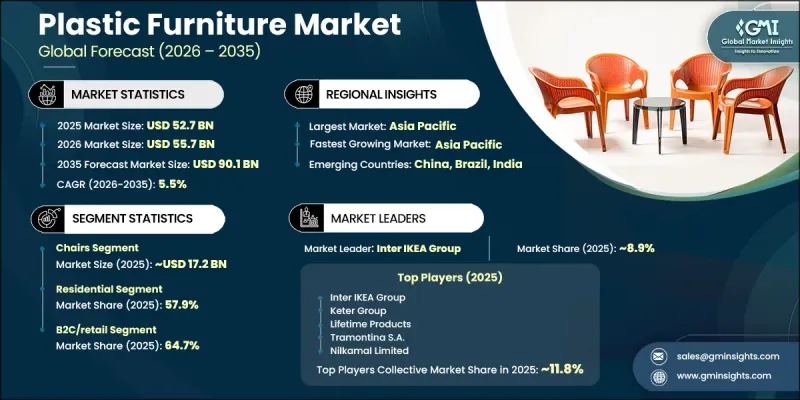
The global plastic furniture market is benefiting from rapid urban development, changing consumer lifestyles, and continuous improvements in polymer technology. Increasing demand for lightweight, cost-effective, and easy-to-maintain furniture solutions is supporting adoption across residential, commercial, and institutional applications. Advancements in material engineering have improved the strength, appearance, and performance of plastic furniture, allowing manufacturers to offer products suitable for a wide range of environments. Rising urbanization across developing regions is creating additional opportunities as consumers increasingly prefer practical furnishing options that combine affordability with durability. Modern plastic materials provide enhanced resistance against environmental conditions while requiring minimal maintenance compared with traditional furniture materials. The growing availability of innovative designs, improved manufacturing processes, and expanded retail distribution channels continues to strengthen market growth. These factors, along with increasing consumer preference for convenient and functional furniture products, are expected to support the steady expansion of the global plastic furniture market through 2035.
| Market Scope | |
|---|---|
| Start Year | 2025 |
| Forecast Year | 2026-2035 |
| Start Value | $52.7 Billion |
| Forecast Value | $90.1 Billion |
| CAGR | 5.5% |
The chairs segment 32.7% share in 2025 growing at a CAGR of 6%. The strong performance of this segment is supported by widespread demand across residential, commercial, hospitality, and institutional applications. Plastic chairs continue to gain popularity due to their lightweight structure, easy handling, affordability, and ability to suit various interior and outdoor settings. Continuous product innovation and broader design availability are further strengthening the position of chairs as the leading product segment within the market.
The B2C and retail segment held 64.7% share and is projected to grow at a CAGR of 5.4% between 2026 and 2035. The segment maintains its leadership due to strong household demand for affordable and practical furniture products. Consumers increasingly purchase plastic furniture for residential spaces because of its lightweight construction, durability, low maintenance requirements, and convenient availability through multiple sales channels. Expansion of retail networks, furniture outlets, specialty stores, and online platforms continues to improve product accessibility and support the sustained growth of the B2C segment.
U.S. Plastic Furniture Market reached USD 8.1 billion in 2025 and is expected to grow at a CAGR of 5.6% from 2026 to 2035. Market growth in the country is supported by strong consumer demand, expanding commercial applications, and increasing preference for practical furniture solutions. Growing emphasis on sustainable procurement practices within commercial sectors is also influencing purchasing decisions, encouraging demand for products with improved environmental performance. Canada's expanding multi-family housing sector further contributes to regional growth by increasing demand for space-efficient and functional furniture formats suitable for modern residential environments.
Major companies operating in the Global Plastic Furniture Market include Lifetime Products, Keter Group, Tramontina, Nilkamal Limited, Nardi S.p.A., Grosfillex, Siesta Exclusive, Supreme Industries, Cello Group, Suncast Corporation, Cosco Home & Office, Stefanplast S.p.A., Resol, Allibert, Avro India Limited, Hebei Zuohui Furniture Co., Ltd., Taizhou Hongyi Furniture Manufacturing Co., Ltd., Parazzo Group (Thailand) Co., Ltd., Blue Vanilla Co., Ltd., and SmartPlast. Companies operating in the global plastic furniture market focus on product innovation, sustainable material development, and market expansion strategies to strengthen their competitive position. Manufacturers continue investing in advanced polymers, improved production techniques, and design enhancements to create durable, attractive, and environmentally responsible furniture solutions. Many companies expand their product portfolios by introducing products designed for residential, commercial, hospitality, and outdoor applications. Strategic partnerships, broader distribution networks, and stronger digital retail presence help businesses reach wider customer groups and improve sales performance. Companies also emphasize recycled materials, efficient manufacturing processes, and customized product offerings to align with evolving consumer preferences.
Table of Contents
Chapter 1 Methodology and Scope
- 1.1 Market scope and definition
- 1.2 Research design
- 1.2.1 Research approach
- 1.2.2 Data collection methods
- 1.3 Data mining sources
- 1.3.1 Global
- 1.3.2 Regional/Country
- 1.4 Base estimates and calculations
- 1.4.1 Base year calculation
- 1.4.2 Key trends for market estimation
- 1.5 Primary research and validation
- 1.5.1 Primary sources
- 1.6 Forecast model
- 1.7 Research assumptions and limitations
Chapter 2 Executive Summary
- 2.1 Industry 360° synopsis
- 2.2 Key market trends
- 2.3 Regional
- 2.4 Product
- 2.5 Material
- 2.6 Price range
- 2.7 End use
- 2.8 Distribution channel
Chapter 3 Industry Insights
- 3.1 Industry Ecosystem Analysis
- 3.1.1 Raw material suppliers (resin producers)
- 3.1.2 Manufacturers & converters
- 3.1.3 Distributors & wholesalers
- 3.1.4 Retailers & e-commerce platforms
- 3.1.5 End-users
- 3.1.6 Factor affecting the value chain
- 3.1.7 Profit margin analysis by value chain stage
- 3.1.8 Disruptions
- 3.1.9 Future outlook
- 3.2 Industry impact forces
- 3.2.1 Growth drivers
- 3.2.1.1 Cost-effectiveness & affordability of plastic furniture
- 3.2.1.2 Low maintenance requirements & durability
- 3.2.1.3 Lightweight nature facilitating easy transport & handling
- 3.2.2 Market pitfalls
- 3.2.2.1 Limited durability & perceived lower quality vs. Wood/metal
- 3.2.2.2 Environmental concerns & plastic pollution stigma
- 3.2.3 Opportunities
- 3.2.3.1 Rising adoption of recycled & bio-based plastics
- 3.2.3.2 Innovation in smart & IoT-enabled furniture
- 3.2.1 Growth drivers
- 3.3 Growth potential analysis
- 3.4 Future market trends
- 3.5 Technology and innovation landscape
- 3.5.1 Current technological trends
- 3.5.2 Emerging technologies
- 3.5.3 Advanced injection molding technologies
- 3.5.4 Bio-based & recycled plastic innovations
- 3.5.5 Smart furniture integration
- 3.5.6 3D printing & additive manufacturing in furniture
- 3.6 Pricing analysis (driven by primary research)
- 3.6.1 Historical price trend analysis
- 3.6.2 Pricing strategy by player type (premium / value / cost-plus)
- 3.6.3 Raw material cost impact on product pricing
- 3.6.4 Regional price variations & competitive pricing dynamics
- 3.7 Regulatory landscape
- 3.7.1 Global regulatory standards
- 3.7.2 Extended Producer Responsibility (EPR) Regulations
- 3.7.3 Plastic Waste Management & Recycling Mandates
- 3.7.4 Single-Use Plastics Bans & Impact on Furniture Industry
- 3.7.5 Chemical Safety Regulations
- 3.7.6 Flammability & Safety Standards
- 3.8 Trade data analysis (driven by paid database) (HS Code- 9403.70.00)
- 3.8.1 Key trade corridors & tariff impact
- 3.8.2 Trade policy changes & regional trade agreements
- 3.9 Supply Chain Analysis
- 3.9.1 Raw material sourcing & supply dynamics
- 3.9.2 Manufacturing footprint & capacity distribution
- 3.9.3 Logistics & distribution networks
- 3.9.4 Supply chain resilience & risk mitigation strategies
- 3.9.5 Nearshoring & reshoring trends
- 3.10 Distribution infrastructure & channel penetration landscape (driven by primary research)
- 3.10.1 Channel coverage by region & format
- 3.10.2 Last-mile infrastructure gaps & emerging channel shifts
- 3.11 Impact of AI & generative AI on the market
- 3.11.1 AI-driven disruption of existing business models
- 3.11.2 GenAI use cases & adoption roadmap by segment
- 3.11.3 Risks, limitations & regulatory considerations
- 3.12 Porter's five forces analysis
- 3.13 PESTEL analysis
- 3.14 Consumer Buying Behaviour Analysis (driven by primary research)
- 3.14.1 Purchase decision drivers by end-user segment
- 3.14.2 Sustainability perception & eco-conscious buying
- 3.14.3 Online vs. Offline purchase behaviour
- 3.14.4 Price sensitivity & willingness-to-pay analysis
- 3.14.5 Brand loyalty vs. switching behaviour
- 3.14.6 Influence channels & purchase triggers
- 3.14.7 Post-purchase behaviour & product lifecycle
Chapter 4 Competitive Landscape, 2025
- 4.1 Introduction
- 4.2 Company market share analysis
- 4.2.1 By region
- 4.2.1.1 North America
- 4.2.1.2 Europe
- 4.2.1.3 Asia Pacific
- 4.2.1.4 Latin America
- 4.2.1.5 Middle East and Africa
- 4.2.1 By region
- 4.3 Company matrix analysis
- 4.4 Competitive analysis of major market players
- 4.5 Competitive positioning matrix
- 4.6 Key developments
- 4.6.1 Mergers & acquisitions
- 4.6.2 Partnerships & collaborations
- 4.6.3 New product launches
- 4.6.4 Expansion plans
Chapter 5 Market Estimates & Forecast, By Product, 2022-2035 (USD Billion) (Thousand Units)
- 5.1 Key trends
- 5.2 Chairs
- 5.2.1 Dining chairs
- 5.2.2 Outdoor/patio chairs
- 5.2.3 Office chairs
- 5.2.4 Stackable chairs
- 5.3 Tables
- 5.3.1 Dining tables
- 5.3.2 Coffee tables
- 5.3.3 Side tables
- 5.3.4 Outdoor tables
- 5.4 Cabinets
- 5.4.1 Storage cabinets
- 5.4.2 Kitchen cabinets
- 5.4.3 Bathroom cabinets
- 5.5 Sofas & seating sets
- 5.6 Stools & benches
- 5.7 Shelves & display units
- 5.8 Others (beds, specialty furniture)
Chapter 6 Market Estimates & Forecast, By Material, 2022-2035 (USD Billion) (Thousand Units)
- 6.1 Key trends
- 6.2 Polypropylene (PP)
- 6.3 Polyethylene (PE/HDPE)
- 6.4 Polycarbonate (PC)
- 6.5 Others (PVC, ABS, acrylic, bio-based plastics)
Chapter 7 Market Estimates & Forecast, By Price Range, 2022-2035 (USD Billion) (Thousand Units)
- 7.1 Key trends
- 7.2 Low
- 7.3 Mid
- 7.4 High
Chapter 8 Market Estimates & Forecast, By End-use, 2022-2035 (USD Billion) (Thousand Units)
- 8.1 Key trends
- 8.2 Residential
- 8.2.1 Urban apartments & compact housing
- 8.2.2 Suburban & single-family homes
- 8.2.3 Student housing & dormitories
- 8.3 Commercial
- 8.3.1 Hospitality (hotels, resorts, restaurants)
- 8.3.2 Corporate offices & coworking spaces
- 8.3.3 Educational institutions
- 8.3.4 Healthcare facilities
- 8.3.5 Retail & public spaces
Chapter 9 Market Estimates & Forecast, By Distribution Channel, 2022-2035 (USD Billion) (Thousand Units)
- 9.1 Key trends
- 9.2 B2C/retail
- 9.2.1 Home centers & improvement stores
- 9.2.2 Specialty furniture stores
- 9.2.3 Department stores
- 9.2.4 Online e-commerce platforms
- 9.2.5 Other retail channels
- 9.3 B2B/project
- 9.3.1 Contract furniture for hospitality
- 9.3.2 Institutional & government procurement
- 9.3.3 Corporate office projects
Chapter 10 Market Estimates & Forecast, By Region, 2022-2035 (USD Billion) (Thousand Units)
- 10.1 Key trends
- 10.2 North America
- 10.2.1 U.S.
- 10.2.2 Canada
- 10.3 Europe
- 10.3.1 UK
- 10.3.2 Germany
- 10.3.3 France
- 10.3.4 Italy
- 10.3.5 Spain
- 10.4 Asia Pacific
- 10.4.1 China
- 10.4.2 India
- 10.4.3 Japan
- 10.4.4 South Korea
- 10.4.5 Australia
- 10.5 Latin America
- 10.5.1 Brazil
- 10.5.2 Mexico
- 10.5.3 Argentina
- 10.6 MEA
- 10.6.1 South Africa
- 10.6.2 Saudi Arabia
- 10.6.3 UAE
Chapter 11 Company Profiles
- 11.1 Global Players
- 11.1.1 Keter Group
- 11.1.2 Tramontina
- 11.1.3 Nilkamal Limited
- 11.1.4 Siesta Exclusive
- 11.1.5 Grosfillex
- 11.1.6 Nardi S.p.A.
- 11.1.7 Lifetime Products
- 11.2 Regional players
- 11.2.1 Supreme Industries
- 11.2.2 Cello Group
- 11.2.3 Suncast Corporation
- 11.2.4 Cosco Home & Office
- 11.2.5 Stefanplast S.p.A.
- 11.2.6 Resol
- 11.2.7 Allibert
- 11.3 Emerging players
- 11.3.1 Avro India Limited
- 11.3.2 Hebei Zuohui Furniture Co., Ltd.
- 11.3.3 Taizhou Hongyi Furniture Manufacturing Co., Ltd.
- 11.3.4 Parazzo Group (Thailand) Co., Ltd.
- 11.3.5 Blue Vanilla Co., Ltd.
- 11.3.6 SmartPlast

