PUBLISHER: Global Market Insights Inc. | PRODUCT CODE: 2101929

PUBLISHER: Global Market Insights Inc. | PRODUCT CODE: 2101929
Liquid Biopsy Market Opportunity, Growth Drivers, Industry Trend Analysis, and Forecast 2026 - 2035
The Global Liquid Biopsy Market was valued at USD 6.3 billion in 2025 and is estimated to grow at a CAGR of 12.1% to reach USD 19.9 billion by 2035.
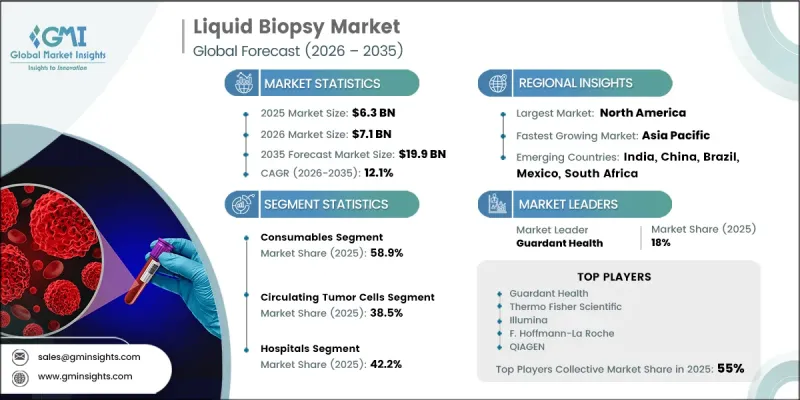
The market is witnessing momentum owing to advancements in cancer diagnostics, increasing adoption of minimally invasive testing methods, and the growing global incidence of cancer. Liquid biopsy has emerged as an advanced diagnostic approach that identifies cancer-associated biomarkers, including circulating tumor DNA (ctDNA), circulating tumor cells (CTCs), and other molecular indicators present in body fluids. Technology supports early cancer detection, treatment selection, and continuous disease monitoring without requiring conventional tissue biopsy procedures. Growing demand for safer and more patient-friendly diagnostic solutions is accelerating the adoption of liquid biopsy technologies. Unlike traditional biopsy methods that often involve invasive procedures, liquid biopsy provides a less disruptive option for analyzing tumor-related information, especially when obtaining tissue samples is challenging. Healthcare providers are increasingly adopting these solutions to improve precision medicine approaches, monitor disease progression, and evaluate changes in treatment response. Continuous innovation in molecular diagnostics, sequencing technologies, and biomarker analysis platforms is further strengthening the role of liquid biopsy in modern oncology.
| Market Scope | |
|---|---|
| Start Year | 2025 |
| Forecast Year | 2026-2035 |
| Start Value | $6.3 Billion |
| Forecast Value | $19.9 Billion |
| CAGR | 12.1% |
The instruments segment generated USD 1.6 billion in 2025 and is forecast to grow at a CAGR of 11.7% between 2026 and 2035. This segment includes advanced platforms and systems used for processing samples, performing sequencing procedures, conducting polymerase chain reaction (PCR) analysis, and identifying biomarkers associated with liquid biopsy applications. These instruments are essential for improving the accuracy, reliability, and efficiency of cancer biomarker detection, supporting both clinical diagnostics and research activities.
The hospitals segment held 42.2% share in 2025. The segment's leading position is supported by the increasing number of cancer diagnosis and treatment procedures conducted in hospital environments, along with the availability of advanced diagnostic infrastructure and specialized oncology departments. Hospitals are increasingly incorporating liquid biopsy solutions into clinical practices to support precision-based treatment decisions and deliver more personalized patient care.
North America Liquid Biopsy Market accounted for 40.8% share in 2025. The region continues to experience significant market expansion due to the rising prevalence of cancer and increasing adoption of advanced diagnostic technologies. The United States remains the primary contributor to regional growth, supported by increasing demand for minimally invasive solutions that assist in cancer identification, therapy selection, and ongoing disease assessment.
Key players operating in the global liquid biopsy industry include ANGLE plc, Guardant Health, Inc., Bio-Rad Laboratories, Inc., Illumina, Inc., F. Hoffmann-La Roche Ltd., Natera, Inc., Thermo Fisher Scientific Inc., GRAIL, Inc., QIAGEN N.V., Epigenomics AG, Myriad Genetics, Inc., Biocept, Inc., Lucence Health Inc., MDxHealth SA, Menarini Group, and Sysmex Corporation. Companies in the liquid biopsy market are focusing on strengthening their competitive position through continuous research and development, strategic collaborations, technology advancements, and expansion of diagnostic capabilities. Key market participants are investing in improving biomarker detection accuracy, developing advanced testing platforms, and expanding applications across cancer screening, monitoring, and personalized treatment planning. Businesses are also pursuing partnerships with healthcare providers, research institutions, and biotechnology organizations to accelerate innovation and improve clinical adoption. Expansion into emerging markets, regulatory approvals, and the integration of artificial intelligence and advanced data analysis tools are additional strategies being adopted to enhance market presence.
Table of Contents
Chapter 1 Research Methodology
- 1.1 Research approach
- 1.2 Quality commitments
- 1.2.1 GMI AI policy and data integrity commitment
- 1.2.1.1 Source consistency protocol
- 1.2.1 GMI AI policy and data integrity commitment
- 1.3 Research trail and confidence scoring
- 1.3.1 Research trail components
- 1.3.2 Scoring components
- 1.4 Data collection
- 1.4.1 Partial list of primary sources
- 1.5 Data mining sources
- 1.5.1 Paid sources
- 1.5.1.1 Sources, by region
- 1.5.1 Paid sources
- 1.6 Base estimates and calculations
- 1.6.1 Base year calculation for any one approach
- 1.7 Forecast model
- 1.7.1 Quantified market impact analysis
- 1.7.1.1 Mathematical impact of growth parameters on forecast
- 1.7.1 Quantified market impact analysis
- 1.8 Research transparency addendum
- 1.8.1 Source attribution framework
- 1.8.2 Quality assurance metrics
- 1.8.3 Our commitment to trust
Chapter 2 Executive Summary
- 2.1 Industry 360° synopsis
- 2.2 Key market trends
- 2.2.1 Product trends
- 2.2.2 Biomarkers trends
- 2.2.3 Disease indication trends
- 2.2.4 Clinical application trends
- 2.2.5 End use trends
- 2.2.6 Regional trends
- 2.3 CXO perspectives: Strategic imperatives
Chapter 3 Industry Insights
- 3.1 Industry ecosystem analysis
- 3.2 Industry impact forces
- 3.2.1 Growth drivers
- 3.2.1.1 Continuous technological advancements in cancer diagnostics.
- 3.2.1.2 Increasing preference for non-invasive disease diagnosis.
- 3.2.1.3 Growing prevalence of cancer worldwide.
- 3.2.1.4 Rising awareness regarding early disease diagnosis.
- 3.2.2 Industry pitfalls and challenges
- 3.2.2.1 Stringent regulatory framework.
- 3.2.2.2 Lack of skilled professionals.
- 3.2.3 Market opportunities
- 3.2.3.1 Expansion of multi-cancer early detection (MCED) tests.
- 3.2.1 Growth drivers
- 3.3 Growth potential analysis
- 3.4 Regulatory landscape (Driven by primary research)
- 3.4.1 North America
- 3.4.2 Europe
- 3.4.3 Asia Pacific
- 3.4.4 Latin America
- 3.4.5 Middle East and Africa
- 3.5 Technology landscape (Driven by primary research)
- 3.5.1 Current technological trends
- 3.5.2 Emerging technologies
- 3.6 Future market trends (Driven by primary research)
- 3.7 Impact of AI and Generative AI on the market (Driven by primary research)
- 3.8 Patent analysis
- 3.9 Pricing trend analysis (Driven by primary research)
- 3.10 Porter's analysis
- 3.11 PESTEL analysis
Chapter 4 Competitive Landscape, 2025
- 4.1 Introduction
- 4.2 Company market share analysis
- 4.2.1 Global
- 4.2.2 North America
- 4.2.3 Europe
- 4.2.4 Asia Pacific
- 4.3 Company matrix analysis
- 4.4 Competitive analysis of major market players
- 4.5 Competitive positioning matrix
- 4.6 Key developments
- 4.6.1 Mergers and acquisitions
- 4.6.2 Partnerships and collaborations
- 4.6.3 New product launches
- 4.6.4 Expansion plans
Chapter 5 Market Estimates and Forecast, By Product, 2022 - 2035 ($ Mn)
- 5.1 Key trends
- 5.2 Consumables
- 5.2.1 Kits and reagents
- 5.2.2 Assay and panels
- 5.3 Instruments
- 5.4 Services
Chapter 6 Market Estimates and Forecast, By Biomarkers, 2022 - 2035 ($ Mn)
- 6.1 Key trends
- 6.2 Circulating tumor cells (CTC)
- 6.3 Circulating tumor DNA
- 6.4 Cell-free DNA
- 6.5 Extracellular vesicles
- 6.6 Other biomarkers
Chapter 7 Market Estimates and Forecast, By Disease Indication, 2022 - 2035 ($ Mn)
- 7.1 Key trends
- 7.2 Cancer
- 7.2.1 Lung cancer
- 7.2.2 Breast cancer
- 7.2.3 Colorectal cancer
- 7.2.4 Prostate cancer
- 7.2.5 Other cancers
- 7.3 Non-cancer
- 7.3.1 Non-invasive prenatal testing
- 7.3.2 Organ transplantation
- 7.3.3 Infectious disease testing
Chapter 8 Market Estimates and Forecast, By Clinical Application, 2022 - 2035 ($ Mn)
- 8.1 Key trends
- 8.2 Treatment monitoring
- 8.3 Prognosis and recurrence monitoring
- 8.4 Treatment selection
- 8.5 Diagnosis and screening
Chapter 9 Market Estimates and Forecast, By Technology, 2022 - 2035 ($ Mn)
- 9.1 Key trends
- 9.2 Multi-gene parallel analysis (NGS)
- 9.3 Single gene analysis (PCR Microarrays)
Chapter 10 Market Estimates and Forecast, By End Use, 2022 - 2035 ($ Mn)
- 10.1 Key trends
- 10.2 Hospitals
- 10.3 Research Laboratories
- 10.4 Clinical Laboratories
- 10.5 Other end users
Chapter 11 Market Estimates and Forecast, By Region, 2022 - 2035 ($ Mn)
- 11.1 Key trends
- 11.2 North America
- 11.2.1 U.S.
- 11.2.2 Canada
- 11.3 Europe
- 11.3.1 Germany
- 11.3.2 UK
- 11.3.3 France
- 11.3.4 Spain
- 11.3.5 Italy
- 11.3.6 Netherlands
- 11.4 Asia Pacific
- 11.4.1 China
- 11.4.2 Japan
- 11.4.3 India
- 11.4.4 Australia
- 11.4.5 South Korea
- 11.5 Latin America
- 11.5.1 Brazil
- 11.5.2 Mexico
- 11.5.3 Argentina
- 11.6 Middle East and Africa
- 11.6.1 South Africa
- 11.6.2 Saudi Arabia
- 11.6.3 UAE
Chapter 12 Company Profiles
- 12.1 ANGLE plc
- 12.2 Biocept, Inc.
- 12.3 Bio-Rad Laboratories, Inc.
- 12.4 Epigenomics AG
- 12.5 F. Hoffmann-La Roche Ltd.
- 12.6 Freenome Holdings, Inc.
- 12.7 GRAIL, Inc.
- 12.8 Guardant Health, Inc.
- 12.9 Illumina, Inc.
- 12.10 Lucence Health Inc.
- 12.11 MDxHealth SA
- 12.12 Menarini group
- 12.13 Myriad Genetics, Inc.
- 12.14 Natera, Inc.
- 12.15 QIAGEN N.V.
- 12.16 Sysmex Corporation
- 12.17 Thermo Fisher Scientific Inc.

