PUBLISHER: Global Market Insights Inc. | PRODUCT CODE: 2101941

PUBLISHER: Global Market Insights Inc. | PRODUCT CODE: 2101941
Guidewires Market Opportunity, Growth Drivers, Industry Trend Analysis, and Forecast 2026 - 2035
The Global Guidewires Market was valued at USD 1.4 billion in 2025 and is estimated to grow at a CAGR of 5.5% to reach USD 2.4 billion by 2035.
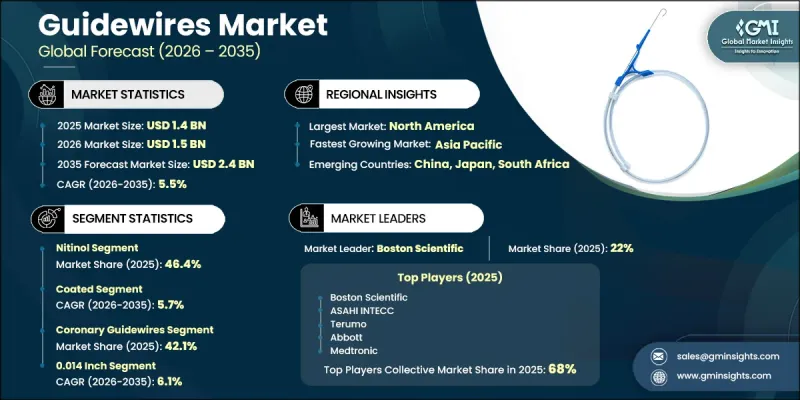
Market expansion is shaped by three interconnected structural drivers, including the rising global burden of chronic diseases that continues to increase demand for catheter-based interventions, a growing elderly population requiring frequent minimally invasive treatments, and continuous advancements in guidewire engineering such as ultra-thin Nitinol-based designs, advanced hydrophilic and antithrombogenic coatings, and hybrid composite constructions. These factors collectively support sustained utilization across established healthcare systems with high procedural intensity, while also enabling strong growth in emerging economies where healthcare infrastructure expansion is widening access to interventional procedures. The increasing preference for minimally invasive techniques over open surgical methods across cardiovascular, vascular, and urological care pathways is significantly boosting guidewire consumption by reducing recovery times, lowering complication risks, and improving cost efficiency. In interventional cardiology, percutaneous coronary intervention has become the standard approach for eligible patients, with guidewires remaining essential for vessel navigation, lesion crossing, and device placement.
| Market Scope | |
|---|---|
| Start Year | 2025 |
| Forecast Year | 2026-2035 |
| Start Value | $1.4 Billion |
| Forecast Value | $2.4 Billion |
| CAGR | 5.5% |
Nitinol-based guidewires accounted for 46.4% share in 2025 and are projected to grow at a CAGR of 5.6% through 2035. This dominance is attributed to the material's unique properties, including superelasticity and shape memory, which allow the wire to endure significant deformation and return to its original form without permanent damage. These characteristics provide superior navigation performance in complex vascular anatomies, particularly in cases involving severe tortuosity or calcified lesions, where conventional stainless steel alternatives often fail to maintain structural integrity during procedures.
The hospitals segment held 77.2% share in 2025 and is growing at a CAGR of 5.4% through 2035. This leadership is driven by the high concentration of interventional procedures performed in hospital catheterization laboratories and specialized surgical units, where guidewires are routinely used across cardiovascular, peripheral vascular, neurovascular, and urological interventions. Centralized procurement systems, long-term supplier agreements, and large-scale institutional purchasing frameworks continue to reinforce hospitals as the primary revenue-generating channel for manufacturers.
North America Guidewires Market held 37.4% share and is expected to grow at a CAGR of 4.7% through 2035. The United States remains the key growth engine in the region, supported by high healthcare spending, an extensive network of interventional facilities, and broad insurance coverage for minimally invasive procedures. Expanding outpatient interventional services and favorable reimbursement structures continue to support sustained procedural volumes across multiple clinical specialties.
Major players operating in the global guidewires industry are Abbott Laboratories, Boston Scientific, Medtronic, Terumo, Stryker, Becton Dickinson, B. Braun, Cook Medical, Teleflex, ASAHI INTECC, AngioDynamics, Cordis, Merit Medical Systems, and Olympus Corporation. Companies in the guidewires market are focusing on continuous product innovation, particularly in ultra-thin diameters, advanced tip shaping, and enhanced torque control technologies to improve procedural precision and safety. They are also investing heavily in surface engineering, including hydrophilic and antithrombogenic coatings, to reduce friction and improve navigation through complex vascular pathways. Strategic expansion into emerging healthcare markets is being prioritized through distributor partnerships and localized manufacturing to improve cost efficiency and market penetration. In addition, firms are strengthening their clinical collaboration programs with hospitals and physicians to support training, product feedback, and faster adoption of next-generation guidewires.
Table of Contents
Chapter 1 Methodology & Scope
- 1.1 Market definitions
- 1.2 Research approach
- 1.3 Quality commitments
- 1.3.1 GMI AI policy & data integrity commitment
- 1.3.1.1 Source consistency protocol
- 1.3.1 GMI AI policy & data integrity commitment
- 1.4 Research trail & confidence scoring
- 1.4.1 Research trail components
- 1.4.2 Scoring components
- 1.5 Data collection
- 1.5.1 Partial list of primary sources
- 1.6 Data mining sources
- 1.6.1 Paid sources
- 1.6.1.1 Sources, by region
- 1.6.1 Paid sources
- 1.7 Base estimates and calculations
- 1.7.1 Base year calculation for any one approach
- 1.8 Forecast model
- 1.8.1 Quantified market impact analysis
- 1.8.1.1 Mathematical impact of growth parameters on forecast
- 1.8.1 Quantified market impact analysis
- 1.9 Research transparency addendum
- 1.9.1 Source attribution framework
- 1.9.2 Quality assurance metrics
- 1.9.3 Our commitment to trust
Chapter 2 Executive Summary
- 2.1 Industry synopsis, 2022 - 2035
- 2.1.1 Business trends
- 2.1.2 Material trends
- 2.1.3 Coating trends
- 2.1.4 Application trends
- 2.1.5 Diameter trends
- 2.1.6 Length trends
- 2.1.7 End use trends
- 2.1.8 Regional trends
Chapter 3 Industry Insights
- 3.1 Industry ecosystem analysis
- 3.2 Industry impact forces
- 3.2.1 Growth drivers
- 3.2.1.1 Rising adoption of minimally invasive surgical procedures
- 3.2.1.2 Increasing number of lifestyle disorders in developing countries
- 3.2.1.3 Various reimbursement policies in developed countries
- 3.2.1.4 Growing geriatric population base across the globe
- 3.2.2 Industry pitfalls and challenges
- 3.2.2.1 High cost of guidewires
- 3.2.2.2 Dearth of skilled professionals in developing economies
- 3.2.2.3 Risks associated with guidewires
- 3.2.3 Market opportunities
- 3.2.3.1 Expansion of healthcare infrastructure in emerging economies
- 3.2.3.2 Growing adoption of image-guided and robotic-assisted interventions
- 3.2.1 Growth drivers
- 3.3 Growth potential analysis
- 3.4 Regulatory landscape (Driven by primary research)
- 3.4.1 North America
- 3.4.2 Europe
- 3.4.3 Asia Pacific
- 3.4.4 Latin America
- 3.4.5 Middle East and Africa
- 3.5 Technology landscape
- 3.5.1 Current technological trends
- 3.5.2 Emerging technologies
- 3.6 Pricing trend analysis (Driven by primary research)
- 3.7 Future market trends
- 3.8 Patent analysis
- 3.9 PESTEL analysis
- 3.10 Impact of AI and Generative AI on the market (Driven by primary research)
- 3.11 Value chain analysis (Driven by primary research)
- 3.12 Investment & funding analysis (Driven by primary research)
Chapter 4 Competitive Landscape, 2025
- 4.1 Introduction
- 4.2 Company market share analysis, by region, 2025
- 4.2.1 North America
- 4.2.2 Europe
- 4.2.3 Asia Pacific
- 4.3 Key developments
- 4.3.1 Key partnerships & collaborations
- 4.3.2 Major M&A activities
- 4.3.3 Product innovations & launches
- 4.3.4 Market expansion strategies
- 4.4 Competitive positioning matrix
Chapter 5 Market Size and Forecast, By Material, 2022 - 2035 (USD Million)
- 5.1 Key trends
- 5.2 Nitinol
- 5.3 Stainless steel
- 5.4 Hybrid
- 5.5 Other materials
Chapter 6 Market Size and Forecast, By Coating, 2022 - 2035 (USD Million)
- 6.1 Key trends
- 6.2 Coated
- 6.2.1 Hydrophilic coating
- 6.2.2 Anti-thrombogenic/Heparin coating
- 6.2.3 Hydrophobic coating
- 6.2.4 Silicone coating
- 6.2.5 Tetrafluoroethylene (TFE) coating
- 6.3 Non-coated
Chapter 7 Market Size and Forecast, By Application, 2022 - 2035 (USD Million)
- 7.1 Key trends
- 7.2 Coronary guidewires
- 7.3 Peripheral guidewires
- 7.4 Urology guidewires
- 7.5 Neurovascular guidewires
- 7.6 Other applications
Chapter 8 Market Size and Forecast, By Diameter, 2022 - 2035 (USD Million)
- 8.1 Key trends
- 8.2 0.014 inch
- 8.3 0.018 inch
- 8.4 0.025 inch
- 8.5 0.032 inch
- 8.6 0.035 inch
- 8.7 0.038 inch
Chapter 9 Market Size and Forecast, By Length, 2022 - 2035 (USD Million)
- 9.1 Key trends
- 9.2 80 - 145 cm
- 9.3 150 - 200 cm
- 9.4 210 - 300 cm
- 9.5 Above 305 cm
Chapter 10 Market Size and Forecast, By End Use, 2022 - 2035 (USD Million)
- 10.1 Key trends
- 10.2 Hospital
- 10.3 Ambulatory surgical centers
- 10.4 Other end users
Chapter 11 Market Size and Forecast, By Region, 2022 - 2035 (USD Million)
- 11.1 Key trends
- 11.2 North America
- 11.2.1 U.S.
- 11.2.2 Canada
- 11.3 Europe
- 11.3.1 Germany
- 11.3.2 France
- 11.3.3 UK
- 11.3.4 Netherlands
- 11.3.5 Spain
- 11.3.6 Italy
- 11.4 Asia Pacific
- 11.4.1 China
- 11.4.2 Japan
- 11.4.3 South Korea
- 11.4.4 India
- 11.4.5 Australia
- 11.5 Middle East & Africa
- 11.5.1 Saudi Arabia
- 11.5.2 UAE
- 11.5.3 South Africa
- 11.6 Latin America
- 11.6.1 Brazil
- 11.6.2 Argentina
- 11.6.3 Mexico
Chapter 12 Company Profiles
- 12.1 Abbott Laboratories
- 12.2 AngioDynamics
- 12.3 ASAHI INTECC
- 12.4 B. Braun SE
- 12.5 Becton, Dickinson and Company
- 12.6 Boston Scientific
- 12.7 Cordis
- 12.8 Cook Medical
- 12.9 Medtronic
- 12.10 Merit Medical Systems
- 12.11 Olympus
- 12.12 Stryker
- 12.13 Teleflex
- 12.14 Terumo

