PUBLISHER: Global Market Insights Inc. | PRODUCT CODE: 2101962

PUBLISHER: Global Market Insights Inc. | PRODUCT CODE: 2101962
Multistage Electric Submersible Pump Market Opportunity, Growth Drivers, Industry Trend Analysis, and Forecast 2026 - 2035
The Global Multistage Electric Submersible Pump Market was valued at USD 7.5 billion in 2025 and is estimated to grow at a CAGR of 5.2% to reach USD 12.5 billion by 2035.
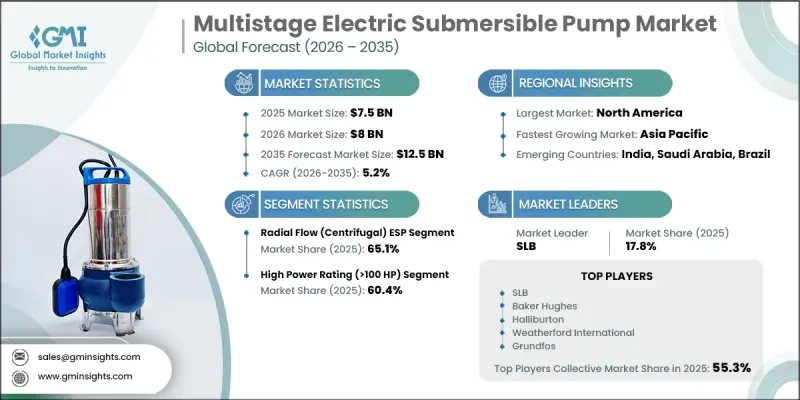
Market expansion reflects a gradually diversifying demand landscape, where traditional oil and gas applications remain important but are increasingly complemented by utilities, mining, and clean energy projects. This diversification is creating a stable mid-single-digit growth trajectory supported by long-term structural demand drivers. The rapid acceleration of electric vehicle battery supply chains is driving significant investments in lithium, cobalt, nickel, and copper mining projects, which in turn is strengthening demand for high-performance pumping systems used in mineral extraction and processing. Increasing mining depth requirements are also elevating dewatering needs, leading to higher adoption of advanced multistage configurations capable of handling greater head pressures and complex operating conditions. Across industries, the shift toward energy transition and resource security is reinforcing long-term demand visibility for these pump systems.
| Market Scope | |
|---|---|
| Start Year | 2025 |
| Forecast Year | 2026-2035 |
| Start Value | $7.5 Billion |
| Forecast Value | $12.5 Billion |
| CAGR | 5.2% |
The radial flow (centrifugal) segment accounted for 65.1% share in 2025. Its leadership is attributed to strong operational efficiency across a wide range of applications, including hydrocarbon production, groundwater extraction, and irrigation systems. This pump type is widely preferred for its ability to deliver stable performance under moderate-to-high flow conditions while maintaining hydraulic efficiency and cost-effectiveness. Its extensive installed base and compatibility with standardized well and borehole systems further reinforce its market position.
The high-power rating segment above 100 HP held a share at 60.4% in 2025. This segment's strength is driven by its use in demanding environments such as deep oil and gas wells, geothermal installations, large-scale municipal water systems, desalination operations, and underground mining dewatering projects. These applications require high-output pumping solutions capable of operating under extreme pressure and depth conditions, contributing to higher system complexity and elevated unit values.
North America Multistage Electric Submersible Pump Market reached USD 2.7 billion in 2025, accounting for 36.3% share. The region's dominance is supported by extensive oil and gas drilling activity, particularly in shale-producing basins, where high-output well completions sustain continuous demand for submersible pumping systems. In addition, ongoing upgrades to aging municipal water infrastructure and pipeline replacement initiatives are further supporting adoption across non-energy applications, strengthening overall regional demand stability.
Major companies operating in the global multistage electric submersible pump market include SLB (Schlumberger Limited), Baker Hughes Company, Halliburton Company, Weatherford International plc, Grundfos, Xylem Inc., Flowserve Corporation, Franklin Electric Co., Inc., EBARA Corporation, Sulzer Ltd, WILO SE, NOV Inc., Pentair plc, Kirloskar Brothers Ltd, Flowco Holdings Inc., Oil Dynamics GmbH, CRI Pumps Pvt. Ltd, Tianjin Premier ESP Pumping Systems, Shakti Pumps, and Caprari S.p.A. Companies operating in the multistage electric submersible pump market are focusing on strengthening their position through continuous advancements in high-efficiency pumping technologies and digital monitoring systems that improve operational reliability and predictive maintenance. Manufacturers are investing in robust product designs capable of withstanding high-pressure, high-temperature, and deep-well operating environments. Strategic partnerships with oilfield service providers and water infrastructure developers are expanding application reach and strengthening long-term contracts. Companies are also increasing investment in R&D to improve energy efficiency, reduce lifecycle costs, and enhance system durability.
Table of Contents
Chapter 1 Methodology & Scope
- 1.1 Research approach
- 1.2 Quality commitments
- 1.2.1 GMI AI policy & data integrity commitment
- 1.2.1.1 Source consistency protocol
- 1.2.1 GMI AI policy & data integrity commitment
- 1.3 Research trail & confidence scoring
- 1.3.1 Research trail components
- 1.3.2 Scoring components
- 1.4 Data collection
- 1.4.1 Partial list of primary sources
- 1.5 Data mining sources
- 1.5.1 Paid sources
- 1.5.1.1 Sources, by region
- 1.5.1 Paid sources
- 1.6 Base estimates and calculations
- 1.6.1 Base year calculation for any one approach
- 1.7 Market estimates & forecasts parameters
- 1.8 Forecast model
- 1.8.1 Quantified market impact analysis
- 1.8.1.1 Mathematical impact of growth parameters on forecast
- 1.8.1 Quantified market impact analysis
- 1.9 Research transparency addendum
- 1.9.1 Source attribution framework
- 1.9.2 Quality assurance metrics
- 1.9.3 Our commitment to trust
- 1.10 Market definitions
Chapter 2 Executive Summary
- 2.1 Industry synopsis, 2022 - 2035
- 2.1.1 Business trends
- 2.1.2 Pump type trends
- 2.1.3 Power Rating trends
- 2.1.4 End-User Industry trends
- 2.1.5 Distribution channel trends
- 2.1.6 Regional trends
Chapter 3 Industry Insights
- 3.1 Industry ecosystem analysis
- 3.1.1 Raw material suppliers (high-grade steel, copper winding, ceramics)
- 3.1.2 Component manufacturers (impellers, motors, seals, power cables)
- 3.1.3 OEM assemblers & system integrators
- 3.1.4 Distributors, rental & service providers
- 3.1.5 End-user industries
- 3.2 Industry impact forces
- 3.2.1 Growth drivers
- 3.2.2 Industry pitfalls and challenges
- 3.2.3 Market opportunities
- 3.3 Growth potential analysis
- 3.4 Regulatory landscape (Driven by primary research)
- 3.4.1 API standards (API 11S series ESP design, testing, handling)
- 3.4.2 IEC & ATEX standards for submersible motors
- 3.4.3 Environmental regulations impacting ESP fluid handling
- 3.4.4 Country-level groundwater extraction & well licensing regimes
- 3.5 Technology landscape
- 3.5.1 Permanent magnet motor (PMM) ESP technology
- 3.5.2 Variable speed drive (VSD/VFD) integration
- 3.5.3 High-temperature & high-pressure ESP advances
- 3.5.4 Corrosion-resistant & abrasion-tolerant materials
- 3.5.5 Digitally enabled ESP systems (IoT, edge analytics, remote monitoring)
- 3.6 Pricing trend analysis (Driven by primary research)
- 3.6.1 Historical price trend analysis (2018–2024) (driven by primary research)
- 3.6.2 Pricing strategy by player type (premium / value / cost-plus) (driven by primary research)
- 3.7 Future market trends
- 3.8 Porter's analysis
- 3.9 PESTEL analysis
- 3.10 Trade data analysis (driven by paid database)
- 3.10.1 Import / export volume & value trends by HS code (8413.70) (driven by primary research)
- 3.10.2 Key trade corridors & tariff impact (US–China, EU–Middle East) (driven by primary research)
- 3.11 Impact of AI & generative AI on the market
- 3.11.1 AI-driven disruption of existing business models (predictive maintenance, pump-as-a-service)
- 3.11.2 GenAI use cases & adoption roadmap by segment (well optimization, design simulation)
- 3.11.3 Risks, limitations & regulatory considerations (data security, liability in automated control)
- 3.12 Capacity & production landscape (driven by primary research)
- 3.12.1 Installed manufacturing capacity by region & key producer (driven by primary research)
- 3.12.2 Capacity utilization rates & expansion pipelines (driven by primary research)
Chapter 4 Competitive Landscape, 2025
- 4.1 Introduction
- 4.2 Company market share analysis, by region, 2025
- 4.2.1 North America
- 4.2.2 Europe
- 4.2.3 Asia Pacific
- 4.2.4 Middle East & Africa
- 4.2.5 Latin America
- 4.3 Key developments
- 4.3.1 Key partnerships & collaborations
- 4.3.2 Major M&A activities
- 4.3.3 Product innovations & launches
- 4.3.4 Market expansion strategies
- 4.4 Competitive positioning matrix
Chapter 5 Market Size and Forecast, By Pump Type, 2022 - 2035 (USD Billion)
- 5.1 Key trends
- 5.2 Radial Flow (Centrifugal) ESP
- 5.2.1 Standard Radial Flow Configuration
- 5.2.2 High-Temperature Variant (≥150°C Rated)
- 5.2.3 Articulated / Flexible-Shaft Variant (Deviated & Horizontal Wells)
- 5.3 Mixed Flow ESP
- 5.4 Axial Flow ESP
- 5.5 Progressive Cavity (Positive Displacement) ESP
- 5.5.1 Heavy Oil & High-Viscosity Fluid
- 5.5.2 Mining Slurry & Abrasive Fluid
- 5.6 Others
Chapter 6 Market Size and Forecast, By Power Rating, 2022 - 2035 (USD Billion)
- 6.1 Key trends
- 6.2 Low Power (< 15 HP)
- 6.3 Medium Power (15 HP – 100 HP)
- 6.4 High Power (> 100 HP)
Chapter 7 Market Size and Forecast, By End-User Industry, 2022 - 2035 (USD Billion)
- 7.1 Key trends
- 7.2 Oil & Gas
- 7.2.1 Onshore Conventional Wells
- 7.2.2 Onshore Unconventional (Shale / Tight) Wells
- 7.2.3 Offshore & Deepwater Wells
- 7.3 Municipal Water & Wastewater
- 7.3.1 Potable Water Supply
- 7.3.2 Sewage Pumping Stations
- 7.3.3 Municipal Wastewater Treatment & Recycling
- 7.4 Agriculture & Irrigation
- 7.4.1 Borewell Irrigation
- 7.4.2 Open Well Irrigation
- 7.5 Mining & Minerals
- 7.5.1 Underground Mine Dewatering
- 7.5.2 Surface Mining Process Fluid Handling
- 7.5.3 Critical Minerals Extraction (Lithium Brine, Copper Slurry)
- 7.6 Industrial Processing & Power
- 7.6.1 Chemical Processing (excl. upstream O&G)
- 7.6.2 Power Plant Cooling & Condensate Systems
- 7.6.3 Geothermal Energy Fluid Extraction
Chapter 8 Market Size and Forecast, By Distribution Channel, 2022 - 2035 (USD Billion)
- 8.1 Key trends
- 8.2 Direct Sales
- 8.3 Indirect sales
Chapter 9 Market Size and Forecast, By Region, 2022 - 2035 (USD Billion)
- 9.1 Key trends
- 9.2 North America
- 9.2.1 U.S.
- 9.2.2 Canada
- 9.3 Europe
- 9.3.1 Germany
- 9.3.2 France
- 9.3.3 UK
- 9.3.4 Netherlands
- 9.3.5 Spain
- 9.3.6 Italy
- 9.4 Asia Pacific
- 9.4.1 China
- 9.4.2 Japan
- 9.4.3 South Korea
- 9.4.4 India
- 9.4.5 Australia
- 9.5 Middle East & Africa
- 9.5.1 Saudi Arabia
- 9.5.2 UAE
- 9.5.3 South Africa
- 9.6 Latin America
- 9.6.1 Brazil
- 9.6.2 Argentina
- 9.6.3 Mexico
Chapter 10 Company Profiles
- 10.1 Global Players
- 10.1.1 SLB
- 10.1.2 Baker Hughes
- 10.1.3 Halliburton
- 10.1.4 Weatherford International
- 10.1.5 Grundfos
- 10.1.6 Xylem Inc.
- 10.1.7 Flowserve Corporation
- 10.2 Regional Players
- 10.2.1 EBARA Corporation
- 10.2.2 Sulzer Ltd
- 10.2.3 WILO SE
- 10.2.4 KSB SE & Co. KGaA
- 10.2.5 Kirloskar Brothers Ltd
- 10.2.6 Franklin Electric Co.
- 10.2.7 Oil Dynamics GmbH
- 10.3 Specialist Players
- 10.3.1 Flowco Holdings Inc.
- 10.3.2 Tianjin Premier ESP Pumping Systems
- 10.3.3 CRI Pumps Pvt. Ltd.
- 10.3.4 Shakti Pumps (India) Ltd
- 10.3.5 NOV Inc.
- 10.3.6 Pentair plc
- 10.3.7 Caprari S.p.A.

