PUBLISHER: Global Market Insights Inc. | PRODUCT CODE: 2101966

PUBLISHER: Global Market Insights Inc. | PRODUCT CODE: 2101966
Vitamin E Market Opportunity, Growth Drivers, Industry Trend Analysis, and Forecast 2026 - 2035
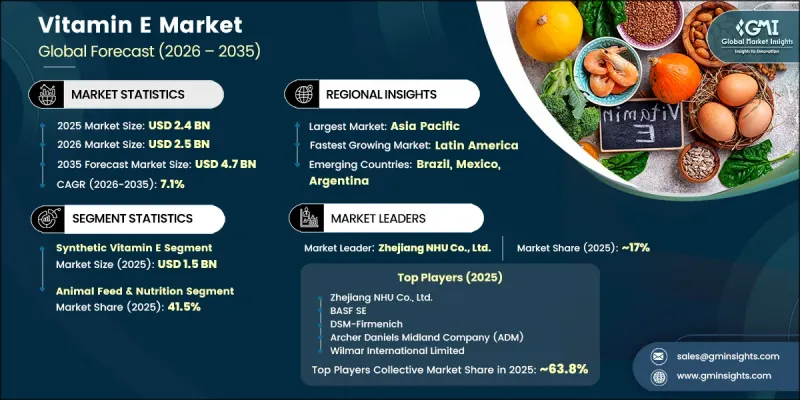
The Global Vitamin E Market was valued at USD 2.4 billion in 2025 and is estimated to grow at a CAGR of 7.1% to reach USD 4.7 billion by 2035.
The market is witnessing consistent growth as consumers are becoming increasingly focused on preventive health, balanced nutrition, and wellness-oriented lifestyles. Growing awareness about the benefits of antioxidants in managing oxidative stress has increased the adoption of vitamin E across supplements, fortified food products, and functional nutrition solutions. Rising concerns associated with lifestyle-related health challenges, including cardiovascular health, skin wellness, and immune support, are encouraging consumers to incorporate vitamin E into regular dietary routines. The increasing use of vitamin E in the personal care and cosmetics industry is also strengthening market expansion. Manufacturers are adding vitamin E to skincare and haircare formulations due to its nourishing, protective, and conditioning characteristics. Rising demand for beauty products offering hydration, skin restoration, and anti-aging benefits is encouraging wider utilization of vitamin E in cosmetic applications. Growing interest in personal grooming and wellness products among urban consumers is expected to further support segment growth.
| Market Scope | |
|---|---|
| Start Year | 2025 |
| Forecast Year | 2026-2035 |
| Start Value | $2.4 Billion |
| Forecast Value | $4.7 Billion |
| CAGR | 7.1% |
The synthetic vitamin E segment generated USD 1.5 billion in 2025 and is projected to grow at a CAGR of 7.2% from 2026 to 2035. The segment maintains a strong market presence due to its affordability, reliable supply chain, and suitability for large-scale production requirements. Synthetic vitamin E continues to be widely preferred in applications where cost efficiency and consistent product performance are essential, including animal nutrition, fortified food products, and commercial supplements. Although demand for naturally sourced alternatives is increasing, synthetic vitamin E remains important across high-volume industrial applications because of its stable availability and uniform quality. Advancements in manufacturing processes and formulation techniques are further supporting the continued adoption of synthetic vitamin E across multiple end-use industries.
The animal feed and nutrition segment was valued at USD 988.4 million in 2025, accounting for a share of 41.5%, and is expected to grow at a CAGR of 6.7% during 2026-2035. The segment is experiencing steady growth as vitamin E plays an important role in supporting animal health, reproductive performance, and overall productivity. Increasing demand for high-quality animal-based food products, combined with the expansion of commercial livestock farming, is encouraging the incorporation of vitamin E into animal feed formulations. Growing emphasis on improving nutritional value and maintaining animal wellness is further contributing to the rising adoption of vitamin E-based feed solutions.
North America Vitamin E Market generated USD 541.8 million in 2025. The regional market expansion is supported by rising consumption of dietary supplements and increasing demand from the personal care sector. The United States represents a significant contributor to regional growth due to strong consumer awareness of health and wellness products and widespread acceptance of fortified nutritional solutions. North America also benefits from advanced production capabilities, ongoing research activities, and continuous innovation in clean-label and plant-derived vitamin E formulations, which are gaining popularity among health-conscious consumers.
Major players operating in the global vitamin E industry include DSM-Firmenich, BASF SE, Wilmar International Limited, Archer Daniels Midland Company (ADM), Cargill, Incorporated, Zhejiang NHU Co., Ltd., Kemin Industries, Inc., American River Nutrition, BTSA (Biotecnologias Aplicadas S.L.), Davos Life Science, Zhejiang Worldbestve Biotechnology Co., Ltd., Vitae Naturals, Carotech Berhad, and others. Companies operating in the vitamin E industry are adopting strategies such as product innovation, expansion of production capabilities, strategic collaborations, and portfolio diversification to strengthen their market position. Manufacturers are focusing on developing high-quality vitamin E solutions that meet changing consumer preferences, including demand for naturally sourced, clean-label, and sustainable ingredients. Companies are also investing in research and development activities to improve formulation efficiency and expand applications across nutrition, animal feed, pharmaceuticals, and personal care industries.
Table of Contents
Chapter 1 Methodology & Scope
- 1.1 Market scope and definition
- 1.2 Research design
- 1.2.1 Research approach
- 1.2.2 Data collection methods
- 1.3 Data mining sources
- 1.3.1 Global
- 1.3.2 Regional/Country
- 1.4 Base estimates and calculations
- 1.4.1 Base year calculation
- 1.4.2 Key trends for market estimation
- 1.5 Primary research and validation
- 1.5.1 Primary sources
- 1.6 Forecast model
- 1.7 Research assumptions and limitations
Chapter 2 Executive Summary
- 2.1 Industry 360° synopsis
- 2.2 Key market trends
- 2.2.1 Regional
- 2.2.2 Product type
- 2.2.3 Application
- 2.3 TAM Analysis, 2026-2035
- 2.4 CXO perspectives: Strategic imperatives
Chapter 3 Industry Insights
- 3.1 Industry ecosystem analysis
- 3.1.1 Supplier landscape
- 3.1.2 Profit margin
- 3.1.3 Value addition at each stage
- 3.1.4 Factor affecting the value chain
- 3.1.5 Disruptions
- 3.2 Industry impact forces
- 3.2.1 Growth drivers
- 3.2.2 Industry pitfalls and challenges
- 3.2.3 Market opportunities
- 3.3 Growth potential analysis
- 3.4 Regulatory landscape
- 3.4.1 North America
- 3.4.2 Europe
- 3.4.3 Asia Pacific
- 3.4.4 Latin America
- 3.4.5 Middle East & Africa
- 3.5 Porter's analysis
- 3.6 PESTEL analysis
- 3.7 Price trends
- 3.7.1 By region
- 3.7.2 By type
- 3.8 Future market trends
- 3.9 Technology and Innovation landscape
- 3.9.1 Current technological trends
- 3.9.2 Emerging technologies
- 3.10 Patent Landscape
- 3.11 Trade statistics (HS code)
- 3.11.1 Major importing countries
- 3.11.2 Major exporting countries
- 3.12 Sustainability and environmental aspects
- 3.12.1 Sustainable practices
- 3.12.2 Waste reduction strategies
- 3.12.3 Energy efficiency in production
- 3.12.4 Eco-friendly initiatives
- 3.13 Carbon footprint consideration
Chapter 4 Competitive Landscape, 2025
- 4.1 Introduction
- 4.2 Company market share analysis
- 4.2.1 By region
- 4.2.1.1 North America
- 4.2.1.2 Europe
- 4.2.1.3 Asia Pacific
- 4.2.1.4 LATAM
- 4.2.1.5 MEA
- 4.2.1 By region
- 4.3 Company matrix analysis
- 4.4 Competitive analysis of major market players
- 4.5 Competitive positioning matrix
- 4.6 Key developments
- 4.6.1 Mergers & acquisitions
- 4.6.2 Partnerships & collaborations
- 4.6.3 New Product Launches
- 4.6.4 Expansion Plans
Chapter 5 Market Estimates and Forecast, By Product Type, 2022-2035 (USD Billion) (Kilo Tons)
- 5.1 Key trends
- 5.2 Natural Vitamin E
- 5.2.1 Tocopherols
- 5.2.1.1 Alpha-Tocopherol
- 5.2.1.2 Beta-Tocopherol
- 5.2.1.3 Gamma-Tocopherol
- 5.2.1.4 Delta-Tocopherol
- 5.2.2 Tocotrienols
- 5.2.2.1 Alpha-Tocotrienol
- 5.2.2.2 Beta-Tocotrienol
- 5.2.2.3 Gamma-Tocotrienol
- 5.2.2.4 Delta-Tocotrienol
- 5.2.1 Tocopherols
- 5.3 Synthetic Vitamin E
Chapter 6 Market Estimates and Forecast, By Application, 2022-2035 (USD Billion) (Kilo Tons)
- 6.1 Key trends
- 6.2 Dietary Supplements & Human Nutrition
- 6.3 Animal Feed & Nutrition
- 6.3.1 Poultry
- 6.3.2 Livestock
- 6.3.3 Aquaculture
- 6.4 Food & Beverages
- 6.4.1 Bakery & Confectionery
- 6.4.2 Dairy & Frozen Desserts
- 6.4.3 Functional Beverages
- 6.5 Cosmetics & Personal Care
- 6.5.1 Skin Care
- 6.5.2 Hair Care
- 6.5.3 Sun Care
- 6.6 Pharmaceuticals
Chapter 7 Market Estimates and Forecast, By Region, 2022-2035 (USD Billion) (Kilo Tons)
- 7.1 Key trends
- 7.2 North America
- 7.2.1 U.S.
- 7.2.2 Canada
- 7.3 Europe
- 7.3.1 Germany
- 7.3.2 UK
- 7.3.3 France
- 7.3.4 Spain
- 7.3.5 Italy
- 7.3.6 Rest of Europe
- 7.4 Asia Pacific
- 7.4.1 China
- 7.4.2 India
- 7.4.3 Japan
- 7.4.4 Australia
- 7.4.5 South Korea
- 7.4.6 Rest of Asia Pacific
- 7.5 Latin America
- 7.5.1 Brazil
- 7.5.2 Mexico
- 7.5.3 Argentina
- 7.5.4 Rest of Latin America
- 7.6 Middle East and Africa
- 7.6.1 Saudi Arabia
- 7.6.2 South Africa
- 7.6.3 UAE
- 7.6.4 Rest of Middle East and Africa
Chapter 8 Company Profiles
- 8.1 BASF SE
- 8.2 DSM-Firmenich
- 8.3 Archer Daniels Midland Company (ADM)
- 8.4 Zhejiang NHU Co., Ltd.
- 8.5 Wilmar International Limited
- 8.6 Cargill, Incorporated
- 8.7 Kemin Industries, Inc.
- 8.8 BTSA (Biotecnologias Aplicadas S.L.)
- 8.9 Zhejiang Worldbestve Biotechnology Co., Ltd.
- 8.10 American River Nutrition
- 8.11 Davos Life Science
- 8.12 Vitae Naturals
- 8.13 Carotech Berhad

