PUBLISHER: Global Market Insights Inc. | PRODUCT CODE: 2101969

PUBLISHER: Global Market Insights Inc. | PRODUCT CODE: 2101969
Laboratory Vacuum Pumps Market Opportunity, Growth Drivers, Industry Trend Analysis, and Forecast 2026 - 2035
The Global Laboratory Vacuum Pumps Market was valued at USD 1.9 billion in 2025 and is estimated to grow at a CAGR of 6.5% to reach USD 3.5 billion by 2035.
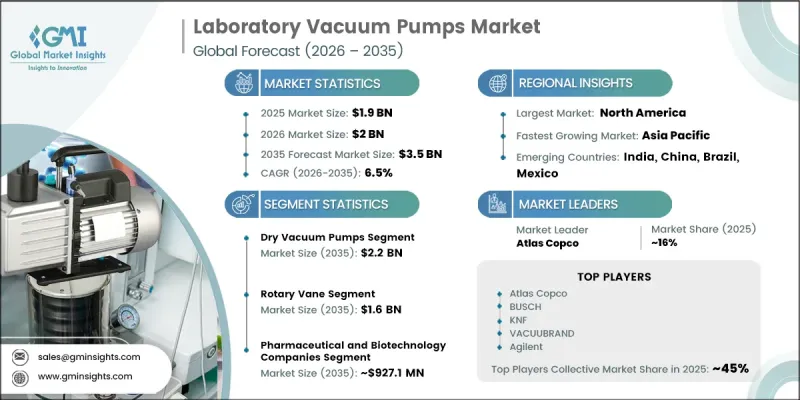
The market growth is supported by rising demand for advanced laboratory infrastructure, increasing diagnostic activities in healthcare, and expanding pharmaceutical and biotechnology research operations. Laboratory vacuum pumps are critical equipment designed to generate controlled vacuum conditions that support various laboratory procedures, including filtration, drying, distillation, and analytical processes. These systems are extensively used across pharmaceutical production, biotechnology applications, clinical testing facilities, and research institutions. Laboratory vacuum pumps are available in dry and wet configurations and incorporate technologies such as rotary vane, screw, claw, and diaphragm mechanisms to address diverse operational requirements. The increasing requirement for sophisticated medical and analytical equipment that depends on vacuum technology is contributing to market expansion. Additionally, the growing number of diagnostic laboratories, driven by higher disease prevalence, increasing emphasis on early detection, and rising adoption of preventive healthcare practices, is strengthening demand for reliable laboratory vacuum systems. The continued development of independent diagnostic facilities, hospital laboratories, and specialized testing centers is increasing laboratory workloads and encouraging investments in efficient vacuum equipment.
| Market Scope | |
|---|---|
| Start Year | 2025 |
| Forecast Year | 2026-2035 |
| Start Value | $1.9 Billion |
| Forecast Value | $3.5 Billion |
| CAGR | 6.5% |
The dry vacuum pumps segment accounted for 59.7% share in 2025, supported by advantages such as cleaner operation, reduced maintenance needs, and improved energy efficiency in laboratory settings. Dry vacuum pumps are increasingly preferred across pharmaceutical, biotechnology, and research environments because they operate without oil or liquid-based sealing systems, reducing contamination risks during sensitive procedures. Their ability to maintain high-purity conditions makes them suitable for applications requiring controlled environments and precise performance. The rising demand for reliable laboratory processes, combined with strict quality requirements in life science and analytical applications, continues to encourage the adoption of dry vacuum pump technologies.
The pharmaceutical and biotechnology companies segment generated USD 927.1 million in 2025. The segment's strong position is attributed to the widespread use of vacuum systems throughout pharmaceutical research, drug development, and manufacturing activities. These companies depend on laboratory vacuum pumps for processes requiring accurate pressure management and contamination-free conditions. Growing investments in advanced therapies, biologics, and biosimilar development are further increasing the need for high-performance vacuum equipment capable of supporting complex laboratory operations.
U.S. Laboratory Vacuum Pumps Market was valued at USD 735.2 million in 2025. The North America laboratory vacuum pumps market is being supported by strong pharmaceutical and biotechnology research activities, along with a well-established life sciences ecosystem and continuous investment in scientific innovation. The region includes a large base of pharmaceutical companies, biotechnology organizations, and research centers involved in drug development, advanced healthcare research, and laboratory-based innovation. These activities require highly controlled laboratory environments where vacuum pumps are essential for procedures such as sample preparation, filtration, and solvent processing.
Key companies operating in the global laboratory vacuum pumps industry include Agilent, BUSCH, Atlas Copco, EDWARDS, KNF, ULVAC, Leybold, VACUUBRAND, Graham, PFEIFFER, SHIMADZU, Ebara Technologies, DEKKER, gast, and WELCH. Companies operating in the laboratory vacuum pumps market are strengthening their market position through product innovation, technology upgrades, strategic partnerships, and expansion into emerging application areas. Manufacturers are focusing on developing energy-efficient, low-maintenance, and contamination-resistant vacuum solutions to meet the evolving needs of pharmaceutical, biotechnology, and research laboratories. Businesses are also investing in advanced engineering capabilities to improve pump performance, durability, and operational efficiency. Strategic collaborations with research organizations and end users help companies understand changing laboratory requirements and develop application-specific solutions.
Table of Contents
Chapter 1 Research Methodology
- 1.1 Research approach
- 1.2 Quality commitments
- 1.2.1 GMI AI policy & data integrity commitment
- 1.2.1.1 Source consistency protocol
- 1.2.1 GMI AI policy & data integrity commitment
- 1.3 Research trail & confidence scoring
- 1.3.1 Research trail components
- 1.3.2 Scoring components
- 1.4 Data collection
- 1.4.1 Partial list of primary sources
- 1.5 Data mining sources
- 1.5.1 Paid sources
- 1.5.1.1 Sources, by region
- 1.5.1 Paid sources
- 1.6 Base estimates and calculations
- 1.6.1 Base year calculation
- 1.7 Forecast model
- 1.7.1 Quantified market impact analysis
- 1.7.1.1 Mathematical impact of growth parameters on forecast
- 1.7.1 Quantified market impact analysis
- 1.8 Research transparency addendum
- 1.8.1 Source attribution framework
- 1.8.2 Quality assurance metrics
- 1.8.3 Our commitment to trust
Chapter 2 Executive Summary
- 2.1 Industry 360° synopsis
- 2.2 Key market trends
- 2.2.1 Regional trends
- 2.2.2 Product trends
- 2.2.3 Technology trends
- 2.2.4 Application trends
- 2.2.5 End use trends
- 2.3 CXO perspectives: Strategic imperatives
Chapter 3 Industry Insights
- 3.1 Industry ecosystem analysis
- 3.2 Industry impact forces
- 3.2.1 Growth drivers
- 3.2.1.1 Increasing demand for diagnostic laboratories in the healthcare sector
- 3.2.1.2 Growth in pharmaceutical and biotechnology research activities
- 3.2.1.3 Rising adoption of advanced medical devices requiring vacuum technology
- 3.2.1.4 Expanding biopharmaceutical industry and vaccine production
- 3.2.1.5 Technological advancements
- 3.2.2 Industry pitfalls and challenges
- 3.2.2.1 Stringent regulatory requirements for medical devices and lab equipment
- 3.2.2.2 Maintenance challenges and operational costs of certain vacuum pumps
- 3.2.3 Opportunities
- 3.2.3.1 Integration of smart pumps with laboratory information management systems (LIMS)
- 3.2.3.2 Expansion of CDMO and CRO capacities in emerging markets
- 3.2.1 Growth drivers
- 3.3 Growth potential analysis
- 3.4 Regulatory landscape
- 3.5 Pricing analysis, 2025
- 3.6 Technology and innovation landscape (Driven by Primary Research)
- 3.6.1 Current technological trends
- 3.6.2 Emerging technologies
- 3.7 Future market trends (Driven by Primary Research)
- 3.8 Impact of AI & Generative AI on the Market (Driven by Primary Research)
- 3.9 Porter's analysis
- 3.10 PESTEL analysis
Chapter 4 Competitive Landscape, 2025
- 4.1 Introduction
- 4.2 Company matrix analysis
- 4.3 Company market share analysis (Driven by Primary Research)
- 4.3.1 Global
- 4.3.2 North America
- 4.3.3 Europe
- 4.3.4 Asia Pacific
- 4.3.5 LAMEA
- 4.4 Competitive analysis of major market players
- 4.5 Competitive positioning matrix
- 4.6 Key developments
- 4.6.1 Mergers & acquisitions
- 4.6.2 Partnerships & collaborations
- 4.6.3 New product launches
- 4.6.4 Expansion plans
Chapter 5 Market Estimates and Forecast, By Product, 2022 - 2035 ($ Mn)
- 5.1 Key trends
- 5.2 Dry vacuum pumps
- 5.3 Wet vacuum pumps
- 5.4 Combination vacuum pumps
Chapter 6 Market Estimates and Forecast, By Technology, 2022 - 2035 ($ Mn)
- 6.1 Key trends
- 6.2 Rotary vane
- 6.3 Rotary screw
- 6.4 Rotary claw
- 6.5 Other technologies
Chapter 7 Market Estimates and Forecast, By Application, 2022 - 2035 ($ Mn)
- 7.1 Key trends
- 7.2 Filtering
- 7.3 Drying
- 7.4 Distillation
- 7.5 Other application
Chapter 8 Market Estimates and Forecast, By End Use, 2022 - 2035 ($ Mn)
- 8.1 Key trends
- 8.2 Pharmaceutical and biotechnology companies
- 8.3 Hospitals and diagnostic labs
- 8.4 Academic and research institutes
- 8.5 Other end users
Chapter 9 Market Estimates and Forecast, By Region, 2022 - 2035 ($ Mn)
- 9.1 Key trends
- 9.2 North America
- 9.2.1 U.S.
- 9.2.2 Canada
- 9.3 Europe
- 9.3.1 Germany
- 9.3.2 UK
- 9.3.3 France
- 9.3.4 Spain
- 9.3.5 Italy
- 9.3.6 Netherlands
- 9.4 Asia Pacific
- 9.4.1 China
- 9.4.2 Japan
- 9.4.3 India
- 9.4.4 Australia
- 9.4.5 South Korea
- 9.5 Latin America
- 9.5.1 Brazil
- 9.5.2 Mexico
- 9.5.3 Argentina
- 9.6 MEA
- 9.6.1 South Africa
- 9.6.2 Saudi Arabia
- 9.6.3 UAE
Chapter 10 Company Profiles
- 10.1 Agilent
- 10.2 Atlas Copco
- 10.3 BUSCH
- 10.4 DEKKER
- 10.5 Ebara Technologies
- 10.6 EDWARDS
- 10.7 gast
- 10.8 Graham
- 10.9 KNF
- 10.10 Leybold
- 10.11 PFEIFFER
- 10.12 SHIMADZU
- 10.13 ULVAC
- 10.14 VACUUBRAND
- 10.15 WELCH

