PUBLISHER: Global Market Insights Inc. | PRODUCT CODE: 2101972

PUBLISHER: Global Market Insights Inc. | PRODUCT CODE: 2101972
Interface IC Market Opportunity, Growth Drivers, Industry Trend Analysis, and Forecast 2026 - 2035
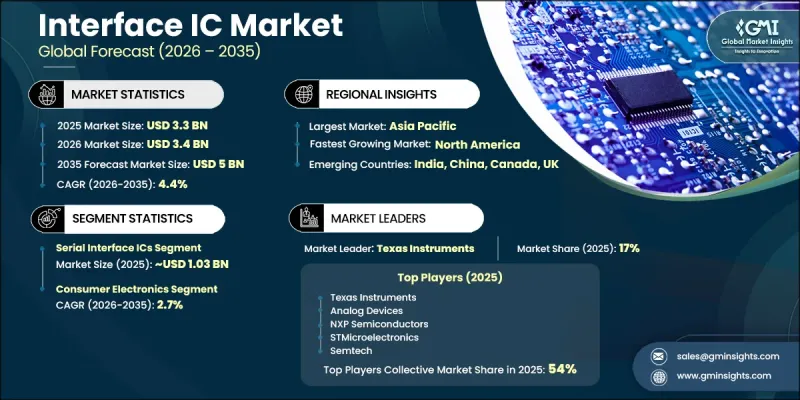
The Global Interface IC Market was valued at USD 3.3 billion in 2025 and is estimated to grow at a CAGR of 4.4% to reach USD 5 billion by 2035.
Market growth is supported by increasing demand for advanced connectivity solutions across consumer electronics, automotive systems, industrial automation, and communication infrastructure. The expansion of high-speed data transmission technologies, rising electronic integration in modern vehicles, and growing adoption of connected industrial devices are creating new opportunities for interface IC manufacturers. The increasing complexity of electronic systems is driving demand for reliable communication components that enable efficient data exchange between processors, memory units, sensors, and connected devices. Growing deployment of artificial intelligence infrastructure is further increasing the requirement for advanced interface solutions capable of supporting high-performance computing environments. Interface ICs are becoming increasingly important in managing signal integrity, improving communication efficiency, and supporting next-generation electronic architectures. Industrial automation, telecom networks, and IoT applications are also contributing to market development as organizations continue to adopt connected technologies. As digital transformation accelerates across multiple industries, the Interface IC market is expected to maintain steady expansion throughout the forecast period.
| Market Scope | |
|---|---|
| Start Year | 2025 |
| Forecast Year | 2026-2035 |
| Start Value | $3.3 Billion |
| Forecast Value | $5 Billion |
| CAGR | 4.4% |
The serial interface IC segment represented 31.1% share in 2025, equivalent to USD 1.03 billion. This segment maintains its leading position due to the widespread use of communication protocols that support embedded systems, industrial equipment, and automotive electronics. Serial interface technologies continue to serve as essential components in various applications requiring reliable data communication between electronic devices. Their established presence across multiple industries and compatibility with diverse system architectures continue to support sustained demand.
The consumer electronics segment accounted for 25.8% share in 2025, generating USD 851 million. The segment is expected to grow at a CAGR of 2.7%, reflecting a mature market environment combined with continued demand for advanced connectivity features. While growth in device volumes remains moderate, increasing complexity within electronic products is creating opportunities for higher-value interface solutions. The transition toward advanced connectivity standards in premium consumer devices is encouraging the adoption of more sophisticated interface controllers with improved functionality and performance.
North America Interface IC Market accounted for 34.7% share, generating USD 1.14 billion in 2025, and is projected to grow at a CAGR of 5.1% during 2026-2035. Regional growth is primarily supported by increasing investments in artificial intelligence infrastructure, advanced computing systems, and high-performance data center technologies. Growing demand for advanced server components, memory connectivity solutions, and high-speed communication technologies is creating significant opportunities for interface IC suppliers. The continued expansion of digital infrastructure across the United States is expected to further strengthen regional market growth.
Major companies operating in the global Interface IC industry include Realtek Semiconductor, Analog Devices, Texas Instruments, Infineon Technologies, NXP Semiconductors, Renesas Electronics, Microchip Technology, STMicroelectronics, onsemi, Marvell Technology, MaxLinear, Semtech, Diodes Incorporated, and Credo Semiconductor. Companies operating in the Interface IC market are strengthening their market position by focusing on technological innovation, product diversification, and advanced connectivity solutions. Manufacturers are investing in research and development activities to create interface components with improved speed, efficiency, reliability, and compatibility across emerging applications. Strategic partnerships, semiconductor technology advancements, and expansion into high-growth sectors such as artificial intelligence infrastructure, automotive electronics, and industrial automation are becoming important growth strategies. Companies are also enhancing their product portfolios by developing solutions that support evolving communication standards and increasingly complex electronic architectures.
Table of Contents
Chapter 1 Methodology & Scope
- 1.1 Research approach
- 1.2 Quality commitments
- 1.2.1 GMI AI policy & data integrity commitment
- 1.2.1.1 Source consistency protocol
- 1.2.1 GMI AI policy & data integrity commitment
- 1.3 Research trail & confidence scoring
- 1.3.1 Research trail components
- 1.3.2 Scoring components
- 1.4 Data collection
- 1.4.1 Partial list of primary sources
- 1.5 Data mining sources
- 1.5.1 Paid sources
- 1.5.1.1 Sources, by region
- 1.5.1 Paid sources
- 1.6 Base estimates and calculations
- 1.6.1 Base year calculation for any one approach
- 1.7 Market estimates & forecasts parameters
- 1.8 Forecast model
- 1.8.1 Quantified market impact analysis
- 1.8.1.1 Mathematical impact of growth parameters on forecast
- 1.8.1 Quantified market impact analysis
- 1.9 Research transparency addendum
- 1.9.1 Source attribution framework
- 1.9.2 Quality assurance metrics
- 1.9.3 Our commitment to trust
- 1.10 Market definitions
Chapter 2 Executive Summary
- 2.1 Industry synopsis, 2022 - 2035
- 2.1.1 Product type trends
- 2.1.2 End-user industry trends
- 2.1.3 Regional trends
Chapter 3 Industry Insights
- 3.1 Industry ecosystem analysis
- 3.2 Industry impact forces
- 3.2.1 Growth drivers
- 3.2.1.1 Rapid expansion of AI servers and data centers
- 3.2.1.2 Rising automotive electronics and EV adoption
- 3.2.1.3 Increasing production of connected consumer electronics Expanding
- 3.2.1.4 5G infrastructure and telecom equipment
- 3.2.2 Industry pitfalls and challenges
- 3.2.2.1 Supply constraints for advanced semiconductor manufacturing
- 3.2.2.2 Complex validation for multiple communication standards
- 3.2.3 Market opportunities
- 3.2.3.1 Increasing adoption of chiplet-based processor architectures
- 3.2.3.2 Growing deployment of software-defined vehicles
- 3.2.1 Growth drivers
- 3.3 Growth potential analysis
- 3.4 Regulatory landscape (Driven by primary research)
- 3.4.1 North America
- 3.4.2 Europe
- 3.4.3 Asia Pacific
- 3.4.4 Latin America
- 3.4.5 MEA
- 3.5 Technology landscape
- 3.5.1 Current technological trends
- 3.5.2 Emerging technologies
- 3.6 Pricing trend analysis (Driven by primary research)
- 3.7 Future market trends
- 3.8 Patent analysis
- 3.9 Porter's analysis
- 3.10 PESTEL analysis
- 3.11 Impact of AI and Generative AI on the market (Driven by primary research)
- 3.12 Value chain analysis (Driven by primary research)
- 3.13 Investment & funding analysis (Driven by primary research)
- 3.14 Consumer insights (Driven by primary research)
Chapter 4 Competitive Landscape, 2025
- 4.1 Introduction
- 4.2 Company market share analysis, by region, 2025
- 4.2.1 North America
- 4.2.2 Europe
- 4.2.3 Asia Pacific
- 4.2.4 Middle East & Africa
- 4.2.5 Latin America
- 4.3 Key developments
- 4.3.1 Key partnerships & collaborations
- 4.3.2 Major M&A activities
- 4.3.3 Product innovations & launches
- 4.3.4 Market expansion strategies
- 4.4 Competitive positioning matrix
Chapter 5 Market Size and Forecast, By Product Type, 2022 - 2035 (USD Million)
- 5.1 Key trends
- 5.2 Serial interface ICs
- 5.3 USB interface ICs
- 5.4 Ethernet interface ICs
- 5.5 Display & video interface ICs
- 5.6 High-speed interface ICs
- 5.7 Signal management interface ICs
- 5.8 Others
Chapter 6 Market Size and Forecast, By End-Use Industry, 2022 - 2035 (USD Million)
- 6.1 Key trends
- 6.2 Consumer electronics
- 6.3 Automotive
- 6.4 Industrial automation
- 6.5 Telecommunications & data centers
- 6.6 Healthcare
- 6.7 Aerospace & defense
- 6.8 Others
Chapter 7 Market Size and Forecast, By Region, 2022 - 2035 (USD Million)
- 7.1 Key trends
- 7.2 North America
- 7.2.1 U.S.
- 7.2.2 Canada
- 7.3 Europe
- 7.3.1 Germany
- 7.3.2 France
- 7.3.3 UK
- 7.3.4 Spain
- 7.3.5 Italy
- 7.4 Asia Pacific
- 7.4.1 China
- 7.4.2 Japan
- 7.4.3 South Korea
- 7.4.4 India
- 7.4.5 Australia
- 7.5 Middle East & Africa
- 7.5.1 Saudi Arabia
- 7.5.2 UAE
- 7.5.3 South Africa
- 7.6 Latin America
- 7.6.1 Brazil
- 7.6.2 Argentina
- 7.6.3 Mexico
Chapter 8 Company Profiles
- 8.1 Analog Devices
- 8.2 Texas Instruments
- 8.3 Infineon Technologies
- 8.4 NXP Semiconductors
- 8.5 Renesas Electronics
- 8.6 Microchip Technology
- 8.7 STMicroelectronics
- 8.8 onsemi
- 8.9 Marvell Technology
- 8.10 MaxLinear
- 8.11 Semtech
- 8.12 Diodes Incorporated
- 8.13 Credo Semiconductor
- 8.14 Realtek Semiconductor

