PUBLISHER: Global Market Insights Inc. | PRODUCT CODE: 2101975

PUBLISHER: Global Market Insights Inc. | PRODUCT CODE: 2101975
Fog Computing Market Opportunity, Growth Drivers, Industry Trend Analysis, and Forecast 2026 - 2035
The Global Fog Computing Market was valued at USD 405.3 million in 2025 and is estimated to grow at a CAGR of 16.4% to reach USD 1.8 billion by 2035.
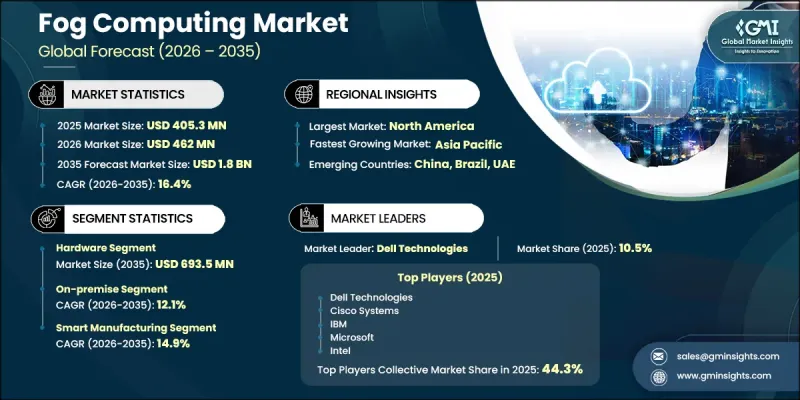
Growth is driven by the need for ultra-low latency processing, improved bandwidth efficiency, and stronger local data governance across connected environments. As digital transformation accelerates, enterprises are increasingly shifting compute workloads closer to data generation points to support real-time decision-making. Applications such as industrial automation, autonomous systems, healthcare monitoring, and robotics require response times that centralized cloud models cannot consistently deliver. At the same time, expanding 5G networks and ultra-reliable low-latency communication requirements are reinforcing the importance of edge-adjacent computing layers. Industrial digitalization initiatives are also pushing compute resources directly into operational environments such as factories, utilities, and logistics hubs. The rapid rise in data generated from connected sensors, machine vision systems, and smart devices is further increasing demand for localized processing. By reducing data transmission to centralized cloud infrastructure, organizations are lowering latency, optimizing costs, and improving operational resilience across distributed networks.
| Market Scope | |
|---|---|
| Start Year | 2025 |
| Forecast Year | 2026-2035 |
| Start Value | $405.3 Million |
| Forecast Value | $1.8 Billion |
| CAGR | 16.4% |
The hardware segment generated USD 188.3 million in 2025. This segment includes edge servers, industrial gateways, embedded computing units, networking infrastructure, and specialized appliances deployed close to data sources. These components form the foundational layer of fog architectures, enabling real-time data processing and localized decision-making across distributed environments.
The on-premise deployment segment reached USD 211.3 million, representing 52.1% share, and is projected to grow at a CAGR of 12.1% through 2035. This deployment model remains widely adopted in sectors requiring strict data control and high operational reliability, including healthcare, defense, financial services, and industrial operations. It is particularly favored in environments where regulatory compliance, deterministic performance, and system uptime are critical, as it reduces dependence on external cloud infrastructure and supports secure localized processing.
North America Fog Computing Market accounted for USD 168 million, representing 41.5% in 2025, and is projected to reach USD 778.7 million by 2035 at a CAGR of 16.8%. The region's growth is supported by strong investment in digital infrastructure modernization, along with structured cybersecurity and edge computing frameworks that guide enterprise adoption and deployment strategies across industries.
Major players operating in the global fog computing market include Microsoft, Amazon Web Services (AWS), Cisco Systems, Intel, IBM, Dell Technologies, Hewlett Packard Enterprise (HPE), Siemens, Schneider Electric, and Fujitsu. Companies in the fog computing market are focusing on strengthening edge-to-cloud integration capabilities to ensure seamless workload distribution across hybrid environments. Many vendors are investing in ruggedized and high-performance edge hardware designed for industrial-grade deployments. Strategic partnerships with telecom providers and cloud hyperscalers are helping expand ecosystem interoperability. Firms are also prioritizing development of unified orchestration platforms that simplify device management, security enforcement, and application deployment across distributed nodes. Increased investment in AI-enabled edge analytics is enhancing real-time decision-making capabilities.
Table of Contents
Chapter 1 Methodology & Scope
- 1.1 Research approach
- 1.2 Quality Commitments
- 1.2.1 GMI AI policy & data integrity commitment
- 1.2.1.1 Source consistency protocol
- 1.2.1 GMI AI policy & data integrity commitment
- 1.3 Research Trail & Confidence Scoring
- 1.3.1 Research Trail Components
- 1.3.2 Scoring Components
- 1.4 Data Collection
- 1.4.1 Partial list of primary sources
- 1.5 Data mining sources
- 1.5.1 Paid sources
- 1.5.1.1 Sources, by region
- 1.5.1 Paid sources
- 1.6 Base estimates and calculations
- 1.6.1 Base year calculation
- 1.7 Forecast
- 1.7.1 Quantified market impact analysis
- 1.7.1.1 Mathematical impact of growth parameters on forecast
- 1.7.1 Quantified market impact analysis
- 1.8 Research transparency addendum
- 1.8.1 Source attribution framework
- 1.8.2 Quality assurance metrics
- 1.8.3 Our commitment to trust
Chapter 2 Executive Summary
- 2.1 Industry 360° synopsis
- 2.2 Key market trends
- 2.2.1 Regional
- 2.2.2 Component
- 2.2.3 Deployment Model
- 2.2.4 Application
- 2.2.5 Industry Vertical
- 2.3 TAM Analysis, 2026-2035
- 2.4 CXO perspectives: Strategic imperatives
Chapter 3 Industry Insights
- 3.1 Industry ecosystem analysis
- 3.1.1 Supplier landscape
- 3.1.1.1 Raw material suppliers
- 3.1.1.2 Component suppliers
- 3.1.1.3 Manufacturers
- 3.1.1.4 Service providers
- 3.1.1.5 Distribution channel
- 3.1.1.6 End Use
- 3.1.2 Cost structure
- 3.1.3 Profit margin
- 3.1.4 Value addition at each stage
- 3.1.5 Vertical integration trends
- 3.1.6 Disruptors
- 3.1.1 Supplier landscape
- 3.2 Industry impact forces
- 3.2.1 Growth drivers
- 3.2.1.1 Exponential Growth of IoT Devices & M2M Communication
- 3.2.1.2 Rising Demand for Low-Latency Real-Time Data Processing
- 3.2.1.3 Rapid 5G Network Rollout Enabling Distributed Compute at the Edge
- 3.2.1.4 Accelerating Industry 4.0 & Smart Manufacturing Adoption
- 3.2.1.5 Increasing Focus on Data Privacy & Localized Processing
- 3.2.2 Market Restraints
- 3.2.2.1 Fragmented Technology Standards & Interoperability Challenges
- 3.2.2.2 High Implementation & Infrastructure Costs, Especially for SMEs
- 3.2.2.3 Competition from Low-Cost Centralized Cloud Infrastructure
- 3.2.3 Market Opportunities
- 3.2.3.1 Convergence of Fog Computing with Edge AI & ML
- 3.2.3.2 Smart City Expansion Programs in Emerging Economies
- 3.2.3.3 Growth of Autonomous Vehicles & V2X Communication Networks
- 3.2.3.4 Fog-as-a-Service (FaaS) Emergence as a New Delivery Model
- 3.2.1 Growth drivers
- 3.3 Growth potential analysis
- 3.4 Pricing Analysis (Driven by Primary Research)
- 3.4.1 Historical Price Trend Analysis
- 3.4.2 Pricing Strategy by Player Type (Premium / Value / Cost-plus)
- 3.5 Regulatory landscape
- 3.5.1 North America
- 3.5.1.1 United States - Federal Communications Commission (FCC), U.S. Department of Energy (DOE), and National Institute of Standards and Technology (NIST)
- 3.5.1.2 Canada - Innovation, Science and Economic Development Canada (ISED) and Canadian Centre for Cyber Security (CCCS)
- 3.5.2 Europe
- 3.5.2.1 United Kingdom - Information Commissioner's Office (ICO) and Department for Science, Innovation and Technology (DSIT)
- 3.5.2.2 Germany - Federal Office for Information Security (BSI)
- 3.5.2.3 France - National Commission on Informatics and Liberty (CNIL)
- 3.5.2.4 European Union - European Commission (EC) and European Union Agency for Cybersecurity (ENISA)
- 3.5.3 Asia-Pacific
- 3.5.3.1 China - Cyberspace Administration of China (CAC) and Ministry of Industry and Information Technology (MIIT)
- 3.5.3.2 India - Ministry of Electronics and Information Technology (MeitY)
- 3.5.3.3 Japan - Ministry of Internal Affairs and Communications (MIC)
- 3.5.4 Latin America
- 3.5.4.1 Brazil - National Data Protection Authority (ANPD)
- 3.5.5 Middle East & Africa
- 3.5.5.1 United Arab Emirates (UAE) - Telecommunications and Digital Government Regulatory Authority (TDRA)
- 3.5.1 North America
- 3.6 Technology and Innovation landscape
- 3.6.1 Current technologies
- 3.6.2 Emerging technologies
- 3.7 Porter's analysis
- 3.8 PESTEL analysis
- 3.9 Patent analysis (Driven by Primary Research)
- 3.10 Impact of AI & generative AI on the market
- 3.10.1 AI-Driven Disruption of Existing Business Models
- 3.10.2 Automated design optimization
- 3.10.3 Supply chain AI for demand forecasting
- 3.10.4 GenAI use cases & adoption roadmap by segment
- 3.10.5 Risks, Limitations & Regulatory Considerations
- 3.11 Sustainability and environmental aspects
- 3.11.1 Sustainable practices
- 3.11.2 Waste reduction strategies
- 3.11.3 Energy efficiency in production
- 3.11.4 Eco-friendly Initiatives
- 3.11.5 Carbon footprint considerations
- 3.12 Forecast assumptions & scenario analysis (Driven by Primary Research)
- 3.12.1 Base Case - key macro & industry variables driving CAGR
- 3.12.2 Optimistic Scenarios - Favorable Macro and Industry Tailwinds
- 3.12.3 Pessimistic Scenario - Macroeconomic slowdown or industry headwinds
Chapter 4 Competitive Landscape, 2025
- 4.1 Introduction
- 4.2 Company market share analysis
- 4.2.1 North America
- 4.2.2 Europe
- 4.2.3 Asia-Pacific
- 4.2.4 Latin America
- 4.2.5 Middle East & Africa
- 4.3 Competitive positioning matrix
- 4.4 Key developments
- 4.4.1 Mergers & acquisitions
- 4.4.2 Partnerships & collaborations
- 4.4.3 New product launches
- 4.4.4 Expansion plans and funding
- 4.5 Company tier benchmarking
- 4.5.1 Tier classification criteria & qualifying thresholds
- 4.5.2 Tier positioning matrix by revenue, geography & innovation
Chapter 5 Market Estimates & Forecast, By Component, 2022 - 2035 ($Mn)
- 5.1 Key trends
- 5.2 Hardware
- 5.2.1 Edge Gateways
- 5.2.2 Routers & Switches
- 5.2.3 Sensors & Micro Data Sensors
- 5.2.4 IP Video Cameras
- 5.2.5 Industrial PCs & Servers
- 5.3 Software & Platforms
- 5.3.1 Fog Computing Platforms & Middleware
- 5.3.2 Orchestration & Workload Management Software
- 5.3.3 Analytics & AI Software
- 5.3.4 Security & Compliance Software
- 5.4 Services
- 5.4.1 Professional Services
- 5.4.2 Managed Services
Chapter 6 Market Estimates & Forecast, By Deployment Model, 2022 - 2035 ($Mn)
- 6.1 Key trends
- 6.2 On-Premise
- 6.3 Cloud-Based
- 6.4 Hybrid
Chapter 7 Market Estimates & Forecast, By Application, 2022 - 2035 ($Mn)
- 7.1 Key trends
- 7.2 Smart Manufacturing
- 7.3 Smart Cities & Building Automation
- 7.4 Connected Healthcare
- 7.5 Connected Vehicles & Transportation
- 7.6 Smart Energy & Grids
- 7.7 Security & Emergency Systems
- 7.8 Others
Chapter 8 Market Estimates & Forecast, By Network Connectivity, 2022 - 2035 ($Mn)
- 8.1 Key trends
- 8.2 Wired
- 8.2.1 Ethernet
- 8.2.2 Fiber Optic
- 8.2.3 Others (Coaxial, PLC, Legacy Industrial Protocols)
- 8.3 Wireless
- 8.3.1 Wi-Fi (IEEE 802.11)
- 8.3.2 5G & 4G LTE
- 8.3.3 LPWAN (LoRa, Sigfox, NB-IoT)
- 8.3.4 Short-Range Wireless (Bluetooth, Zigbee)
- 8.3.5 Others
Chapter 9 Market Estimates & Forecast, By Industry Vertical, 2022 - 2035 ($Mn)
- 9.1 Key trends
- 9.2 Manufacturing
- 9.3 IT & Telecom
- 9.4 Healthcare & Life Sciences
- 9.5 BFSI
- 9.6 Energy & Utilities
- 9.7 Government & Defense
- 9.8 Retail & E-Commerce
- 9.9 Transportation & Logistics
- 9.10 Others
Chapter 10 Market Estimates & Forecast, By Region, 2022 - 2035 ($Mn)
- 10.1 North America
- 10.1.1 US
- 10.1.2 Canada
- 10.2 Europe
- 10.2.1 UK
- 10.2.2 Germany
- 10.2.3 France
- 10.2.4 Italy
- 10.2.5 Spain
- 10.2.6 Belgium
- 10.2.7 Netherlands
- 10.2.8 Sweden
- 10.2.9 Russia
- 10.3 Asia Pacific
- 10.3.1 China
- 10.3.2 India
- 10.3.3 Japan
- 10.3.4 Australia
- 10.3.5 Singapore
- 10.3.6 South Korea
- 10.3.7 Vietnam
- 10.3.8 Indonesia
- 10.3.9 Thailand
- 10.4 Latin America
- 10.4.1 Brazil
- 10.4.2 Mexico
- 10.4.3 Argentina
- 10.5 MEA
- 10.5.1 South Africa
- 10.5.2 Saudi Arabia
- 10.5.3 UAE
Chapter 11 Company Profiles
- 11.1 Global Players
- 11.1.1 Cisco Systems
- 11.1.2 Microsoft
- 11.1.3 IBM
- 11.1.4 Dell Technologies
- 11.1.5 Intel
- 11.1.6 Hewlett Packard Enterprise (HPE)
- 11.1.7 Amazon Web Services (AWS)
- 11.1.8 Siemens
- 11.1.9 Schneider Electric
- 11.1.10 Fujitsu
- 11.2 Regional Players
- 11.2.1 Advantech
- 11.2.2 Nokia
- 11.2.3 Ericsson
- 11.2.4 NEC
- 11.2.5 Kontron
- 11.2.6 Moxa
- 11.2.7 Eurotech
- 11.2.8 Litmus Automation
- 11.2.9 Wind River Systems
- 11.2.10 ADLINK Technology

