PUBLISHER: Global Market Insights Inc. | PRODUCT CODE: 2101982

PUBLISHER: Global Market Insights Inc. | PRODUCT CODE: 2101982
Cross-border Workforce and Migration Solution Market Opportunity, Growth Drivers, Industry Trend Analysis, and Forecast 2026 - 2035
The Global Cross-Border Workforce and Migration Solution Market was valued at USD 4.6 billion in 2025 and is estimated to grow at a CAGR of 11.2% to reach USD 13.2 billion by 2035.
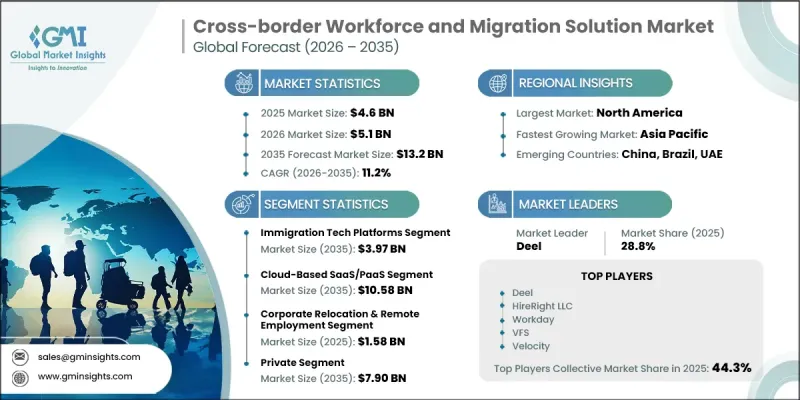
The cross-border workforce and migration solution market is experiencing growth as organizations increasingly expand their international hiring strategies to address skilled labor shortages and build geographically diverse workforces. Rising demand for global talent is encouraging employers to adopt digital workforce mobility platforms that simplify employee relocation, immigration management, and cross-border employment administration. Businesses are moving away from fragmented manual processes in favor of integrated cloud-based solutions that improve operational efficiency and support workforce management across multiple countries. Growing regulatory complexity surrounding immigration and labor compliance is further driving the adoption of automated platforms capable of managing documentation, employment verification, and compliance obligations at scale. As cross-border employment becomes a routine business function rather than an occasional workforce activity, organizations are placing greater emphasis on centralized workforce management solutions that provide real-time visibility, standardized workflows, and enhanced regulatory oversight. Increasing international recruitment activity, combined with ongoing digital transformation initiatives, continues to create significant opportunities for providers operating in the cross-border workforce and migration solution market.
| Market Scope | |
|---|---|
| Start Year | 2025 |
| Forecast Year | 2026-2035 |
| Start Value | $4.6 Billion |
| Forecast Value | $13.2 Billion |
| CAGR | 11.2% |
The immigration technology platforms segment generated USD 1.27 billion in 2025, accounting for 27.9% share. This segment continues to maintain a leading position because organizations require centralized platforms capable of managing immigration processes, employment documentation, workforce administration, payroll coordination, employee benefits, and compliance monitoring through a unified operating environment. Growing demand for digital workforce mobility solutions that streamline international employment procedures and improve organizational visibility is expected to support continued expansion of this segment throughout the forecast period.
The cloud-based SaaS/PaaS segment generated USD 3.10 billion holding a 68% share in 2025. Cloud deployment remains the preferred delivery model because it enables continuous updates to immigration policies, employment regulations, payroll requirements, and workforce documentation across multiple jurisdictions. Organizations increasingly favor cloud platforms that provide real-time processing capabilities, scalable infrastructure, centralized workforce management, and enhanced audit readiness while supporting globally distributed operations through a single technology environment.
North America Cross-Border Workforce and Migration Solution Market accounted for USD 1.6 billion in 2025, representing 38.4% share. Regional market growth is supported by rising demand for employment-based immigration management, workforce compliance, and digital solutions that simplify international hiring processes. Organizations across North America continue to invest in integrated workforce management platforms that consolidate immigration administration, payroll operations, employee verification, and compliance activities into centralized systems, contributing to sustained regional market expansion.
Leading companies operating in the global cross-border workforce and migration solution market include Deel, Workday, Papaya, VFS, Velocity, Equus Software, HireRight, G-P (Globalization Partners), Rippling, and Oyster HR. Companies operating in the cross-border workforce and migration solution market are strengthening their market position by expanding cloud-based platform capabilities and developing integrated solutions that simplify international workforce management. Providers continue to invest in automation, artificial intelligence, and advanced analytics to improve compliance monitoring, document processing, workflow efficiency, and workforce visibility. Businesses are also enhancing platform scalability to support multinational organizations managing employees across multiple jurisdictions. Strategic partnerships, product enhancements, and geographic expansion remain key priorities for increasing customer reach and strengthening service portfolios.
Table of Contents
Chapter 1 Methodology & Scope
- 1.1 Research approach
- 1.2 Quality Commitments
- 1.2.1 GMI AI policy & data integrity commitment
- 1.2.1.1 Source consistency protocol
- 1.2.1 GMI AI policy & data integrity commitment
- 1.3 Research Trail & Confidence Scoring
- 1.3.1 Research Trail Components
- 1.3.2 Scoring Components
- 1.4 Data Collection
- 1.4.1 Partial list of primary sources
- 1.5 Data mining sources
- 1.5.1 Paid sources
- 1.5.1.1 Sources, by region
- 1.5.1 Paid sources
- 1.6 Base estimates and calculations
- 1.6.1 Base year calculation
- 1.7 Forecast
- 1.7.1 Quantified market impact analysis
- 1.7.1.1 Mathematical impact of growth parameters on forecast
- 1.7.1 Quantified market impact analysis
- 1.8 Research transparency addendum
- 1.8.1 Source attribution framework
- 1.8.2 Quality assurance metrics
- 1.8.3 Our commitment to trust
Chapter 2 Executive Summary
- 2.1 Industry 360° synopsis
- 2.2 Key market trends
- 2.2.1 Regional
- 2.2.2 Solution
- 2.2.3 Deployment Model
- 2.2.4 Application
- 2.2.5 End User
- 2.3 TAM Analysis, 2026-2035
- 2.4 CXO perspectives: Strategic imperatives
Chapter 3 Industry Insights
- 3.1 Industry ecosystem analysis
- 3.1.1 Supplier landscape
- 3.1.1.1 Raw material suppliers
- 3.1.1.2 Component suppliers
- 3.1.1.3 Manufacturers
- 3.1.1.4 Service providers
- 3.1.1.5 Distribution channel
- 3.1.1.6 End Use
- 3.1.2 Cost structure
- 3.1.3 Profit margin
- 3.1.4 Value addition at each stage
- 3.1.5 Vertical integration trends
- 3.1.6 Disruptors
- 3.1.1 Supplier landscape
- 3.2 Industry impact forces
- 3.2.1 Growth drivers
- 3.2.1.1 Rising global talent shortages
- 3.2.1.2 Growth in remote and international hiring
- 3.2.1.3 Increasing complexity of immigration and labor regulations
- 3.2.1.4 Government investments in digital immigration and border management systems
- 3.2.2 Market Restraints
- 3.2.2.1 Data privacy and cybersecurity concerns
- 3.2.2.2 Diverse immigration and labor regulations across countries
- 3.2.3 Market Opportunities
- 3.2.3.1 AI and automation in immigration case management
- 3.2.3.2 Employer of Record platform expansion
- 3.2.3.3 Cloud-based workforce mobility deployment
- 3.2.3.4 Digital identity and biometric verification integration
- 3.2.1 Growth drivers
- 3.3 Growth potential analysis
- 3.4 Pricing Analysis (Driven by Primary Research)
- 3.4.1 Historical Price Trend Analysis
- 3.4.2 Pricing Strategy by Player Type (Premium / Value / Cost-plus)
- 3.5 Regulatory landscape
- 3.5.1 North America
- 3.5.1.1 USMCA Temporary Entry for Business Persons
- 3.5.1.2 H-1B Visa Program
- 3.5.1.3 TN Nonimmigrant Classification
- 3.5.1.4 U.S. Immigration and Nationality Act (INA)
- 3.5.1.5 Canada's Temporary Foreign Worker Program (TFWP)
- 3.5.2 Europe
- 3.5.2.1 EU Blue Card Directive
- 3.5.2.2 Single Permit Directive
- 3.5.2.3 Posted Workers Directive
- 3.5.2.4 Schengen Visa Code
- 3.5.2.5 European Labour Authority (ELA) Framework
- 3.5.2.6 Intra-Corporate Transferees (ICT) Directive
- 3.5.3 Asia-Pacific
- 3.5.3.1 ASEAN Agreement on the Movement of Natural Persons (MNP)
- 3.5.3.2 Comprehensive and Progressive Agreement for Trans-Pacific Partnership (CPTPP) - Temporary Entry Provisions
- 3.5.3.3 Australia Temporary Skill Shortage (Subclass 482) Visa
- 3.5.3.4 Singapore Employment Pass Framework
- 3.5.3.5 Japan Specified Skilled Worker (SSW) Program
- 3.5.4 Latin America
- 3.5.4.1 ILO Migrant Workers Convention
- 3.5.4.2 MERCOSUR Residence Agreement
- 3.5.4.3 Pacific Alliance Mobility Framework
- 3.5.4.4 Brazil Migration Law (Law No. 13,445/2017)
- 3.5.5 Middle East & Africa
- 3.5.5.1 GCC Unified Visa and Labor Mobility Framework
- 3.5.5.2 Saudi Arabia Labor Law
- 3.5.5.3 UAE Labour Law (Federal Decree-Law No. 33 of 2021)
- 3.5.5.4 African Continental Free Trade Area (AfCFTA) Protocol on Movement of Persons
- 3.5.1 North America
- 3.6 Technology and Innovation landscape
- 3.6.1 Current technologies
- 3.6.2 Emerging technologies
- 3.7 Porter's analysis
- 3.8 PESTEL analysis
- 3.9 Patent analysis (Driven by Primary Research)
- 3.10 Impact of AI & generative AI on the market
- 3.10.1 AI-Driven Disruption of Existing Business Models
- 3.10.2 Automated design optimization
- 3.10.3 Supply chain AI for demand forecasting
- 3.10.4 GenAI use cases & adoption roadmap by segment
- 3.10.5 Risks, Limitations & Regulatory Considerations
- 3.11 Sustainability and environmental aspects
- 3.11.1 Sustainable practices
- 3.11.2 Waste reduction strategies
- 3.11.3 Energy efficiency in production
- 3.11.4 Eco-friendly Initiatives
- 3.11.5 Carbon footprint considerations
- 3.12 Forecast assumptions & scenario analysis (Driven by Primary Research)
- 3.12.1 Base Case - key macro & industry variables driving CAGR
- 3.12.2 Optimistic Scenarios - Favorable Macro and Industry Tailwinds
- 3.12.3 Pessimistic Scenario - Macroeconomic slowdown or industry headwinds
Chapter 4 Competitive Landscape, 2025
- 4.1 Introduction
- 4.2 Company market share analysis
- 4.2.1 North America
- 4.2.2 Europe
- 4.2.3 Asia-Pacific
- 4.2.4 Latin America
- 4.2.5 Middle East & Africa
- 4.3 Competitive positioning matrix
- 4.4 Key developments
- 4.4.1 Mergers & acquisitions
- 4.4.2 Partnerships & collaborations
- 4.4.3 New product launches
- 4.4.4 Expansion plans and funding
- 4.5 Company tier benchmarking
- 4.5.1 Tier classification criteria & qualifying thresholds
- 4.5.2 Tier positioning matrix by revenue, geography & innovation
Chapter 5 Market Estimates & Forecast, By Solution, 2022 - 2035 ($Mn)
- 5.1 Key trends
- 5.2 Immigration Tech Platforms
- 5.3 Workforce Centralized Management Systems
- 5.4 Mobility & Relocation Management
- 5.5 Labor Compliance & Verification Tools
- 5.6 Digital Identity & Background Screening Platforms
- 5.7 Others
Chapter 6 Market Estimates & Forecast, By Deployment Model, 2022 - 2035 ($Mn)
- 6.1 Key trends
- 6.2 Cloud-Based (SaaS/PaaS)
- 6.3 On-Premise
- 6.4 Hybrid
Chapter 7 Market Estimates & Forecast, By Application, 2022 - 2035 ($Mn)
- 7.1 Key trends
- 7.2 Corporate Relocation & Remote Employment
- 7.3 Skilled Labor Migration
- 7.4 Seasonal & Low-Skilled Workforce Mobility
- 7.5 International Student Migration
- 7.6 Medical & Healthcare Workforce Mobility
Chapter 8 Market Estimates & Forecast, By End User, 2022 - 2035 ($Mn)
- 8.1 Key trends
- 8.2 Private Sector Employers
- 8.3 Government Agencies & Regulatory Bodies
- 8.4 Recruitment & Labor Migration Agencies
- 8.5 Healthcare Institutions
- 8.6 Educational Institutions
Chapter 9 Market Estimates & Forecast, By Region, 2022 - 2035 ($Mn)
- 9.1 North America
- 9.1.1 US
- 9.1.2 Canada
- 9.2 Europe
- 9.2.1 UK
- 9.2.2 Germany
- 9.2.3 France
- 9.2.4 Italy
- 9.2.5 Spain
- 9.2.6 Belgium
- 9.2.7 Netherlands
- 9.2.8 Sweden
- 9.2.9 Russia
- 9.3 Asia Pacific
- 9.3.1 China
- 9.3.2 India
- 9.3.3 Japan
- 9.3.4 Australia
- 9.3.5 Singapore
- 9.3.6 South Korea
- 9.3.7 Vietnam
- 9.3.8 Indonesia
- 9.3.9 Thailand
- 9.4 Latin America
- 9.4.1 Brazil
- 9.4.2 Mexico
- 9.4.3 Argentina
- 9.5 MEA
- 9.5.1 South Africa
- 9.5.2 Saudi Arabia
- 9.5.3 UAE
Chapter 10 Company Profiles
- 10.1 Global Players
- 10.1.1 Deel
- 10.1.2 Remote
- 10.1.3 Velocity
- 10.1.4 Papaya
- 10.1.5 G-P (Globalization Partners)
- 10.1.6 Rippling
- 10.1.7 Oyster HR
- 10.1.8 Atlas HXM
- 10.1.9 ADP GlobalView + Streamline
- 10.1.10 Workday
- 10.2 Regional Players
- 10.2.1 Multiplier
- 10.2.2 WorkMotion
- 10.2.3 Acclime
- 10.2.4 Remofirst
- 10.2.5 Lano
- 10.2.6 VFS
- 10.2.7 Equus Software
- 10.2.8 HireRight
- 10.2.9 Payoneer
- 10.2.10 Emerald

