PUBLISHER: Global Market Insights Inc. | PRODUCT CODE: 2101988

PUBLISHER: Global Market Insights Inc. | PRODUCT CODE: 2101988
Wooden Decking Market Opportunity, Growth Drivers, Industry Trend Analysis, and Forecast 2026 - 2035
The Global Wooden Decking Market was valued at USD 8.5 billion in 2025 and is estimated to grow at a CAGR of 2.8% to reach USD 11.2 billion by 2035.
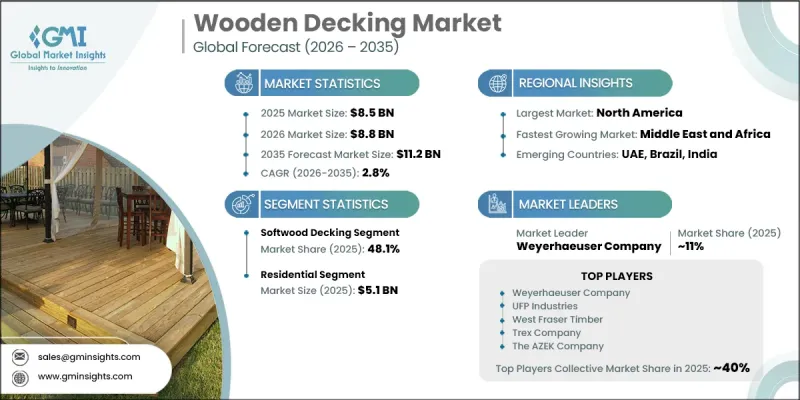
Market growth is supported by construction expansion across developing economies, increasing homeownership among middle-income populations, and growing adoption of advanced wood treatment technologies. The wooden decking industry is experiencing a gradual transformation as consumers and builders balance the traditional appeal of natural wood with the growing availability of alternative decking materials. While composite solutions are creating competitive pressure for conventional wood products, demand for premium timber, certified materials, and engineered wood solutions continues to provide growth opportunities. Increasing preference for outdoor recreational areas and aesthetically appealing residential environments remains a major factor supporting market expansion. Across Europe, North America, and other developed regions, homeowners are increasingly investing in exterior living spaces as part of broader renovation and lifestyle improvement trends. The adoption of sustainable forestry practices and enhanced wood durability treatments is also strengthening the position of wooden decking in premium construction segments.
| Market Scope | |
|---|---|
| Start Year | 2025 |
| Forecast Year | 2026-2035 |
| Start Value | $8.5 Billion |
| Forecast Value | $11.2 Billion |
| CAGR | 2.8% |
The softwood decking segment accounted for 48.1% share 2025 owing to strong demand in residential construction and do-it-yourself projects. Products made from pressure-treated pine, Douglas fir, and cedar continue to dominate because of their affordability, accessibility, and suitability for a wide range of outdoor applications. The cost advantage of softwood materials remains a major factor supporting their adoption, with pressure-treated lumber typically available at approximately USD 2-4 per linear foot in North American markets. Extensive distribution through home improvement retailers and established supply chains further reinforces the segment's strong presence in mainstream residential decking applications.
The residential application segment held 59.3% share in 2025. Demand within this segment is primarily driven by residential deck installations, outdoor terrace development, and balcony applications in housing projects. Growth is supported by renovation activity in mature markets and increasing residential construction in emerging economies. Residential consumers continue to prioritize attractive outdoor spaces that enhance property value and improve lifestyle experiences. Typical residential decking projects in North America involving 300-600 square feet of pressure-treated softwood or composite materials installed by specialized contractors generate material values ranging from USD 2,000-8,000 per project. This value range continues to increase as premium materials, thermally modified wood, and higher-end decking solutions gain wider acceptance.
North America Wooden Decking Market generated USD 3.3 billion in 2025 and is expected to reach USD 3.8 billion by 2035 at a CAGR of 1.2%. The slower regional growth rate reflects the maturity of the market and increasing competition from composite decking alternatives. Pressure-treated southern yellow pine continues to represent a significant volume category due to established production networks and strong regional availability. However, changing consumer preferences are gradually encouraging greater adoption of thermally modified wood and composite products as older decking installations require replacement. Demand for premium appearances, enhanced durability, and improved outdoor aesthetics is influencing replacement decisions, particularly in markets where consumers prioritize upgraded materials and long-term performance.
Major companies operating in the global wooden decking market include Weyerhaeuser Company, Trex Company, Inc., The AZEK Company, UFP Industries, Inc., Fortune Brands Innovations, West Fraser Timber Co. Ltd., UPM-Kymmene Corporation, and Metsa Wood. Companies operating in the global wooden decking market are focusing on product innovation, sustainable sourcing, strategic expansion, and enhanced customer engagement to strengthen their market position. Leading manufacturers are investing in advanced wood treatment technologies, environmentally responsible production methods, and premium product development to meet changing consumer preferences. Companies are also expanding their product portfolios with durable, low-maintenance, and aesthetically improved decking solutions to compete with alternative materials. Strategic partnerships with distributors, contractors, and construction companies help businesses improve market reach and strengthen supply capabilities.
Table of Contents
Chapter 1 Research methodology
- 1.1 Research approach
- 1.2 Quality Commitments
- 1.2.1 GMI AI policy & data integrity commitment
- 1.2.1.1 Source consistency protocol
- 1.2.1 GMI AI policy & data integrity commitment
- 1.3 Research trail & confidence scoring
- 1.3.1 Research trail components
- 1.3.2 Scoring components
- 1.4 Data Collection
- 1.4.1 Partial list of primary sources
- 1.5 Data mining sources
- 1.5.1 Paid sources
- 1.5.1.1 Sources, by region
- 1.5.1 Paid sources
- 1.6 Base estimates and calculations
- 1.6.1 Base year calculation
- 1.7 Forecast model
- 1.7.1 Quantified market impact analysis
- 1.7.1.1 Mathematical impact of growth parameters on forecast
- 1.7.1 Quantified market impact analysis
- 1.8 Research transparency addendum
- 1.8.1 Source attribution framework
- 1.8.2 Quality assurance metrics
- 1.8.3 Our commitment to trust
Chapter 2 Executive Summary
- 2.1 Industry 360° synopsis
- 2.2 Business trends
- 2.3 Regional
- 2.4 Wood type
- 2.5 Installation
- 2.6 Application
- 2.7 End use
- 2.8 Distribution channel
Chapter 3 Industry Insights
- 3.1 Industry ecosystem analysis
- 3.1.1 Supplier landscape
- 3.1.2 Manufacturers
- 3.1.3 Distributors
- 3.1.4 End users
- 3.1.5 Profit margin analysis
- 3.1.6 Value addition at each stage
- 3.1.7 Factor affecting the value chain
- 3.2 Industry impact forces
- 3.2.1 Growth drivers
- 3.2.1.1 Outdoor Living Space Expansion and Lifestyle-Driven Investment
- 3.2.1.2 Urbanization and Residential Construction Growth
- 3.2.1.3 Green Building Codes and Sustainable Construction Mandates
- 3.2.1.4 Rise of Thermally Modified Wood and Performance Positioning
- 3.2.2 Industry pitfalls & challenges
- 3.2.2.1 Timber Resource Constraints and Deforestation Regulations
- 3.2.2.2 Raw Material Price Volatility and Treatment Chemical Costs
- 3.2.2.3 Competition from Non-Wood Alternatives
- 3.2.3 Opportunities
- 3.2.1 Growth drivers
- 3.3 Growth potential analysis
- 3.4 Technology and innovation landscape
- 3.4.1 Current technological trends
- 3.4.2 Emerging technologies
- 3.5 Pricing analysis (driven by primary research)
- 3.5.1 Historical price trend analysis by product category
- 3.5.2 Pricing strategy by player type (premium / value / cost-plus)
- 3.6 Trade data analysis (based on paid database)
- 3.6.1 Import/export volume & value trends
- 3.6.2 Key trade corridors & tariff impact
- 3.7 Regulatory landscape
- 3.7.1 Standards and compliance requirements
- 3.7.2 Regional regulatory frameworks
- 3.7.3 Certification standards
- 3.8 Porter's analysis
- 3.9 PESTEL analysis
- 3.10 Impact of AI & generative AI on the market
- 3.10.1 AI-driven disruption of existing business models
- 3.10.2 GenAI use cases & adoption roadmap by segment
- 3.10.3 Risks, limitations & regulatory considerations
Chapter 4 Competitive Landscape, 2025
- 4.1 Introduction
- 4.2 Company market share analysis
- 4.2.1 By Region
- 4.2.1.1 North America
- 4.2.1.2 Europe
- 4.2.1.3 Asia Pacific
- 4.2.1.4 Latin America
- 4.2.1.5 Middle East & Africa
- 4.2.1 By Region
- 4.3 Company matrix analysis
- 4.4 Competitive analysis of major market players
- 4.5 Competitive positioning matrix
- 4.6 Key developments
- 4.6.1 Mergers & acquisitions
- 4.6.2 Partnerships & collaborations
- 4.6.3 New product launches
- 4.6.4 Expansion plans
Chapter 5 Market Estimates & Forecast, By Wood type, 2022 - 2035, (USD Billion)
- 5.1 Key trends
- 5.2 Softwood decking
- 5.2.1 Cedar decking
- 5.2.2 Pine decking
- 5.2.3 Redwood & sequoia decking
- 5.2.4 Spruce and others
- 5.3 Hardwood decking
- 5.3.1 Tropical hardwood decking
- 5.3.2 Temperate hardwood decking
- 5.4 Thermally modified wood decking
- 5.5 Wood-Plastic Composite (WPC) decking
Chapter 6 Market Estimates & Forecast, By Installation, 2022 - 2035, (USD Billion)
- 6.1 Key trends
- 6.2 Indoor
- 6.3 Outdoor
Chapter 7 Market Estimates & Forecast, By Application, 2022 - 2035, (USD Billion)
- 7.1 Key trends
- 7.2 Railing
- 7.3 Floor
- 7.4 Wall
- 7.5 Others
Chapter 8 Market Estimates & Forecast, By End use, 2022 - 2035, (USD Billion)
- 8.1 Key trends
- 8.2 Residential
- 8.2.1 New residential construction
- 8.2.2 Residential renovation & replacement
- 8.3 Commercial
- 8.3.1 Hotels, resorts & hospitality
- 8.3.2 Restaurants & foodservice
- 8.3.3 Retail, office & mixed-use commercial developments
- 8.4 Public infrastructure & institutional
- 8.4.1 Boardwalks, piers & waterfront infrastructure
- 8.4.2 Parks, recreation areas & urban landscaping
- 8.4.3 Municipal & government projects
- 8.5 Industrial & others
Chapter 9 Market Estimates & Forecast, By Distribution channel, 2022 - 2035, (USD Billion)
- 9.1 Key trends
- 9.2 Direct sales
- 9.3 Indirect sales
Chapter 10 Market Estimates & Forecast, By Region, 2022 - 2035, (USD Billion)
- 10.1 Key trends
- 10.2 North America
- 10.2.1 U.S.
- 10.2.2 Canada
- 10.3 Europe
- 10.3.1 Germany
- 10.3.2 UK
- 10.3.3 France
- 10.3.4 Italy
- 10.3.5 Spain
- 10.3.6 Sweden
- 10.3.7 Netherlands
- 10.4 Asia Pacific
- 10.4.1 China
- 10.4.2 India
- 10.4.3 Japan
- 10.4.4 South Korea
- 10.4.5 Australia
- 10.4.6 Indonesia
- 10.5 Latin America
- 10.5.1 Brazil
- 10.5.2 Mexico
- 10.5.3 Argentina
- 10.6 Middle East and Africa
- 10.6.1 Saudi Arabia
- 10.6.2 UAE
- 10.6.3 South Africa
Chapter 11 Company Profiles
- 11.1 Global Players
- 11.1.1 Trex Company, Inc.
- 11.1.2 The AZEK Company
- 11.1.3 Fortune Brands Innovations
- 11.1.4 UFP Industries, Inc
- 11.1.5 Weyerhaeuser Company
- 11.1.6 West Fraser Timber Co. Ltd.
- 11.1.7 UPM-Kymmene Corporation
- 11.2 Regional Players
- 11.2.1 Metsa Wood
- 11.2.2 Setra Group AB
- 11.2.3 Thermory AS
- 11.2.4 Kebony AS
- 11.2.5 Silvadec
- 11.2.6 MoistureShield
- 11.2.7 Nova USA Wood Products
- 11.3 Emerging Players & Innovators
- 11.3.1 Accsys Technologies
- 11.3.2 The Millboard Company
- 11.3.3 Cali
- 11.3.4 DuraLife Decking & Railing Systems
- 11.3.5 Futurewood Pty Ltd
- 11.3.6 NewTechWood
- 11.3.7 Envision Building Products

