PUBLISHER: Global Market Insights Inc. | PRODUCT CODE: 2101993

PUBLISHER: Global Market Insights Inc. | PRODUCT CODE: 2101993
Passenger Ferries Market Opportunity, Growth Drivers, Industry Trend Analysis, and Forecast 2026 - 2035
The Global Passenger Ferries Market was valued at USD 18.4 billion in 2025 and is estimated to grow at a CAGR of 7% to reach USD 36.4 billion by 2035.
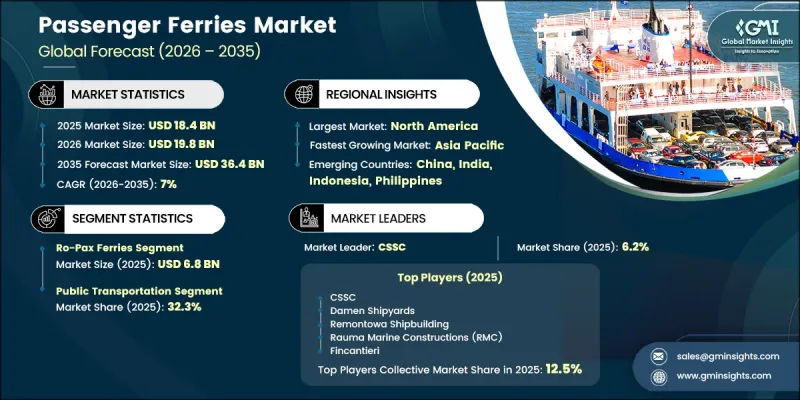
The Passenger Ferries Market continues to witness growth as governments and private operators increase investments in modern marine transportation systems to improve regional connectivity and passenger mobility. Market expansion is being supported by fleet replacement programs focused on reducing emissions, growing tourism activities across coastal and island destinations, increased investment in public transportation infrastructure, and the commercialization of marine passenger services in developing regions. Growth is expected to gain additional momentum during the middle years of the forecast period as newly commissioned battery-electric and hybrid-electric ferries begin commercial operations, generating additional market revenue. Favorable environmental regulations and long-term sustainability targets are encouraging operators to replace aging diesel-powered vessels with low- and zero-emission alternatives. At the same time, rising domestic and international travel continues to strengthen demand for ferry transportation across coastal routes, islands, and inland waterways. These combined factors are creating favorable conditions for long-term growth while encouraging continuous investments in technologically advanced and environmentally sustainable passenger ferry fleets.
| Market Scope | |
|---|---|
| Start Year | 2025 |
| Forecast Year | 2026-2035 |
| Start Value | $18.4 Billion |
| Forecast Value | $36.4 Billion |
| CAGR | 7% |
The Ro-Pax segment is anticipated to grow at a CAGR of 6.8% through 2035. Its market leadership is primarily supported by the ability to generate revenue from both passenger transportation and vehicle carriage within the same voyage. This dual-purpose operating model improves asset utilization and revenue generation, making Ro-Pax vessels the preferred choice for many ferry operators while supporting sustained demand throughout the forecast period.
The public transportation segment is projected to grow at a CAGR of 6% through 2035, supported by the continued expansion of public marine transit networks and long-term investments in transportation infrastructure. Ongoing fleet modernization initiatives and capacity expansion programs across government-operated ferry services continue to strengthen market demand while improving operational efficiency and passenger transportation capabilities.
North America Passenger Ferries Market is expected to grow at a CAGR of 6.2% through 2035, reaching USD 13.5 billion. Market growth is supported by expanding commuter ferry networks, inter-island transportation services, and regional waterway connectivity. Continued public investment in fleet modernization, electrification programs, and next-generation ferry infrastructure is accelerating the adoption of advanced passenger vessels while supporting long-term regional market expansion.
Major companies operating in the Global Passenger Ferries Market include CSSC, Damen Shipyards, Remontowa Shipbuilding, Rauma Marine Constructions (RMC), Fincantieri, Hyundai Mipo Dockyard (HMD), and Brodrene Aa. Companies operating in the Passenger Ferries Market are strengthening their market position by investing in advanced vessel technologies, expanding production capabilities, and developing low-emission ferry solutions that align with evolving environmental regulations. Many manufacturers are focusing on battery-electric and hybrid-electric vessel development to support the industry's transition toward sustainable marine transportation. Strategic collaborations, long-term supply agreements, and investments in research and development are helping companies improve product innovation and broaden their global presence. Businesses are also enhancing vessel efficiency through digital technologies, automation, and advanced propulsion systems while expanding customized ferry offerings to meet diverse customer requirements.
Table of Contents
Chapter 1 Methodology & Scope
- 1.1 Research approach
- 1.2 Quality Commitments
- 1.2.1 GMI AI policy & data integrity commitment
- 1.2.1.1 Source consistency protocol
- 1.2.1 GMI AI policy & data integrity commitment
- 1.3 Research Trail & Confidence Scoring
- 1.3.1 Research Trail Components
- 1.3.2 Scoring Components
- 1.4 Data Collection
- 1.4.1 Partial list of primary sources
- 1.5 Data mining sources
- 1.5.1 Paid sources
- 1.5.1.1 Sources, by region
- 1.5.1 Paid sources
- 1.6 Base estimates and calculations
- 1.6.1 Base year calculation
- 1.7 Forecast model
- 1.7.1 Quantified market impact analysis
- 1.7.1.1 Mathematical impact of growth parameters on forecast
- 1.7.1 Quantified market impact analysis
- 1.8 Research transparency addendum
- 1.8.1 Source attribution framework
- 1.8.2 Quality assurance metrics
- 1.8.3 Our commitment to trust
Chapter 2 Executive Summary
- 2.1 Industry 360° synopsis
- 2.2 Key market trends
- 2.2.1 Ferry Type
- 2.2.2 Propulsion Type
- 2.2.3 Passenger Capacity
- 2.2.4 Ownership/Operator
- 2.2.5 Application
- 2.2.6 Region
- 2.3 TAM Analysis, 2026-2035
- 2.4 CXO perspectives: Strategic imperatives
Chapter 3 Industry Insights
- 3.1 Industry ecosystem analysis
- 3.1.1 Supplier landscape
- 3.1.2 Cost structure
- 3.1.3 Profit margin
- 3.1.4 Value addition at each stage
- 3.1.5 Vertical integration trends
- 3.1.6 Disruptors
- 3.2 Industry impact forces
- 3.2.1 Growth drivers
- 3.2.1.1 Increasing demand for sustainable maritime transportation
- 3.2.1.2 Growing tourism and coastal passenger traffic
- 3.2.1.3 Government investment in waterborne public transport
- 3.2.1.4 Improved inter-island and regional connectivity
- 3.2.2 Industry pitfalls & challenges
- 3.2.2.1 High capital and vessel construction costs
- 3.2.2.2 Limited charging and alternative fuel infrastructure
- 3.2.2.3 Stringent maritime safety and environmental regulations
- 3.2.3 Market opportunities
- 3.2.3.1 Fleet modernization and replacement programs
- 3.2.3.2 Adoption of zero-emission ferry technologies
- 3.2.3.3 Expansion of urban water transport networks
- 3.2.3.4 Digitalization and smart ferry operations
- 3.2.1 Growth drivers
- 3.3 Growth potential analysis
- 3.4 Technology and Innovation landscape
- 3.4.1 Current technologies
- 3.4.2 Emerging technologies
- 3.5 Pricing Analysis (Driven by Primary Research)
- 3.5.1 Historical Price Trend Analysis
- 3.5.2 Pricing Strategy by Player Type (Premium / Value / Cost-plus)
- 3.6 Regulatory landscape
- 3.6.1 North America
- 3.6.1.1 US Coast Guard (USCG) Passenger Vessel Regulations (US)
- 3.6.1.2 US Environmental Protection Agency (EPA) Marine Engine Emission Standards (US)
- 3.6.1.3 Transport Canada Marine Safety Regulations (Canada)
- 3.6.1.4 US Coast Guard Subchapter K Regulations for Small Passenger Vessels (US)
- 3.6.2 Europe
- 3.6.2.1 EU Directive 2009/45/EC on Safety Rules and Standards for Passenger Ships
- 3.6.2.2 Regulation (EU) 2023/1805 (FuelEU Maritime)
- 3.6.2.3 EU MRV Regulation (Monitoring, Reporting and Verification of CO2 Emissions)
- 3.6.2.4 European Maritime Safety Agency (EMSA) Passenger Ship Safety Framework
- 3.6.3 Asia-Pacific
- 3.6.3.1 China Maritime Safety Administration (MSA) Passenger Ship Regulations (China)
- 3.6.3.2 Japan Ship Safety Act (Japan)
- 3.6.3.3 Indian Merchant Shipping Act & Inland Vessels Act (India)
- 3.6.3.4 Australian National Standard for Commercial Vessels (NSCV) (Australia)
- 3.6.3.5 Marine Safety (Domestic Commercial Vessel) National Law (Australia)
- 3.6.4 Latin America
- 3.6.4.1 Brazilian Maritime Authority (NORMAM) Passenger Vessel Regulations (Brazil)
- 3.6.4.2 Mexican Merchant Marine Regulations (Mexico)
- 3.6.5 Middle East & Africa
- 3.6.5.1 UAE Maritime Transport Law & Passenger Vessel Regulations (UAE)
- 3.6.5.2 Saudi Ports Authority (Mawani) Maritime Safety Regulations (Saudi Arabia)
- 3.6.5.3 South African Merchant Shipping Act & SAMSA Passenger Ship Regulations (South Africa)
- 3.6.1 North America
- 3.7 Porter's analysis
- 3.8 PESTEL analysis
- 3.9 Patent analysis (Driven by Primary Research)
- 3.10 Trade Data Analysis (Driven by paid database)
- 3.10.1 Import/export volume & value trends
- 3.10.2 Key trade corridors & tariff impact
- 3.11 Cost breakdown analysis
- 3.12 Impact of AI & generative AI on the market
- 3.12.1 AI Driven Disruption of Existing Business Models
- 3.12.2 GenAI Use Cases and Adoption Roadmap by Segment
- 3.12.3 Risks Limitations and Regulatory Considerations
- 3.13 Capacity & Production Landscape (Driven by Primary Research)
- 3.13.1 Installed Capacity by Region & Key Producer
- 3.13.2 Capacity Utilization Rates & Expansion Pipelines
- 3.14 Sustainability and environmental aspects
- 3.14.1 Sustainable practices
- 3.14.2 Waste reduction strategies
- 3.14.3 Energy efficiency in production
- 3.14.4 Eco-friendly Initiatives
- 3.14.5 Carbon footprint considerations
- 3.15 Forecast assumptions & scenario analysis (Driven by Primary Research)
- 3.15.1 Base Case key macro & industry variables driving CAGR
- 3.15.2 Optimistic Scenarios Favorable Macro and Industry Tailwinds
- 3.15.3 Pessimistic Scenario Macroeconomic slowdown or industry headwinds
Chapter 4 Competitive Landscape, 2025
- 4.1 Introduction
- 4.2 Company market share analysis
- 4.2.1 North America
- 4.2.2 Europe
- 4.2.3 Asia-Pacific
- 4.2.4 Latin America
- 4.2.5 Middle East & Africa
- 4.3 Competitive positioning matrix
- 4.4 Key developments
- 4.4.1 Mergers & acquisitions
- 4.4.2 Partnerships & collaborations
- 4.4.3 New product launches
- 4.4.4 Expansion plans and funding
- 4.5 Company tier benchmarking
- 4.5.1 Tier classification criteria & qualifying thresholds
- 4.5.2 Tier positioning matrix by revenue, geography & innovation
Chapter 5 Market Estimates & Forecast, By Ferry Type, 2022 - 2035 ($Mn, Units)
- 5.1 Key trends
- 5.2 Ro-Pax Ferry (Roll-on/Roll-off Passenger Ferry)
- 5.3 Cruise Ferry
- 5.4 Cable/Chain Ferry
- 5.5 High-Speed Ferry
- 5.6 Others
Chapter 6 Market Estimates & Forecast, By Propulsion Type, 2022 - 2035 ($Mn, Units)
- 6.1 Key trends
- 6.2 Diesel
- 6.3 Hybrid Diesel-Electric
- 6.4 Battery Electric
- 6.5 LNG (Liquefied Natural Gas)
- 6.6 Hydrogen Fuel Cell
- 6.7 Other
Chapter 7 Market Estimates & Forecast, By Passenger Capacity, 2022 - 2035 ($Mn, Units)
- 7.1 Key trends
- 7.2 Up to 300 Passengers
- 7.3 301-1,000 Passengers
- 7.4 Above 1,000 Passengers
Chapter 8 Market Estimates & Forecast, By Ownership/Operator, 2022 - 2035 ($Mn, Units)
- 8.1 Key trends
- 8.2 Government/Public Operators
- 8.3 Private Commercial Operators
- 8.4 Public-Private Partnership (PPP) Operators
Chapter 9 Market Estimates & Forecast, By Application, 2022 - 2035 ($Mn, Units)
- 9.1 Key trends
- 9.2 Public Transportation
- 9.3 Tourism & Sightseeing
- 9.4 Island & Remote Connectivity
- 9.5 Inland Waterway Transportation
- 9.6 Cross-Border Transportation
- 9.7 Others
Chapter 10 Market Estimates & Forecast, By Region, 2022 - 2035 ($Mn, Units)
- 10.1 North America
- 10.1.1 US
- 10.1.2 Canada
- 10.2 Europe
- 10.2.1 UK
- 10.2.2 Germany
- 10.2.3 France
- 10.2.4 Italy
- 10.2.5 Spain
- 10.2.6 Belgium
- 10.2.7 Netherlands
- 10.2.8 Sweden
- 10.2.9 Russia
- 10.3 Asia Pacific
- 10.3.1 China
- 10.3.2 India
- 10.3.3 Japan
- 10.3.4 Australia
- 10.3.5 Singapore
- 10.3.6 South Korea
- 10.3.7 Vietnam
- 10.3.8 Indonesia
- 10.3.9 Thailand
- 10.4 Latin America
- 10.4.1 Brazil
- 10.4.2 Mexico
- 10.4.3 Argentina
- 10.5 MEA
- 10.5.1 South Africa
- 10.5.2 Saudi Arabia
- 10.5.3 UAE
- 10.5.4 Turkey
Chapter 11 Company Profiles
- 11.1 Global Players
- 11.1.1 Austal
- 11.1.2 Chantiers de l'Atlantique
- 11.1.3 CSSC
- 11.1.4 Damen Shipyards
- 11.1.5 Fincantieri
- 11.1.6 Hyundai Mipo Dockyard (HMD)
- 11.1.7 Incat Tasmania
- 11.1.8 Meyer Werft
- 11.1.9 Mitsubishi Heavy Industries (MHI)
- 11.1.10 VARD
- 11.2 Regional Players
- 11.2.1 Cochin Shipyard Limited (CSL)
- 11.2.2 Eastern Shipbuilding
- 11.2.3 Navantia
- 11.2.4 Nichols Brothers Boat Builders
- 11.2.5 Rauma Marine Constructions (RMC)
- 11.2.6 Remontowa Shipbuilding
- 11.3 Emerging Players / Disruptors
- 11.3.1 Brødrene Aa
- 11.3.2 Ferguson Marine
- 11.3.3 Penguin International
- 11.3.4 Strategic Marine

