PUBLISHER: Global Market Insights Inc. | PRODUCT CODE: 2101999

PUBLISHER: Global Market Insights Inc. | PRODUCT CODE: 2101999
Asset Based Lending Market Opportunity, Growth Drivers, Industry Trend Analysis, and Forecast 2026 - 2035
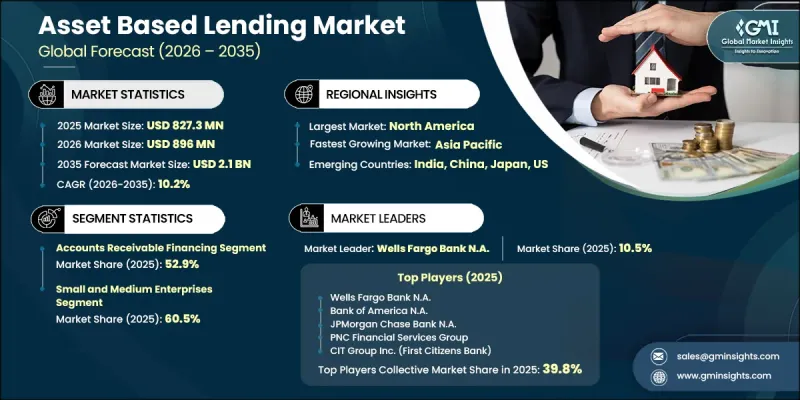
The Global Asset Based Lending Market was valued at USD 827.3 million in 2025 and is estimated to grow at a CAGR of 10.2% to reach USD 2.1 billion by 2035.
Market expansion is driven by structural changes in business financing behavior and the rising presence of non-bank lenders offering diversified credit solutions. Growth is also supported by the widening participation of mid-sized enterprises and SMEs that face limited access to unsecured lending facilities, alongside the increasing digitization of credit assessment and collateral tracking systems that streamline loan origination and monitoring processes. The emergence of private credit platforms alongside established banking institutions is improving pricing competitiveness and broadening product availability across global markets. Demand for asset-backed financing continues to rise across manufacturing, distribution, and retail sectors, where companies frequently experience cash flow constraints linked to inventory cycles, delayed receivables, and supply chain inefficiencies. Asset based lending enables businesses to unlock liquidity from existing balance sheet assets such as receivables, inventory, and equipment without relying on traditional unsecured lending criteria, making it a critical financing tool in modern corporate funding structures.
| Market Scope | |
|---|---|
| Start Year | 2025 |
| Forecast Year | 2026-2035 |
| Start Value | $827.3 Million |
| Forecast Value | $2.1 Billion |
| CAGR | 10.2% |
The accounts receivable financing segment held 52.9% share in 2025. This segment continues to lead due to the high liquidity value of receivables and its applicability across industries with extended payment cycles. It includes multiple structured financing models designed to improve cash flow efficiency while offering flexible collateral-backed lending options for businesses operating with delayed customer payments.
The small and medium enterprise segment accounted for 60.5% share in 2025, representing the largest borrower category. This dominance is attributed to the large global base of SMEs and their stronger reliance on asset-backed credit solutions compared to large enterprises. SMEs typically access smaller facility sizes, but their volume-driven participation significantly contributes to overall market expansion.
North America Asset Based Lending Market held 41.9% share in 2025, supported by a mature financial ecosystem and strong lending infrastructure in the region. The presence of well-established credit frameworks and advanced collateral enforcement mechanisms continues to support lender confidence and borrower participation. The region's developed banking and non-bank lending ecosystem further strengthens market accessibility and credit availability.
Major players operating in the global asset based lending market include Bank of America N.A., HSBC Holdings plc, JPMorgan Chase Bank N.A., BNP Paribas SA, Wells Fargo Bank N.A., PNC Financial Services Group, and CIT Group Inc. (First Citizens Bank). Companies operating in the asset based lending market are focusing on strengthening their competitive position through digital transformation of lending operations and enhanced credit underwriting capabilities. Financial institutions are increasingly adopting advanced data analytics and automated collateral monitoring systems to improve risk assessment and loan performance tracking. Expansion of private credit platforms and hybrid lending models is enabling firms to diversify their product portfolios and reach underserved borrower segments. Strategic partnerships between banks, fintech firms, and alternative lenders are improving capital deployment efficiency and broadening distribution networks.
Table of Contents
Chapter 1 Methodology & Scope
- 1.1 Research approach
- 1.2 Quality commitments
- 1.2.1 GMI AI policy & data integrity commitment
- 1.2.1.1 Source consistency protocol
- 1.2.1 GMI AI policy & data integrity commitment
- 1.3 Research trail & confidence scoring
- 1.3.1 Research trail components
- 1.3.2 Scoring components
- 1.4 Data collection
- 1.4.1 Partial list of primary sources
- 1.5 Data mining sources
- 1.5.1 Paid sources
- 1.5.1.1 Sources, by region
- 1.5.1 Paid sources
- 1.6 Base estimates and calculations
- 1.6.1 Base year calculation for any one approach
- 1.7 Market estimates & forecasts parameters
- 1.8 Forecast model
- 1.8.1 Quantified market impact analysis
- 1.8.1.1 Mathematical impact of growth parameters on forecast
- 1.8.1 Quantified market impact analysis
- 1.9 Research transparency addendum
- 1.9.1 Source attribution framework
- 1.9.2 Quality assurance metrics
- 1.9.3 Our commitment to trust
- 1.10 Market definitions
Chapter 2 Executive Summary
- 2.1 Industry synopsis, 2022 - 2035
- 2.1.1 Asset Type trends
- 2.1.2 Application trends
- 2.1.3 Borrower Type trends
- 2.1.4 Provider Type trends
- 2.1.5 Regional trends
Chapter 3 Industry Insights
- 3.1 Industry ecosystem analysis
- 3.2 Industry impact forces
- 3.2.1 Growth drivers
- 3.2.1.1 Rising Need for Working Capital Financing
- 3.2.1.2 Limited Availability of Traditional Bank Credit
- 3.2.1.3 Growth in Inventory and Receivables Financing Demand
- 3.2.1.4 Expansion of Private Credit and Alternative Lending Markets
- 3.2.2 Industry pitfalls and challenges
- 3.2.2.1 Collateral Valuation and Monitoring Complexity
- 3.2.2.2 Economic Uncertainty and Credit Risk Exposure
- 3.2.3 Market opportunities
- 3.2.3.1 Expansion into Emerging Markets
- 3.2.3.2 Integration of Digital Lending and AI-Based Risk Assessment
- 3.2.1 Growth drivers
- 3.3 Growth potential analysis
- 3.4 Regulatory landscape (Driven by primary research)
- 3.4.1 North America
- 3.4.2 Europe
- 3.4.3 Asia Pacific
- 3.4.4 Latin America
- 3.4.5 MEA
- 3.5 Technology landscape
- 3.5.1 Current technological trends
- 3.5.2 Emerging technologies
- 3.6 Pricing trend analysis (Driven by primary research)
- 3.7 Future market trends
- 3.8 Patent analysis
- 3.9 Porter's analysis
- 3.10 PESTEL analysis
- 3.11 Impact of AI and Generative AI on the market (Driven by primary research)
- 3.12 Value chain analysis (Driven by primary research)
- 3.13 Investment & funding analysis (Driven by primary research)
- 3.14 Consumer insights (Driven by primary research)
Chapter 4 Competitive Landscape, 2025
- 4.1 Introduction
- 4.2 Company market share analysis, by region, 2025
- 4.2.1 North America
- 4.2.2 Europe
- 4.2.3 Asia Pacific
- 4.2.4 Middle East & Africa
- 4.2.5 Latin America
- 4.3 Key developments
- 4.3.1 Key partnerships & collaborations
- 4.3.2 Major M&A activities
- 4.3.3 Product innovations & launches
- 4.3.4 Market expansion strategies
- 4.4 Competitive positioning matrix
Chapter 5 Market Size and Forecast, By Asset Type, 2022 - 2035 (USD Million)
- 5.1 Key trends
- 5.2 Accounts Receivable Financing
- 5.3 Inventory Financing
- 5.4 Equipment Financing
- 5.5 Real Estate
- 5.6 Multi-Asset Facilities
Chapter 6 Market Size and Forecast, By Application, 2022 - 2035 (USD Million)
- 6.1 Key trends
- 6.2 Working Capital Financing
- 6.3 Expansion Financing
- 6.4 Merger & Acquisition Financing
- 6.5 Refinancing
- 6.6 Distressed/Turnaround Financing
- 6.7 Others
Chapter 7 Market Size and Forecast, By Provider Type, 2022 - 2035 (USD Million)
- 7.1 Commercial Banks
- 7.2 Non-Bank Financial Institutions
- 7.3 Private Credit Firms
- 7.4 Specialty/Regional Lenders
Chapter 8 Market Size and Forecast, By Borrower Type, 2022 - 2035 (USD Million)
- 8.1 Key trends
- 8.2 Large Enterprises
- 8.2.1 Manufacturing
- 8.2.2 Retail & Distribution
- 8.2.3 Others
- 8.3 Small & Medium Enterprises (SMEs)
- 8.4 Government Agencies & Non-Profits
Chapter 9 Market Size and Forecast, By Region, 2022 - 2035 (USD Million)
- 9.1 Key trends
- 9.2 North America
- 9.2.1 U.S.
- 9.2.2 Canada
- 9.3 Europe
- 9.3.1 Germany
- 9.3.2 France
- 9.3.3 UK
- 9.3.4 Netherlands
- 9.3.5 Spain
- 9.3.6 Italy
- 9.4 Asia Pacific
- 9.4.1 China
- 9.4.2 Japan
- 9.4.3 South Korea
- 9.4.4 India
- 9.4.5 Australia
- 9.5 Middle East & Africa
- 9.5.1 Saudi Arabia
- 9.5.2 UAE
- 9.5.3 South Africa
- 9.6 Latin America
- 9.6.1 Brazil
- 9.6.2 Argentina
- 9.6.3 Mexico
Chapter 10 Company Profiles
- 10.1 JPMorgan Chase Bank N.A.
- 10.2 Wells Fargo Bank N.A.
- 10.3 Bank of America N.A.
- 10.4 CIT Group Inc. (First Citizens Bank)
- 10.5 PNC Financial Services Group
- 10.6 HSBC Holdings plc
- 10.7 BNP Paribas SA
- 10.8 White Oak Commercial Finance LLC
- 10.9 Rosenthal & Rosenthal Inc.
- 10.10 Sallyport Commercial Finance LLC
- 10.11 Encina Business Credit LLC
- 10.12 Hilco Global
- 10.13 Gordon Brothers Finance Company
- 10.14 Golub Capital LLC
- 10.15 Twin Brook Capital Partners
- 10.16 Blackstone Credit & Insurance (BXCI)
- 10.17 Ares Management Corporation
- 10.18 Blue Torch Capital LP

