PUBLISHER: Global Market Insights Inc. | PRODUCT CODE: 2102002

PUBLISHER: Global Market Insights Inc. | PRODUCT CODE: 2102002
Orthopedic Surgical Robots Market Opportunity, Growth Drivers, Industry Trend Analysis, and Forecast 2026 - 2035
The Global Orthopedic Surgical Robots Market was valued at USD 2 billion in 2025 and is estimated to grow at a CAGR of 16.8% to reach USD 9.5 billion by 2035.
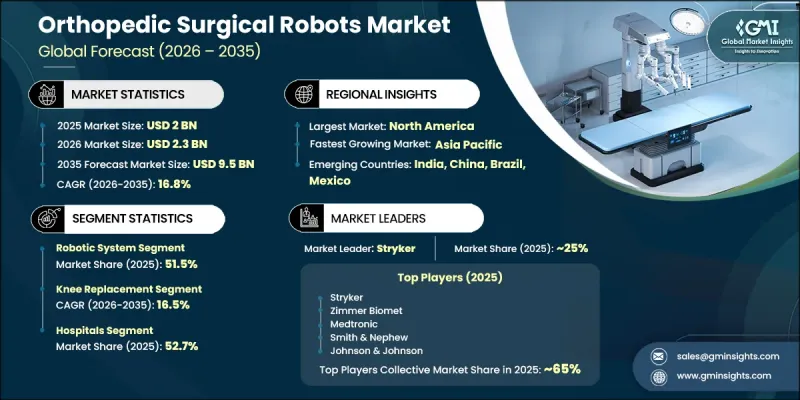
Market expansion is driven by the increasing integration of robotic technologies into orthopedic surgical workflows, supported by rising procedure volumes, greater capital investment in advanced healthcare infrastructure, and growing physician confidence in robot-assisted procedures. The combination of advanced imaging, real-time navigation, and AI-enabled surgical planning is transforming orthopedic surgery by improving procedural accuracy and clinical consistency. Rising cases of osteoarthritis, rheumatoid arthritis, osteoporosis, and musculoskeletal disorders continue to generate sustained demand for orthopedic interventions worldwide. Increasing obesity rates, aging populations, sedentary lifestyles, and greater participation in physical activities are expanding the number of patients requiring joint reconstruction and spinal procedures. Robotic systems are increasingly recognized for their ability to improve implant positioning, enhance surgical precision, reduce revision procedures, and support better long-term patient outcomes. As healthcare providers continue prioritizing efficiency, precision, and value-based care, robotic-assisted orthopedic surgery is becoming an increasingly important component of modern surgical practice, creating long-term growth opportunities across global healthcare systems.
| Market Scope | |
|---|---|
| Start Year | 2025 |
| Forecast Year | 2026-2035 |
| Start Value | $2 Billion |
| Forecast Value | $9.5 Billion |
| CAGR | 16.8% |
The robotic system segment accounted for 51.5% share in 2025 and is projected to grow at a CAGR of 16.5% through 2035. Its leading position reflects the high capital investment associated with robotic platform deployment, along with recurring revenue generated through software upgrades, maintenance agreements, installation services, and system enhancements. Adoption remains strongest among large hospitals and specialized healthcare institutions that perform high volumes of orthopedic procedures and possess the operational infrastructure required to manage advanced surgical technologies.
The hospitals segment held 52.7% share in 2025 growing at a CAGR of 16.6% during 2026-2035. Large healthcare systems continue to lead adoption due to their financial resources, extensive surgical case volumes, and established clinical infrastructure. These institutions increasingly utilize robotic technologies to improve surgical precision, support physician training, strengthen research capabilities, and enhance their reputation for delivering advanced orthopedic care.
North America Orthopedic Surgical Robots Market held 41.8% share in 2025 and is expected to grow at a CAGR of 16.4% through 2035. The United States continues to dominate regional demand due to its large patient base, advanced hospital infrastructure, favorable reimbursement environment, and ongoing investment in surgical innovation. Continuous regulatory approvals for next-generation robotic systems have further supported technology adoption and accelerated product innovation across the regional healthcare market.
Major players operating in the global orthopedic surgical robots market are Stryker, Zimmer Biomet, Medtronic, Johnson and Johnson, Intuitive, Smith and Nephew, Globus Medical, Brainlab, Think Surgical, Corin, MicroPort Orthopedics, NUVASIVE, Asensus Surgical, CUREXO, and Accuray. Companies operating in the orthopedic surgical robots market are focusing on continuous technological innovation to improve surgical accuracy, workflow efficiency, and clinical outcomes. Significant investments in artificial intelligence, advanced navigation systems, real-time imaging integration, and software enhancements are helping strengthen product competitiveness. Manufacturers are expanding partnerships with hospitals and healthcare networks to increase platform adoption while offering comprehensive surgeon training and clinical education programs that accelerate user acceptance. Companies are also strengthening recurring revenue through service contracts, software upgrades, maintenance programs, and digital ecosystem integration.
Table of Contents
Chapter 1 Research Methodology
- 1.1 Market definitions and scope
- 1.2 Research approach
- 1.3 Quality commitments
- 1.3.1 GMI AI policy & data integrity commitment
- 1.3.1.1 Source consistency protocol
- 1.3.1 GMI AI policy & data integrity commitment
- 1.4 Research trail & confidence scoring
- 1.4.1 Research trail components
- 1.4.2 Scoring components
- 1.5 Data collection
- 1.5.1 Partial list of primary sources
- 1.6 Data mining sources
- 1.6.1 Paid sources
- 1.6.1.1 Sources, by region
- 1.6.1 Paid sources
- 1.7 Base estimates and calculations
- 1.7.1 Base year calculation
- 1.8 Forecast model
- 1.8.1 Quantified market impact analysis
- 1.8.1.1 Mathematical impact of growth parameters on forecast
- 1.8.1 Quantified market impact analysis
- 1.9 Research transparency addendum
- 1.9.1 Source attribution framework
- 1.9.2 Quality assurance metrics
- 1.9.3 Our commitment to trust
Chapter 2 Executive Summary
- 2.1 Industry 360° synopsis
- 2.2 Key market trends
- 2.2.1 Regional trends
- 2.2.2 Component trends
- 2.2.3 Application trends
- 2.2.4 End use trends
- 2.3 CXO perspectives: Strategic imperatives
Chapter 3 Industry Insights
- 3.1 Industry ecosystem analysis
- 3.2 Industry impact forces
- 3.2.1 Growth drivers
- 3.2.1.1 Growing Prevalence of Orthopedic Disorders and Injuries
- 3.2.1.2 Advancements in Robotic Assisted Surgery Technology
- 3.2.1.3 Increasing Demand for Minimally Invasive Surgeries
- 3.2.1.4 Rising Geriatric Population
- 3.2.2 Industry pitfalls and challenges
- 3.2.2.1 High Cost of Robotic Surgical Systems and Procedures
- 3.2.2.2 Limited Reimbursement Policies
- 3.2.3 Opportunities
- 3.2.3.1 Growing access in emerging markets
- 3.2.3.2 Adoption of AI-driven capabilities for enhanced platform intelligence
- 3.2.1 Growth drivers
- 3.3 Growth potential analysis
- 3.4 Regulatory landscape
- 3.5 Pricing trend analysis
- 3.6 Technology and innovation landscape (Driven by Primary Research)
- 3.6.1 Current technological trends
- 3.6.2 Emerging technologies
- 3.7 Future market trends (Driven by Primary Research)
- 3.8 Patent analysis
- 3.9 Reimbursement scenario
- 3.10 Impact of AI & Generative AI on the Market (Driven by Primary Research)
- 3.11 Porter's analysis
- 3.12 PESTEL analysis
Chapter 4 Competitive Landscape, 2025
- 4.1 Introduction
- 4.2 Company matrix analysis
- 4.3 Company market share analysis (Driven by Primary Research)
- 4.3.1 Global
- 4.3.2 North America
- 4.3.3 Europe
- 4.3.4 Asia Pacific
- 4.3.5 LAMEA
- 4.4 Competitive analysis of major market players
- 4.5 Competitive positioning matrix
- 4.6 Key developments
- 4.6.1 Mergers & acquisitions
- 4.6.2 Partnerships & collaborations
- 4.6.3 New product launches
- 4.6.4 Expansion plans
Chapter 5 Market Estimates and Forecast, By Component, 2022 - 2035 ($ Mn)
- 5.1 Key trends
- 5.2 Robotic systems
- 5.3 Accessories
- 5.4 Software and services
Chapter 6 Market Estimates and Forecast, By Application, 2022 - 2035 ($ Mn)
- 6.1 Key trends
- 6.2 Knee replacement
- 6.3 Hip replacement
- 6.4 Shoulder replacement
- 6.5 Spinal surgeries
- 6.6 Other applications
Chapter 7 Market Estimates and Forecast, By End Use, 2022 - 2035 ($ Mn)
- 7.1 Key trends
- 7.2 Hospitals
- 7.3 Ambulatory surgical centers (ASCs)
- 7.4 Specialty orthopedic clinics
- 7.5 Other end uses
Chapter 8 Market Estimates and Forecast, By Region, 2022 - 2035 ($ Mn)
- 8.1 Key trends
- 8.2 North America
- 8.2.1 U.S.
- 8.2.2 Canada
- 8.3 Europe
- 8.3.1 Germany
- 8.3.2 UK
- 8.3.3 France
- 8.3.4 Spain
- 8.3.5 Italy
- 8.3.6 Netherlands
- 8.4 Asia Pacific
- 8.4.1 China
- 8.4.2 Japan
- 8.4.3 India
- 8.4.4 Australia
- 8.4.5 South Korea
- 8.5 Latin America
- 8.5.1 Brazil
- 8.5.2 Mexico
- 8.5.3 Argentina
- 8.6 MEA
- 8.6.1 South Africa
- 8.6.2 Saudi Arabia
- 8.6.3 UAE
Chapter 9 Company Profiles
- 9.1 Accuray
- 9.2 Asensus Surgical
- 9.3 Brainlab
- 9.4 Corin
- 9.5 CUREXO
- 9.6 Globus Medical
- 9.7 Intuitive
- 9.8 Johnson & Johnson
- 9.9 Medtronic
- 9.10 MicroPort Orthopedics
- 9.11 NUVASIVE
- 9.12 Smith & Nephew
- 9.13 Stryker
- 9.14 Think Surgical
- 9.15 Zimmer Biomet

