PUBLISHER: Global Market Insights Inc. | PRODUCT CODE: 2102003

PUBLISHER: Global Market Insights Inc. | PRODUCT CODE: 2102003
Molecular Diagnostics Equipment and Reagent Market Opportunity, Growth Drivers, Industry Trend Analysis, and Forecast 2026 - 2035
The Global Molecular Diagnostics Equipment and Reagent Market was valued at USD 18.5 billion in 2025 and is estimated to grow at a CAGR of 7.6% to reach USD 38.6 billion by 2035.
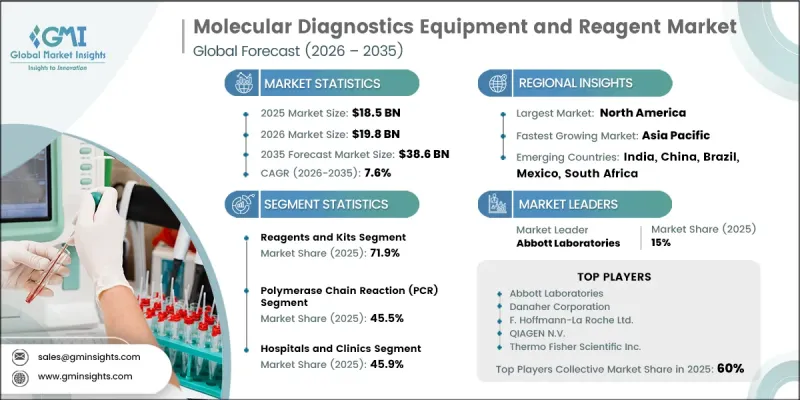
The market growth is supported by continuous technological advancements, rising awareness about early disease detection, increasing demand for point-of-care (POC) diagnostic solutions, and the expanding global elderly population. Molecular diagnostics equipment and reagents include diagnostic instruments, analyzers, assay solutions, and consumables that identify and monitor diseases through the analysis of genetic materials such as DNA, RNA, and other molecular markers. These products are widely used in clinical diagnostics, infectious disease testing, cancer detection, genetic analysis, and research applications, while excluding software and informatics platforms. The increasing occurrence of infectious diseases, emergence of new pathogens, and recurring disease outbreaks are creating a strong need for faster and more precise diagnostic technologies. Healthcare systems are increasingly emphasizing early detection, accurate disease identification, and effective outbreak response, which is driving adoption of molecular diagnostic instruments, testing kits, and reagents across hospitals, laboratories, and research facilities.
| Market Scope | |
|---|---|
| Start Year | 2025 |
| Forecast Year | 2026-2035 |
| Start Value | $18.5 Billion |
| Forecast Value | $38.6 Billion |
| CAGR | 7.6% |
The reagents and kits segment held 71.9% share in 2025. Reagents and kits represent essential components of molecular diagnostic workflows because they are required for conducting testing procedures across infectious disease screening, oncology applications, genetic diagnostics, and prenatal testing. Increasing laboratory testing volumes and the growing number of diagnostic procedures are creating consistent demand for these consumable products. In addition, advancements in assay development, enhanced multiplex testing capabilities, and specialized disease detection panels are improving the efficiency and accuracy of molecular diagnostics. The rising preference among laboratories and healthcare providers for reliable, standardized, and user-friendly testing solutions is further contributing to segment expansion.
The hospitals and clinics segment accounted for 45.9% share in 2025. Healthcare facilities are increasingly incorporating molecular diagnostic technologies into routine clinical practices for disease identification, treatment decisions, patient monitoring, and ongoing care management. Hospitals and clinics are benefiting from the wider integration of molecular testing into healthcare processes, particularly as demand increases for accurate diagnostic information. Growing patient volumes, increasing healthcare investments, and the need for improved diagnostic precision are encouraging medical facilities to enhance their molecular testing capabilities.
North America Molecular Diagnostics Equipment and Reagent Market 42.4% share in 2025 and continues to demonstrate strong market growth. The region maintains significant demand for molecular diagnostic solutions due to the increasing need for advanced infectious disease testing and improved healthcare surveillance systems. Healthcare organizations and public health institutions are placing greater focus on early diagnosis, routine screening programs, and preventive healthcare strategies. Molecular diagnostic technologies provide high accuracy and sensitivity, allowing healthcare providers to identify diseases at earlier stages and support faster treatment decisions. Continued advancements in diagnostic infrastructure and increasing adoption of precision healthcare approaches are expected to strengthen regional market development.
Key players operating in the global molecular diagnostics equipment and reagent industry include Danaher Corporation, Abbott Laboratories, Thermo Fisher Scientific Inc., bioMerieux, Roche, Illumina, Inc., Agilent Technologies, Becton, Dickinson and Company (BD), Bio-Rad Laboratories, Siemens Healthineers AG, QIAGEN N.V., Hologic, Inc., Biocartis, QuidelOrtho Corporation, Huwel Lifesciences, and Sysmex Corporation. Companies operating in the molecular diagnostics equipment and reagent market are implementing strategies such as product innovation, strategic partnerships, research and development investments, and expansion of diagnostic portfolios to improve their competitive position. Market participants are focusing on developing faster, more accurate, and easy-to-use molecular testing solutions to address evolving healthcare requirements. Companies are also investing in advanced assay technologies, automation capabilities, and expanded testing applications to increase adoption across hospitals, laboratories, and research facilities. Collaborations with healthcare organizations and research institutions are helping manufacturers improve product performance and market reach.
Table of Contents
Chapter 1 Research Methodology
- 1.1 Research approach
- 1.2 Quality commitments
- 1.2.1 GMI AI policy and data integrity commitment
- 1.2.1.1 Source consistency protocol
- 1.2.1 GMI AI policy and data integrity commitment
- 1.3 Research trail and confidence scoring
- 1.3.1 Research trail components
- 1.3.2 Scoring components
- 1.4 Data collection
- 1.4.1 Partial list of primary sources
- 1.5 Data mining sources
- 1.5.1 Paid sources
- 1.5.1.1 Sources, by region
- 1.5.1 Paid sources
- 1.6 Base estimates and calculations
- 1.6.1 Base year calculation for any one approach
- 1.7 Forecast model
- 1.7.1 Quantified market impact analysis
- 1.7.1.1 Mathematical impact of growth parameters on forecast
- 1.7.1 Quantified market impact analysis
- 1.8 Research transparency addendum
- 1.8.1 Source attribution framework
- 1.8.2 Quality assurance metrics
- 1.8.3 Our commitment to trust
Chapter 2 Executive Summary
- 2.1 Industry 360° synopsis
- 2.2 Key market trends
- 2.2.1 Product type trends
- 2.2.2 Technology trends
- 2.2.3 Application trends
- 2.2.4 Test setting trends
- 2.2.5 End use trends
- 2.2.6 Regional trends
- 2.3 CXO perspectives: Strategic imperatives
Chapter 3 Industry Insights
- 3.1 Industry ecosystem analysis
- 3.2 Industry impact forces
- 3.2.1 Growth drivers
- 3.2.1.1 Technological advances and increasing awareness towards early disease diagnosis globally
- 3.2.1.2 Escalating demand for POC diagnostics
- 3.2.1.3 Increasing geriatric population base
- 3.2.1.4 Increasing number of R&D initiatives
- 3.2.2 Industry pitfalls and challenges
- 3.2.2.1 High cost of molecular diagnostic tests
- 3.2.2.2 Lack of skilled personnel
- 3.2.3 Market opportunities
- 3.2.3.1 Integration of pharmacogenomics and companion diagnostics with precision medicine
- 3.2.1 Growth drivers
- 3.3 Growth potential analysis
- 3.4 Regulatory landscape (Driven by primary research)
- 3.4.1 North America
- 3.4.2 Europe
- 3.4.3 Asia Pacific
- 3.4.4 Latin America
- 3.4.5 Middle East and Africa
- 3.5 Technology landscape (Driven by primary research)
- 3.5.1 Current technological trends
- 3.5.2 Emerging technologies
- 3.6 Future market trends (Driven by primary research)
- 3.7 Impact of AI and Generative AI on the market (Driven by primary research)
- 3.8 Patent analysis
- 3.9 Pricing trend analysis (Driven by primary research)
- 3.10 Porter's analysis
- 3.11 PESTEL analysis
Chapter 4 Competitive Landscape, 2025
- 4.1 Introduction
- 4.2 Company market share analysis
- 4.2.1 Global
- 4.2.2 North America
- 4.2.3 Europe
- 4.2.4 Asia Pacific
- 4.3 Company matrix analysis
- 4.4 Competitive analysis of major market players
- 4.5 Competitive positioning matrix
- 4.6 Key developments
- 4.6.1 Mergers and acquisitions
- 4.6.2 Partnerships and collaborations
- 4.6.3 New product launches
- 4.6.4 Expansion plans
Chapter 5 Market Estimates and Forecast, By Product Type, 2022 - 2035 ($ Mn)
- 5.1 Key trends
- 5.2 Instruments
- 5.3 Reagents and kits
Chapter 6 Market Estimates and Forecast, By Technology, 2022 - 2035 ($ Mn)
- 6.1 Key trends
- 6.2 Polymerase chain reaction (PCR)
- 6.3 Hybridization
- 6.4 Sequencing
- 6.5 Isothermal nucleic acid amplification technology (INAAT)
- 6.6 Microarrays
- 6.7 Other technologies
Chapter 7 Market Estimates and Forecast, By Application, 2022 - 2035 ($ Mn)
- 7.1 Key trends
- 7.2 Infectious disease diagnostics
- 7.2.1 COVID-19
- 7.2.2 Flu
- 7.2.3 Respiratory syncytial virus (RSV)
- 7.2.4 Tuberculosis
- 7.2.5 CT/NG
- 7.2.6 HIV
- 7.2.7 Hepatitis C
- 7.2.8 Hepatitis B
- 7.2.9 Other infectious disease diagnostics
- 7.3 Genetic disease testing
- 7.4 Oncology testing
- 7.5 Other applications
Chapter 8 Market Estimates and Forecast, By Test Setting, 2022 - 2035 ($ Mn)
- 8.1 Key trends
- 8.2 Laboratory-based Tests
- 8.3 Point-of-Care (POC) Tests
Chapter 9 Market Estimates and Forecast, By End Use, 2022 - 2035 ($ Mn)
- 9.1 Key trends
- 9.2 Hospitals and clinics
- 9.3 Diagnostic Laboratories
- 9.4 Other end users
Chapter 10 Market Estimates and Forecast, By Region, 2022 - 2035 ($ Mn)
- 10.1 Key trends
- 10.2 North America
- 10.2.1 U.S.
- 10.2.2 Canada
- 10.3 Europe
- 10.3.1 Germany
- 10.3.2 UK
- 10.3.3 France
- 10.3.4 Spain
- 10.3.5 Italy
- 10.3.6 Netherlands
- 10.4 Asia Pacific
- 10.4.1 China
- 10.4.2 Japan
- 10.4.3 India
- 10.4.4 Australia
- 10.4.5 South Korea
- 10.5 Latin America
- 10.5.1 Brazil
- 10.5.2 Mexico
- 10.5.3 Argentina
- 10.6 Middle East and Africa
- 10.6.1 South Africa
- 10.6.2 Saudi Arabia
- 10.6.3 UAE
Chapter 11 Company Profiles
- 11.1 Abbott Laboratories
- 11.2 Agilent Technologies
- 11.3 Becton, Dickinson and Company (BD)
- 11.4 Biocartis
- 11.5 bioMerieux
- 11.6 Bio-Rad Laboratories
- 11.7 Danaher Corporation
- 11.8 F. Hoffmann-La Roche Ltd.
- 11.9 Hologic, Inc.
- 11.10 Huwel Lifesciences
- 11.11 Illumina, Inc.
- 11.12 QIAGEN N.V.
- 11.13 QuidelOrtho Corporation
- 11.14 Siemens Healthineers AG
- 11.15 Sysmex Corporation
- 11.16 Thermo Fisher Scientific Inc.

