PUBLISHER: Global Market Insights Inc. | PRODUCT CODE: 2109136

PUBLISHER: Global Market Insights Inc. | PRODUCT CODE: 2109136
Europe Laser Cutting Machines Market Opportunity, Growth Drivers, Industry Trend Analysis, and Forecast 2026 - 2035
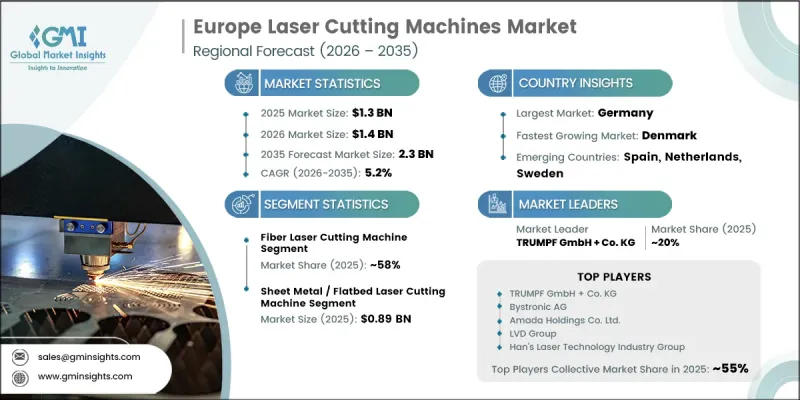
Europe Laser Cutting Machines Market was valued at USD 1.3 billion in 2025 and is estimated to grow at a CAGR of 5.2% to reach USD 2.3 billion by 2035.
Growth will be supported by renewed industrial investment, defense modernization programs, electric vehicle production upgrades, and increasing replacement of older laser cutting equipment with advanced fiber laser systems. The transition from CO2 laser technology to fiber laser platforms is expected to remain a major market transformation, driven by improved efficiency, reduced operating requirements, and broader material processing capabilities. Fiber laser machines provide significantly higher energy efficiency compared with traditional CO2 systems while enabling precise cutting of reflective materials. Automotive manufacturers across Europe are upgrading production facilities to support electric vehicle platforms, increasing demand for advanced laser cutting solutions used in battery components, vehicle structures, and lightweight materials. Automated cutting systems equipped with robotic handling, intelligent nesting solutions, and connected monitoring technologies are becoming increasingly important among advanced manufacturers.
| Market Scope | |
|---|---|
| Start Year | 2025 |
| Forecast Year | 2026-2035 |
| Start Value | $1.3 Billion |
| Forecast Value | $2.3 Billion |
| CAGR | 5.2% |
The fiber laser cutting machine segment held 58% share in 2025, valued at USD 0.77 billion. Expansion within this segment is being driven by both new equipment demand and the replacement of conventional CO2 laser machines. Market growth is increasingly influenced by the adoption of high-powered fiber laser systems ranging from 10 kW to 24 kW, which offer higher performance and command greater pricing compared with earlier-generation 4-6 kW fiber laser models.
The sheet metal and flatbed laser cutting system segment held 67% share in 2025, as tube laser and combination cutting systems gain additional market acceptance. Flatbed laser cutting technology continues to serve diverse manufacturing industries by supporting applications that require precision processing of different metal thicknesses. The segment remains a core contributor to European fabrication activities, while premium manufacturing operations are increasingly adopting larger-format systems integrated with automated sorting and handling technologies to improve productivity and enable highly efficient production environments.
Germany Laser Cutting Machines Market held 24% share, generating USD 0.32 billion in 2025. The country's strong industrial ecosystem, advanced manufacturing capabilities, and concentration of engineering companies continue to support its leadership position. TRUMPF's headquarters and major production facilities in Ditzingen, along with the extensive presence of automotive suppliers throughout key industrial regions, reinforce Germany's role as both a major demand center and an important technology development hub for the European laser cutting industry.
Key companies participating in the Europe laser cutting machines market include Amada Holdings Co., Ltd., TRUMPF GmbH + Co. KG, LVD Group, Salvagnini Italia S.p.A., Bystronic AG, IPG Photonics Corporation, Prima Power S.p.A., Mazak Optonics Corporation, Messer Cutting Systems, Han's Laser Technology Industry Group, Ermaksan, and Durma. Companies operating in the Europe laser cutting machines market are adopting strategies focused on technological advancement, strategic partnerships, product portfolio expansion, and localized customer support. Manufacturers are prioritizing investments in fiber laser technology, automation, artificial intelligence-based production systems, and digital connectivity solutions to improve machine performance and operational efficiency. Leading companies are also expanding their service networks, strengthening relationships with industrial users, and introducing customized solutions for automotive, aerospace, electronics, and metal fabrication industries. Continuous research and development activities, integration of smart manufacturing features, and improvements in energy efficiency are helping companies differentiate their offerings. Strategic acquisitions and collaborations are further enabling market players to expand their geographic presence and strengthen their competitive position across Europe.
Table of Contents
Chapter 1 Research methodology
- 1.1 Research approach
- 1.2 Quality Commitments
- 1.2.1 GMI AI policy & data integrity commitment
- 1.2.1.1 Source consistency protocol
- 1.2.1 GMI AI policy & data integrity commitment
- 1.3 Research trail & confidence scoring
- 1.3.1 Research trail components
- 1.3.2 Scoring components
- 1.4 Data Collection
- 1.4.1 Partial list of primary sources
- 1.5 Data mining sources
- 1.5.1 Paid sources
- 1.5.1.1 Sources, by region
- 1.5.1 Paid sources
- 1.6 Base estimates and calculations
- 1.6.1 Base year calculation
- 1.7 Forecast model
- 1.7.1 Quantified market impact analysis
- 1.7.1.1 Mathematical impact of growth parameters on forecast
- 1.7.1 Quantified market impact analysis
- 1.8 Research transparency addendum
- 1.8.1 Source attribution framework
- 1.8.2 Quality assurance metrics
- 1.8.3 Our commitment to trust
Chapter 2 Executive Summary
- 2.1 Industry 360° synopsis
- 2.2 Business trends
- 2.3 Regional
- 2.4 Technology
- 2.5 Power output
- 2.6 Product type
- 2.7 End use
- 2.8 Automation level
- 2.9 Distribution channel
Chapter 3 Industry Insights
- 3.1 Industry ecosystem analysis
- 3.1.1 Supplier landscape
- 3.1.2 Manufacturers
- 3.1.3 Distributors
- 3.1.4 End users
- 3.1.5 Profit margin analysis
- 3.1.6 Value addition at each stage
- 3.1.7 Factor affecting the value chain
- 3.2 Industry impact forces
- 3.2.1 Growth drivers
- 3.2.1.1 High-Power Fiber Laser Proliferation
- 3.2.1.2 Growing Demand in Metalworking Applications
- 3.2.1.3 Rising Demand from EV and Automotive Lightweighting
- 3.2.2 Industry pitfalls & challenges
- 3.2.2.1 High Initial Capital Expenditure Barrier
- 3.2.2.2 Skilled Operator and Maintenance Requirement
- 3.2.3 Opportunities
- 3.2.1 Growth drivers
- 3.3 Growth potential analysis
- 3.4 Technology and innovation landscape
- 3.4.1 Current technological trends
- 3.4.2 Emerging technologies
- 3.5 Pricing analysis (driven by primary research)
- 3.5.1 Historical price trend analysis by product category
- 3.5.2 Pricing strategy by player type (premium / value / cost-plus)
- 3.6 Trade data analysis (based on paid database)
- 3.6.1 Import/export volume & value trends
- 3.6.2 Key trade corridors & tariff impact
- 3.7 Regulatory landscape
- 3.7.1 Standards and compliance requirements
- 3.7.2 Regional regulatory frameworks
- 3.7.3 Certification standards
- 3.8 Porter's analysis
- 3.9 PESTEL analysis
- 3.10 Impact of AI & generative AI on the market
- 3.10.1 AI-driven disruption of existing business models
- 3.10.2 GenAI use cases & adoption roadmap by segment
- 3.10.3 Risks, limitations & regulatory considerations
Chapter 4 Competitive Landscape, 2025
- 4.1 Introduction
- 4.2 Company market share analysis
- 4.2.1 By Region
- 4.2.1.1 North America
- 4.2.1.2 Europe
- 4.2.1.3 Asia Pacific
- 4.2.1.4 Latin America
- 4.2.1.5 Middle East & Africa
- 4.2.1 By Region
- 4.3 Company matrix analysis
- 4.4 Competitive analysis of major market players
- 4.5 Competitive positioning matrix
- 4.6 Key developments
- 4.6.1 Mergers & acquisitions
- 4.6.2 Partnerships & collaborations
- 4.6.3 New product launches
- 4.6.4 Expansion plans
Chapter 5 Market Estimates & Forecast, By Technology, 2022 - 2035, (USD Billion) (Units)
- 5.1 Key trends
- 5.2 Fiber Laser Cutting Machine
- 5.3 CO2 Laser Cutting Machine
- 5.4 Solid-State & Other Emerging Technologies
Chapter 6 Market Estimates & Forecast, By Power Output, 2022 - 2035, (USD Billion) (Units)
- 6.1 Key trends
- 6.2 Low Power (< 3 kW)
- 6.3 Medium Power (3-6 kW)
- 6.4 High Power (6-15 kW)
- 6.5 Ultra-High Power (> 15 kW)
Chapter 7 Market Estimates & Forecast, By Product Type, 2022 - 2035, (USD Billion) (Units)
- 7.1 Key trends
- 7.2 Sheet Metal / Flatbed Laser Cutting Machine
- 7.3 Tube Laser Cutting System
- 7.4 Combination Systems (Tube + Sheet Metal)
Chapter 8 Market Estimates & Forecast, By End Use, 2022 - 2035, (USD Billion) (Units)
- 8.1 Key trends
- 8.2 Automotive & EV Manufacturing
- 8.3 Aerospace and Defense
- 8.4 Electronics and Semiconductors
- 8.5 Construction and Architecture
- 8.6 Industrial Machinery & Equipment Manufacturing
- 8.7 Energy
- 8.8 Metal Fabrication & Structural Steel
- 8.9 Others
Chapter 9 Market Estimates & Forecast, By Automation Level, 2022 - 2035, (USD Billion) (Units)
- 9.1 Key trends
- 9.2 Manual Laser Cutting Machine
- 9.3 Semi-Automated Laser Cutting Machine
- 9.4 Fully Automated Laser Cutting Machine
Chapter 10 Market Estimates & Forecast, By Distribution Channel, 2022 - 2035, (USD Billion) (Units)
- 10.1 Key trends
- 10.2 Direct Sales
- 10.3 Indirect Sales
Chapter 11 Market Estimates & Forecast, By Region, 2022 - 2035, (USD Billion) (Units)
- 11.1 Key trends
- 11.2 Europe
- 11.2.1 Germany
- 11.2.2 UK
- 11.2.3 France
- 11.2.4 Italy
- 11.2.5 Spain
- 11.2.6 Sweden
- 11.2.7 Netherlands
- 11.2.8 Denmark
- 11.2.9 Switzerland
- 11.2.10 Poland
Chapter 12 Company Profiles
- 12.1 Global Players
- 12.1.1 TRUMPF GmbH + Co. KG
- 12.1.2 Bystronic AG
- 12.1.3 Amada Holdings Co., Ltd.
- 12.1.4 Mazak Optonics Corporation
- 12.1.5 Han's Laser Technology Industry Group
- 12.1.6 IPG Photonics Corporation
- 12.1.7 Prima Power S.p.A.
- 12.1.8 Mitsubishi Electric Corporation
- 12.2 Regional Players
- 12.2.1 LVD Group
- 12.2.2 Salvagnini Italia S.p.A.
- 12.2.3 Tanaka Engineering Inc
- 12.2.4 HG Laser / Huagong Laser Engineering Co.
- 12.2.5 Ermaksan
- 12.2.6 Bodor Laser
- 12.2.7 Messer Cutting Systems
- 12.3 Emerging Players & Innovators
- 12.3.1 HSG Laser Co., Ltd.
- 12.3.2 Gweike Laser Technology
- 12.3.3 Senfeng Laser Technology Co., Ltd.
- 12.3.4 Penta Laser
- 12.3.5 SLTL Group
- 12.3.6 Durma

