PUBLISHER: Global Market Insights Inc. | PRODUCT CODE: 2109138

PUBLISHER: Global Market Insights Inc. | PRODUCT CODE: 2109138
Asia Pacific Ventilation Market Opportunity, Growth Drivers, Industry Trend Analysis, and Forecast 2026 - 2035
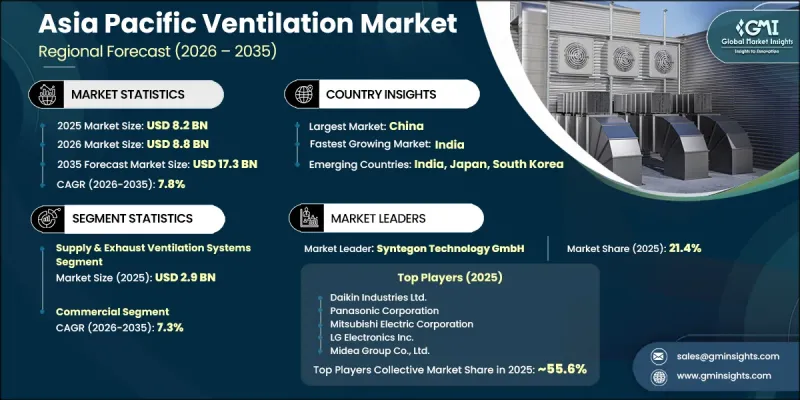
Asia Pacific Ventilation Market was valued at USD 8.2 billion in 2025 and is estimated to grow at a CAGR of 7.8% to reach USD 17.3 billion by 2035.
The market continues to benefit from rapid urban development, increasing construction activity, and rising investment in modern residential, commercial, and industrial infrastructure across the region. Expanding urban populations are creating sustained demand for ventilation systems that improve indoor air circulation, enhance occupant comfort, and support healthier indoor environments. Growing emphasis on energy-efficient buildings and stricter construction standards is encouraging developers to integrate advanced mechanical ventilation solutions into new and renovated properties. At the same time, increasing awareness of indoor air quality among consumers, businesses, and institutional organizations is accelerating the adoption of high-performance ventilation technologies. Regulatory initiatives focused on improving indoor environmental quality and building efficiency are also contributing to market expansion. As demand grows for sustainable, intelligent, and energy-saving building systems, ventilation equipment is becoming an essential component of modern infrastructure. Continuous investments in urban development and greater attention to indoor environmental performance are expected to support the long-term growth of the Asia Pacific ventilation market throughout the forecast period.
| Market Scope | |
|---|---|
| Start Year | 2025 |
| Forecast Year | 2026-2035 |
| Start Value | $8.2 Billion |
| Forecast Value | $17.3 Billion |
| CAGR | 7.8% |
The supply and exhaust ventilation systems segment generated USD 2.9 billion in 2025. The segment continues to dominate because of its broad adoption across residential, commercial, and industrial buildings to maintain efficient airflow and improve indoor air quality. These systems help remove contaminated indoor air while introducing fresh outdoor air, supporting humidity control, pollutant reduction, and enhanced occupant comfort. Rising infrastructure development, rapid urbanization, and increasingly stringent building requirements related to ventilation performance and energy efficiency continue to strengthen demand across the region.
The commercial segment accounted for a 45% share in 2025 and is projected to grow at a CAGR of 7.3% from 2026 to 2035. Continued investment in commercial infrastructure is driving demand for advanced ventilation systems that improve indoor environmental quality while supporting compliance with modern building standards. Growing focus on occupant well-being, operational efficiency, and regulatory requirements is accelerating system installations across commercial facilities. Energy recovery ventilators (ERVs) and heat recovery ventilators (HRVs) are gaining significant commercial acceptance because they recover heat or energy from exhaust air and transfer it to incoming fresh air, reducing HVAC conditioning loads by 50%-80% under favorable operating conditions.
China Ventilation Market generated USD 3.67 billion in 2025. The country's leadership is supported by ongoing urban expansion, continuous infrastructure development, and increasing industrial activity. Strong growth in residential, commercial, and industrial construction continues to drive demand for advanced ventilation systems that improve indoor air quality and enhance energy efficiency. Manufacturers are increasingly introducing intelligent ventilation technologies featuring automated controls, air quality monitoring capabilities, and energy-efficient operation to meet evolving construction requirements.
Key players operating in the Asia Pacific ventilation market include Daikin Industries Ltd., Panasonic Corporation, Mitsubishi Electric Corporation, Carrier Global Corporation, Systemair AB, Honeywell International Inc., Zehnder Group AG, LG Electronics Inc., Midea Group Co., Ltd., Gree Electric Appliances Inc., Hitachi Global Life Solutions, Inc., Johnson Controls International plc, Fujitsu General Limited, Haier Smart Home Co., Ltd., Holtop Energy Saving Technology Co., Ltd., Rinnai Corporation, Blue Star Limited, Voltas Limited (TATA Group), Taikisha Ltd., Airmate (Zhuhai) Co., Ltd., and Seeley International. Companies participating in the Asia Pacific ventilation market are strengthening their market position by expanding energy-efficient product portfolios, integrating smart technologies, and developing advanced ventilation solutions that address evolving building performance requirements. Manufacturers are investing in research and development to improve airflow efficiency, reduce energy consumption, and enhance indoor air quality through intelligent monitoring and automated control systems. Strategic partnerships, manufacturing expansion, and stronger regional distribution networks are enabling companies to improve product availability and customer support across key markets. Businesses are also focusing on customized ventilation solutions for residential, commercial, and industrial applications while enhancing after-sales services and technical assistance.
Table of Contents
Chapter 1 Research Methodology
- 1.1 Research approach
- 1.2 Quality Commitments
- 1.2.1 GMI AI policy & data integrity commitment
- 1.2.1.1 Source consistency protocol
- 1.2.1 GMI AI policy & data integrity commitment
- 1.3 Research Trail & Confidence Scoring
- 1.3.1 Research Trail Components
- 1.3.2 Scoring Components
- 1.4 Data Collection
- 1.4.1 Partial list of primary sources
- 1.5 Data mining sources
- 1.5.1 Paid sources
- 1.5.1.1 Sources, by region
- 1.5.1 Paid sources
- 1.6 Base estimates and calculations
- 1.6.1 Base year calculation for any one approach
- 1.7 Forecast model
- 1.7.1 Quantified market impact analysis
- 1.7.1.1 Mathematical impact of growth parameters on forecast
- 1.7.1 Quantified market impact analysis
- 1.8 Research transparency addendum
- 1.8.1 Source attribution framework
- 1.8.2 Quality assurance metrics
- 1.8.3 Our commitment to trust
Chapter 2 Executive Summary
- 2.1 Industry 360° synopsis, 2022 – 2035
- 2.2 Key market trends
- 2.2.1 Country
- 2.2.2 Product Type
- 2.2.3 Application
- 2.2.4 Installation
- 2.2.5 Distribution Channel
Chapter 3 Industry Insights
- 3.1 Industry ecosystem analysis
- 3.1.1 Factor affecting the value chain
- 3.1.2 Profit margin analysis
- 3.1.3 Disruptions
- 3.1.4 Future outlook
- 3.1.5 Manufacturers
- 3.1.6 Distributors
- 3.2 Supplier landscape
- 3.3 Key news & initiatives
- 3.4 Technology & Innovation Landscape
- 3.5 Regulatory landscape
- 3.6 Impact on forces
- 3.6.1 Growth drivers
- 3.6.1.1 Rising construction activities increase ventilation system demand
- 3.6.1.2 Growing indoor air quality awareness boosts adoption
- 3.6.1.3 Stringent building regulations encourage ventilation upgrades
- 3.6.2 Industry pitfalls & challenges
- 3.6.2.1 High installation costs limit widespread adoption
- 3.6.2.2 Complex maintenance increases operational expenses
- 3.6.3 Opportunities
- 3.6.3.1 Smart ventilation systems enhance building automation
- 3.6.3.2 Green building initiatives drive ventilation adoption
- 3.6.1 Growth drivers
- 3.7 Porter’s analysis
- 3.8 PESTEL analysis
- 3.9 Pricing analysis (driven by primary research)
- 3.9.1 Historical price trend analysis by product type (driven by primary research)
- 3.9.2 Pricing strategy by player type (premium / value / cost-plus) (driven by primary research)
- 3.10 Trade data analysis (driven by paid database)
- 3.10.1 Import/export volume & value trends by HS code (driven by paid database)
- 3.10.2 Key trade corridors & tariff impact on ventilation equipment (driven by paid database)
- 3.11 Impact of AI & generative AI on the market
- 3.11.1 AI-driven disruption of existing business models (predictive maintenance, smart controls)
- 3.11.2 GenAI use cases & adoption roadmap by segment
- 3.11.3 Risks, limitations & regulatory considerations
- 3.12 Capacity & production landscape (driven by primary research)
- 3.12.1 Installed manufacturing capacity by region & key producer (driven by primary research)
- 3.12.2 Capacity utilization rates & expansion pipelines (driven by primary research)
Chapter 4 Competitive Landscape, 2025
- 4.1 Introduction
- 4.2 Company market share analysis
- 4.3 Competitive positioning matrix
- 4.4 Strategic outlook matrix
- 4.5 Competitive analysis of major market players
- 4.6 Key developments
- 4.6.1 Mergers & acquisitions
- 4.6.2 Partnerships & collaborations
- 4.6.3 New product launches
- 4.6.4 Expansion plans
Chapter 5 Market Estimates & Forecast, By Product Type, 2022-2035 (USD Billion) (Million Units)
- 5.1 Key trends
- 5.2 ERV (energy recovery ventilator)
- 5.3 HRV (heat recovery ventilator)
- 5.4 Supply & exhaust ventilation systems
- 5.5 Natural ventilation systems
- 5.6 Others
Chapter 6 Market Estimates & Forecast, By Application, 2022-2035 (USD Billion) (Million Units)
- 6.1 Key trends
- 6.2 Residential
- 6.3 Commercial
- 6.4 Industrial
Chapter 7 Market Estimates & Forecast, By Installation, 2022-2035 (USD Billion) (Million Units)
- 7.1 Key trends
- 7.2 New construction
- 7.3 Retrofit
Chapter 8 Market Estimates & Forecast, By Distribution Channel, 2022-2035 (USD Billion) (Million Units)
- 8.1 Key trends
- 8.2 Direct sales
- 8.3 Indirect sales
Chapter 9 Market Estimates & Forecast, By Country, 2022 – 2035, (USD Billion) (Million Units)
- 9.1 Key trends
- 9.2 China
- 9.3 India
- 9.4 Japan
- 9.5 South Korea
- 9.6 Australia
- 9.7 Philippines
- 9.8 Thailand
- 9.9 Vietnam
Chapter 10 Company Profiles
- 10.1 Global players
- 10.1.1 Daikin Industries Ltd.
- 10.1.2 Panasonic Corporation
- 10.1.3 Mitsubishi Electric Corporation
- 10.1.4 Carrier Global Corporation
- 10.1.5 Systemair AB
- 10.1.6 Honeywell International Inc.
- 10.1.7 Zehnder Group AG
- 10.2 Regional players
- 10.2.1 LG Electronics Inc.
- 10.2.2 Midea Group Co., Ltd.
- 10.2.3 Gree Electric Appliances Inc.
- 10.2.4 Hitachi Global Life Solutions, Inc.
- 10.2.5 Johnson Controls International plc
- 10.2.6 Fujitsu General Limited
- 10.2.7 Haier Smart Home Co., Ltd.
- 10.3 Emerging players
- 10.3.1 Holtop Energy Saving Technology Co., Ltd.
- 10.3.2 Rinnai Corporation
- 10.3.3 Blue Star Limited
- 10.3.4 Voltas Limited (TATA Group)
- 10.3.5 Taikisha Ltd.
- 10.3.6 Airmate (Zhuhai) Co., Ltd.
- 10.3.7 Seeley International

