PUBLISHER: Global Market Insights Inc. | PRODUCT CODE: 2109142

PUBLISHER: Global Market Insights Inc. | PRODUCT CODE: 2109142
Personal and Entry Level Storage System (PLES) Market Opportunity, Growth Drivers, Industry Trend Analysis, and Forecast 2026 - 2035
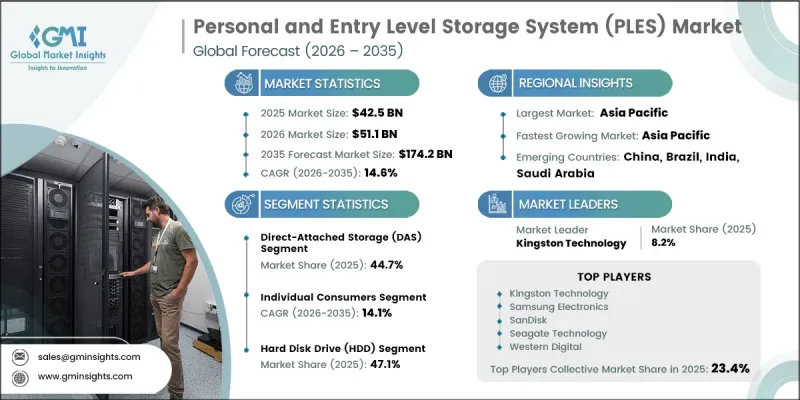
The Global Personal and Entry Level Storage System (PLES) market was valued at USD 42.5 billion in 2025 and is estimated to grow at a CAGR of 14.6% to reach USD 174.2 billion by 2035.
The market is experiencing robust growth as the volume of digital content created by consumers and professionals continues to increase at a rapid pace. Rising demand for reliable, high-capacity, and cost-effective storage solutions is being driven by the growing use of high-definition multimedia, digital documents, creative projects, business files, and other data-intensive applications. Increasing digital transformation, widespread adoption of connected devices, and the expansion of remote work environments are further accelerating the need for efficient personal storage systems. Consumers are increasingly seeking storage solutions that offer faster performance, enhanced data protection, and greater flexibility for managing expanding digital libraries. Continuous advancements in storage technologies, including improvements in speed, capacity, portability, and energy efficiency, are encouraging product upgrades across both consumer and professional markets. The growing importance of secure data backup, seamless file accessibility, and long-term data preservation continues to strengthen market demand.
| Market Scope | |
|---|---|
| Start Year | 2025 |
| Forecast Year | 2026-2035 |
| Start Value | $42.5 Billion |
| Forecast Value | $174.2 Billion |
| CAGR | 14.6% |
The direct-attached storage (DAS) segment captured a 44.7% share in 2025 and is forecast to grow at a 14.3% CAGR through 2035. The segment continues to dominate the market due to its ability to deliver high-speed data access, straightforward deployment, and cost-effective storage for personal and professional users. Direct-attached storage solutions remain a preferred option for individuals seeking reliable backup, efficient file management, and quick access to large volumes of digital data. Growing demand for high-performance storage devices capable of supporting expanding digital workloads continues to reinforce the segment's leadership position. Continuous product enhancements focused on storage capacity, transfer speed, and user convenience are expected to further strengthen adoption throughout the forecast period.
The Individual consumers segment held a 51.4% share in 2025 and is forecast to grow at a 14.1% CAGR through 2035. This segment remains the largest end-user category due to increasing demand for affordable and dependable storage solutions that support personal data management and digital content preservation. Rising digital lifestyles, expanding use of personal computing devices, and increasing awareness regarding secure data backup are encouraging consumers to invest in advanced storage systems. Growing adoption of personal storage devices for multimedia content, gaming libraries, work-related files, and long-term data protection continues to support sustained market growth. Improvements in storage performance, portability, and ease of use are expected to further accelerate demand among individual users.
U.S. Personal and Entry Level Storage System (PLES) market generated USD 11.7 billion in 2025 and is forecast to grow at a 13.5% CAGR during 2026-2035. The United States continues to represent one of the largest regional markets due to strong adoption of advanced storage technologies across consumers, professionals, and small and medium-sized businesses. Increasing digitalization, growing remote work adoption, and rising dependence on high-capacity storage devices continue to support market expansion. Continuous investments in advanced storage technologies, combined with increasing demand for secure, high-performance, and scalable storage solutions, are creating favorable opportunities for manufacturers operating across the country. The growing need for efficient data management and long-term digital storage is expected to sustain robust market growth over the forecast period.
Major companies operating in the global personal and entry level storage system (PLES) market include Synology, Samsung Electronics, Seagate, Western Digital, SanDisk, Buffalo, TerraMaster, QNAP Systems, Kingston Technology, Toshiba E&S, and Kioxia. Companies operating in the global personal and entry level storage system (PLES) market are strengthening their competitive position by investing in product innovation, storage performance improvements, and capacity expansion. Manufacturers are developing advanced storage solutions with faster data transfer speeds, enhanced security features, improved reliability, and greater compatibility across multiple devices and operating systems. Strategic partnerships with technology providers, retail distributors, and cloud service companies are helping businesses expand their market reach and strengthen customer engagement. Companies are also increasing investments in research and development to improve energy efficiency, portability, and data protection capabilities while addressing evolving consumer requirements. Expansion of manufacturing capacity, broader product portfolios, and stronger after-sales support services continue to reinforce market competitiveness.
Table of Contents
Chapter 1 Methodology
- 1.1 Research approach
- 1.2 Quality Commitments
- 1.2.1 GMI AI policy & data integrity commitment
- 1.2.1.1 Source consistency protocol
- 1.2.1 GMI AI policy & data integrity commitment
- 1.3 Research Trail & Confidence Scoring
- 1.3.1 Research Trail Components
- 1.3.2 Scoring Components
- 1.4 Data Collection
- 1.4.1 Partial list of primary sources
- 1.5 Data mining sources
- 1.5.1 Paid sources
- 1.5.1.1 Sources, by region
- 1.5.1 Paid sources
- 1.6 Base estimates and calculations
- 1.6.1 Base year calculation
- 1.7 Forecast model
- 1.7.1 Quantified market impact analysis
- 1.7.1.1 Mathematical impact of growth parameters on forecast
- 1.7.1 Quantified market impact analysis
- 1.8 Research transparency addendum
- 1.8.1 Source attribution framework
- 1.8.2 Quality assurance metrics
- 1.8.3 Our commitment to trust
Chapter 2 Executive Summary
- 2.1 Industry 360° synopsis
- 2.2 Key market trends
- 2.2.1 Regional
- 2.2.2 Storage architecture
- 2.2.3 Storage medium
- 2.2.4 Storage capacity
- 2.2.5 Distribution channel
- 2.2.6 End use
- 2.3 TAM analysis, 2026-2035
- 2.4 CXO perspectives: Strategic imperatives
Chapter 3 Industry Insights
- 3.1 Industry ecosystem analysis
- 3.1.1 Supplier landscape
- 3.1.1.1 Storage hardware manufacturers
- 3.1.1.2 NAND/flash memory suppliers
- 3.1.1.3 HDD manufacturers
- 3.1.1.4 NAS manufacturers
- 3.1.1.5 Cloud storage providers
- 3.1.1.6 Distribution & retail channels
- 3.1.2 Profit margin
- 3.1.3 Cost structure
- 3.1.4 Value addition at each stage
- 3.1.5 Factor affecting the value chain
- 3.1.6 Disruptions
- 3.1.1 Supplier landscape
- 3.2 Industry impact forces
- 3.2.1 Growth drivers
- 3.2.1.1 Explosion of digital content creation
- 3.2.1.2 Remote work and SOHO segment expansion
- 3.2.1.3 Declining NAND flash costs enabling mass-market SSD adoption
- 3.2.1.4 Data sovereignty concerns and subscription fatigue
- 3.2.2 Industry pitfalls and challenges
- 3.2.2.1 Cloud storage commoditization compressing hardware margins
- 3.2.2.2 NAND and DRAM supply chain volatility
- 3.2.3 Market opportunities
- 3.2.3.1 Growing adoption of AI-driven personal storage solutions
- 3.2.3.2 Rising demand for hybrid cloud-storage ecosystems
- 3.2.3.3 Expansion of creator and gaming storage segments
- 3.2.3.4 Increasing storage adoption in emerging market
- 3.2.1 Growth drivers
- 3.3 Growth potential analysis
- 3.4 Technology and innovation landscape
- 3.4.1 Current technological trends
- 3.4.1.1 HDD vs SSD Performance & Cost Trajectory
- 3.4.1.2 Emerging Storage Interfaces (NVMe, Thunderbolt 5, USB4)
- 3.4.1.3 High-Speed Storage Interfaces
- 3.4.2 Emerging technologies
- 3.4.2.1 Cloud-Native Personal Storage Architecture Innovations
- 3.4.2.2 Smart NAS & AI-Assisted Storage Management
- 3.4.2.3 High-Capacity Consumer Storage Technologies
- 3.4.1 Current technological trends
- 3.5 Regulatory landscape
- 3.5.1 North America
- 3.5.1.1 Federal Trade Commission (FTC) Data Security & Consumer Protection Requirements (U.S.)
- 3.5.1.2 Federal Information Processing Standards (FIPS) & Data Security Requirements (U.S.)
- 3.5.2 Europe
- 3.5.2.1 European Commission (EU Product Safety Regulation, CE Marking, RoHS, WEEE)
- 3.5.2.2 European Chemicals Agency (ECHA) RoHS Compliance
- 3.5.3 Asia Pacific
- 3.5.3.1 Ministry of Industry and Information Technology (MIIT), China
- 3.5.3.2 State Administration for Market Regulation (SAMR), China
- 3.5.4 Latin America
- 3.5.4.1 National Institute of Industrial Property (INPI), Brazil Product Standards & Certification
- 3.5.4.2 National Institute of Standards and Technology (INMETRO), Brazil Electrical Product Compliance
- 3.5.5 Middle East & Africa
- 3.5.5.1 Saudi Standards, Metrology and Quality Organization (SASO), Saudi Arabia
- 3.5.5.2 Telecommunications and Digital Government Regulatory Authority (TDRA), UAE
- 3.5.1 North America
- 3.6 Porter’s analysis
- 3.7 PESTEL analysis
- 3.8 Patent analysis (Driven by Primary Research)
- 3.9 Pricing Analysis (Driven by Primary Research)
- 3.9.1 Historical Price Trend Analysis Cost Per GB by Storage Medium, 2022-2025
- 3.9.2 Pricing Strategy by Player Type (Premium / Value / Cost-plus)
- 3.10 Cost breakdown analysis, 2025
- 3.11 Impact of AI & Generative AI on the Market
- 3.11.1 AI-driven disruption of existing business models
- 3.11.2 GenAI use cases & adoption roadmap by segment
- 3.11.3 Risks, limitations & regulatory considerations
- 3.12 Forecast assumptions & scenario analysis (Driven by primary research)
- 3.12.1 Base Case key macro & industry variables driving CAGR
- 3.12.2 Optimistic Scenarios Favorable macro and industry tailwinds
- 3.12.3 Pessimistic Scenario Macroeconomic slowdown or industry headwinds
Chapter 4 Competitive Landscape, 2025
- 4.1 Introduction
- 4.2 Company market share analysis
- 4.2.1 North America
- 4.2.2 Europe
- 4.2.3 Asia Pacific
- 4.2.4 LATAM
- 4.2.5 MEA
- 4.3 Competitive analysis of major market players
- 4.4 Competitive positioning matrix
- 4.5 Key developments
- 4.5.1 Mergers & acquisitions
- 4.5.2 Partnerships & collaborations
- 4.5.3 New product launches
- 4.5.4 Expansion plans and funding
- 4.6 Company tier benchmarking
- 4.6.1 Tier classification criteria & qualifying thresholds
- 4.6.2 Tier positioning matrix by revenue, geography & innovation
Chapter 5 Market Estimates & Forecast, By Storage architecture, 2022 2035 ($Mn)
- 5.1 Key trends
- 5.2 Direct-attached storage (DAS)
- 5.3 Network-attached storage (NAS)
- 5.4 Cloud-based personal storage
- 5.5 Hybrid storage solutions
Chapter 6 Market Estimates & Forecast, By Storage medium, 2022 2035 ($Mn, Units)
- 6.1 Key trends
- 6.2 Hard disk drive (HDD)
- 6.3 Solid-state drive (SSD) / flash-based
- 6.4 Optical / recordable media
- 6.5 Hybrid (HDD + SSD)
Chapter 7 Market Estimates & Forecast, By Storage capacity, 2022 2035 ($Mn, Units)
- 7.1 Key trends
- 7.2 Up to 1 TB
- 7.3 1–5 TB
- 7.4 5–10 TB
- 7.5 Above 10 TB
Chapter 8 Market Estimates & Forecast, By Distribution channel, 2022 2035 ($Mn)
- 8.1 Key trends
- 8.2 Online retail
- 8.3 Offline retail
- 8.4 Direct sales
Chapter 9 Market Estimates & Forecast, By End use, 2022 2035 ($Mn)
- 9.1 Key trends
- 9.2 Individual Consumers
- 9.3 SOHO / Small Businesses
- 9.4 Prosumers & Content Creators
- 9.5 Educational Users
- 9.6 Others
Chapter 10 Market Estimates & Forecast, By Region, 2022 2035 ($Mn, Units)
- 10.1 Key trends
- 10.2 North America
- 10.2.1 U.S.
- 10.2.2 Canada
- 10.3 Europe
- 10.3.1 Germany
- 10.3.2 UK
- 10.3.3 France
- 10.3.4 Italy
- 10.3.5 Spain
- 10.3.6 Nordics
- 10.3.7 Russia
- 10.3.8 Netherlands
- 10.4 Asia Pacific
- 10.4.1 China
- 10.4.2 India
- 10.4.3 Japan
- 10.4.4 South Korea
- 10.4.5 Australia
- 10.4.6 Singapore
- 10.4.7 Malaysia
- 10.5 Latin America
- 10.5.1 Brazil
- 10.5.2 Mexico
- 10.5.3 Argentina
- 10.6 MEA
- 10.6.1 South Africa
- 10.6.2 Saudi Arabia
- 10.6.3 UAE
Chapter 11 Company Profiles
- 11.1 Global players
- 11.1.1 Kingston Technology
- 11.1.2 Kioxia
- 11.1.3 QNAP
- 11.1.4 Samsung Electronics
- 11.1.5 SanDisk
- 11.1.6 Seagate Technology
- 11.1.7 Synology
- 11.1.8 Western Digital
- 11.2 Regional players
- 11.2.1 ADATA Technology
- 11.2.2 Buffalo
- 11.2.3 Fantec
- 11.2.4 Integral Memory
- 11.2.5 Netac Technology
- 11.2.6 TerraMaster
- 11.2.7 Toshiba Electronic Devices & Storage
- 11.2.8 Transcend Information
- 11.3 Emerging players
- 11.3.1 ASUSTOR
- 11.3.2 Sabrent
- 11.3.3 TeamGroup
- 11.3.4 Ugreen

