PUBLISHER: Global Market Insights Inc. | PRODUCT CODE: 2109164

PUBLISHER: Global Market Insights Inc. | PRODUCT CODE: 2109164
Asia-Pacific Hacksaw Blades Market Opportunity, Growth Drivers, Industry Trend Analysis, and Forecast 2026 - 2035
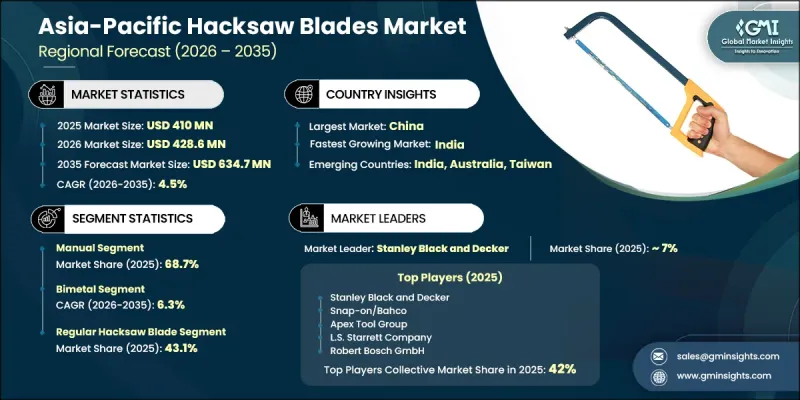
Asia-Pacific Hacksaw Blades Market was valued at USD 410 million in 2025 and is estimated to grow at a CAGR of 4.5% to reach USD 634.7 million by 2035.
The market continues to benefit from steady demand across metalworking, fabrication, construction, and maintenance, repair, and overhaul (MRO) applications. Ongoing industrial development across the Asia-Pacific region continues to create favorable conditions for cutting tool manufacturers, while improvements in blade technology are enhancing product performance and expanding commercial opportunities. Rising investments in manufacturing infrastructure, greater requirements for production efficiency, and increasing emphasis on durable cutting solutions are encouraging broader adoption of products across industrial environments. The market is also witnessing stronger demand for premium blade materials that offer improved operational life and cutting precision. In addition, manufacturers are focusing on product innovation to improve productivity, reduce downtime, and lower replacement frequency, supporting long-term market expansion. Continuous investments in industrial production capabilities, combined with modernization initiatives across manufacturing facilities, are expected to sustain healthy demand for hacksaw blades throughout the forecast period while creating opportunities for both established manufacturers and regional suppliers operating across the Asia-Pacific hacksaw blades market.
| Market Scope | |
|---|---|
| Start Year | 2025 |
| Forecast Year | 2026-2035 |
| Start Value | $410 Million |
| Forecast Value | $634.7 Million |
| CAGR | 4.5% |
Asia-Pacific hacksaw blades industry continues to benefit from the expanding metalworking, automotive, machinery, and fabrication sectors, which are driving consistent demand for reliable cutting tools across industrial facilities and maintenance, repair, and overhaul operations. Growing production volumes and increasing requirements for accurate cutting applications are encouraging users to invest in higher-quality blade solutions that improve efficiency and minimize operational interruptions. Another major trend shaping market development is the increasing transition from conventional high-speed steel (HSS) and alloy steel blades to bimetal products. Bimetal hacksaw blades feature a high-speed steel cutting edge joined with a flexible spring steel backing, allowing them to deliver longer operating life, greater tooth durability, improved cutting consistency, and enhanced versatility when processing a wider range of materials. These performance advantages continue to accelerate product adoption as end users seek cost-effective solutions that reduce replacement frequency and improve productivity in demanding industrial applications.
The manual hacksaw blades segment accounted for 68.7% share in 2025 and is expected to register a 3.7% CAGR from 2026 to 2035. Demand for manually operated hacksaw blades remains strong because hand-operated cutting tools continue to play a significant role across fabrication workshops, construction activities, maintenance services, and repair operations throughout the region. Many end users continue to prefer manual blades because they require lower capital investment while providing dependable cutting performance for diverse applications. Their widespread acceptance is further supported by operational flexibility, ease of handling, simple maintenance requirements, and suitability for smaller production environments where precision and portability remain important considerations.
The bimetal segment held 36.9% share in 2025 and is forecast to grow at 6.3% CAGR through 2035. The segment continues to gain momentum as industrial users increasingly prioritize products that deliver higher durability, improved cutting accuracy, and lower lifecycle costs. Bimetal blades offer superior resistance to wear and tooth breakage while maintaining cutting performance under demanding operating conditions. Their extended service life significantly reduces blade replacement intervals, enabling businesses to improve operational efficiency and minimize maintenance expenses. In addition, their compatibility with multiple material types makes them an attractive solution for manufacturers seeking versatile cutting tools capable of supporting diverse production requirements.
China Hacksaw Blades Market captured 34.2% share, generating USD 140.3 million, in 2025. The country's strong manufacturing ecosystem continues to provide a solid foundation for sustained demand for hacksaw blades and related cutting tools. Manufacturing value added maintained growth ranging from 6.2% to 7.4% during sequential months through mid-2025, supported by industrial modernization initiatives and continued expansion in manufacturing activity. Industrial production also maintained positive month-to-month momentum throughout 2024, reflecting stable production levels across manufacturing facilities. The combination of ongoing industrial investment, equipment modernization, expanding production capacity, and favorable manufacturing activity continues to reinforce China's position as the largest regional market for hacksaw blades while supporting long-term growth opportunities for industry participants.
Companies operating in the Asia-Pacific hacksaw blades market include Apex Tool Group, Bipico Industries Pvt. Ltd., Groz Engineering Tools Pvt. Ltd., Gwalior Tools Ltd., Hailian Saw Technology Co., Ltd., Hangzhou Fuweisi Saw Industry Co., Ltd., Hangzhou Jinzhi Steel Co., Ltd., ITL Industries Limited, Jiangxi Hongsheng Saws Manufacturing Co., Ltd., Jinan Ganghua Business of Saw Co., Ltd., L.S. Starrett Company, Mastek Tools, Nanjing Jinmeida Tools Co., Ltd., Robert Bosch GmbH, Shandong Liangshan Julong Saws Co., Ltd., Snap-on, Soteck Corporation, Stanley Black & Decker, Techtronic Industries (TTI), Trident Tools Pvt. Ltd., and Ultra Tools India Private Limited. Leading manufacturers in the Asia-Pacific hacksaw blades market are strengthening their market position by expanding product portfolios with advanced blade materials that improve durability, cutting precision, and operating life. Companies continue investing in manufacturing upgrades to improve production efficiency, maintain consistent product quality, and support growing customer demand. Many participants are increasing their regional distribution networks to improve product availability and strengthen relationships with industrial buyers and distributors. Strategic collaborations with channel partners, continuous product development, and regular portfolio enhancements are helping companies address changing customer requirements across industrial and maintenance applications. Businesses are also focusing on competitive pricing, operational efficiency, brand recognition, and customer support to enhance long-term loyalty.
Table of Contents
Chapter 1 Methodology and Scope
- 1.1 Research approach
- 1.2 Quality Commitments
- 1.2.1 GMI AI policy & data integrity commitment
- 1.2.1.1 Source consistency protocol
- 1.2.1 GMI AI policy & data integrity commitment
- 1.3 Research Trail & Confidence Scoring
- 1.3.1 Research Trail Components
- 1.3.2 Scoring Components
- 1.4 Data Collection
- 1.4.1 Partial list of primary sources
- 1.5 Data mining sources
- 1.5.1 Paid sources
- 1.5.1.1 Sources, by region
- 1.5.1 Paid sources
- 1.6 Base estimates and calculations
- 1.6.1 Base year calculation for any one approach
- 1.7 Forecast model
- 1.7.1 Quantified market impact analysis
- 1.7.1.1 Mathematical impact of growth parameters on forecast
- 1.7.1 Quantified market impact analysis
- 1.8 Research transparency addendum
- 1.8.1 Source attribution framework
- 1.8.2 Quality assurance metrics
- 1.8.3 Our commitment to trust
Chapter 2 Executive Summary
- 2.1 Industry 360° synopsis
- 2.2 Business trends
- 2.2.1 Mechanism
- 2.2.2 Blade Type
- 2.2.3 Blade Material
- 2.2.4 Blade Length
- 2.2.5 Teeth per Inch (TPI)
- 2.2.6 Price
- 2.2.7 Application
- 2.2.8 Distribution channel
Chapter 3 Industry Insights
- 3.1 Industry ecosystem analysis
- 3.1.1 Factor affecting the value chain
- 3.1.2 Profit margin analysis
- 3.1.3 Disruptions
- 3.1.4 Future outlook
- 3.1.5 Manufacturers
- 3.1.6 Distributors
- 3.2 Supplier landscape
- 3.3 Key news & initiatives
- 3.4 Technology & Innovation Landscape
- 3.5 Regulatory landscape
- 3.6 Impact on forces
- 3.6.1 Growth drivers
- 3.6.2 Industry pitfalls & challenges
- 3.6.3 Opportunities
- 3.7 Pricing analysis, 2025 (driven by primary research)
- 3.7.1 Historical price trend analysis (2022-2025)
- 3.7.2 Pricing strategy by player type (premium/value/cost-plus)
- 3.7.3 Regional price variation analysis
- 3.8 Growth potential analysis
- 3.9 Porter’s analysis
- 3.10 PESTEL analysis
- 3.11 Trade data analysis (driven by paid database)
- 3.11.1 Import/export volume & value trends (Driven by Primary Research)
- 3.11.2 Key trade corridors & tariff impact (Driven by Primary Research)
- 3.12 Impact of AI & generative AI on the market
- 3.12.1 AI-driven disruption of existing business models
- 3.12.2 GenAI use cases & adoption roadmap by segment
- 3.12.3 Risks, limitations & regulatory considerations
- 3.13 Capacity & Production Landscape (Driven by Primary Research)
- 3.13.1 Manufacturing Capacity Installed by Region & Key Producer (Driven by Primary Research)
- 3.13.2 Capacity Utilization Rates & Expansion Pipelines (Driven by Primary Research)
Chapter 4 Competitive Landscape, 2025
- 4.1 Introduction
- 4.2 Company market share analysis
- 4.3 Company matrix analysis
- 4.4 Competitive analysis of major market players
- 4.5 Competitive positioning matrix
- 4.6 Key developments
- 4.6.1 Mergers & acquisitions
- 4.6.2 Partnerships & collaborations
- 4.6.3 New product launches
- 4.6.4 Expansion plans
Chapter 5 Market Estimates and Forecast, By Mechanism, 2022 – 2035 (USD Million, Units)
- 5.1 Key trends
- 5.2 Manual
- 5.3 Electric
Chapter 6 Market Estimates and Forecast, By Blade Type, 2022 – 2035 (USD Million, Units)
- 6.1 Key trends
- 6.2 Regular Hacksaw Blade
- 6.3 Raker Hacksaw Blade
- 6.4 Wavy Hacksaw Blade
Chapter 7 Market Estimates and Forecast, By Blade Material, 2022 – 2035 (USD Million, Units)
- 7.1 Key trends
- 7.2 High Speed Steel
- 7.3 Bimetal
- 7.4 Tungsten Steel
- 7.5 Alloy Steel
- 7.6 Others
Chapter 8 Market Estimates and Forecast, By Blade Length, 2022 – 2035 (USD Million, Units)
- 8.1 Key trends
- 8.2 Small ( 6”)
- 8.3 Medium (6 - 12”)
- 8.4 High (Over 12”)
Chapter 9 Market Estimates and Forecast, By Teeth per Inch (TPI), 2022 – 2035 (USD Million, Units)
- 9.1 Key trends
- 9.2 14 TPI
- 9.3 18 TPI
- 9.4 24 TPI
- 9.5 32 TPI
Chapter 10 Market Estimates and Forecast, By Price, 2022 – 2035 (USD Million, Units)
- 10.1 Key trends
- 10.2 Low
- 10.3 Medium
- 10.4 High
Chapter 11 Market Estimates and Forecast, By Application, 2022 – 2035 (USD Million, Units)
- 11.1 Key trends
- 11.2 Residential
- 11.3 Commercial
- 11.4 Industrial
Chapter 12 Market Estimates and Forecast, By Distribution channel, 2022 – 2035 (USD Million, Units)
- 12.1 Key trends
- 12.2 Online channel
- 12.3 Offline channel
Chapter 13 Market Estimates and Forecast, By Country, 2022 – 2035 (USD Million, Units)
- 13.1 Key trends
- 13.2 China
- 13.3 Japan
- 13.4 India
- 13.5 South Korea
- 13.6 Australia
- 13.7 Taiwan
- 13.8 Singapore
- 13.9 Thailand
Chapter 14 Company Profiles
- 14.1 Global/Top PLAYERS
- 14.1.1 Robert Bosch GmbH
- 14.1.2 Stanley Black & Decker
- 14.1.3 Snap-on
- 14.1.4 Apex Tool Group
- 14.1.5 L.S. Starrett Company
- 14.1.6 Techtronic Industries (TTI)
- 14.2 REGIONAL/NICHE PLAYERS
- 14.2.1 Bipico Industries Pvt. Ltd.
- 14.2.2 Trident Tools Pvt. Ltd.
- 14.2.3 Gwalior Tools Ltd.
- 14.2.4 Groz Engineering Tools Pvt. Ltd.
- 14.2.5 ITL Industries Limited
- 14.2.6 Soteck Corporation
- 14.2.7 Jinan Ganghua Business of Saw Co., Ltd.
- 14.2.8 Hailian Saw Technology Co., Ltd.
- 14.2.9 Hangzhou Fuweisi Saw Industry Co., Ltd.
- 14.3 Emerging players
- 14.3.1 Hangzhou Jinzhi Steel Co., Ltd.
- 14.3.2 Mastek Tools
- 14.3.3 Shandong Liangshan Julong Saws Co., Ltd.
- 14.3.4 Nanjing Jinmeida Tools Co., Ltd.
- 14.3.5 Jiangxi Hongsheng Saws Manufacturing Co., Ltd.
- 14.3.6 Ultra Tools India Private Limited

