PUBLISHER: Global Market Insights Inc. | PRODUCT CODE: 2109167

PUBLISHER: Global Market Insights Inc. | PRODUCT CODE: 2109167
Antifog Films and Sheets Market Opportunity, Growth Drivers, Industry Trend Analysis, and Forecast 2026 - 2035
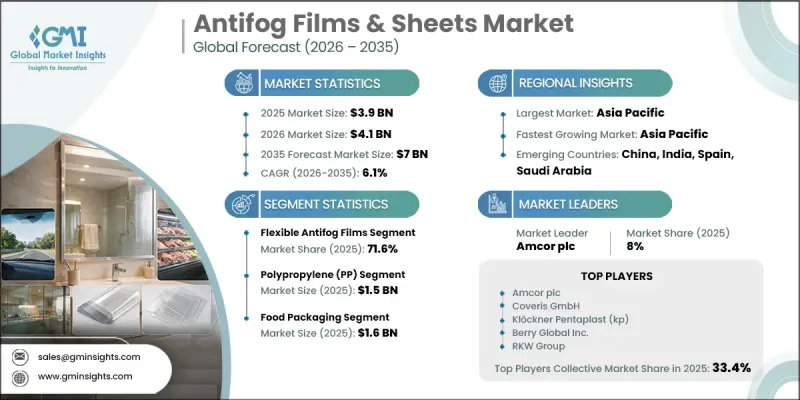
The Global Antifog Films & Sheets Market was valued at USD 3.9 billion in 2025 and is estimated to grow at a CAGR of 6.1% to reach USD 7 billion by 2035.
The market continues to expand as industries increasingly seek packaging materials that preserve product visibility while preventing moisture accumulation. Rising demand for transparent packaging solutions, greater emphasis on food quality and safety, expanding cold chain infrastructure, and the growing adoption of sustainable packaging materials are supporting long-term market growth. Continuous technological improvements in antifog coating formulations are further enhancing product performance across multiple end-use sectors, including food packaging, healthcare, agriculture, and industrial applications. The increasing need to maintain product freshness, improve shelf appeal, and minimize condensation-related quality issues is encouraging manufacturers to adopt advanced antifog films and sheets. At the same time, the growing focus on protected cultivation and modern agricultural practices is strengthening demand for specialized greenhouse films. These combined factors are reinforcing the commercial importance of the antifog sheets & films market, positioning it for sustained growth as manufacturers continue investing in high-performance materials that improve durability, transparency, and operational efficiency.
| Market Scope | |
|---|---|
| Start Year | 2025 |
| Forecast Year | 2026-2035 |
| Start Value | $3.9 Billion |
| Forecast Value | $7 Billion |
| CAGR | 6.1% |
The antifog films and sheets industry is experiencing increasing demand as transparent packaging becomes a preferred solution for preserving the quality and appearance of perishable products. These materials effectively reduce condensation, allowing packaged products to remain clearly visible while helping extend product freshness throughout storage and transportation. Growing investments in protected agriculture are also driving demand for greenhouse films that improve light transmission, reduce internal moisture buildup, and support better crop productivity. In addition, ongoing emphasis on sustainable agricultural practices and resource-efficient production methods is encouraging wider adoption of advanced antifog technologies across greenhouse applications. As industries continue to prioritize product protection, operational efficiency, and packaging performance, demand for antifog films and sheets is expected to strengthen across both food packaging and agricultural sectors.
The flexible antifog films segment accounted for 71.6% share in 2025, making it the leading product category. Strong demand across food packaging, agricultural applications, healthcare packaging, and flexible consumer packaging continues to support its market leadership. Flexible antifog films offer excellent optical clarity, effective condensation resistance, lightweight construction, and compatibility with recyclable packaging formats, making them suitable for a wide range of commercial applications. Their ability to improve product presentation while supporting longer shelf life has significantly increased adoption across industries where product quality and packaging performance remain essential.
The polypropylene (PP) segment reached USD 1.5 billion in 2025. Polypropylene remains one of the most widely used materials because of its excellent transparency, moisture resistance, heat-sealing capability, cost efficiency, and compatibility with high-performance antifog coatings. These characteristics make it an ideal material for packaging applications requiring reliable visibility and moisture control while maintaining processing efficiency. Its compatibility with recyclable material systems further strengthens its position as manufacturers increasingly prioritize sustainable packaging solutions. Growing demand across food, beverage, healthcare, medical, and consumer packaging applications is expected to continue supporting polypropylene-based antifog film adoption during the forecast period.
North America Antifog Films & Sheets Market held a 22.2% share in 2025. Market expansion across the region is being driven by increasing demand for sustainable food packaging and the growing use of advanced packaging materials within the healthcare sector. Strong regulatory emphasis on safe food-contact materials and improved packaging performance is encouraging manufacturers to develop higher-quality antifog products that meet evolving industry requirements. Rising consumption of packaged food, expanding greenhouse cultivation activities, and continued innovation across healthcare, medical, and automotive manufacturing are expected to support healthy regional growth through 2035, reinforcing North America's position as a key market for advanced antifog film technologies.
Prominent companies operating in the global antifog films & sheets market include 3M Company, Amcor plc, Berry Global Inc., Chiripal Poly Films Ltd., Cosmo First Ltd. (Cosmo Films), Coveris GmbH, Ester Industries Ltd., FSI Coating Technologies, Inc., Garware Hi-Tech Films Ltd., Jindal Poly Films Ltd., JPFL Films Pvt. Ltd., Klockner Pentaplast (kp), Mitsubishi Chemical Group Corp., Polyplex Corporation Ltd., RKW Group, SABIC, Sealed Air Corporation (Cryovac), Sumitomo Bakelite Co., Ltd., SUDPACK Holding GmbH, Taghleef Industries, Toray Industries, Inc., UFlex Limited, and Vacmet India Ltd. Companies participating in the antifog films & sheets market are strengthening their market position by investing in advanced coating technologies, expanding production capacity, and developing high-performance films with improved transparency and moisture-control capabilities. Manufacturers are focusing on sustainable product innovation by introducing recyclable and environmentally responsible packaging materials that align with evolving regulatory and customer requirements. Many companies are broadening their application portfolio to serve food packaging, healthcare, agriculture, industrial, and consumer packaging industries while increasing investments in research and development to enhance product functionality. Strategic partnerships, distribution network expansion, and long-term supply agreements are helping manufacturers strengthen customer relationships and improve market reach.
Table of Contents
Chapter 1 Methodology and Scope
- 1.1 Market scope and definition
- 1.2 Research design
- 1.2.1 Research approach
- 1.2.2 Data collection methods
- 1.3 Data mining sources
- 1.3.1 Global
- 1.3.2 Regional/Country
- 1.4 Base estimates and calculations
- 1.4.1 Base year calculation
- 1.4.2 Key trends for market estimation
- 1.5 Primary research and validation
- 1.5.1 Primary sources
- 1.6 Forecast model
- 1.7 Research assumptions and limitations
Chapter 2 Executive Summary
- 2.1 Industry 360° synopsis, 2022 – 2035
- 2.2 Key market trends
- 2.2.1 Product type trends
- 2.2.2 Material type trends
- 2.2.3 Application trends
- 2.2.4 Regional trends
- 2.3 TAM Analysis, 2026-2035
- 2.4 CXO perspectives: Strategic imperatives
Chapter 3 Industry Insights
- 3.1 Industry ecosystem analysis
- 3.1.1 Supplier Landscape
- 3.1.2 Profit Margin
- 3.1.3 Cost structure
- 3.1.4 Value addition at each stage
- 3.1.5 Factor affecting the value chain
- 3.1.6 Disruptions
- 3.2 Industry impact forces
- 3.2.1 Growth drivers
- 3.2.1.1 Increasing demand for fresh food packaging and shelf-life extension
- 3.2.1.2 Expansion of protected agriculture and greenhouse cultivation
- 3.2.1.3 Growing automotive production and advanced glazing applications
- 3.2.1.4 Increasing demand from healthcare and medical packaging applications
- 3.2.1.5 Rising adoption of optical, consumer electronics, and protective display applications
- 3.2.2 Industry pitfalls and challenges
- 3.2.2.1 High cost of advanced antifog coatings and specialty polymers
- 3.2.2.2 Performance durability and coating degradation under harsh conditions
- 3.2.3 Market opportunities
- 3.2.3.1 Development of sustainable and recyclable antifog film technologies
- 3.2.3.2 Growing adoption in electric vehicles, smart displays, and healthcare applications
- 3.2.1 Growth drivers
- 3.3 Growth potential analysis
- 3.4 Regulatory landscape
- 3.4.1 North America
- 3.4.2 Europe
- 3.4.3 Asia Pacific
- 3.4.4 Latin America
- 3.4.5 Middle East & Africa
- 3.5 Porter’s analysis
- 3.6 PESTEL analysis
- 3.7 Technology and Innovation landscape
- 3.7.1 Current technological trends
- 3.7.2 Emerging technologies
- 3.8 Price trends
- 3.8.1 By region
- 3.8.2 By product
- 3.9 Pricing Strategies
- 3.10 Emerging Business Models
- 3.11 Compliance Requirements
- 3.12 Patent and IP analysis
Chapter 4 Competitive Landscape, 2025
- 4.1 Introduction
- 4.2 Company market share analysis
- 4.2.1 By region
- 4.2.1.1 North America
- 4.2.1.2 Europe
- 4.2.1.3 Asia Pacific
- 4.2.1.4 Latin America
- 4.2.1.5 Middle East & Africa
- 4.2.2 Market concentration analysis
- 4.2.1 By region
- 4.3 Competitive benchmarking of key players
- 4.3.1 Financial performance comparison
- 4.3.1.1 Revenue
- 4.3.1.2 Profit margin
- 4.3.1.3 R&D
- 4.3.2 Product portfolio comparison
- 4.3.2.1 Product range breadth
- 4.3.2.2 Technology
- 4.3.2.3 Innovation
- 4.3.3 Geographic presence comparison
- 4.3.3.1 Global footprint analysis
- 4.3.3.2 Service network coverage
- 4.3.3.3 Market penetration by region
- 4.3.4 Competitive positioning matrix
- 4.3.4.1 Leaders
- 4.3.4.2 Challengers
- 4.3.4.3 Followers
- 4.3.4.4 Niche players
- 4.3.5 Strategic outlook matrix
- 4.3.1 Financial performance comparison
- 4.4 Key developments
- 4.4.1 Mergers and acquisitions
- 4.4.2 Partnerships and collaborations
- 4.4.3 Technological advancements
- 4.4.4 Expansion and investment strategies
- 4.4.5 Digital transformation initiatives
- 4.5 Emerging/ startup competitors landscape
Chapter 5 Market Estimates and Forecast, By Product Type, 2022 – 2035 (USD Million)
- 5.1 Key trends
- 5.2 Flexible antifog films
- 5.3 Rigid antifog sheets
Chapter 6 Market Estimates and Forecast, By Material Type, 2022 – 2035 (USD Million)
- 6.1 Key trends
- 6.2 Polypropylene (PP)
- 6.3 Polyethylene (PE)
- 6.4 Polyethylene terephthalate (PET)
- 6.5 Polycarbonate (PC)
- 6.6 Others
Chapter 7 Market Estimates and Forecast, By Application, 2022 – 2035 (USD Million)
- 7.1 Key trends
- 7.2 Food packaging
- 7.3 Agriculture & horticulture
- 7.4 Medical & healthcare
- 7.5 Automotive & transportation
- 7.6 Building & construction
- 7.7 Consumer products
- 7.8 Others
Chapter 8 Market Estimates and Forecast, By Region, 2022 – 2035 (USD Million)
- 8.1 Key trends
- 8.2 North America
- 8.2.1 U.S.
- 8.2.2 Canada
- 8.3 Europe
- 8.3.1 Germany
- 8.3.2 UK
- 8.3.3 France
- 8.3.4 Spain
- 8.3.5 Italy
- 8.4 Asia Pacific
- 8.4.1 China
- 8.4.2 India
- 8.4.3 Japan
- 8.4.4 Australia
- 8.4.5 South Korea
- 8.5 Latin America
- 8.5.1 Brazil
- 8.5.2 Mexico
- 8.5.3 Argentina
- 8.6 Middle East and Africa
- 8.6.1 South Africa
- 8.6.2 Saudi Arabia
- 8.6.3 UAE
Chapter 9 Company Profiles
- 9.1 Global Key Players
- 9.1.1 Amcor plc
- 9.1.2 Coveris GmbH
- 9.1.3 Klockner Pentaplast (kp)
- 9.1.4 Berry Global Inc.
- 9.1.5 RKW Group
- 9.2 Regional key players
- 9.2.1 North America
- 9.2.1.1 3M Company
- 9.2.1.2 FSI Coating Technologies, Inc.
- 9.2.1.3 Sealed Air Corporation (Cryovac)
- 9.2.2 Asia Pacific
- 9.2.2.1 Cosmo First Ltd. (Cosmo Films)
- 9.2.2.2 Jindal Poly Films Ltd.
- 9.2.2.3 Polyplex Corporation Ltd.
- 9.2.2.4 Garware Hi-Tech Films Ltd.
- 9.2.2.5 Toray Industries, Inc.
- 9.2.2.6 Mitsubishi Chemical Group Corp.
- 9.2.2.7 JPFL Films Pvt. Ltd.
- 9.2.2.8 Chiripal Poly Films Ltd.
- 9.2.2.9 Vacmet India Ltd.
- 9.2.2.10 Ester Industries Ltd.
- 9.2.2.11 SABIC
- 9.2.2.12 Sumitomo Bakelite Co., Ltd.
- 9.2.3 Europe
- 9.2.3.1 Taghleef Industries
- 9.2.3.2 SUDPACK Holding GmbH
- 9.2.1 North America
- 9.3 Niche Players/Disruptors
- 9.3.1 UFlex Limited

