PUBLISHER: Global Market Insights Inc. | PRODUCT CODE: 2109174

PUBLISHER: Global Market Insights Inc. | PRODUCT CODE: 2109174
UAV Jammers Market Opportunity, Growth Drivers, Industry Trend Analysis, and Forecast 2026 - 2035
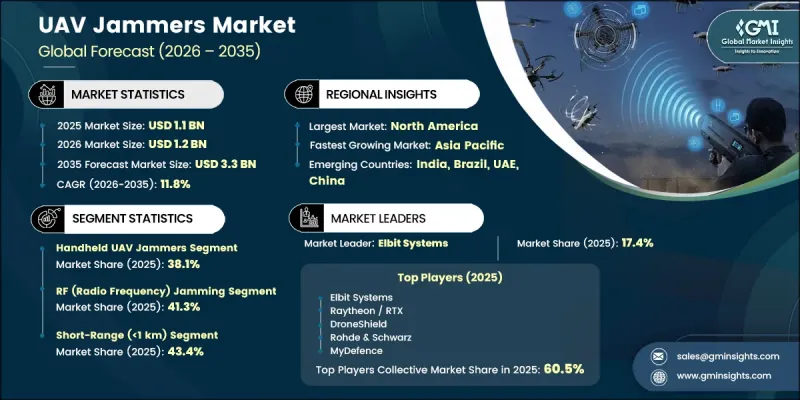
The Global UAV Jammers Market was valued at USD 1.1 billion in 2025 and is estimated to grow at a CAGR of 11.8% to reach USD 3.3 billion by 2035.
Market expansion is fueled by rising geopolitical tensions, evolving regulatory frameworks that broaden the deployment of counter-drone technologies, and the widespread availability of unmanned aerial vehicles with increasingly advanced operational capabilities. These developments are transforming the role of UAV jamming solutions from specialized defense equipment into an essential component of modern security infrastructure across multiple sectors. Continuous advancements in electronic warfare technologies, signal disruption capabilities, and system integration are further supporting market growth by improving operational effectiveness and deployment flexibility. As organizations strengthen their efforts to address emerging aerial security risks, investments in advanced UAV jamming technologies continue to increase. The growing need to safeguard critical infrastructure, transportation networks, industrial facilities, and public assets from unauthorized drone activities is expected to create sustained demand for innovative counter-drone systems, positioning the global UAV jammers market for long-term expansion throughout the forecast period.
| Market Scope | |
|---|---|
| Start Year | 2025 |
| Forecast Year | 2026-2035 |
| Start Value | $1.1 Billion |
| Forecast Value | $3.3 Billion |
| CAGR | 11.8% |
The UAV jammers market continues to expand as concerns over unauthorized drone activities and evolving aerial security threats drive higher investments in counter-drone technologies. Increasing incidents involving unmanned aerial systems have encouraged organizations to strengthen protective measures through advanced electronic countermeasure solutions. In addition, changing defense priorities and the growing use of tactical unmanned systems in modern security operations have accelerated the procurement of UAV jamming equipment. Rising investments in electronic warfare capabilities and broader deployment of counter-drone technologies continue to reinforce market growth while encouraging the development of more efficient and adaptable jamming solutions.
The handheld UAV jammers segment accounted for 38.1% share in 2025. The segment maintains its leading position because of its portability, rapid deployment capability, and flexibility across a broad range of security and defense operations. Handheld systems are widely preferred for mobile counter-drone missions where immediate response capabilities are essential without requiring permanent infrastructure. Their relatively lower acquisition cost compared with larger system configurations also supports greater procurement volumes, enabling organizations to equip personnel with efficient and easily deployable counter-drone solutions.
The short-range (<1 km) segment held 43.4% share in 2025. The segment benefits from its suitability for security operations requiring localized protection while minimizing interference with surrounding communication systems. Compact design, operational efficiency, regulatory compatibility, and cost-effective deployment continue to support strong demand for short-range UAV jammers. Their leadership also reflects the increasing need for effective counter-drone protection in environments where aerial security threats typically emerge within proximity to protected locations.
North America UAV Jammers Market accounted for 37.1% share in 2025. Regional market growth is supported by expanding investments in border protection, critical infrastructure security, and advanced counter-drone capabilities. Continued deployment of fixed-site and mobile UAV jamming technologies, combined with coordinated procurement initiatives and greater standardization across security organizations, is strengthening regional demand. The development of compatible counter-drone systems and streamlined acquisition processes continues to reinforce North America's position as a leading market for UAV jamming technologies throughout the forecast period.
Key companies operating in the UAV jammers market include DZYNE Technologies, MyDefence, Elbit Systems, Raytheon / RTX, Rohde & Schwarz, Aaronia AG, Skylock (AVNON), Paras Anti-Drone, BlueBird Tech, SRC Inc., Phantom Technologies, Regulus, and K9 Electronics. Companies participating in the UAV jammers market are strengthening their competitive position by investing heavily in research and development to enhance electronic warfare capabilities, improve signal disruption performance, and increase operational reliability. Manufacturers are expanding their product portfolios with portable, vehicle-mounted, and fixed-installation solutions to address diverse customer requirements. Strategic collaborations with defense organizations, technology providers, and security agencies are helping companies accelerate product development and expand market reach. Businesses are also focusing on improving system integration, software capabilities, and interoperability with broader security platforms to enhance operational efficiency.
Table of Contents
Chapter 1 Methodology and Scope
- 1.1 Market scope and definition
- 1.2 Research design
- 1.2.1 Research approach
- 1.2.2 Data collection methods
- 1.3 Data mining sources
- 1.3.1 Global
- 1.3.2 Regional/Country
- 1.4 Base estimates and calculations
- 1.4.1 Base year calculation
- 1.4.2 Key trends for market estimation
- 1.5 Primary research and validation
- 1.5.1 Primary sources
- 1.6 Forecast model
- 1.7 Research assumptions and limitations
Chapter 2 Executive Summary
- 2.1 Industry 360° synopsis, 2022 - 2035
- 2.2 Key market trends
- 2.2.1 Product Type trends
- 2.2.2 Jamming Technology trends
- 2.2.3 Range Capability trends
- 2.2.4 End-user trends
- 2.2.5 Regional trends
- 2.3 TAM Analysis, 2026-2035
- 2.4 CXO perspectives: Strategic imperatives
Chapter 3 Industry Insights
- 3.1 Industry ecosystem analysis
- 3.1.1 Supplier Landscape
- 3.1.2 Profit Margin
- 3.1.3 Cost structure
- 3.1.4 Value addition at each stage
- 3.1.5 Factor affecting the value chain
- 3.1.6 Disruptions
- 3.2 Industry impact forces
- 3.2.1 Growth drivers
- 3.2.1.1 Rising Drone-Related Security Incidents at Airports and Critical Infrastructure
- 3.2.1.2 Escalating Geopolitical Tensions Fueling Counter-UAS Procurement
- 3.2.1.3 Increasing Illicit Drone Use for Smuggling, Espionage, and Terrorism
- 3.2.1.4 Expanding Homeland Security and Law Enforcement Deployments
- 3.2.1.5 Growing Investment in Military Modernization and Border Security
- 3.2.2 Industry pitfalls and challenges
- 3.2.2.1 High Cost and Complex Integration of Advanced AI-Based Jamming Systems, Limiting Adoption Compared to Conventional RF/GNSS Jammers
- 3.2.2.2 Rising Component and Production Costs Due to Tariffs on Semiconductors, RF Modules, and Military-Grade Electronics
- 3.2.3 Market opportunities
- 3.2.3.1 Integration of AI, Radar, and Multi-Band Detection into Comprehensive Counter-Drone Systems
- 3.2.3.2 Expansion into Commercial Security, Public Events, and Emerging Markets
- 3.2.1 Growth drivers
- 3.3 Growth potential analysis
- 3.4 Pricing Analysis (Driven by Primary Research)
- 3.4.1 Historical Price Trend Analysis
- 3.4.2 Pricing Strategy by Player Type (Premium / Value / Cost-plus)
- 3.5 Regulatory landscape
- 3.5.1 North America
- 3.5.2 Europe
- 3.5.3 Asia Pacific
- 3.5.4 Latin America
- 3.5.5 Middle East & Africa
- 3.6 Porter's analysis
- 3.7 PESTEL analysis
- 3.8 Trade Data Analysis (Based on Paid Database)
- 3.8.1 Import/Export Volume & Value Trends
- 3.8.2 Key Trade Corridors & Tariff Impact
- 3.9 Impact of AI & Generative AI on the Market (Driven by Primary Research)
- 3.9.1 AI-Driven Disruption of Existing Business Models
- 3.9.2 GenAI Use Cases & Adoption Roadmap by Segment
- 3.10 Capacity & Production Landscape (Driven by Primary Research)
- 3.10.1 Production Capacity by Key Producer
- 3.10.2 Capacity Utilization Rates & Expansion Pipelines
Chapter 4 Competitive Landscape, 2025
- 4.1 Company market share analysis, 2025
- 4.1.1 By Region
- 4.1.1.1 North America
- 4.1.1.2 Europe
- 4.1.1.3 Asia-Pacific
- 4.1.1.4 Latin America
- 4.1.1.5 Middle East and Africa
- 4.1.2 Market Concentration Analysis
- 4.1.1 By Region
- 4.2 Competitive analysis of major market players
- 4.3 Competitive positioning matrix
- 4.4 Key developments
- 4.4.1 Mergers & acquisitions
- 4.4.2 Partnerships & collaborations
- 4.4.3 New product launches
- 4.4.4 Expansion plans and funding
- 4.5 Company tier benchmarking
- 4.5.1 Tier classification criteria & qualifying thresholds
- 4.5.2 Tier positioning matrix by revenue, geography & innovation
Chapter 5 Market Estimates and Forecast, By Product Type, 2022 - 2035 (USD Million)
- 5.1 Key trends
- 5.2 Handheld UAV Jammers
- 5.3 Fixed/Stationary UAV Jammers
- 5.4 Vehicle-Mounted UAV Jammers
- 5.5 Manpack/Backpack UAV Jammers
Chapter 6 Market Estimates and Forecast, By Jamming Technology, 2022 - 2035 (USD Million)
- 6.1 Key trends
- 6.2 RF (Radio Frequency) Jamming
- 6.3 GPS/GNSS Jamming
- 6.4 Video/Data Link Jamming
- 6.5 Multi-Band/Hybrid Jamming
Chapter 7 Market Estimates and Forecast, By Range Capability, 2022 - 2035 (USD Million)
- 7.1 Key trends
- 7.2 Short-Range (<1 km)
- 7.3 Medium-Range (1-5 km)
- 7.4 Long-Range (>5 km)
Chapter 8 Market Estimates and Forecast, By End-User, 2022 - 2035 (USD Million)
- 8.1 Key trends
- 8.2 Military & Defense
- 8.3 Homeland Security & Border Protection
- 8.4 Law Enforcement Agencies
- 8.5 Critical Infrastructure Operators
- 8.6 Commercial & Industrial Users
- 8.7 Others
Chapter 9 Market Estimates and Forecast, By Region, 2022 - 2035 (USD Million)
- 9.1 Key trends
- 9.2 North America
- 9.2.1 U.S.
- 9.2.2 Canada
- 9.3 Europe
- 9.3.1 Germany
- 9.3.2 UK
- 9.3.3 France
- 9.3.4 Spain
- 9.3.5 Italy
- 9.4 Asia Pacific
- 9.4.1 China
- 9.4.2 India
- 9.4.3 Japan
- 9.4.4 Australia
- 9.4.5 South Korea
- 9.5 Latin America
- 9.5.1 Brazil
- 9.5.2 Mexico
- 9.5.3 Argentina
- 9.6 Middle East and Africa
- 9.6.1 South Africa
- 9.6.2 Saudi Arabia
- 9.6.3 UAE
Chapter 10 Company Profiles
- 10.1 Global Key Players
- 10.1.1 Elbit Systems
- 10.1.2 Raytheon / RTX
- 10.1.3 DroneShield
- 10.1.4 Rohde & Schwarz
- 10.1.5 MyDefence
- 10.2 Regional key players
- 10.2.1 North America
- 10.2.1.1 DZYNE Technologies
- 10.2.1.2 SRC Inc.
- 10.2.2 Asia Pacific
- 10.2.2.1 Paras Anti-Drone
- 10.2.2.2 Phantom Technologies
- 10.2.3 Europe
- 10.2.3.1 Aaronia AG
- 10.2.1 North America
- 10.3 Niche Players/Disruptors
- 10.3.1 Skylock (AVNON)
- 10.3.2 BlueBird Tech
- 10.3.3 Regulus
- 10.3.4 K9 Electronics

