
PUBLISHER: Global Market Insights Inc. | PRODUCT CODE: 2109185

PUBLISHER: Global Market Insights Inc. | PRODUCT CODE: 2109185
Data Center Connectors Market Opportunity, Growth Drivers, Industry Trend Analysis, and Forecast 2026 - 2035
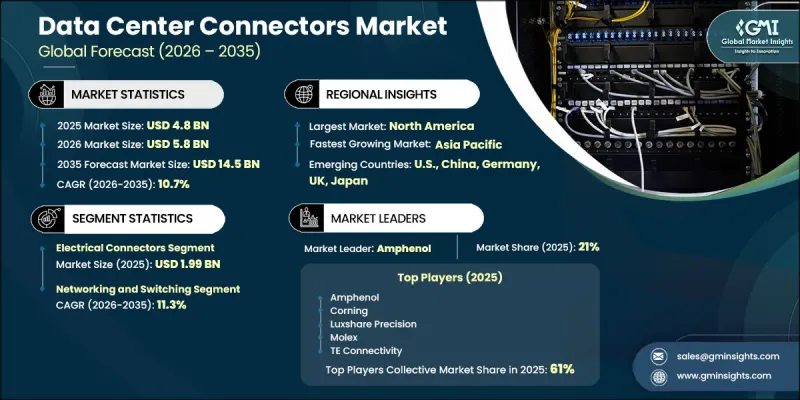
The Global Data Center Connectors Market was valued at USD 4.8 billion in 2025 and is estimated to grow at a CAGR of 10.7% to reach USD 14.5 billion by 2035.
Strong investment in digital infrastructure over the past decade, combined with rapidly growing AI deployments across hyperscale, colocation, and enterprise data centers, continues to reshape market demand. The industry is transitioning toward AI-ready, high-bandwidth architectures that require greater connector density, enhanced signal integrity, and a faster shift from conventional electrical connectivity to advanced optical interconnect technologies. As infrastructure complexity increases, the number of connectors installed within each facility continues to rise, while purchasing decisions are increasingly influenced by application-specific performance requirements rather than standard product availability. The data center connectors market is becoming a critical component of next-generation computing infrastructure as organizations expand AI workloads and modernize networking environments. The growing adoption of generative AI, large language models, and AI inference applications is significantly increasing bandwidth requirements across servers, storage systems, and network infrastructure. At the same time, evolving data center designs are placing greater emphasis on scalable interconnect architectures that support higher computing density, improved operational efficiency, and long-term infrastructure flexibility.
| Market Scope | |
|---|---|
| Start Year | 2025 |
| Forecast Year | 2026-2035 |
| Start Value | $4.8 Billion |
| Forecast Value | $14.5 Billion |
| CAGR | 10.7% |
The electrical connectors segment generated USD 1.99 billion in 2025. The segment continues to maintain its leading position due to the widespread use of electrical connectivity solutions across server backplanes, storage infrastructure, and internal computing systems where they provide a practical combination of performance, reliability, and cost efficiency. Ongoing investments in data center expansion and higher-performance computing environments are expected to sustain demand for electrical connector technologies throughout the forecast period.
The networking and switching application segment accounted for USD 1.39 billion in 2025. Growth in this segment is supported by increasing deployment of high-speed networking infrastructure and advanced switching environments that require a significantly higher volume of connector interfaces to support greater bandwidth, improved scalability, and reliable data transmission. As enterprises and cloud providers continue expanding digital infrastructure, demand for high-performance connector solutions across networking equipment is expected to remain strong.
North America Data Center Connectors Market reached USD 1.83 billion in 2025. Regional growth is driven by continued investments in advanced data center infrastructure, increasing emphasis on energy-efficient facility development, and expanding adoption of high-performance computing technologies. Infrastructure operators are also placing greater focus on connector solutions that improve network efficiency, minimize signal loss, and support lower power consumption as demand for high-capacity computing environments continues to accelerate.
Major players operating in the global data center connectors market include Amphenol, Corning, FIT (Foxconn Interconnect), HARTING Technology, Hirose Electric, Huber+Suhner, Luxshare-Tech (Luxshare Precision subsidiary), Molex (Koch Industries), Samtec, Staubli Fluid Connectors, TE Connectivity, and US Conec. Companies participating in the data center connectors market focus on continuous product innovation, advanced engineering capabilities, and portfolio diversification to strengthen their market position. Leading manufacturers invest heavily in research and development to introduce high-performance connector solutions that address evolving AI, cloud computing, and high-speed networking requirements. Strategic collaborations with technology providers, system integrators, and infrastructure developers enable companies to expand their customer base and accelerate product adoption. Many organizations also prioritize manufacturing expansion, supply chain optimization, and production capacity enhancements to meet increasing global demand.
Table of Contents
Chapter 1 Methodology
- 1.1 Research approach
- 1.2 Quality Commitments
- 1.2.1 GMI AI policy & data integrity commitment
- 1.2.1.1 Source consistency protocol
- 1.2.1 GMI AI policy & data integrity commitment
- 1.3 Research Trail & Confidence Scoring
- 1.3.1 Research Trail Components
- 1.3.2 Scoring Components
- 1.4 Data Collection
- 1.4.1 Partial list of primary sources
- 1.5 Data mining sources
- 1.5.1 Paid sources
- 1.5.1.1 Sources, by region
- 1.5.1 Paid sources
- 1.6 Base estimates and calculations
- 1.6.1 Base year calculation
- 1.7 Forecast model
- 1.7.1 Quantified market impact analysis
- 1.7.1.1 Mathematical impact of growth parameters on forecast
- 1.7.1 Quantified market impact analysis
- 1.8 Research transparency addendum
- 1.8.1 Source attribution framework
- 1.8.2 Quality assurance metrics
- 1.8.3 Our commitment to trust
Chapter 2 Executive Summary
- 2.1 Industry 360° synopsis
- 2.2 Key market trends
- 2.2.1 Regional
- 2.2.2 Connectors
- 2.2.3 Form factor
- 2.2.4 Application
- 2.2.5 End use
- 2.3 TAM analysis, 2026-2035
- 2.4 CXO perspectives: Strategic imperatives
Chapter 3 Industry Insights
- 3.1 Industry ecosystem analysis
- 3.1.1 Supplier landscape
- 3.1.2 Profit margin
- 3.1.3 Cost structure
- 3.1.4 Value addition at each stage
- 3.1.5 Factor affecting the value chain
- 3.1.6 Disruptions
- 3.2 Industry impact forces
- 3.2.1 Growth drivers
- 3.2.1.1 AI and HPC infrastructure expansion
- 3.2.1.2 Hyperscale data center capex surge
- 3.2.1.3 Optical-copper substitution in high-bandwidth fabrics
- 3.2.1.4 Edge data center proliferation
- 3.2.2 Industry pitfalls and challenges
- 3.2.2.1 Signal integrity and thermal management complexity
- 3.2.2.2 Standardization gaps in next-generation connector form factors
- 3.2.3 Market opportunities
- 3.2.3.1 Open standards enable innovative connector ecosystems
- 3.2.3.2 Emerging markets accelerate colocation infrastructure growth
- 3.2.3.3 AI servers drive power connector upgrades
- 3.2.3.4 Next-generation optical technologies enable higher bandwidth connectivity
- 3.2.1 Growth drivers
- 3.3 Growth potential analysis
- 3.4 Technology and innovation landscape
- 3.4.1 Current technological trends
- 3.4.1.1 High-speed signal integrity advances (400G–800G)
- 3.4.1.2 Miniaturization & high-density connector architectures
- 3.4.2 Emerging technologies
- 3.4.2.1 Liquid & immersion cooling connector innovation
- 3.4.2.2 Co-packaged optics & pluggable module standards
- 3.4.1 Current technological trends
- 3.5 Regulatory landscape
- 3.5.1 North America
- 3.5.1.1 Data Center Coalition (DCC)
- 3.5.1.2 AFCOM (Association for Data Center Professionals)
- 3.5.2 Europe
- 3.5.2.1 European Data Centre Association (EUDCA)
- 3.5.2.2 CISPE (Cloud Infrastructure Services Providers in Europe)
- 3.5.3 Asia Pacific
- 3.5.3.1 Asia Cloud Computing Association (ACCA)
- 3.5.3.2 Japan Data Center Council (JDCC)
- 3.5.4 Latin America
- 3.5.4.1 Inter-American Development Bank (IDB)
- 3.5.4.2 Data Center Dynamics (DCD) Latin America
- 3.5.5 Middle East & Africa
- 3.5.5.1 Middle East Data Centre Association (MEDCA)
- 3.5.5.2 Africa Data Centres Association (ADCA)
- 3.5.1 North America
- 3.6 Porter’s analysis
- 3.7 PESTEL analysis
- 3.8 Pricing Analysis (Driven by Primary Research)
- 3.8.1 Historical Price Trend Analysis by Connector Type, 2022-2030
- 3.8.2 Pricing Strategy by Player Type (Premium / Value / Cost-plus)
- 3.9 Patent analysis (Driven by Primary Research)
- 3.10 Cost breakdown analysis
- 3.11 Installed data center capacity
- 3.11.1 Data Center Capacity (MW) installed by Region and Country, 2025
- 3.11.2 Data Center Capacity Expansion Pipeline (2026–2035)
- 3.12 Infrastructure & Deployment Landscape (Driven by Primary Research)
- 3.12.1 Deployment Penetration by Region & Buyer Segment
- 3.12.2 Scalability Constraints & Infrastructure Investment Trends
- 3.13 Sustainability and environmental aspects
- 3.13.1 Sustainable practices
- 3.13.2 Waste reduction strategies
- 3.13.3 Energy efficiency in production
- 3.13.4 Eco-friendly Initiatives
- 3.13.5 Carbon footprint considerations
- 3.14 Impact of AI & Generative AI on the Market
- 3.14.1 AI-driven disruption of existing business models
- 3.14.2 Gen AI use cases & adoption roadmap by segment
- 3.14.3 Risks, limitations & regulatory considerations
- 3.15 Forecast assumptions & scenario analysis (Driven by primary research)
- 3.15.1 Base Case key macro & industry variables driving CAGR
- 3.15.2 Optimistic Scenarios Favorable macro and industry tailwinds
- 3.15.3 Pessimistic Scenario Macroeconomic slowdown or industry headwinds
Chapter 4 Competitive Landscape, 2025
- 4.1 Introduction
- 4.2 Company Market share analysis (value and volume), 2022-2025
- 4.2.1 North America
- 4.2.2 Europe
- 4.2.3 Asia Pacific
- 4.2.4 LATAM
- 4.2.5 MEA
- 4.3 Top 10 Company production & sales analysis, 2022-2035
- 4.4 Competitive positioning matrix
- 4.5 Key developments
- 4.5.1 Mergers & acquisitions
- 4.5.2 Partnerships & collaborations
- 4.5.3 New product launches
- 4.5.4 Expansion plans and funding
- 4.6 Company tier benchmarking
- 4.6.1 Tier classification criteria & qualifying thresholds
- 4.6.2 Tier positioning matrix by revenue, geography & innovation
Chapter 5 Market Estimates & Forecast, By Connectors, 2022 - 2035 ($Mn, Units)
- 5.1 Key trends
- 5.2 Electrical connectors
- 5.3 Optical connectors
- 5.4 Power connectors
- 5.5 RF/coaxial connectors
Chapter 6 Market Estimates & Forecast, By Form Factor, 2022 - 2035 ($Mn, Units)
- 6.1 Key trends
- 6.2 Wire-to-Wire
- 6.3 Wire-to-Board
- 6.4 Panel-Mount
Chapter 7 Market Estimates & Forecast, By Application, 2022 - 2035 ($Mn, Units)
- 7.1 Key trends
- 7.2 Servers & Compute Systems
- 7.3 Storage Systems
- 7.4 Networking & Switching
- 7.5 Power Distribution Infrastructure
- 7.6 Cooling Infrastructure
- 7.7 AI & High-Performance Computing (HPC)
Chapter 8 Market Estimates & Forecast, By End Use, 2022 - 2035 ($Mn, Units)
- 8.1 Key trends
- 8.2 Hyperscale Data Centers
- 8.3 Colocation Data Centers
- 8.4 Enterprise Data Centers
- 8.5 Edge Data Centers
Chapter 9 Market Estimates & Forecast, By Region, 2022 - 2035 ($Mn, Units)
- 9.1 Key trends
- 9.2 North America
- 9.2.1 U.S.
- 9.2.2 Canada
- 9.3 Europe
- 9.3.1 Germany
- 9.3.2 UK
- 9.3.3 France
- 9.3.4 Italy
- 9.3.5 Spain
- 9.3.6 Nordics
- 9.3.7 Russia
- 9.3.8 Netherlands
- 9.4 Asia Pacific
- 9.4.1 China
- 9.4.2 India
- 9.4.3 Japan
- 9.4.4 South Korea
- 9.4.5 Australia
- 9.4.6 Singapore
- 9.4.7 Malaysia
- 9.5 Latin America
- 9.5.1 Brazil
- 9.5.2 Mexico
- 9.5.3 Argentina
- 9.6 MEA
- 9.6.1 South Africa
- 9.6.2 Saudi Arabia
- 9.6.3 UAE
Chapter 10 Company Profiles
- 10.1 Global players
- 10.1.1 Amphenol
- 10.1.2 TE Connectivity
- 10.1.3 Molex (Koch Industries)
- 10.1.4 Samtec
- 10.1.5 HARTING Technology
- 10.1.6 US Conec
- 10.1.7 Hirose Electric
- 10.1.8 Huber+Suhner
- 10.1.9 FIT (Foxconn Interconnect)
- 10.2 Regional players
- 10.2.1 JAE (Japan Aviation Electronics Industry)
- 10.2.2 Luxshare-Tech (Luxshare Precision subsidiary)
- 10.2.3 Radiall
- 10.2.4 Rosenberger
- 10.2.5 SENKO Advanced Components
- 10.2.6 Staubli Fluid Connectors
- 10.2.7 Yamaichi Electronics
- 10.3 Emerging players
- 10.3.1 Corning
- 10.3.2 CPC / Colder Products Company (Dover)
- 10.3.3 Hakusan
- 10.3.4 Sanwa Technologies

