PUBLISHER: Global Market Insights Inc. | PRODUCT CODE: 2109190

PUBLISHER: Global Market Insights Inc. | PRODUCT CODE: 2109190
Neutral Atom Quantum Computing Market Opportunity, Growth Drivers, Industry Trend Analysis, and Forecast 2026 - 2035
The Global Neutral Atom Quantum Computing Market was valued at USD 134 million in 2025 and is estimated to grow at a CAGR of 23.9% to reach USD 1.2 billion by 2035.
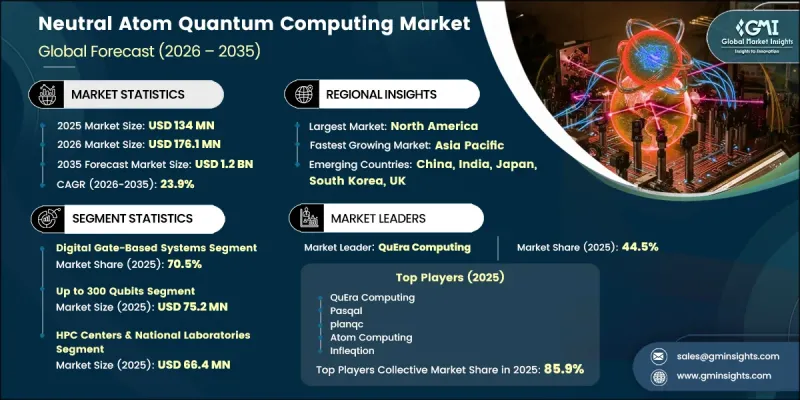
The neutral atom quantum computing industry is expanding as investments in quantum technologies continue to accelerate across both public and private sectors. Increasing financial support for quantum infrastructure, rising collaboration between quantum hardware developers and cloud technology providers, and continuous improvements in qubit scalability and error correction are creating favorable conditions for market expansion. Growing demand for sovereign quantum capabilities is encouraging additional investment in advanced computing platforms, while enterprises are increasingly evaluating quantum technologies to address computationally intensive workloads beyond the capabilities of conventional systems. The commercialization of scalable neutral atom architectures is progressing steadily through technology partnerships and ongoing innovation, enabling broader adoption across research institutions and commercial organizations. Expanding cooperation between technology developers, research organizations, and infrastructure providers is accelerating product development while strengthening the overall quantum ecosystem. Rising interest in applying quantum computing to complex scientific, industrial, and enterprise challenges is expected to further support long-term growth of the global neutral atom quantum computing market.
| Market Scope | |
|---|---|
| Start Year | 2025 |
| Forecast Year | 2026-2035 |
| Start Value | $134 Million |
| Forecast Value | $1.2 Billion |
| CAGR | 23.9% |
In 2025, the digital gate-based systems segment accounted for a 70.5% share. This segment continues to dominate because it provides highly accurate execution of universal quantum algorithms, making it well suited for a wide range of advanced computational workloads. Continuous progress in gate performance, qubit operations, and error correction technologies is further enhancing system capabilities. Growing investment from both government organizations and technology companies is also supporting ongoing adoption of digital gate-based neutral atom quantum computing platforms, reinforcing their leadership position within the market.
The up to 300 qubits segment reached USD 75.2 million in 2025. This category continues to attract significant demand because it provides an accessible and practical platform for quantum research, technology validation, and early commercial deployment. Organizations continue to utilize these systems to evaluate new computational approaches while advancing quantum software and hardware development. Their relatively lower implementation costs, dependable performance, and increasing availability through cloud-based access are contributing to wider adoption across research institutions and commercial users, supporting continued growth of this segment throughout the forecast period.
North America Neutral Atom Quantum Computing Market accounted for a 57.1% share in 2025. The regional market continues to benefit from strong public-sector funding, an established quantum research ecosystem, and the presence of leading neutral atom quantum computing companies. Ongoing investment in quantum research, infrastructure development, and technology commercialization is accelerating innovation while strengthening regional capabilities. Continued collaboration among government organizations, research institutions, and industry participants is fostering technological progress and supporting broader deployment of advanced neutral atom quantum computing solutions across North America.
Prominent companies operating in the global neutral atom quantum computing market include Atom Computing, AtomQL, CAS Cold Atom Technology, EQCITED, Infleqtion, Logiqal, OQT, Pasqal, planqc, Q-Factor, QuEra Computing, and Yaqumo. Companies operating in the neutral atom quantum computing market are strengthening their competitive position by increasing investments in research and development, expanding quantum hardware capabilities, and improving qubit scalability and system reliability. Strategic collaborations with research institutions, cloud service providers, and technology partners are helping accelerate product commercialization while broadening market reach. Many companies are focusing on enhancing software compatibility, developing scalable quantum architectures, and improving error correction technologies to support more complex computing applications. Businesses are also investing in cloud-based quantum access, expanding international partnerships, and strengthening intellectual property portfolios to maintain technological leadership.
Table of Contents
Chapter 1 Methodology and Scope
- 1.1 Market scope and definition
- 1.2 Research design
- 1.2.1 Research approach
- 1.2.2 Data collection methods
- 1.3 Data mining sources
- 1.3.1 Global
- 1.3.2 Regional/Country
- 1.4 Base estimates and calculations
- 1.4.1 Base year calculation
- 1.4.2 Key trends for market estimation
- 1.5 Primary research and validation
- 1.5.1 Primary sources
- 1.6 Forecast model
- 1.7 Research assumptions and limitations
Chapter 2 Executive Summary
- 2.1 Industry 360° synopsis, 2022 – 2035
- 2.2 Key market trends
- 2.2.1 Computing paradigm trends
- 2.2.2 Application trends
- 2.2.3 Qubit scale trends
- 2.2.4 End-user trends
- 2.2.5 Regional trends
- 2.3 TAM Analysis, 2026-2035
- 2.4 CXO perspectives: Strategic imperatives
Chapter 3 Industry Insights
- 3.1 Industry ecosystem analysis
- 3.1.1 Supplier Landscape
- 3.1.2 Profit Margin
- 3.1.3 Cost structure
- 3.1.4 Value addition at each stage
- 3.1.5 Factor affecting the value chain
- 3.1.6 Disruptions
- 3.2 Industry impact forces
- 3.2.1 Growth drivers
- 3.2.1.1 Rising government investments and national quantum technology initiatives
- 3.2.1.2 Increasing commercialization through cloud-based quantum access and strategic partnerships
- 3.2.1.3 Advancements in scalable, fault-tolerant neutral atom architectures
- 3.2.1.4 Growing adoption in defense, aerospace, and national security applications
- 3.2.1.5 Expanding applications across pharmaceuticals, materials science, finance, and AI optimization
- 3.2.2 Industry pitfalls and challenges
- 3.2.2.1 High cost of scaling fault-tolerant neutral atom quantum systems
- 3.2.2.2 Limited quantum-ready workforce and software ecosystem
- 3.2.3 Market opportunities
- 3.2.3.1 Expansion of cloud-based Quantum Computing-as-a-Service (QCaaS)
- 3.2.3.2 Growing demand for quantum-enabled drug discovery, materials science, and AI optimization
- 3.2.1 Growth drivers
- 3.3 Growth potential analysis
- 3.4 Regulatory landscape
- 3.4.1 North America
- 3.4.2 Europe
- 3.4.3 Asia Pacific
- 3.4.4 Latin America
- 3.4.5 Middle East & Africa
- 3.5 Porter’s analysis
- 3.6 PESTEL analysis
- 3.7 Technology and Innovation landscape
- 3.7.1 Current technological trends
- 3.7.2 Emerging technologies
- 3.8 Price trends
- 3.8.1 By region
- 3.8.2 By product
- 3.9 Pricing Strategies
- 3.10 Emerging Business Models
- 3.11 Compliance Requirements
- 3.12 Patent and IP analysis
Chapter 4 Competitive Landscape, 2025
- 4.1 Introduction
- 4.2 Company market share analysis
- 4.2.1 By region
- 4.2.1.1 North America
- 4.2.1.2 Europe
- 4.2.1.3 Asia Pacific
- 4.2.1.4 Latin America
- 4.2.1.5 Middle East & Africa
- 4.2.2 Market concentration analysis
- 4.2.1 By region
- 4.3 Competitive benchmarking of key players
- 4.3.1 Financial performance comparison
- 4.3.1.1 Revenue
- 4.3.1.2 Profit margin
- 4.3.1.3 R&D
- 4.3.2 Product portfolio comparison
- 4.3.2.1 Product range breadth
- 4.3.2.2 Technology
- 4.3.2.3 Innovation
- 4.3.3 Geographic presence comparison
- 4.3.3.1 Global footprint analysis
- 4.3.3.2 Service network coverage
- 4.3.3.3 Market penetration by region
- 4.3.4 Competitive positioning matrix
- 4.3.4.1 Leaders
- 4.3.4.2 Challengers
- 4.3.4.3 Followers
- 4.3.4.4 Niche players
- 4.3.5 Strategic outlook matrix
- 4.3.1 Financial performance comparison
- 4.4 Key developments
- 4.4.1 Mergers and acquisitions
- 4.4.2 Partnerships and collaborations
- 4.4.3 Technological advancements
- 4.4.4 Expansion and investment strategies
- 4.4.5 Digital transformation initiatives
- 4.5 Emerging/ startup competitors landscape
Chapter 5 Market Estimates and Forecast, By Computing Paradigm, 2022 – 2035 (USD Million)
- 5.1 Key trends
- 5.2 Digital gate-based systems
- 5.3 Analog quantum simulators
- 5.4 Hybrid digital-analog systems
Chapter 6 Market Estimates and Forecast, By Application, 2022 – 2035 (USD Million)
- 6.1 Key trends
- 6.2 Quantum simulation
- 6.3 Optimization
- 6.4 Quantum machine learning & AI acceleration
- 6.5 Cryptography & quantum security
- 6.6 Other applications
Chapter 7 Market Estimates and Forecast, By Qubit Scale, 2022 – 2035 (USD Million)
- 7.1 Key trends
- 7.2 Up to 300 Qubits
- 7.3 301–1,000 Qubits
- 7.4 Above 1,000 Qubits
Chapter 8 Market Estimates and Forecast, By End-User, 2022 – 2035 (USD Million)
- 8.1 Key trends
- 8.2 Government & defense
- 8.3 Hpc centers & national laboratories
- 8.4 Academic & research institutions
- 8.5 Pharmaceutical & biotechnology
- 8.6 Others
Chapter 9 Market Estimates and Forecast, By Region, 2022 – 2035 (USD Million)
- 9.1 Key trends
- 9.2 North America
- 9.2.1 U.S.
- 9.2.2 Canada
- 9.3 Europe
- 9.3.1 Germany
- 9.3.2 UK
- 9.3.3 France
- 9.3.4 Spain
- 9.3.5 Italy
- 9.4 Asia Pacific
- 9.4.1 China
- 9.4.2 India
- 9.4.3 Japan
- 9.4.4 Australia
- 9.4.5 South Korea
- 9.5 Latin America
- 9.5.1 Brazil
- 9.5.2 Mexico
- 9.5.3 Argentina
- 9.6 Middle East and Africa
- 9.6.1 South Africa
- 9.6.2 Saudi Arabia
- 9.6.3 UAE
Chapter 10 Company Profiles
- 10.1 Global Key Players
- 10.1.1 QuEra Computing
- 10.1.2 Pasqal
- 10.1.3 planqc
- 10.1.4 Atom Computing
- 10.1.5 Infleqtion
- 10.2 Regional key players
- 10.2.1 North America
- 10.2.1.1 AtomQL
- 10.2.2 Asia Pacific
- 10.2.2.1 CAS Cold Atom Technology
- 10.2.2.2 EQCITED
- 10.2.2.3 Yaqumo
- 10.2.3 Europe
- 10.2.3.1 Logiqal
- 10.2.3.2 OQT
- 10.2.1 North America
- 10.3 Niche Players/Disruptors
- 10.3.1 Q-Factor

