PUBLISHER: Global Market Insights Inc. | PRODUCT CODE: 2109191

PUBLISHER: Global Market Insights Inc. | PRODUCT CODE: 2109191
Cell and Gene Therapy CDMO Market Opportunity, Growth Drivers, Industry Trend Analysis, and Forecast 2026 - 2035
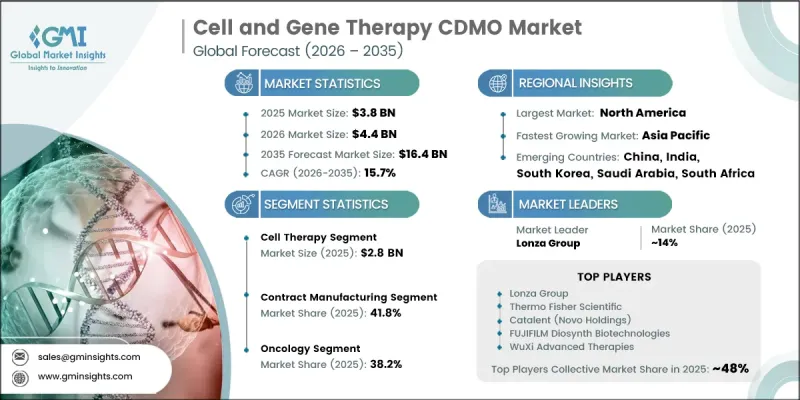
The Global Cell and Gene Therapy CDMO Market was valued at USD 3.8 billion in 2025 and is estimated to grow at a CAGR of 15.7% to reach USD 16.4 billion by 2035.
Growth in the cell & gene therapy CDMO market is fueled by the expanding pipeline of advanced therapies, increasing reliance on outsourcing for highly specialized manufacturing, and rising demand for comprehensive contract development and manufacturing solutions. As more cell- and gene-based therapies move through clinical development and commercialization, biotechnology and pharmaceutical companies continue to collaborate with experienced CDMOs to gain access to advanced production technologies, reduce infrastructure investments, accelerate product development, and maintain regulatory compliance. The cell and gene therapy CDMO market includes organizations that provide integrated development and manufacturing services covering every stage of the product lifecycle. Their capabilities span process optimization, analytical development, technology transfer, vector manufacturing, plasmid DNA production, cell processing, commercial and clinical manufacturing, aseptic fill-finish operations, quality assurance, regulatory assistance, cold-chain management, and supply chain support. Through these integrated capabilities, CDMOs simplify manufacturing operations while helping therapy developers efficiently advance innovative treatments from early-stage development through commercial production.
| Market Scope | |
|---|---|
| Start Year | 2025 |
| Forecast Year | 2026-2035 |
| Start Value | $3.8 Billion |
| Forecast Value | $16.4 Billion |
| CAGR | 15.7% |
The cell therapy segment generated USD 2.8 billion in 2025. Segment growth is supported by the increasing commercialization of cell-based therapies, a rapidly expanding clinical development pipeline, and a greater preference for outsourcing technically demanding manufacturing activities to specialized CDMOs. Producing both autologous and allogeneic cell therapies requires advanced manufacturing capabilities, including expertise in cell processing, genetic engineering, cell expansion, preservation techniques, quality management, aseptic production, and temperature-controlled logistics. These technical requirements continue to encourage biotechnology and pharmaceutical companies to collaborate with experienced manufacturing partners.
The contract manufacturing segment accounted for a 41.8% share in 2025. The segment continues to maintain its leadership as companies increasingly outsource GMP-compliant manufacturing operations to specialized service providers. Rising commercialization of advanced therapies, combined with the growing need for scalable manufacturing infrastructure and highly specialized production capabilities, is driving sustained demand for comprehensive manufacturing solutions that support development through commercial-scale production.
North America Cell and Gene Therapy CDMO Market held a 45.7% share in 2025. Regional growth is supported by a well-established biotechnology industry, advanced biomanufacturing infrastructure, and the strong presence of leading contract development and manufacturing organizations. Continuous investment in manufacturing innovation and specialized production capabilities further strengthens the region's leadership while supporting the expanding commercialization of advanced therapies.
Key players operating in the cell and gene therapy CDMO market include AGC Biologics, Andelyn Biosciences, Catalent, Inc. (Novo Holdings), Center for Breakthrough Medicines (CBM), Charles River Laboratories, Forge Biologics, FUJIFILM Diosynth Biotechnologies, Genezen Laboratories, Lonza Group, Minaris Advanced Therapies, National Resilience, Oxford Biomedica, Samsung Biologics, SK pharmteco, Thermo Fisher Scientific, Viralgen, and WuXi Advanced Therapies (WuXi AppTec). Companies participating in the cell and gene therapy CDMO market are reinforcing their competitive position by expanding manufacturing capacity, investing in advanced production technologies, and strengthening research and development capabilities. Many organizations are enhancing end-to-end service portfolios to support customers throughout development and commercial manufacturing while improving production efficiency and regulatory compliance. Strategic collaborations with biotechnology and pharmaceutical companies remain a major growth strategy, enabling long-term business relationships and accelerating therapy development. Businesses are also optimizing manufacturing processes, upgrading quality systems, and expanding global operational footprints to meet rising demand.
Table of Contents
Chapter 1 Methodology and Scope
- 1.1 Market scope and definition
- 1.2 Research approach
- 1.3 Quality commitments
- 1.3.1 GMI AI policy and data integrity commitment
- 1.3.1.1 Source consistency protocol
- 1.3.1 GMI AI policy and data integrity commitment
- 1.4 Research trail and confidence scoring
- 1.4.1 Research trail components
- 1.4.2 Scoring components
- 1.5 Data collection
- 1.5.1 Partial list of primary sources
- 1.6 Data mining sources
- 1.6.1 Paid sources
- 1.6.1.1 Sources, by region
- 1.6.1 Paid sources
- 1.7 Base estimates and calculations
- 1.7.1 Revenue share analysis
- 1.7.2 Base year calculation
- 1.8 Forecast model
- 1.8.1 Quantified market impact analysis
- 1.8.1.1 Mathematical impact of growth parameters on forecast
- 1.8.1 Quantified market impact analysis
- 1.9 Research transparency addendum
- 1.9.1 Source attribution framework
- 1.9.2 Quality assurance metrics
- 1.9.3 Our commitment to trust
Chapter 2 Executive Summary
- 2.1 Industry 360° synopsis
- 2.2 Key market trends
- 2.2.1 Regional trends
- 2.2.2 Product type trends
- 2.2.3 Services trends
- 2.2.4 Therapeutic area trends
- 2.2.5 End use trends
- 2.3 CXO perspectives: Strategic imperatives
Chapter 3 Industry Insights
- 3.1 Industry ecosystem analysis
- 3.2 Industry impact forces
- 3.2.1 Growth drivers
- 3.2.1.1 Accelerating clinical pipeline of cell & gene therapies driving CDMO demand
- 3.2.1.2 High manufacturing complexity & capital requirements favoring outsourcing
- 3.2.1.3 FDA & EMA approvals catalyzing commercial-scale manufacturing contracts
- 3.2.2 Industry pitfalls and challenges
- 3.2.2.1 High Cost of GMP manufacturing limiting accessibility for small biotech
- 3.2.2.2 Regulatory complexity & evolving GMP standards creating compliance burden
- 3.2.3 Market opportunities
- 3.2.3.1 Emerging CDMO hubs in Asia Pacific
- 3.2.3.2 Point-of-care & decentralized manufacturing as an emerging business model
- 3.2.1 Growth drivers
- 3.3 Growth potential analysis
- 3.4 Regulatory landscape
- 3.4.1 North America
- 3.4.2 Europe
- 3.4.3 Asia Pacific
- 3.4.4 Latin America
- 3.4.5 MEA
- 3.5 Technology and innovation landscape
- 3.5.1 Current technological trends
- 3.5.2 Emerging technologies
- 3.6 Pricing analysis (Driven by Primary Research)
- 3.7 Porter’s analysis
- 3.8 PESTEL analysis
- 3.9 Investment & funding analysis
- 3.9.1 Global CGT CDMO investment trends (2022–2026)
- 3.9.2 Government, NIH & grant funding landscape
- 3.10 Future market trends
- 3.11 Impact of AI & generative AI on the market
Chapter 4 Competitive Landscape, 2025
- 4.1 Introduction
- 4.2 Company market share analysis
- 4.2.1 North America
- 4.2.2 Europe
- 4.2.3 Asia Pacific
- 4.3 Company matrix analysis
- 4.4 Competitive analysis of major market players
- 4.5 Competitive positioning matrix
- 4.6 Key developments
- 4.6.1 Merger and acquisition
- 4.6.2 Partnership and collaboration
- 4.6.3 New product launches
- 4.6.4 Expansion plans
Chapter 5 Market Estimates and Forecast, By Product Type, 2022 - 2035 ($ Mn)
- 5.1 Key trends
- 5.2 Cell therapy
- 5.3 Gene therapy
- 5.3.1 Viral vectors
- 5.3.2 Non-viral vectors
Chapter 6 Market Estimates and Forecast, By Services, 2022 - 2035 ($ Mn)
- 6.1 Key trends
- 6.2 Contract development
- 6.3 Contract manufacturing
- 6.4 Analytical testing & quality control
- 6.5 Fill-finish & packaging
- 6.6 Regulatory support
- 6.7 Other services
Chapter 7 Market Estimates and Forecast, By Therapeutic Area, 2022 - 2035 ($ Mn)
- 7.1 Key trends
- 7.2 Oncology
- 7.3 Hematological disorders
- 7.4 Rare genetic disorders
- 7.5 Neurological disorders
- 7.6 Ophthalmological disorders
- 7.7 Dermatological disorders
- 7.8 Immunological disorders
- 7.9 Other therapeutic areas
Chapter 8 Market Estimates and Forecast, By End Use, 2022 - 2035 ($ Mn)
- 8.1 Key trends
- 8.2 Pharmaceutical companies
- 8.3 Biotechnology companies
- 8.4 Other end users
Chapter 9 Market Estimates and Forecast, By Region, 2022 - 2035 ($ Mn)
- 9.1 Key trends
- 9.2 North America
- 9.2.1 U.S.
- 9.2.2 Canada
- 9.3 Europe
- 9.3.1 Germany
- 9.3.2 UK
- 9.3.3 France
- 9.3.4 Spain
- 9.3.5 Italy
- 9.3.6 Netherlands
- 9.4 Asia Pacific
- 9.4.1 China
- 9.4.2 India
- 9.4.3 Japan
- 9.4.4 Australia
- 9.4.5 South Korea
- 9.5 Latin America
- 9.5.1 Brazil
- 9.5.2 Mexico
- 9.5.3 Argentina
- 9.6 Middle East and Africa
- 9.6.1 South Africa
- 9.6.2 Saudi Arabia
- 9.6.3 UAE
Chapter 10 Company Profiles
- 10.1 AGC Biologics
- 10.2 Andelyn Biosciences
- 10.3 Catalent, Inc. (Novo Holdings)
- 10.4 Center for Breakthrough Medicines (CBM)
- 10.5 Charles River Laboratories
- 10.6 Forge Biologics
- 10.7 FUJIFILM Diosynth Biotechnologies
- 10.8 Genezen Laboratories
- 10.9 Lonza Group
- 10.10 Minaris Advanced Therapies
- 10.11 National Resilience
- 10.12 Oxford Biomedica
- 10.13 Samsung Biologics
- 10.14 SK pharmteco
- 10.15 Thermo Fisher Scientific
- 10.16 Viralgen
- 10.17 WuXi Advanced Therapies (WuXi AppTec)

