PUBLISHER: Global Market Insights Inc. | PRODUCT CODE: 2109192

PUBLISHER: Global Market Insights Inc. | PRODUCT CODE: 2109192
North America Adaptive Clothing Market Opportunity, Growth Drivers, Industry Trend Analysis, and Forecast 2026 - 2035
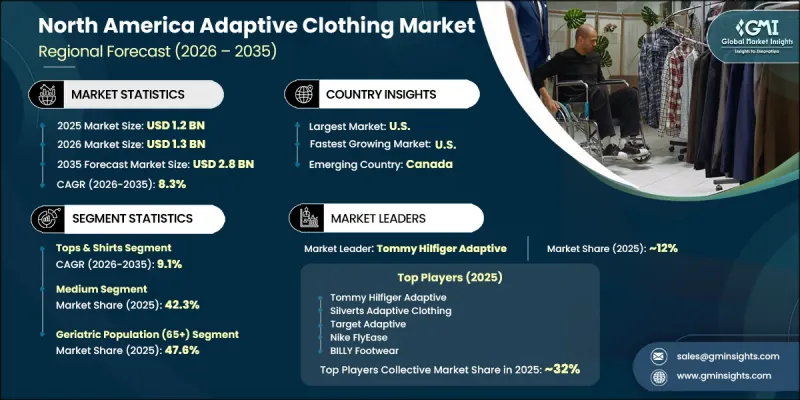
North America Adaptive Clothing Market was valued at USD 1.2 billion in 2025 and is estimated to grow at a CAGR of 8.3% to reach USD 2.8 billion by 2035.
The market is gaining strong momentum as the region experiences demographic changes, including a growing elderly population and a higher prevalence of mobility-related challenges and chronic conditions. Increasing awareness about inclusive fashion and the rising need for comfortable, easy-to-use apparel solutions are encouraging greater adoption of adaptive clothing among seniors and individuals with physical limitations. These garments are designed with functional elements that simplify dressing routines while supporting greater independence and personal comfort. Manufacturers are increasingly focusing on product innovation by incorporating enhanced fabrics, improved designs, and technology-driven features to meet evolving consumer requirements. Growing demand for clothing that combines accessibility, style, and convenience is encouraging brands to expand their adaptive apparel offerings. The integration of advanced textile solutions, including performance fabrics and health-focused wearable technologies, is further creating opportunities for market growth. Rising life expectancy and increased focus on improving quality of life are expected to support the continued expansion of the North America adaptive clothing market throughout the forecast period.
| Market Scope | |
|---|---|
| Start Year | 2025 |
| Forecast Year | 2026-2035 |
| Start Value | $1.2 Billion |
| Forecast Value | $2.8 Billion |
| CAGR | 8.3% |
The tops and shirts segment generated USD 0.3 billion in 2025 and is expected to grow at a CAGR of 9.1% from 2026 to 2035. This category remains one of the most significant product segments due to its essential role in everyday dressing requirements. Demand is increasing among consumers who require clothing solutions that simplify garment handling and improve comfort during daily activities. Adaptive tops and shirts address challenges associated with dressing, movement flexibility, and garment fastening, making them a frequently preferred choice among users with mobility or dexterity limitations.
The medium price segment accounted for 42.3% share in 2025, establishing itself as the leading pricing category. The segment's growth is supported by increasing consumer preference for affordable adaptive apparel that delivers practical functionality and dependable quality. Buyers are increasingly looking for products that provide essential adaptive features without the higher costs associated with premium customization. Medium-priced adaptive clothing generally offers practical designs, comfortable materials, and user-friendly features that appeal to both individuals and caregivers. The balance between affordability, durability, and performance continues to make this segment attractive within the North America adaptive clothing market.
Major players operating in the North America adaptive clothing market include Tommy Hilfiger Adaptive (PVH Corp.), Nike FlyEase / Nike EasyOn (Nike Inc.), Silverts Adaptive Clothing & Footwear, Care+Wear, BILLY Footwear, Target Adaptive (Cat & Jack / Universal Thread), IZ Adaptive (Izzy Camilleri; under Silverts), Joe & Bella, Buck & Buck Clothing, Creation Confort, Kozie Clothes, JCPenney Adaptive, Koolway Sports, Reboundwear, Friendly Shoes, Slick Chicks, Liberare, Springrose, Sense-ational You, MagnaReady, and Cadense. Companies operating in the North America adaptive clothing market are strengthening their market position through product innovation, inclusive design strategies, and customer-focused development. Leading brands are investing in advanced materials, improved garment functionality, and technology integration to create apparel that supports changing consumer needs. Businesses are expanding their product portfolios by introducing solutions across multiple clothing categories and targeting a wider range of users. Strategic collaborations with healthcare providers, retailers, and accessibility-focused organizations are helping companies increase market awareness and distribution reach. Manufacturers are also emphasizing comfort, style, and affordability to improve consumer acceptance.
Table of Contents
Chapter 1 Methodology and Scope
- 1.1 Market scope and definition
- 1.2 Research design
- 1.2.1 Research approach
- 1.2.2 Data collection methods
- 1.3 Data mining sources
- 1.3.1 Global
- 1.3.2 Regional/Country
- 1.4 Base estimates and calculations
- 1.4.1 Base year calculation
- 1.4.2 Key trends for market estimation
- 1.5 Primary research and validation
- 1.5.1 Primary sources
- 1.6 Forecast model
- 1.7 Research assumptions and limitations
Chapter 2 Executive Summary
- 2.1 Industry 360° synopsis
- 2.2 Key market trends
- 2.2.1 Country
- 2.2.2 Product type
- 2.2.3 Function and adaptive type
- 2.2.4 End user
- 2.2.5 Distribution channel
Chapter 3 Industry Insights
- 3.1 Industry ecosystem analysis
- 3.1.1 Raw material & fabric suppliers
- 3.1.2 Adaptive component manufacturers
- 3.1.3 Garment manufacturers & designers
- 3.1.4 Distribution & retail layer
- 3.1.5 End users & caregiver network
- 3.1.6 Profit margin
- 3.1.7 Value addition at each stage
- 3.1.8 Factor affecting the value chain
- 3.2 Industry impact forces
- 3.2.1 Growth drivers
- 3.2.1.1 Aging population & rising disability rates
- 3.2.1.2 Growing emphasis on inclusion & accessibility
- 3.2.1.3 Expansion of e-commerce & direct to consumer channels
- 3.2.2 Pitfalls & Challenges
- 3.2.2.1 High product development & manufacturing costs
- 3.2.2.2 Limited awareness & retail penetration
- 3.2.3 Opportunities
- 3.2.3.1 Entry of mainstream apparel brands
- 3.2.3.2 Innovation in smart & personalized apparel
- 3.2.1 Growth drivers
- 3.3 Growth potential analysis
- 3.4 Technology and innovation landscape
- 3.4.1 Adaptive closure technologies
- 3.4.2 Sensory-friendly fabric innovation
- 3.4.3 Seated-fit & ergonomic pattern engineering
- 3.4.4 Smart & connected garment technologies
- 3.5 Regulatory framework
- 3.5.1 Disability rights & inclusive design legislation
- 3.5.2 Product safety & flammability standards
- 3.5.3 FDA Medical Device Classification For Therapeutic Garments
- 3.5.4 REACH & chemical compliance
- 3.5.5 Government procurement & accessibility mandates
- 3.6 Pricing analysis (driven by primary research)
- 3.6.1 Historical price trend analysis by product category
- 3.6.2 Pricing strategy by player type (premium / value / cost-plus)
- 3.7 Supply chain analysis
- 3.7.1 Rare-earth magnet sourcing & geopolitical risk
- 3.7.2 Specialized fabric & material procurement
- 3.7.3 Small-batch production challenges & contract manufacturing
- 3.7.4 Logistics & last-mile delivery for institutional buyers
- 3.8 Trade data analysis (driven by paid database) (HS code - 8436 8090)
- 3.8.1 Import/export volume & value trends
- 3.8.2 Key trade corridors & tariff impact on system components
- 3.9 Impact of AI & generative AI on the market
- 3.9.1 AI-driven disruption of existing business models
- 3.9.2 GenAI use cases & adoption roadmap by segment
- 3.9.3 Risks, limitations & regulatory consideration
- 3.10 Distribution infrastructure & channel penetration landscape (driven by primary research)
- 3.10.1 Channel coverage by region & format
- 3.10.2 Last-mile infrastructure gaps & emerging channel shifts
Chapter 4 Competitive Landscape, 2025
- 4.1 Introduction
- 4.2 Company market share analysis
- 4.2.1 By country
- 4.2.1.1 U.S.
- 4.2.1.2 Canada
- 4.2.1 By country
- 4.3 Company matrix analysis
- 4.4 Competitive analysis of major market players
- 4.5 Competitive positioning matrix
- 4.6 Key developments
- 4.6.1 Mergers & acquisitions
- 4.6.2 Partnerships & collaborations
- 4.6.3 New product launches
- 4.6.4 Expansion plans
Chapter 5 Market Estimates and Forecast, By Product Type, 2022 - 2035 (USD Billion) (Million Units)
- 5.1 Key trends Tops & shirts
- 5.2 Open-back tops
- 5.2.1 Magnetic-closure tops
- 5.2.2 Sensory-friendly tops
- 5.3 Bottom wear
- 5.3.1 Adaptive pants
- 5.3.2 Seated-fit pants & shorts
- 5.3.3 Adaptive skirts & dresses
- 5.4 Innerwear & undergarments
- 5.4.1 Adaptive underwear
- 5.4.2 Sensory-friendly undergarments
- 5.5 One-piece & full-body apparel
- 5.5.1 Adaptive dresses (formal/semi-formal)
- 5.5.2 Jumpsuits & bodysuits
- 5.6 Footwear
- 5.6.1 Wide-opening adaptive shoes
- 5.6.2 Adaptive boots
- 5.6.3 Adaptive sandals & slippers
- 5.7 Accessories
- 5.7.1 Adaptive belts & suspenders
- 5.7.2 Adaptive hats & headwear
- 5.7.3 Adaptive gloves & mittens
Chapter 6 Market Estimates and Forecast, By Feature, 2022 - 2035 (USD Billion) (Million Units)
- 6.1 Key trends
- 6.2 Sensory-friendly wear
- 6.2.1 Tag-free & seamless garments
- 6.2.2 Soft-touch & hypoallergenic fabric garments
- 6.3 Medical & care access wear
- 6.3.1 Open-back & hospital-gown replacement designs
- 6.3.2 Catheter-access & ostomy-friendly garments
- 6.3.3 Post-surgery & rehabilitation wear
- 6.4 Wheelchair & seated-position wear
- 6.4.1 Anti-pressure-sore fabric garments
- 6.4.2 Seated-fit cut bottoms & tops
- 6.4.3 Easy-fastening & dexterity-assist wear
- 6.5 Magnetic-closure garments
- 6.5.1 Velcro & hook-loop closure garments
- 6.5.2 No-tie & slip-on solutions
Chapter 7 Market Estimates and Forecast, By Price Range, 2022 - 2035 (USD Billion) (Million Units)
- 7.1 Key trends
- 7.2 Low
- 7.3 Medium
- 7.4 High
Chapter 8 Market Estimates and Forecast, By End User, 2022 - 2035 (USD Billion) (Million Units)
- 8.1 Key trends
- 8.2 Geriatric population (65+)
- 8.2.1 Independent community-dwelling elderly
- 8.2.2 Care home & assisted-living residents
- 8.3 Disabled adults
- 8.3.1 Physical disability
- 8.3.2 Neurological & cognitive conditions
- 8.3.3 Sensory processing disorders
- 8.4 Children
- 8.4.1 Children with physical disabilities
- 8.4.2 Children with developmental & sensory conditions
Chapter 9 Market Estimates and Forecast, By Distribution Channel, 2022 - 2035 (USD Billion) (Million Units)
- 9.1 Key trends
- 9.2 Online retail
- 9.2.1 D2C brand websites
- 9.2.2 Third-party e-commerce platforms
- 9.3 Specialty stores
- 9.3.1 Adaptive & assistive product specialty retailers
- 9.3.2 Medical supply & pharmacy retail
- 9.4 Institutional sales
- 9.4.1 Hospital & healthcare facility procurement
- 9.4.2 Care home & assisted-living facility procurement
- 9.4.3 Rehabilitation center procurement
- 9.5 Supermarkets & hypermarkets
- 9.5.1 Mainstream department store adaptive lines
- 9.5.2 Mass-market retail chains
Chapter 10 Market Estimates and Forecast, By Country, 2022 - 2035 (USD Billion) (Million Units)
- 10.1 Key trends
- 10.2 North America
- 10.2.1 U.S.
- 10.2.2 Canada
Chapter 11 Company Profiles
- 11.1 Global players
- 11.1.1 Tommy Hilfiger Adaptive (PVH Corp.)
- 11.1.2 Nike FlyEase / Nike EasyOn (Nike Inc.)
- 11.1.3 Silverts Adaptive Clothing & Footwear
- 11.1.4 Care+Wear
- 11.1.5 BILLY Footwear
- 11.1.6 Target Adaptive (Cat & Jack / Universal Thread)
- 11.1.7 IZ Adaptive (Izzy Camilleri; under Silverts)
- 11.1.8 Joe & Bella
- 11.1.9 Buck & Buck Clothing
- 11.2 Regional Players
- 11.2.1 Creation Confort
- 11.2.2 Kozie Clothes
- 11.2.3 JCPenney Adaptive
- 11.2.4 Koolway Sports
- 11.2.5 Reboundwear
- 11.2.6 Friendly Shoes
- 11.2.7 Slick Chicks
- 11.2.8 Liberare
- 11.3 Emerging Players
- 11.3.1 Springrose
- 11.3.2 Sense-ational You
- 11.3.3 MagnaReady
- 11.3.4 Cadense

