PUBLISHER: Global Market Insights Inc. | PRODUCT CODE: 2109194

PUBLISHER: Global Market Insights Inc. | PRODUCT CODE: 2109194
Asia Pacific Agriculture Gateway Market Opportunity, Growth Drivers, Industry Trend Analysis, and Forecast 2026 - 2035
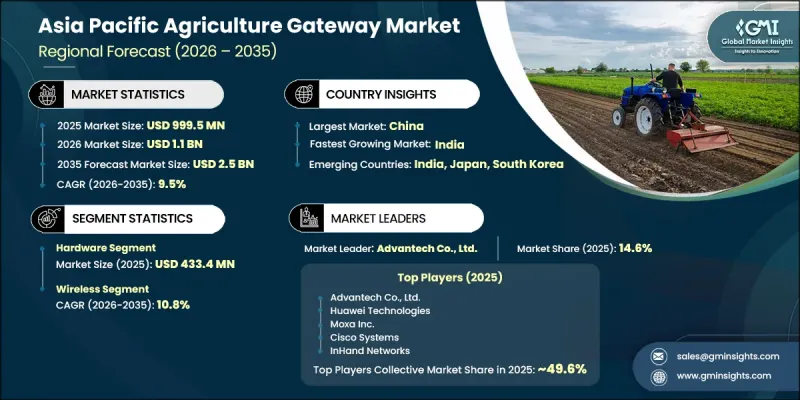
Asia Pacific Agriculture Gateway Market was valued at USD 999.5 million in 2025 and is estimated to grow at a CAGR of 9.5% to reach USD 2.5 billion by 2035.
The market is expanding as precision agriculture becomes more widely adopted across the region, increasing the demand for advanced connectivity solutions that support data-driven farming operations. Agriculture gateways play a critical role in connecting field devices, monitoring equipment, and cloud-based management platforms, enabling efficient data transmission and real-time farm visibility. Rising investments in digital agriculture, growing deployment of connected farming technologies, and supportive government initiatives promoting agricultural modernization are accelerating market adoption. These solutions help improve resource utilization, streamline irrigation and fertilizer management, and enhance overall farm productivity through accurate field intelligence. At the same time, increasing integration of Internet of Things (IoT) technologies into agricultural operations is strengthening the need for reliable communication infrastructure capable of supporting connected devices and automated farming systems. Expanding wireless connectivity, continued advancements in cloud-based farm management solutions, and growing emphasis on sustainable agricultural practices are expected to drive long-term growth in the Asia Pacific agriculture gateway market throughout the forecast period.
| Market Scope | |
|---|---|
| Start Year | 2025 |
| Forecast Year | 2026-2035 |
| Start Value | $999.5 Million |
| Forecast Value | $2.5 Billion |
| CAGR | 9.5% |
The hardware segment generated USD 433.4 million in 2025. Hardware continues to dominate because it provides the essential infrastructure required for connectivity, real-time data acquisition, and communication across modern agricultural environments. Devices that enable interaction between field equipment, monitoring systems, and digital farm management platforms remain fundamental to the effective deployment of agriculture gateway solutions.
The wireless segment accounted for 70.9% share in 2025 and is projected to grow at a CAGR of 10.8% from 2026 to 2035. The segment maintains its leadership due to its flexibility, scalability, and ability to support agricultural operations without extensive wired infrastructure. Wireless communication technologies enable efficient data exchange between connected farm equipment and digital management systems, supporting real-time monitoring, automated operations, and improved decision-making. Continued adoption of IoT-enabled farming technologies is expected to sustain strong demand for wireless connectivity solutions.
China Agriculture Gateway Market generated USD 522.5 million in 2025 and is expected to register a CAGR of 9.4% from 2026 to 2035. The country's market leadership is supported by continued modernization of agricultural infrastructure, increasing adoption of connected farming technologies, and rising demand for efficient farm management solutions. Ongoing investments in digital agriculture and smart farming initiatives continue to strengthen deployment of agriculture gateways that improve connectivity, operational efficiency, and real-time agricultural monitoring.
Key players operating in the Asia Pacific agriculture gateway market include Cisco Systems, Siemens AG, Trimble Inc., John Deere, Advantech Co., Ltd., Moxa Inc., Huawei Technologies, RAKwireless, Sierra Wireless (Semtech), Teltonika Networks, Milesight IoT, AAEON Technology, Robustel, InHand Networks, Kore Wireless, Digi International, SenseCAP by Seeed Studio, Arable Labs, FourFaith Communications, Digital Matter, and CalAmp. Companies operating in the Asia Pacific agriculture gateway market are strengthening their competitive position by investing in advanced IoT connectivity technologies, expanding intelligent gateway portfolios, and developing integrated solutions that improve farm automation and digital agriculture capabilities. Manufacturers are focusing on research and development to enhance wireless communication, edge computing performance, cloud integration, and real-time data processing. Strategic collaborations with technology providers, agricultural equipment manufacturers, and digital farming platform developers are helping companies broaden their customer base and accelerate product adoption. Businesses are also strengthening regional distribution networks, improving technical support services, and introducing scalable solutions designed for farms of varying sizes.
Table of Contents
Chapter 1 Research Methodology
- 1.1 Research approach
- 1.2 Quality Commitments
- 1.2.1 GMI AI policy & data integrity commitment
- 1.2.1.1 Source consistency protocol
- 1.2.1 GMI AI policy & data integrity commitment
- 1.3 Research Trail & Confidence Scoring
- 1.3.1 Research Trail Components
- 1.3.2 Scoring Components
- 1.4 Data Collection
- 1.4.1 Partial list of primary sources
- 1.5 Data mining sources
- 1.5.1 Paid sources
- 1.5.1.1 Sources, by region
- 1.5.1 Paid sources
- 1.6 Base estimates and calculations
- 1.6.1 Base year calculation for any one approach
- 1.7 Forecast model
- 1.7.1 Quantified market impact analysis
- 1.7.1.1 Mathematical impact of growth parameters on forecast
- 1.7.1 Quantified market impact analysis
- 1.8 Research transparency addendum
- 1.8.1 Source attribution framework
- 1.8.2 Quality assurance metrics
- 1.8.3 Our commitment to trust
Chapter 2 Executive Summary
- 2.1 Industry 360° synopsis, 2022 – 2035
- 2.2 Key market trends
- 2.2.1 Country
- 2.2.2 Component
- 2.2.3 Technology
- 2.2.4 Connectivity
- 2.2.5 Deployment Model
- 2.2.6 Application
- 2.2.7 End User
Chapter 3 Industry Insights
- 3.1 Industry ecosystem analysis
- 3.1.1 Factor affecting the value chain
- 3.1.2 Profit margin analysis
- 3.1.3 Disruptions
- 3.1.4 Future outlook
- 3.1.5 Manufacturers
- 3.1.6 Distributors
- 3.2 Supplier landscape
- 3.3 Key news & initiatives
- 3.4 Technology & Innovation Landscape
- 3.5 Regulatory landscape
- 3.6 Impact on forces
- 3.6.1 Growth drivers
- 3.6.1.1 Rising precision farming boosts agriculture gateway adoption
- 3.6.1.2 Growing IoT integration supports smart farming infrastructure
- 3.6.1.3 Increasing demand for farm automation drives growth
- 3.6.2 Industry pitfalls & challenges
- 3.6.2.1 High deployment costs limit small farm adoption
- 3.6.2.2 Limited rural connectivity affects gateway performance
- 3.6.3 Opportunities
- 3.6.3.1 5G expansion improves agricultural connectivity
- 3.6.3.2 AI-powered analytics enhance farm decision-making
- 3.6.1 Growth drivers
- 3.7 Porter’s analysis
- 3.8 PESTEL analysis
- 3.9 Pricing analysis (driven by primary research)
- 3.9.1 Historical price trend analysis — gateway hardware & software licensing (driven by primary research)
- 3.9.2 Pricing strategy by player type (premium / value / cost-plus) (driven by primary research)
- 3.10 Impact of AI & generative AI on the agriculture gateway market
- 3.10.1 AI-driven disruption of traditional farm data management models
- 3.10.2 GenAI use cases & adoption roadmap by segment (precision farming, livestock, irrigation)
- 3.10.3 Risks, limitations & regulatory considerations for AI in AgriTech
- 3.11 Capacity & production landscape (driven by primary research)
- 3.11.1 Installed manufacturing capacity by region & key gateway producer (driven by primary research)
- 3.11.2 Capacity utilization rates & expansion pipelines — key hardware manufacturers (driven by primary research)
Chapter 4 Competitive Landscape, 2025
- 4.1 Introduction
- 4.2 Company market share analysis
- 4.3 Competitive positioning matrix
- 4.4 Strategic outlook matrix
- 4.5 Competitive analysis of major market players
- 4.6 Key developments
- 4.6.1 Mergers & acquisitions
- 4.6.2 Partnerships & collaborations
- 4.6.3 New product launches
- 4.6.4 Expansion plans
Chapter 5 Market Estimates & Forecast, By Component, 2022-2035 (USD Billion) (Million Units)
- 5.1 Key trends
- 5.2 Hardware
- 5.3 Software
- 5.4 Services
Chapter 6 Market Estimates & Forecast, By Technology, 2022-2035 (USD Billion) (Million Units)
- 6.1 Key trends
- 6.2 IoT solutions
- 6.3 Artificial intelligence & machine learning
- 6.4 Big data analytics
- 6.5 Others
Chapter 7 Market Estimates & Forecast, By Connectivity, 2022-2035 (USD Billion) (Million Units)
- 7.1 Key trends
- 7.2 Wired
- 7.3 Wireless
Chapter 8 Market Estimates & Forecast, By Deployment Model, 2022-2035 (USD Billion) (Million Units)
- 8.1 Key trends
- 8.2 Cloud-based
- 8.3 On-premises
Chapter 9 Market Estimates & Forecast, By Application, 2022-2035 (USD Billion) (Million Units)
- 9.1 Key trends
- 9.2 Precision Farming
- 9.3 Livestock Monitoring
- 9.4 Smart Irrigation
- 9.5 Greenhouse Automation
- 9.6 Others
Chapter 10 Market Estimates & Forecast, By End User, 2022-2035 (USD Billion) (Million Units)
- 10.1 Key trends
- 10.2 Farmers
- 10.3 Agricultural Cooperatives
- 10.4 Government Agencies
- 10.5 Research Institutes
- 10.6 Agribusinesses
- 10.7 Others
Chapter 11 Market Estimates & Forecast, By Country, 2022 – 2035, (USD Billion) (Million Units)
- 11.1 Key trends
- 11.2 China
- 11.3 Japan
- 11.4 India
- 11.5 South Korea
- 11.6 Australia
- 11.7 Philippines
- 11.8 Thailand
- 11.9 Vietnam
Chapter 12 Company Profiles
- 12.1 Global players
- 12.1.1 Cisco Systems
- 12.1.2 Siemens AG
- 12.1.3 Trimble Inc.
- 12.1.4 John Deere
- 12.1.5 Advantech Co., Ltd.
- 12.1.6 Moxa Inc.
- 12.1.7 Huawei Technologies
- 12.2 Regional players
- 12.2.1 RAKwireless
- 12.2.2 Sierra Wireless (Semtech)
- 12.2.3 Teltonika Networks
- 12.2.4 Milesight IoT
- 12.2.5 AAEON Technology
- 12.2.6 Robustel
- 12.2.7 InHand Networks
- 12.3 Emerging players
- 12.3.1 Kore Wireless
- 12.3.2 Digi International
- 12.3.3 SenseCAP by Seeed Studio
- 12.3.4 Arable Labs
- 12.3.5 FourFaith Communications
- 12.3.6 Digital Matter
- 12.3.7 CalAmp

