PUBLISHER: Global Market Insights Inc. | PRODUCT CODE: 2109201

PUBLISHER: Global Market Insights Inc. | PRODUCT CODE: 2109201
High-Purity Specialty Gases Market Opportunity, Growth Drivers, Industry Trend Analysis, and Forecast 2026 - 2035
The Global High-Purity Specialty Gases Market was valued at USD 12.1 billion in 2025 and is estimated to grow at a CAGR of 7% to reach USD 23.8 billion by 2035.
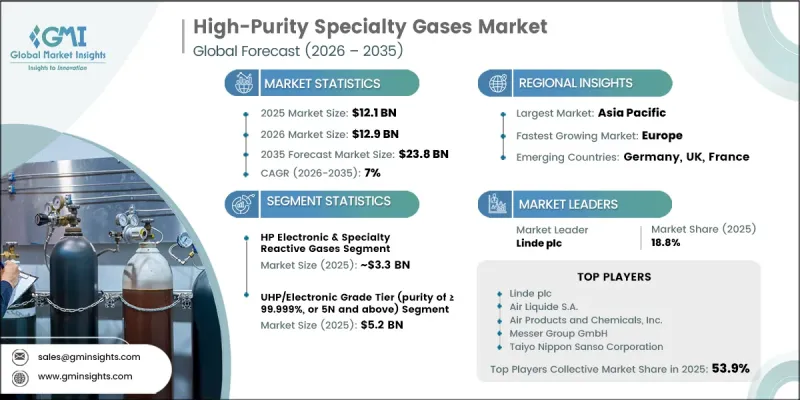
The market is witnessing sustained expansion due to the increasing adoption of high-performance gases across advanced industrial processes that require exceptional purity, consistency, and reliability. Growing investments in semiconductor manufacturing, expanding healthcare infrastructure, and the rapid development of clean energy technologies continue to create strong demand for gases with ultra-high purity levels. In addition, the rising complexity of precision manufacturing processes and stricter quality standards across regulated industries are encouraging manufacturers to transition from conventional industrial gases to highly refined specialty gas solutions. Continuous advancements in electronics manufacturing, pharmaceutical production, laboratory research, and analytical testing are further strengthening market demand. Companies are also investing in advanced purification technologies, quality assurance systems, and specialized gas handling infrastructure to meet increasingly demanding customer specifications. The expansion of advanced manufacturing facilities, coupled with growing emphasis on process efficiency, product quality, and operational reliability, is expected to create long-term opportunities for industry participants. As industries continue to prioritize precision, safety, and regulatory compliance, the high-purity specialty gases market is expected to maintain a strong growth trajectory throughout the forecast period.
| Market Scope | |
|---|---|
| Start Year | 2025 |
| Forecast Year | 2026-2035 |
| Start Value | $12.1 Billion |
| Forecast Value | $23.8 Billion |
| CAGR | 7% |
The HP electronic & specialty reactive gases segment generated a USD 3.3 billion in 2025 and is forecast to grow at a 27.5% CAGR through 2035. The segment continues to benefit from increasing demand for highly specialized gases that support precision manufacturing processes requiring exceptional consistency and process control. Rising investments in advanced electronics production, microfabrication technologies, and next-generation industrial manufacturing are contributing to the segment's expansion. Manufacturers are focusing on delivering gases with superior purity and stable chemical performance to improve production efficiency, reduce contamination risks, and enhance manufacturing yields.
The UHP/Electronic Grade segment held 43.8% share in 2025. The segment maintains its leading position because industries requiring the highest levels of process accuracy continue to prioritize premium-quality gas products that deliver consistent performance and minimal contamination. Higher purity grades command greater market value due to the sophisticated purification technologies, stringent quality control procedures, advanced analytical testing, and specialized production infrastructure required to achieve and maintain these specifications. Growing investments in quality assurance, regulatory compliance, and high-precision manufacturing continue to accelerate demand for ultra-high-purity gas solutions. As industries increasingly adopt advanced production technologies, demand for gases meeting the highest purity standards is expected to remain strong throughout the forecast period.
North America High-Purity Specialty Gases Market held a 29.2% share in 2025. The region continues to maintain a leading position due to its strong industrial base, ongoing investments in advanced manufacturing, and continuous expansion of technology-intensive industries. Increasing production of sophisticated electronic components, growing pharmaceutical manufacturing capacity, and rising adoption of high-performance industrial processes continue to support regional market growth. Strong research and development activities, well-established production infrastructure, and increasing emphasis on product quality and regulatory compliance are further enhancing demand for high-purity specialty gases across North America. Continued investment in innovation and advanced industrial capabilities is expected to reinforce the region's dominant position over the forecast period.
Major companies operating in the Global High-Purity Specialty Gases Market include Air Products and Chemicals, Inc., Messer Group GmbH, Air Liquide S.A., Taiyo Nippon Sanso Corporation, and Linde plc. Companies operating in the global high-purity specialty gases market are strengthening their market position through continuous investment in advanced purification technologies, production capacity expansion, and product innovation. Manufacturers are prioritizing research and development to enhance gas purity, improve production efficiency, and meet increasingly stringent quality standards across high-value industries. Strategic partnerships, long-term supply agreements, and expansion of global distribution networks are helping companies improve customer reach and secure recurring business. Market participants are also investing in specialized packaging, storage, and delivery systems to maintain product integrity throughout the supply chain. In addition, businesses are expanding regional manufacturing facilities, improving technical support services, and developing customized gas solutions tailored to specific industrial applications.
Table of Contents
Chapter 1 Methodology & Scope
- 1.1 Market scope and definition
- 1.2 Research design
- 1.2.1 Research approach
- 1.2.2 Data collection methods
- 1.3 Data mining sources
- 1.3.1 Global
- 1.3.2 Regional/Country
- 1.4 Base estimates and calculations
- 1.4.1 Base year calculation
- 1.4.2 Key trends for market estimation
- 1.5 Primary research and validation
- 1.5.1 Primary sources
- 1.6 Forecast model
- 1.7 Research assumptions and limitations
Chapter 2 Executive Summary
- 2.1 Industry 360° synopsis
- 2.2 Key market trends
- 2.2.1 Gas type
- 2.2.2 Purity level
- 2.2.3 End-user industry
- 2.2.4 Regional
- 2.3 TAM Analysis, 2026-2035
- 2.4 CXO perspectives: Strategic imperatives
- 2.4.1 Executive decision points
Chapter 3 Industry Insights
- 3.1 Industry ecosystem analysis
- 3.1.1 Supplier landscape
- 3.1.2 Profit margin
- 3.1.3 Value addition at each stage
- 3.1.4 Factor affecting the value chain
- 3.1.5 Disruptions
- 3.2 Industry impact forces
- 3.2.1 Growth drivers
- 3.2.2 Industry pitfalls and challenges
- 3.2.3 Market opportunities
- 3.3 Growth potential analysis
- 3.4 Regulatory landscape
- 3.4.1 North America
- 3.4.2 Europe
- 3.4.3 Asia Pacific
- 3.4.4 Latin America
- 3.4.5 Middle East & Africa
- 3.5 Porter’s analysis
- 3.6 PESTEL analysis
- 3.7 Price trends
- 3.7.1 By region
- 3.7.2 By type
- 3.8 Future market trends
- 3.9 Technology and Innovation landscape
- 3.9.1 Current technological trends
- 3.9.2 Emerging technologies
- 3.10 Patent Landscape
- 3.11 Trade statistics (HS code)
- 3.11.1 Major importing countries
- 3.11.2 Major exporting countries
- 3.12 Sustainability and environmental aspects
- 3.12.1 Sustainable practices
- 3.12.2 Waste reduction strategies
- 3.12.3 Energy efficiency in production
- 3.12.4 Eco-friendly initiatives
- 3.13 Carbon footprint consideration
Chapter 4 Competitive Landscape, 2025
- 4.1 Introduction
- 4.2 Company market share analysis
- 4.2.1 By region
- 4.2.1.1 North America
- 4.2.1.2 Europe
- 4.2.1.3 Asia Pacific
- 4.2.1.4 LATAM
- 4.2.1.5 MEA
- 4.2.1 By region
- 4.3 Company matrix analysis
- 4.4 Competitive analysis of major market players
- 4.5 Competitive positioning matrix
- 4.6 Key developments
- 4.6.1 Mergers & acquisitions
- 4.6.2 Partnerships & collaborations
- 4.6.3 New Product Launches
- 4.6.4 Expansion Plans
Chapter 5 Market Estimates and Forecast, By Gas Type, 2022–2035 (USD Billion) (Kilo Tons)
- 5.1 Key trends
- 5.2 High-purity atmospheric gases
- 5.2.1 Nitrogen (N₂)
- 5.2.2 Oxygen (O₂)
- 5.2.3 Argon (Ar)
- 5.3 High-purity rare & noble gases
- 5.3.1 Helium (He)
- 5.3.2 Neon (Ne)
- 5.3.3 Krypton (Kr)
- 5.3.4 Xenon (Xe)
- 5.4 High-purity carbon gases
- 5.4.1 Carbon Dioxide (CO₂)
- 5.4.2 Carbon Monoxide (CO)
- 5.4.3 Methane (CH₄)
- 5.5 High-purity hydrogen (H₂)
- 5.6 High-purity electronic & specialty reactive gases
- 5.6.1 Fluorine-based Gases
- 5.6.2 Silicon & Germanium Hydrides
- 5.6.3 Halogen & Acid Gases
- 5.6.4 Nitrogen & Phosphorus Compounds
- 5.7 Others
Chapter 6 Market Estimates and Forecast, By Purity Level, 2022–2035 (USD Billion) (Kilo Tons)
- 6.1 Key trends
- 6.2 Ultra High Purity (UHP) / electronic grade ≥99.999% (5N+)
- 6.3 High Purity (HP) 99.99% to <99.999% (4N)
- 6.4 Standard / research grade 99.9% to <99.99% (3N)
Chapter 7 Market Estimates and Forecast, By End-User Industry, 2022–2035 (USD Billion) (Kilo Tons)
- 7.1 Key trends
- 7.2 Electronics & semiconductor
- 7.3 Healthcare & pharmaceutical
- 7.4 Chemical & petrochemical
- 7.5 Food, beverage & agriculture
- 7.6 Energy & power
- 7.7 Automotive & aerospace
- 7.8 Academic & research institutions
- 7.9 Others
Chapter 8 Market Estimates and Forecast, By Region, 2022–2035 (USD Billion) (Kilo Tons)
- 8.1 Key trends
- 8.2 North America
- 8.2.1 U.S.
- 8.2.2 Canada
- 8.3 Europe
- 8.3.1 Germany
- 8.3.2 UK
- 8.3.3 France
- 8.3.4 Spain
- 8.3.5 Italy
- 8.3.6 Rest of Europe
- 8.4 Asia Pacific
- 8.4.1 China
- 8.4.2 India
- 8.4.3 Japan
- 8.4.4 Australia
- 8.4.5 South Korea
- 8.4.6 Rest of Asia Pacific
- 8.5 Latin America
- 8.5.1 Brazil
- 8.5.2 Mexico
- 8.5.3 Argentina
- 8.5.4 Rest of Latin America
- 8.6 Middle East and Africa
- 8.6.1 Saudi Arabia
- 8.6.2 South Africa
- 8.6.3 UAE
- 8.6.4 Rest of Middle East and Africa
Chapter 9 Company Profiles
- 9.1 Linde plc
- 9.2 Air Liquide S.A.
- 9.3 Air Products and Chemicals, Inc.
- 9.4 Messer Group GmbH
- 9.5 Taiyo Nippon Sanso Corporation
- 9.6 Iwatani Corporation
- 9.7 Resonac Holdings Corporation (formerly Showa Denko)
- 9.8 Yingde Gases Group Company
- 9.9 SOL S.p.A.
- 9.10 Gulf Cryo
- 9.11 Ellenbarrie Industrial Gases Ltd.
- 9.12 Huate Gas Co., Ltd. (Guangdong Huate)
- 9.13 Chengdu Taiyu Industrial Gases Co., Ltd.
- 9.14 MESA Specialty Gases & Equipment
- 9.15 Samator Gas
- 9.16 Stella Chemifa Corporation

