PUBLISHER: Global Market Insights Inc. | PRODUCT CODE: 2109209

PUBLISHER: Global Market Insights Inc. | PRODUCT CODE: 2109209
Asia-Pacific Gaskets Market Opportunity, Growth Drivers, Industry Trend Analysis, and Forecast 2026 - 2035
Asia-Pacific Gaskets Market was valued at USD 1.3 billion in 2025 and is estimated to grow at a CAGR of 6.1% to reach USD 2.4 billion by 2035.
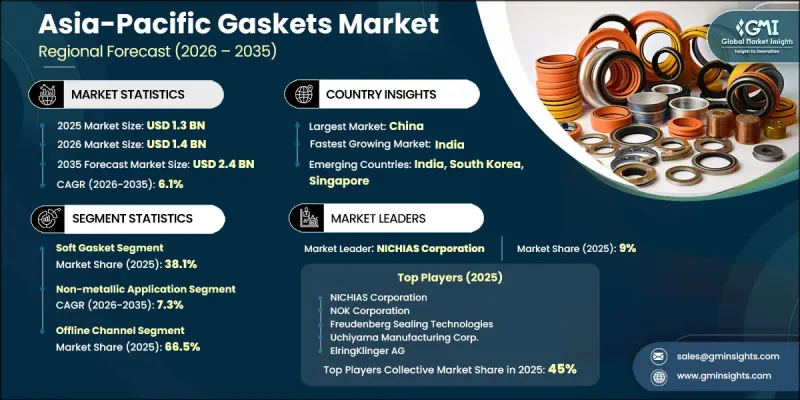
Strong industrial expansion across the region continues to create sustained demand for advanced sealing solutions across multiple manufacturing and processing industries. Ongoing investments in industrial facilities, energy infrastructure, and large-scale processing operations are increasing the need for reliable gasket products that enhance operational efficiency and minimize equipment downtime. The growing emphasis on emissions reduction, operational reliability, and regulatory compliance is encouraging industries to adopt high-performance sealing technologies that support leak prevention and improved process integrity. At the same time, increasing investments in industrial modernization and digital supply chain management are reshaping procurement practices and strengthening demand for technically advanced gasket solutions. Manufacturers are increasingly competing through engineering expertise, product performance, and service quality rather than price alone. This transition is driving greater adoption of specialized sealing materials designed to improve durability, operational safety, and long-term equipment performance. As industries continue to modernize production facilities and prioritize sustainable operations, the Asia-Pacific gaskets market is expected to experience consistent growth throughout the forecast period.
| Market Scope | |
|---|---|
| Start Year | 2025 |
| Forecast Year | 2026-2035 |
| Start Value | $1.3 Billion |
| Forecast Value | $2.4 Billion |
| CAGR | 6.1% |
The soft gasket segment accounted for a 38.1% share, generating USD 500 million in 2025. The segment continues to maintain its leading position in general industrial applications and low- to medium-pressure environments due to its affordability, broad compatibility, dependable sealing performance, and ease of installation. The widespread use of soft gasket materials across routine maintenance and industrial processing applications is expected to support continued demand during the forecast period.
The metallic gasket segment held a 42.3% share in 2025 and is projected to hold 47% by 2035. Rising demand for high-performance sealing solutions capable of operating under elevated temperatures, high-pressure conditions, and demanding industrial environments is driving this growth. Metallic gasket designs offer superior sealing integrity, extended service life, and improved resistance to harsh operating conditions, making them increasingly preferred for critical industrial applications.
Asia-Pacific Gasket Market held a 38% share in 2025. Continued industrial development, expanding manufacturing activities, increasing investments in process industries, and growing energy infrastructure projects continue to strengthen long-term demand for gasket solutions across the region.
Key players operating in the Asia-Pacific gaskets market include Banco Products Ltd., Dana Incorporated, ElringKlinger AG, Freudenberg Sealing Technologies, Garlock Sealing Technologies, Goodrich Gasket Pvt. Ltd., Ishikawa Gasket Co., Ltd., James Walker Group, KLINGER Holding GmbH, NICHIAS Corporation, Ningbo Kaxite Sealing Materials Co., Ltd., Nippon Pillar Packing Co., Ltd., Nippon Valqua Industries Ltd., NOK Corporation, Parker Hannifin Corporation, Smiths Group plc, Sunwell Sealing Materials Co., Ltd., Teadit Group, Trelleborg Sealing Solutions, Uchiyama Manufacturing Corp., and W.L. Gore & Associates. Companies participating in the Asia-Pacific gaskets market are strengthening their market presence by expanding manufacturing capabilities, investing in advanced sealing technologies, and introducing high-performance gasket materials designed for demanding industrial applications. Many manufacturers are prioritizing research and development to improve product durability, leak resistance, and operational reliability while addressing evolving regulatory requirements. Businesses are also enhancing technical support services, strengthening regional distribution networks, and improving supply chain efficiency to serve customers more effectively.
Table of Contents
Chapter 1 Methodology & Scope
- 1.1 Market scope and definition
- 1.2 Research design
- 1.2.1 Research approach
- 1.2.2 Data collection methods
- 1.3 Data mining sources
- 1.3.1 Global
- 1.3.2 Regional/Country
- 1.4 Base estimates and calculations
- 1.4.1 Base year calculation
- 1.4.2 Key trends for market estimation
- 1.5 Primary research and validation
- 1.5.1 Primary sources
- 1.6 Forecast model
- 1.7 Research assumptions and limitations
Chapter 2 Executive Summary
- 2.1 Industry 360° synopsis
- 2.2 Key market trends
- 2.2.1 Product Type
- 2.2.2 Material Type
- 2.2.3 Application
- 2.2.4 End Use
- 2.2.5 Distribution Channel
Chapter 3 Industry Insights
- 3.1 Industry ecosystem analysis
- 3.1.1 Supplier landscape
- 3.1.2 Profit margin
- 3.1.3 Value addition at each stage
- 3.1.4 Factor affecting the value chain
- 3.2 Industry impact forces
- 3.2.1 Growth drivers
- 3.2.2 Industry pitfalls & challenges
- 3.2.3 Opportunities
- 3.3 Growth potential analysis
- 3.4 Future market trends
- 3.5 Technology and innovation landscape
- 3.5.1 Current technological trends
- 3.5.2 Emerging technologies
- 3.6 Regulatory landscape
- 3.6.1 Standards and compliance requirements
- 3.6.2 Regional regulatory frameworks
- 3.6.3 Certification standards
- 3.7 Porter’s analysis
- 3.8 PESTEL analysis
- 3.9 Price trends
- 3.9.1 Historical Price Trend Analysis — Asia Pacific (2022–2025) (Driven by Primary Research)
- 3.9.2 Pricing Strategy by Player Type (Premium / Value / Cost-Plus) (Driven by Primary Research)
- 3.10 Trade Data Analysis (Driven by Primary Research)
- 3.10.1 Import/Export Volume & Value Trends (Driven by Primary Research)
- 3.10.2 Key Trade Corridors & Tariff Impact (Driven by Primary Research)
- 3.11 Impact of AI & Generative AI on the Market
- 3.11.1 AI-Driven Disruption of Existing Business Models
- 3.11.2 GenAI Use Cases & Adoption Roadmap by Segment
- 3.11.3 Risks, Limitations & Regulatory Considerations
- 3.12 Capacity and Production Landscape — Asia Pacific (Driven by Primary Research)
- 3.12.1 Installed Bioreactor Capacity by Country and Key Producer — Asia Pacific (Driven by Primary Research)
- 3.12.2 Capacity Utilization Rates and Expansion Pipelines (Driven by Primary Research)
Chapter 4 Competitive Landscape, 2025
- 4.1 Introduction
- 4.2 Company market share analysis
- 4.3 Company matrix analysis
- 4.4 Competitive analysis of major market players
- 4.5 Competitive positioning matrix
- 4.6 Key developments
- 4.6.1 Mergers & acquisitions
- 4.6.2 Partnerships & collaborations
- 4.6.3 New product launches
- 4.6.4 Expansion plans
Chapter 5 Market Estimates & Forecast, By Product Type, 2022 – 2035, (USD Billion) (Thousand Units)
- 5.1 Key trends
- 5.2 Soft
- 5.3 Spiral wound
- 5.4 Ring joint
- 5.5 Jacketed
- 5.6 Corrugated
- 5.7 Others
Chapter 6 Market Estimates & Forecast, By Material Type, 2022 – 2035, (USD Billion) (Thousand Units)
- 6.1 Key trends
- 6.2 Metallic
- 6.3 Non-metallic
Chapter 7 Market Estimates & Forecast, By Application, 2022 – 2035, (USD Billion) (Thousand Units)
- 7.1 Key trends
- 7.2 Sealing
- 7.3 Pressure containment
- 7.4 Heat transfer
- 7.5 Vibration dampening
Chapter 8 Market Estimates & Forecast, By End Use, 2022 – 2035, (USD Billion) (Thousand Units)
- 8.1 Key trends
- 8.2 Automotive
- 8.3 Aerospace
- 8.4 Oil & Gas
- 8.5 Chemical & petrochemical
- 8.6 Power generation
- 8.7 Food & beverage
- 8.8 Water & wastewater treatment
- 8.9 Pharmaceutical
- 8.10 Mining
- 8.11 Others (e.g., electronics, marine)
Chapter 9 Market Estimates & Forecast, By Distribution Channel, 2022 – 2035, (USD Billion) (Thousand Units)
- 9.1 Key trends
- 9.2 Online
- 9.2.1 E-commerce
- 9.2.2 Company website
- 9.3 Offline
- 9.3.1 Hypermarkets/supermarkets
- 9.3.2 Specialty stores
- 9.3.3 Other retail stores
Chapter 10 Market Estimates and Forecast, By Country, 2022 – 2035 (USD Billion) (Thousand Units)
- 10.1 Key trends
- 10.2 China
- 10.3 India
- 10.4 Japan
- 10.5 South Korea
- 10.6 Taiwan
- 10.7 Indonesia
- 10.8 Thailand
- 10.9 Singapore
- 10.10 Australia
Chapter 11 Company Profiles
- 11.1 Top Global Player
- 11.1.1 NICHIAS Corporation
- 11.1.2 Freudenberg Sealing Technologies
- 11.1.3 ElringKlinger AG
- 11.1.4 NOK Corporation
- 11.1.5 Uchiyama Manufacturing Corp.
- 11.1.6 Trelleborg Sealing Solutions
- 11.1.7 Parker Hannifin Corporation
- 11.2 Regional Player
- 11.2.1 Nippon Pillar Packing Co., Ltd.
- 11.2.2 Nippon Valqua Industries Ltd.
- 11.2.3 Ishikawa Gasket Co., Ltd.
- 11.2.4 KLINGER Holding GmbH
- 11.2.5 W.L. Gore & Associates
- 11.2.6 Garlock Sealing Technologies
- 11.2.7 Dana Incorporated — Victor Reinz
- 11.2.8 Banco Products (India) Ltd.
- 11.2.9 Goodrich Gasket Pvt. Ltd.
- 11.3 Emerging Players
- 11.3.1 Smiths Group plc
- 11.3.2 James Walker Group
- 11.3.3 Teadit Group
- 11.3.4 Ningbo Kaxite Sealing Materials Co., Ltd.
- 11.3.5 Sunwell Sealing Materials Co., Ltd.

