PUBLISHER: Global Market Insights Inc. | PRODUCT CODE: 2109219

PUBLISHER: Global Market Insights Inc. | PRODUCT CODE: 2109219
Optical I/O for AI Chips Market Opportunity, Growth Drivers, Industry Trend Analysis, and Forecast 2026 - 2035
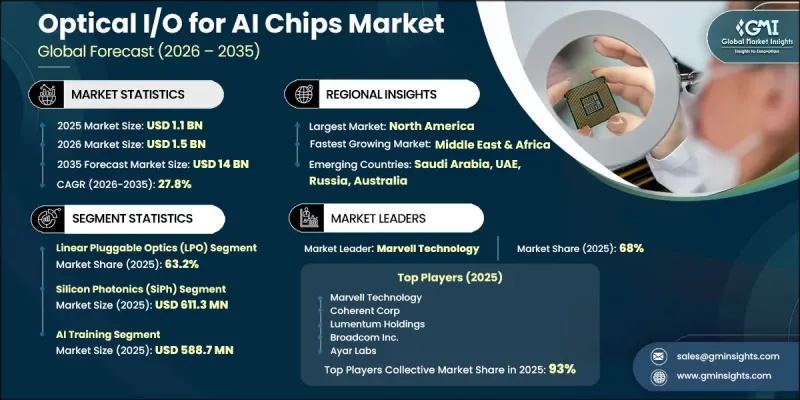
The Global Optical I/O for AI Chips Market was valued at USD 1.1 billion in 2025 and is estimated to grow at a CAGR of 27.8% to reach USD 14 billion by 2035.
Rapid expansion of artificial intelligence computing infrastructure is creating strong demand for advanced optical connectivity solutions capable of delivering greater bandwidth, lower latency, and improved energy efficiency. The increasing deployment of co-packaged optics (CPO), supportive government initiatives aimed at strengthening domestic semiconductor manufacturing, and growing investments in silicon photonics technologies are accelerating market growth. Rising adoption of high-speed optical networking standards is further supporting the transition toward next-generation AI hardware architectures. Continuous innovation in silicon photonics-based photonic integrated circuits and optical transceivers is enabling higher scalability while reducing power consumption across advanced computing environments. As AI workloads become increasingly complex and data-intensive, optical I/O technologies are emerging as a critical component for improving interconnect performance and system efficiency. The growing need for high-performance computing infrastructure, combined with sustained investment in semiconductor and photonics ecosystems, is expected to drive long-term expansion of the global optical I/O for AI chips market.
| Market Scope | |
|---|---|
| Start Year | 2025 |
| Forecast Year | 2026-2035 |
| Start Value | $1.1 Billion |
| Forecast Value | $14 Billion |
| CAGR | 27.8% |
The optical I/O for AI chips market is experiencing strong momentum as the rapid expansion of AI data centers increases demand for interconnect technologies that provide significantly higher bandwidth and lower power consumption than conventional electrical connections. Growing investments in large-scale AI computing infrastructure are accelerating the adoption of optical interconnect solutions capable of supporting advanced processing requirements. At the same time, increasing public and private investment in semiconductor manufacturing and silicon photonics production is strengthening domestic supply chains and supporting the commercialization of next-generation optical technologies, further contributing to sustained market growth.
The linear pluggable optics (LPO) segment accounted for a 63.2% share in 2025, making it the leading product category. The segment continues to gain widespread acceptance because of its straightforward integration with existing data center infrastructure and its cost-efficient migration path toward co-packaged optics with fewer deployment complexities than conventional pluggable solutions. LPO technology delivers exceptionally high bandwidth while maintaining low power consumption, making it well suited for demanding AI workloads and advanced computing applications.
The silicon photonics (SiPh) segment reached USD 611.3 million in 2025. The segment has achieved strong market adoption due to its compatibility with CMOS manufacturing processes, superior integration capabilities, and ability to deliver high-bandwidth, energy-efficient optical interconnects at large production volumes. Expanding deployment across AI computing platforms, hyperscale data centers, and high-performance computing environments continues to strengthen demand and encourage greater investment in silicon photonics technologies.
North America Optical I/O for AI Chips Market accounted for 57.8% share in 2025. Regional growth is supported by a well-established semiconductor ecosystem, significant investments in AI computing infrastructure, and the presence of leading developers of AI hardware, optical networking technologies, and silicon photonics solutions. Rising demand for high-speed, low-latency optical interconnects designed to support increasingly complex AI training and inference workloads continues to reinforce the region's leadership position.
Key players operating in the global optical I/O for AI chips market include Ayar Labs, Broadcom Inc., Celestial AI, Ciena Corporation, Coherent Corp., Furukawa Electric Co., Hamamatsu Photonics, Intel Corporation, Lightmatter, Lumentum Holdings Inc., MACOM Technology Solutions, Marvell Technology Group, NewPhotonics, Nexus Photonics, PhotonicX AI Pte. Ltd., POET Technologies Inc., Ranovus Inc., Salience Labs, Scintil Photonics, and Sumitomo Electric Industries. Companies operating in the optical I/O for AI chips market are strengthening their market position by investing heavily in silicon photonics innovation, advanced optical interconnect technologies, and next-generation packaging solutions. Many organizations are expanding research and development activities to improve bandwidth, reduce power consumption, and enhance scalability for AI-driven computing environments. Strategic collaborations with semiconductor manufacturers, cloud infrastructure providers, and technology developers are helping companies accelerate commercialization and broaden product adoption. Businesses are also increasing manufacturing capabilities, strengthening supply chain resilience, and introducing integrated optical solutions tailored to evolving AI infrastructure requirements.
Table of Contents
Chapter 1 Methodology and Scope
- 1.1 Market scope and definition
- 1.2 Research design
- 1.2.1 Research approach
- 1.2.2 Data collection methods
- 1.3 Data mining sources
- 1.3.1 Global
- 1.3.2 Regional/Country
- 1.4 Base estimates and calculations
- 1.4.1 Base year calculation
- 1.4.2 Key trends for market estimation
- 1.5 Primary research and validation
- 1.5.1 Primary sources
- 1.6 Forecast model
- 1.7 Research assumptions and limitations
Chapter 2 Executive Summary
- 2.1 Industry 360° synopsis, 2022 – 2035
- 2.2 Key market trends
- 2.2.1 Product type trends
- 2.2.2 Technology trends
- 2.2.3 Application trends
- 2.2.4 End-user trends
- 2.2.5 Regional trends
- 2.3 TAM Analysis, 2026-2035
- 2.4 CXO perspectives: Strategic imperatives
Chapter 3 Industry Insights
- 3.1 Industry ecosystem analysis
- 3.1.1 Supplier Landscape
- 3.1.2 Profit Margin
- 3.1.3 Cost structure
- 3.1.4 Value addition at each stage
- 3.1.5 Factors affecting the value chain
- 3.1.6 Disruptions
- 3.2 Industry impact forces
- 3.2.1 Growth drivers
- 3.2.1.1 Rapid expansion of AI data centers driving demand for optical interconnects
- 3.2.1.2 Growing commercialization of co-packaged optics (CPO) for AI infrastructure
- 3.2.1.3 Government investments supporting silicon photonics and semiconductor manufacturing
- 3.2.1.4 Increasing adoption of high-bandwidth optical networking standards for AI clusters
- 3.2.1.5 Advancements in silicon photonics and optical transceiver technologies improving power efficiency
- 3.2.2 Industry pitfalls and challenges
- 3.2.2.1 High cost of silicon photonics integration and packaging
- 3.2.2.2 Complexity in optical-electrical integration and industry standardization
- 3.2.3 Market opportunities
- 3.2.3.1 Commercialization of co-packaged optics (CPO) for next-generation AI infrastructure
- 3.2.3.2 Expansion of silicon photonics in hyperscale data centers and AI networking
- 3.2.1 Growth drivers
- 3.3 Growth potential analysis
- 3.4 Regulatory landscape
- 3.4.1 North America
- 3.4.2 Europe
- 3.4.3 Asia Pacific
- 3.4.4 Latin America
- 3.4.5 Middle East & Africa
- 3.5 Porter’s analysis
- 3.6 PESTEL analysis
- 3.7 Technology and Innovation landscape
- 3.7.1 Current technological trends
- 3.7.2 Emerging technologies
- 3.8 Price trends
- 3.8.1 By region
- 3.8.2 By product
- 3.9 Pricing Strategies
- 3.10 Emerging Business Models
- 3.11 Compliance Requirements
- 3.12 Patent and IP analysis
Chapter 4 Competitive Landscape, 2025
- 4.1 Introduction
- 4.2 Company market share analysis
- 4.2.1 By region
- 4.2.1.1 North America
- 4.2.1.2 Europe
- 4.2.1.3 Asia Pacific
- 4.2.1.4 Latin America
- 4.2.1.5 Middle East & Africa
- 4.2.2 Market concentration analysis
- 4.2.1 By region
- 4.3 Competitive benchmarking of key players
- 4.3.1 Financial performance comparison
- 4.3.1.1 Revenue
- 4.3.1.2 Profit margin
- 4.3.1.3 R&D
- 4.3.2 Product portfolio comparison
- 4.3.2.1 Product range breadth
- 4.3.2.2 Technology
- 4.3.2.3 Innovation
- 4.3.3 Geographic presence comparison
- 4.3.3.1 Global footprint analysis
- 4.3.3.2 Service network coverage
- 4.3.3.3 Market penetration by region
- 4.3.4 Competitive positioning matrix
- 4.3.4.1 Leaders
- 4.3.4.2 Challengers
- 4.3.4.3 Followers
- 4.3.4.4 Niche players
- 4.3.5 Strategic outlook matrix
- 4.3.1 Financial performance comparison
- 4.4 Key developments
- 4.4.1 Mergers and acquisitions
- 4.4.2 Partnerships and collaborations
- 4.4.3 Technological advancements
- 4.4.4 Expansion and investment strategies
- 4.4.5 Digital transformation initiatives
- 4.5 Emerging/ startup competitors landscape
Chapter 5 Market Estimates and Forecast, By Product Type, 2022 – 2035 (USD Million)
- 5.1 Key trends
- 5.2 In-package optical I/O (OIO)
- 5.3 Co-packaged optics (CPO)
- 5.4 Near-package optics (NPO)
- 5.5 On-board optics (OBO)
- 5.6 Linear pluggable optics (LPO)
Chapter 6 Market Estimates and Forecast, By Technology, 2022 – 2035 (USD Million)
- 6.1 Key trends
- 6.2 Silicon photonics (SiPh)
- 6.3 Indium phosphide (InP)
- 6.4 Thin-film lithium niobate (TFLN)
- 6.5 Heterogeneous / hybrid integration
- 6.6 Others
Chapter 7 Market Estimates and Forecast, By Application, 2022 – 2035 (USD Million)
- 7.1 Key trends
- 7.2 AI training
- 7.3 AI inference
- 7.4 HPC & scientific computing
- 7.5 Data center networking & switching
Chapter 8 Market Estimates and Forecast, By End-User, 2022 – 2035 (USD Million)
- 8.1 Key trends
- 8.2 Hyperscalers & cloud providers
- 8.3 Enterprise data centers
- 8.4 HPC & research institutions
- 8.5 Government & defense
Chapter 9 Market Estimates and Forecast, By Region, 2022 – 2035 (USD Million)
- 9.1 Key trends
- 9.2 North America
- 9.2.1 U.S.
- 9.2.2 Canada
- 9.3 Europe
- 9.3.1 Germany
- 9.3.2 UK
- 9.3.3 France
- 9.3.4 Spain
- 9.3.5 Italy
- 9.3.6 Russia
- 9.4 Asia Pacific
- 9.4.1 China
- 9.4.2 India
- 9.4.3 Japan
- 9.4.4 Australia
- 9.4.5 South Korea
- 9.4.6 Taiwan
- 9.5 Latin America
- 9.5.1 Brazil
- 9.5.2 Mexico
- 9.5.3 Argentina
- 9.6 Middle East and Africa
- 9.6.1 South Africa
- 9.6.2 Saudi Arabia
- 9.6.3 UAE
Chapter 10 Company Profiles
- 10.1 Global Key Players
- 10.1.1 Marvell Technology
- 10.1.2 Coherent Corp
- 10.1.3 Lumentum Holdings
- 10.1.4 Broadcom Inc
- 10.1.5 Ayar Labs
- 10.2 Regional key players
- 10.2.1 North America
- 10.2.1.1 Intel Corporation
- 10.2.1.2 Ranovus Inc.
- 10.2.1.3 MACOM Technology Solutions
- 10.2.1.4 Lightmatter
- 10.2.1.5 Celestial AI
- 10.2.1.6 Ciena Corporation
- 10.2.1.7 POET Technologies Inc.
- 10.2.2 Asia Pacific
- 10.2.2.1 Sumitomo Electric Industries
- 10.2.2.2 Hamamatsu Photonics
- 10.2.2.3 Furukawa Electric Co.
- 10.2.2.4 NewPhotonics
- 10.2.2.5 PhotonicX AI Pte. Ltd.
- 10.2.3 Europe
- 10.2.3.1 Scintil Photonics
- 10.2.3.2 Salience Labs
- 10.2.1 North America
- 10.3 Niche Players/Disruptors
- 10.3.1 Nexus Photonics

