PUBLISHER: Global Market Insights Inc. | PRODUCT CODE: 2109227

PUBLISHER: Global Market Insights Inc. | PRODUCT CODE: 2109227
Standardized Plant Extract Manufacturing Market Opportunity, Growth Drivers, Industry Trend Analysis, and Forecast 2026 - 2035
The Global Standardized Plant Extract Manufacturing Market was valued at USD 19.6 billion in 2025 and is estimated to grow at a CAGR of 7.6% to reach USD 40.2 billion by 2035.
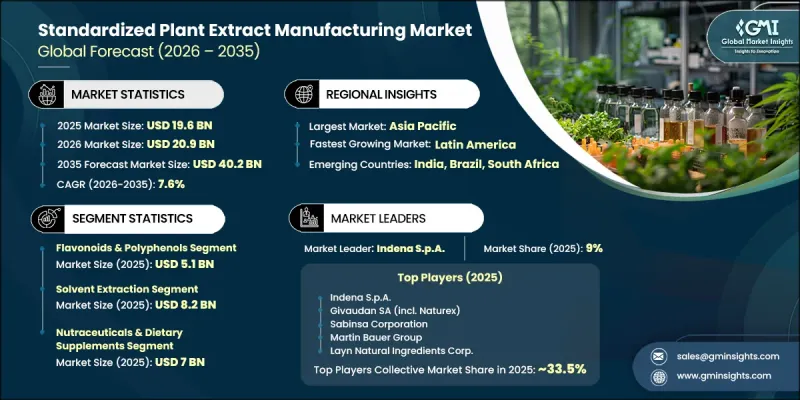
Strong momentum across the standardized plant extract manufacturing industry continues to be fueled by the growing use of botanical active pharmaceutical ingredients (APIs) within established regulatory systems, expanding global interest in preventive healthcare, which supports higher nutraceutical consumption, and rising clean-label requirements that influence ingredient sourcing across the food, beverage, and cosmetics industries. Continuous advancements in extraction technologies, including supercritical CO2 and enzymatic processing, are also enabling manufacturers to supply high-purity, pharmaceutical-grade extracts that are difficult to achieve with conventional methods, while improving production efficiency. Increasing demand for phytopharmaceuticals and botanical APIs further supports market expansion as regulatory pathways continue to encourage the integration of standardized botanical ingredients into pharmaceutical development. At the same time, manufacturers are strengthening quality assurance through AI-powered bioactivity screening technologies and blockchain-enabled batch traceability. These digital innovations enhance authentication, optimize supply chain transparency, support regulatory compliance, predict biomass potency before production, improve quality consistency, reduce material losses, and minimize batch rejection rates, enabling producers to improve operational efficiency while delivering standardized botanical extracts that meet increasingly stringent customer requirements.
| Market Scope | |
|---|---|
| Start Year | 2025 |
| Forecast Year | 2026-2035 |
| Start Value | $19.6 Billion |
| Forecast Value | $40.2 Billion |
| CAGR | 7.6% |
The flavonoids & polyphenols segment generated USD 5.1 billion in 2025. This category continues to represent the largest product segment because of its extensive utilization across nutraceuticals, pharmaceuticals, functional foods, and cosmetic formulations. Market participants are increasingly differentiating their offerings by investing in advanced formulation technologies that improve ingredient absorption, bioavailability, stability, and performance rather than competing solely through standardized concentration levels. This strategy enables manufacturers to deliver higher-value products while maintaining premium pricing and strengthening their competitive positioning within the global standardized plant extract manufacturing market.
The nutraceuticals and dietary supplements application segment accounted for a 35.8% share, generating USD 7 billion in 2025. The segment continues to benefit from growing consumer preference for preventive wellness, increasing confidence in clinically supported botanical ingredients, and the rapid expansion of online dietary supplement sales channels. Rising demand for standardized plant extracts across wellness-focused product categories continues to encourage manufacturers to develop formulations with verified potency, consistent quality, and scientifically supported efficacy. These factors are allowing ingredient suppliers to secure premium pricing while meeting evolving consumer expectations for reliable botanical products.
North America Standardized Plant Extract Manufacturing Market was valued at USD 5.3 billion in 2025 and is forecast to grow at a CAGR of 7.1% through 2035. The United States remains the largest contributor to regional revenue, supported by the world's largest dietary supplement industry and an established regulatory environment governing ingredient labeling and marketing practices. Increasing regulatory oversight surrounding product claims is encouraging manufacturers and formulators to rely on standardized botanical ingredients supported by validated analytical specifications, creating sustained demand for high-quality plant extracts across pharmaceutical, nutraceutical, and consumer health applications.
The major companies operating in the global standardized plant extract manufacturing market include Indena S.p.A., Givaudan SA (including Naturex), Sabinsa Corporation, Martin Bauer Group, Layn Natural Ingredients Corp., Euromed S.A., Arjuna Natural Ltd., PLT Health Solutions, Star Hi Herbs Pvt. Ltd., ChenGuang Biotech Group Co., Ltd., Specialty Natural Products Co., Ltd. (SNPS), Inner Mongolia Ever Brilliance Biotechnology Co., Ltd. (KEB), Organic Herb Inc., Synthite Industries Ltd., and Nexira SAS. Companies operating in the standardized plant extract manufacturing industry are strengthening their market position by prioritizing investments in advanced extraction technologies, quality assurance systems, and product innovation. Many manufacturers are expanding production capacity while adopting automated processing, digital quality monitoring, and traceability solutions to improve consistency and regulatory compliance. Businesses are also focusing on developing high-purity standardized extracts with enhanced functionality to address the evolving requirements of pharmaceutical, nutraceutical, food, beverage, and personal care manufacturers. Strategic partnerships with raw material suppliers, contract manufacturers, and research organizations help secure reliable sourcing and accelerate product development.
Table of Contents
Chapter 1 Methodology & Scope
- 1.1 Market scope and definition
- 1.2 Research design
- 1.2.1 Research approach
- 1.2.2 Data collection methods
- 1.3 Data mining sources
- 1.3.1 Global
- 1.3.2 Regional/Country
- 1.4 Base estimates and calculations
- 1.4.1 Base year calculation
- 1.4.2 Key trends for market estimation
- 1.5 Primary research and validation
- 1.5.1 Primary sources
- 1.6 Forecast model
- 1.7 Research assumptions and limitations
Chapter 2 Executive Summary
- 2.1 Industry 360° synopsis
- 2.2 Key market trends
- 2.2.1 Active Constituent/Compound Type
- 2.2.2 Extraction Technology
- 2.2.3 Application
- 2.2.4 Output Form
- 2.2.5 Regional
- 2.3 TAM Analysis, 2026-2035
- 2.4 CXO perspectives: Strategic imperatives
- 2.5 Future outlook and strategic recommendations
Chapter 3 Industry Insights
- 3.1 Industry ecosystem analysis
- 3.1.1 Supplier landscape
- 3.1.2 Profit margin
- 3.1.3 Value addition at each stage
- 3.1.4 Factor affecting the value chain
- 3.1.5 Disruptions
- 3.2 Industry impact forces
- 3.2.1 Growth drivers
- 3.2.2 Industry pitfalls and challenges
- 3.2.3 Market opportunities
- 3.3 Growth potential analysis
- 3.4 Regulatory landscape
- 3.4.1 North America
- 3.4.2 Europe
- 3.4.3 Asia Pacific
- 3.4.4 Latin America
- 3.4.5 Middle East & Africa
- 3.5 Porter’s analysis
- 3.6 PESTEL analysis
- 3.7 Technology and innovation landscape
- 3.7.1 Current technological trends
- 3.7.2 Emerging technologies
- 3.8 Price trends
- 3.8.1 By region
- 3.8.2 By Active Constituent/Compound Type
- 3.9 Future market trends
- 3.10 Patent landscape
- 3.11 Trade statistics (HS code)
- 3.11.1 Major importing countries
- 3.11.2 Major exporting countries
- 3.12 Sustainability and environmental aspects
- 3.12.1 Sustainable practices
- 3.12.2 Waste reduction strategies
- 3.12.3 Energy efficiency in production
- 3.12.4 Eco-friendly initiatives
Chapter 4 Competitive Landscape, 2025
- 4.1 Introduction
- 4.2 Company market share analysis
- 4.2.1 By region
- 4.2.1.1 North America
- 4.2.1.2 Europe
- 4.2.1.3 Asia Pacific
- 4.2.1.4 LATAM
- 4.2.1.5 MEA
- 4.2.1 By region
- 4.3 Company matrix analysis
- 4.4 Competitive analysis of major market players
- 4.5 Competitive positioning matrix
- 4.6 Key developments
- 4.6.1 Mergers & acquisitions
- 4.6.2 Partnerships & collaborations
- 4.6.3 New product launches
- 4.6.4 Expansion plans
Chapter 5 Market Estimates and Forecast, By Active Constituent/Compound Type, 2022–2035 (USD Million) (Kilo Tons)
- 5.1 Key trends
- 5.2 Flavonoids & Polyphenols
- 5.3 Alkaloids
- 5.4 Terpenoids & Saponins
- 5.5 Carotenoids
- 5.6 Tannins & Phenolic Acids
- 5.7 Glycosides
- 5.8 Others
Chapter 6 Market Estimates and Forecast, By Extraction Technology, 2022–2035 (USD Million) (Kilo Tons)
- 6.1 Key trends
- 6.2 Solvent Extraction
- 6.3 Supercritical CO₂ Extraction
- 6.4 Aqueous/Water-Based Extraction
- 6.5 Enzymatic Extraction
- 6.6 Chromatography-Based Separation & Purification
- 6.7 Others
Chapter 7 Market Estimates and Forecast, By Application, 2022–2035 (USD Million) (Kilo Tons)
- 7.1 Key trends
- 7.2 Pharmaceuticals & Botanical Drugs
- 7.3 Nutraceuticals & Dietary Supplements
- 7.4 Food & Beverages
- 7.5 Cosmetics & Personal Care
- 7.6 Animal Nutrition & Veterinary
- 7.7 Agricultural Applications
Chapter 8 Market Estimates and Forecast, By Output Form, 2022–2035 (USD Million) (Kilo Tons)
- 8.1 Key trends
- 8.2 Dry Powder Extract
- 8.3 Liquid Extract
- 8.4 Semi-Solid
Chapter 9 Market Estimates and Forecast, By Region, 2022–2035 (USD Million) (Kilo Tons)
- 9.1 Key trends
- 9.2 North America
- 9.2.1 U.S.
- 9.2.2 Canada
- 9.3 Europe
- 9.3.1 Germany
- 9.3.2 UK
- 9.3.3 France
- 9.3.4 Spain
- 9.3.5 Italy
- 9.3.6 Rest of Europe
- 9.4 Asia Pacific
- 9.4.1 China
- 9.4.2 India
- 9.4.3 Japan
- 9.4.4 Australia
- 9.4.5 South Korea
- 9.4.6 Rest of Asia Pacific
- 9.5 Latin America
- 9.5.1 Brazil
- 9.5.2 Mexico
- 9.5.3 Argentina
- 9.5.4 Rest of Latin America
- 9.6 Middle East and Africa
- 9.6.1 Saudi Arabia
- 9.6.2 South Africa
- 9.6.3 UAE
- 9.6.4 Rest of Middle East and Africa
Chapter 10 Company Profiles
- 10.1 Indena S.p.A.
- 10.2 Givaudan SA (incl. Naturex)
- 10.3 Sabinsa Corporation
- 10.4 Martin Bauer Group
- 10.5 Layn Natural Ingredients Corp.
- 10.6 Euromed S.A.
- 10.7 Arjuna Natural Ltd.
- 10.8 PLT Health Solutions
- 10.9 Star Hi Herbs Pvt. Ltd.
- 10.10 ChenGuang Biotech Group Co., Ltd.
- 10.11 Specialty Natural Products Co., Ltd. (SNPS)
- 10.12 Inner Mongolia Ever Brilliance Biotechnology Co., Ltd. (KEB)
- 10.13 Organic Herb Inc.
- 10.14 Synthite Industries Ltd.
- 10.15 Nexira SAS

