PUBLISHER: Global Market Insights Inc. | PRODUCT CODE: 2109231

PUBLISHER: Global Market Insights Inc. | PRODUCT CODE: 2109231
Commercial and Multi-Family Heat Pump Market Opportunity, Growth Drivers, Industry Trend Analysis, and Forecast 2026 - 2035
The Global Commercial & Multi-Family Heat Pump Market was valued at USD 29.8 billion in 2025 and is estimated to grow at a CAGR of 14.3% to reach USD 110.9 billion by 2035.
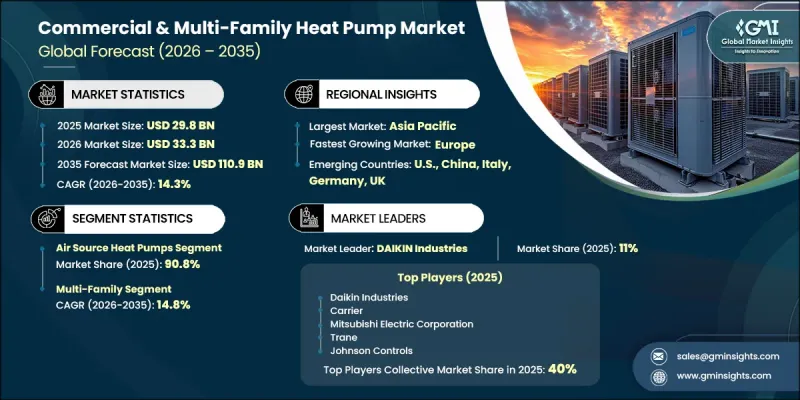
Market growth continues to accelerate as regulatory frameworks increasingly support low-emission building technologies while long-term sustainability objectives reshape investment decisions throughout the construction sector. Financial support mechanisms have further improved project economics, encouraging broader deployment of heat pump systems across both new developments and retrofit projects. Ongoing technological advancements have also strengthened system efficiency, reliability, and year-round operating capabilities, making heat pumps an increasingly attractive solution for large-scale building applications. In addition, greater emphasis on reducing operating expenses, improving energy efficiency, and complying with evolving building performance standards continues to reinforce market expansion. Continuous product innovation, wider equipment availability, and rising investments in electrified heating solutions are collectively creating favorable conditions for sustained industry growth throughout the forecast timeline, positioning the commercial & Multi-Family Heat Pump Market for significant long-term expansion. Financial incentive programs, tax benefits, and structured subsidy initiatives have significantly lowered the overall cost of installing heat pump systems, accelerating adoption across North America and Western Europe. At the same time, the incorporation of heat pump technologies into intelligent building control platforms has transformed operational efficiency for commercial property owners. Advanced control platforms now enable seamless communication with centralized energy management systems, allowing building operators to improve equipment performance, optimize energy consumption, and enhance overall system efficiency through automated operational control.
| Market Scope | |
|---|---|
| Start Year | 2025 |
| Forecast Year | 2026-2035 |
| Start Value | $29.8 Billion |
| Forecast Value | $110.9 Billion |
| CAGR | 14.3% |
The air source heat pumps (ASHPs) segment captured a 90.8% share in 2025 and is forecast to grow at a 14.8% CAGR through 2035. Their market leadership is supported by simplified installation requirements, continued reductions in manufacturing costs through production scale, and ongoing improvements in performance across a wider range of operating conditions. These advantages continue to strengthen the adoption of air source technologies across commercial and multi-family applications worldwide.
The multi-family application segment accounted for 49.9% in 2025 and is forecast to grow at 14.8% CAGR through 2035. Market expansion remains closely associated with increasing residential development activity across North America and Asia Pacific, supported by stricter energy efficiency requirements and growing adoption of fully electrified building designs. These long-term construction trends continue to generate favorable demand for heat pump installations throughout the residential sector.
North America Commercial & Multi-Family Heat Pump Market held 21.9% share in 2025 and is expected to expand at a CAGR of 8.1% through 2035. The United States continues to represent the largest source of regional demand, supported by favorable government incentive programs, evolving construction regulations, and broader policy initiatives that encourage the deployment of energy-efficient heating technologies across commercial and residential buildings.
The leading companies operating in the global commercial & multi-family heat pump market include Bosch Thermotechnology Corp., Carrier, DAIKIN INDUSTRIES, FUJITSU GENERAL, Glen Dimplex Group, Gree Electric Appliances, Johnson Controls, Kensa Heat Pumps, Lennox, LG Electronics, Lochinvar, Midea, Mitsubishi Electric Corporation, NIBE Industrier AB, OCHSNER, Panasonic Corporation, Rheem Manufacturing, SAMSUNG, STIEBEL ELTRON GmbH & Co. KG, Trane, and Vaillant Group. Companies operating in the commercial & multi-family heat pump market continue to strengthen their market position by prioritizing product innovation, expanding manufacturing capabilities, and improving energy efficiency across their product portfolios. Many manufacturers are investing in advanced heat pump technologies designed to enhance system performance, reduce operating costs, and support evolving regulatory requirements. Strategic partnerships with distributors, contractors, and technology providers are helping companies expand market reach while strengthening customer support networks. Businesses are also increasing investments in research and development to improve product reliability, digital connectivity, and overall system intelligence.
Table of Contents
Chapter 1 Methodology & Scope
- 1.1 Research approach
- 1.2 Quality commitments
- 1.2.1 GMI AI policy & data integrity commitment
- 1.2.1.1 Source consistency protocol
- 1.2.1 GMI AI policy & data integrity commitment
- 1.3 Research trail & confidence scoring
- 1.3.1 Research trail components
- 1.3.2 Scoring components
- 1.4 Data collection
- 1.4.1 Partial list of primary sources
- 1.5 Data mining sources
- 1.5.1 Paid sources
- 1.5.1.1 Sources, by region
- 1.5.1 Paid sources
- 1.6 Base estimates and calculations
- 1.6.1 Base year calculation for any one approach
- 1.7 Market estimates & forecasts parameters
- 1.8 Forecast model
- 1.8.1 Quantified market impact analysis
- 1.8.1.1 Mathematical impact of growth parameters on forecast
- 1.8.1 Quantified market impact analysis
- 1.9 Research transparency addendum
- 1.9.1 Source attribution framework
- 1.9.2 Quality assurance metrics
- 1.9.3 Our commitment to trust
- 1.10 Market definitions
Chapter 2 Executive Summary
- 2.1 Industry synopsis, 2022 - 2035
- 2.1.1 Business trends
- 2.1.2 Product trends
- 2.1.3 Application trends
- 2.1.4 Installation trends
- 2.1.5 Regional trends
Chapter 3 Industry Insights
- 3.1 Industry ecosystem analysis
- 3.1.1 Raw material & component sourcing analysis
- 3.1.2 Factors affecting the value chain
- 3.1.3 Disruptions
- 3.2 Regulatory landscape
- 3.2.1 North America
- 3.2.2 Europe
- 3.2.3 Asia Pacific
- 3.2.4 Middle East & Africa
- 3.2.5 Latin America
- 3.3 Industry impact forces
- 3.3.1 Growth drivers
- 3.3.1.1 Accelerating building decarbonization mandates
- 3.3.1.2 Encouraging financial incentive programs
- 3.3.1.3 Expanding cold-climate performance capabilities
- 3.3.1.4 Rising commercial construction and urban housing development
- 3.3.2 Industry pitfalls and challenges
- 3.3.2.1 High upfront capital cost
- 3.3.2.2 Limited availability of skilled professionals coupled with limited adoption in long-standing buildings
- 3.3.1 Growth drivers
- 3.4 Growth potential analysis
- 3.5 Technology and innovation landscape
- 3.5.1 Current technological trends
- 3.6 Porter's analysis
- 3.6.1 Bargaining power of suppliers
- 3.6.2 Bargaining power of buyers
- 3.6.3 Threat of new entrants
- 3.6.4 Threat of substitute
- 3.6.5 Intensity of competitive rivalry
- 3.7 PESTEL analysis
- 3.7.1 Political factors
- 3.7.2 Economic factors
- 3.7.3 Social factors
- 3.7.4 Technological factors
- 3.7.5 Environmental factors
- 3.7.6 Legal factors
- 3.8 Cost structure analysis of commercial & multi-family heat pump (Driven by Primary Research)
- 3.9 Price trend analysis, 2022-2035 (USD/Unit) (Driven by Primary Research)
- 3.9.1 By product
- 3.9.2 By region
- 3.10 Impact of AI and generative AI on the market (Driven by primary research)
- 3.10.1 AI-driven disruption of existing business models
- 3.10.2 GenAI use cases & adoption roadmap by segment
- 3.10.3 Risks, limitations & regulatory considerations
- 3.11 Emerging opportunities & trends
- 3.12 Digitalization and IoT integration
- 3.13 Investment analysis & future outlook
Chapter 4 Competitive Landscape, 2026
- 4.1 Introduction
- 4.2 Company market share analysis, by region, 2025
- 4.2.1 North America
- 4.2.2 Europe
- 4.2.3 Asia Pacific
- 4.2.4 Middle East & Africa
- 4.2.5 Latin America
- 4.3 Competitive analysis of major market players
- 4.4 Competitive positioning matrix
- 4.5 Key developments
- 4.5.1 Mergers & acquisitions
- 4.5.2 Partnerships & collaborations
- 4.5.3 New product launches
- 4.5.4 Expansion plans and funding
- 4.6 Company tier benchmarking
- 4.6.1 Tier classification criteria & qualifying thresholds
- 4.6.2 Tier positioning matrix by revenue, geography & innovation
Chapter 5 Market Size and Forecast, By Product, 2022 - 2035 (USD Million, '000 Units)
- 5.1 Key trends
- 5.2 Air source
- 5.3 Ground source
- 5.4 Water source
Chapter 6 Market Size and Forecast, By Application, 2022 - 2035 (USD Million, '000 Units)
- 6.1 Key trends
- 6.2 Multi family
- 6.3 Commercial
- 6.3.1 Education
- 6.3.2 Healthcare
- 6.3.3 Retail
- 6.3.4 Logistics & transportation
- 6.3.5 Offices
- 6.3.6 Hospitality
- 6.3.7 Others
Chapter 7 Market Size and Forecast, By Installation, 2022 - 2035 (USD Million, '000 Units)
- 7.1 Key trends
- 7.2 New construction
- 7.3 Retrofit
Chapter 8 Market Size and Forecast, By Region, 2022 - 2035 (USD Million, '000 Units)
- 8.1 Key trends
- 8.2 North America
- 8.2.1 U.S.
- 8.2.2 Canada
- 8.3 Europe
- 8.3.1 Austria
- 8.3.2 Norway
- 8.3.3 Denmark
- 8.3.4 Finland
- 8.3.5 France
- 8.3.6 Germany
- 8.3.7 Italy
- 8.3.8 Switzerland
- 8.3.9 Spain
- 8.3.10 Sweden
- 8.3.11 UK
- 8.3.12 Netherlands
- 8.4 Asia Pacific
- 8.4.1 China
- 8.4.2 Japan
- 8.4.3 Australia
- 8.4.4 South Korea
- 8.5 Middle East & Africa
- 8.5.1 Saudi Arabia
- 8.5.2 Turkey
- 8.5.3 South Africa
- 8.6 Latin America
- 8.6.1 Brazil
- 8.6.2 Mexico
- 8.6.3 Argentina
Chapter 9 Company Profiles
- 9.1 Bosch Thermotechnology Corp.
- 9.2 Carrier
- 9.3 DAIKIN INDUSTRIES
- 9.4 FUJITSU GENERAL
- 9.5 Glen Dimplex Group
- 9.6 Gree Electric Appliances
- 9.7 Johnson Controls
- 9.8 Kensa Heat Pumps
- 9.9 Lennox
- 9.10 LG Electronics
- 9.11 Lochinvar
- 9.12 Midea
- 9.13 Mitsubishi Electric Corporation
- 9.14 NIBE Industrier AB
- 9.15 OCHSNER
- 9.16 Panasonic Corporation
- 9.17 Rheem Manufacturing
- 9.18 SAMSUNG
- 9.19 STIEBEL ELTRON GmbH & Co. KG
- 9.20 Trane
- 9.21 Vaillant Group

