PUBLISHER: Global Market Insights Inc. | PRODUCT CODE: 2109239

PUBLISHER: Global Market Insights Inc. | PRODUCT CODE: 2109239
Precision Gearbox Machinery Market Opportunity, Growth Drivers, Industry Trend Analysis, and Forecast 2026 - 2035
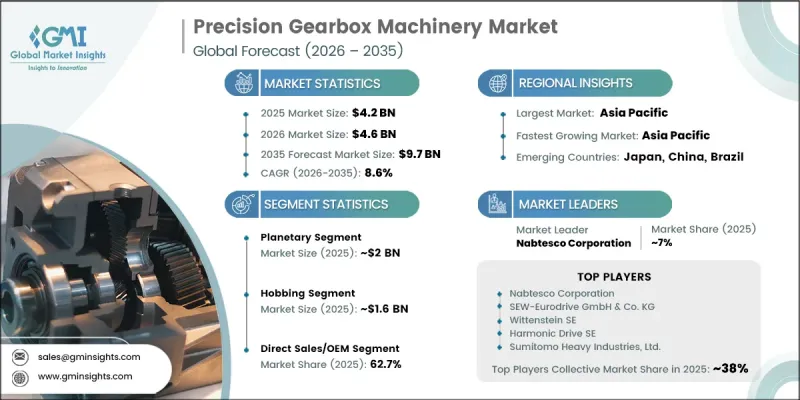
The Global Precision Gearbox Machinery Market was valued at USD 4.2 billion in 2025 and is estimated to grow at a CAGR of 8.6% to reach USD 9.7 billion by 2035.
Growth across the precision gearbox machinery industry is driven by sustained investments in industrial automation, modernization of gear manufacturing technologies, and rising demand for highly accurate motion control systems. Manufacturers continue to prioritize advanced gearbox production capabilities to meet the increasing precision requirements of modern industrial equipment while improving manufacturing efficiency and operational reliability. The expanding adoption of automated production systems is accelerating demand for high-performance gearbox machinery capable of delivering superior accuracy and consistent output. Continuous integration of Industry 4.0 technologies, Industrial Internet of Things (IIoT) connectivity, digital monitoring, and real-time machine analytics is transforming production environments and encouraging investment in next-generation manufacturing equipment. Growing emphasis on compact equipment design, improved motion control, and enhanced production precision is further strengthening demand for advanced gearbox manufacturing solutions. These ongoing technological advancements and increasing industrial automation initiatives continue to support the long-term expansion of the global precision gearbox machinery market throughout the forecast period.
| Market Scope | |
|---|---|
| Start Year | 2025 |
| Forecast Year | 2026-2035 |
| Start Value | $4.2 Billion |
| Forecast Value | $9.7 Billion |
| CAGR | 8.6% |
The precision gearbox machinery market continues to benefit from the rapid advancement of automated manufacturing technologies and increasingly demanding production standards. Equipment manufacturers are focusing on producing gearbox systems capable of achieving extremely high levels of accuracy while supporting multi-axis motion within compact machine configurations. The growing need for advanced motion control, improved manufacturing precision, and higher operational efficiency is encouraging broader adoption of technologically advanced gearbox production equipment. Continuous innovation in intelligent manufacturing systems and digital production technologies is further enhancing machine performance, improving process optimization, and increasing overall production reliability across industrial applications.
The planetary segment accounted for a 47.9% share, generating USD 2 billion in 2025. The segment maintains its leading position because planetary gearbox designs provide high torque transmission, excellent efficiency, compact construction, and dependable performance across a wide variety of precision motion applications. Their versatility and ability to support demanding industrial operations continue to drive strong market demand, reinforcing their position as the largest product segment throughout the forecast period.
The hobbing segment held a 39.1% share in 2025, capturing USD 1.6 billion. Hobbing remains the preferred manufacturing process because it offers high production efficiency, excellent machining accuracy, and broad compatibility with multiple gear configurations. The widespread use of CNC-based hobbing equipment and increasing integration of digital manufacturing technologies continue to strengthen demand for this process, supporting its leadership within the market.
U.S. Precision Gearbox Machinery Market held a 25% share in 2025 and is expected to grow at a CAGR of 9.3% from 2026 to 2035, making it the second-fastest-growing regional market worldwide. Continued investment in advanced manufacturing, expanding industrial automation initiatives, and increasing production of high-technology industrial equipment are supporting strong market growth. Rising emphasis on modern manufacturing capabilities and increasing adoption of automated production technologies continue to generate substantial demand for precision gearbox machinery across the country.
Major companies operating in the global precision gearbox machinery market include Apex Dynamics Inc., Bonfiglioli Riduttori S.p.A., Elecon Engineering Company Ltd., Flender GmbH, Harmonic Drive SE, HIWIN Technologies Corp., Leaderdrive Systems, maxon Group, Nabtesco Corporation, Neugart GmbH, NGC Gear Group, Nidec Corporation, Regal Rexnord Corporation, Reggiana Riduttori S.r.l., Rossi S.p.A., SEW-Eurodrive GmbH & Co. KG, STOBER Antriebstechnik GmbH, Sumitomo Heavy Industries Ltd., The Timken Company, Wittenstein SE, and Zhejiang Shuanghuan Driveline. Companies competing in the precision gearbox machinery market are strengthening their market position through continuous investment in advanced manufacturing technologies, product innovation, and precision engineering capabilities. Manufacturers are focusing on improving machining accuracy, production efficiency, digital integration, and equipment reliability to meet evolving industrial requirements. Many organizations are expanding manufacturing capacity, strengthening global distribution channels, and enhancing technical support services to improve customer satisfaction and market reach. Strategic partnerships, technology collaborations, and sustained investment in research and development remain key approaches for accelerating innovation and broadening product portfolios.
Table of Contents
Chapter 1 Methodology and Scope
- 1.1 Market scope and definition
- 1.2 Research design
- 1.2.1 Research approach
- 1.2.2 Data collection methods
- 1.3 Data mining sources
- 1.3.1 Global
- 1.3.2 Regional/Country
- 1.4 Base estimates and calculations
- 1.4.1 Base year calculation
- 1.4.2 Key trends for market estimation
- 1.5 Primary research and validation
- 1.5.1 Primary sources
- 1.6 Forecast model
- 1.7 Research assumptions and limitations
Chapter 2 Executive Summary
- 2.1 Industry 360° synopsis
- 2.2 Key market trends
- 2.2.1 Regional
- 2.2.2 Product Type
- 2.2.3 Manufacturing Process
- 2.2.4 Application
- 2.2.5 Distribution Channel
Chapter 3 Industry Insights
- 3.1 Industry ecosystem analysis
- 3.1.1 Supplier landscape
- 3.1.2 Profit margin
- 3.1.3 Value addition at each stage
- 3.1.4 Factor affecting the value chain
- 3.2 Industry impact forces
- 3.2.1 Growth drivers
- 3.2.2 Industry pitfalls & challenges
- 3.2.3 Opportunities
- 3.3 Growth potential analysis
- 3.3.1 Price volatility and market unpredictability
- 3.3.2 Quality assurance and equipment reliability concerns
- 3.4 Future market trends
- 3.5 Technology and innovation landscape
- 3.5.1 Current technological trends
- 3.5.2 Emerging technologies
- 3.6 Pricing Analysis (Driven by Primary Research)
- 3.6.1 Historical Price Trend Analysis (Driven by Primary Research)
- 3.6.2 Pricing Strategy by Player Type (Premium/Value/Cost-plus) (Driven by Primary Research)
- 3.6.3 Average Selling Price by Product Type & Capacity
- 3.7 Regulatory landscape
- 3.7.1 Standards and compliance requirements
- 3.7.2 Regional regulatory frameworks
- 3.7.3 Certification standards
- 3.8 Porter’s analysis
- 3.9 PESTEL analysis
- 3.10 Trade Data Analysis (Driven by Primary Research)
- 3.10.1 Import/Export Volume & Value Trends by Region (HS Code Level) (Driven by Primary Research)
- 3.10.2 Key Trade Corridors (China–North America, China–Europe) & Tariff Impact (Driven by Primary Research)
- 3.11 Impact of AI & Generative AI on the Precision Gearbox Machinery Market
- 3.11.1 AI-Driven Disruption of Existing Business Models
- 3.11.2 GenAI Use Cases & Adoption Roadmap by Segment
- 3.11.3 Risks, Limitations & Regulatory Considerations
- 3.12 Capacity and Production Landscape (Driven by Primary Research)
- 3.12.1 Installed Capacity by Country and Key Producer (Driven by Primary Research)
- 3.12.2 Capacity Utilization Rates and Expansion Pipelines (Driven by Primary Research)
Chapter 4 Competitive Landscape, 2025
- 4.1 Introduction
- 4.2 Company market share analysis
- 4.2.1 By region
- 4.2.1.1 North America
- 4.2.1.2 Europe
- 4.2.1.3 Asia Pacific
- 4.2.1.4 Latin America
- 4.2.1.5 Middle East and Africa
- 4.2.1 By region
- 4.3 Company matrix analysis
- 4.4 Competitive analysis of major market players
- 4.5 Competitive positioning matrix
- 4.6 Key developments
- 4.6.1 Mergers & acquisitions
- 4.6.2 Partnerships & collaborations
- 4.6.3 New product launches
- 4.6.4 Expansion plans
Chapter 5 Market Estimates & Forecast, By Product Type, 2022 – 2035, (USD Billion) (Thousand Units)
- 5.1 Key trends
- 5.2 Planetary
- 5.3 Right Angle
- 5.4 Parallel Shaft
Chapter 6 Market Estimates & Forecast, By Manufacturing Process, 2022 – 2035, (USD Billion) (Thousand Units)
- 6.1 Key trends
- 6.2 Hobbing
- 6.3 Grinding
- 6.4 Turning
- 6.5 Honing
Chapter 7 Market Estimates & Forecast, By Application, 2022 – 2035, (USD Billion) (Thousand Units)
- 7.1 Key trends
- 7.2 Robotics & Automation
- 7.3 Wind Energy
- 7.4 Machine Tools
- 7.5 Automotive
- 7.6 Material Handling
- 7.7 Packaging
- 7.8 Aerospace/Defense/Medical
- 7.9 Off-Highway
- 7.10 Railways
- 7.11 Marine
- 7.12 Agriculture
- 7.13 Others
Chapter 8 Market Estimates & Forecast, By Distribution Channel, 2022 – 2035, (USD Billion) (Thousand Units)
- 8.1 Key trends
- 8.2 Direct Sales / OEM
- 8.3 Distributors & Dealers
- 8.4 Online / E-Commerce
- 8.5 Specialty Stores & Showrooms
Chapter 9 Market Estimates and Forecast, By Region, 2022 – 2035 (USD Billion) (Thousand Units)
- 9.1 Key trends
- 9.2 North America
- 9.2.1 U.S.
- 9.2.2 Canada
- 9.3 Europe
- 9.3.1 Germany
- 9.3.2 UK
- 9.3.3 France
- 9.3.4 Italy
- 9.3.5 Spain
- 9.4 Asia Pacific
- 9.4.1 China
- 9.4.2 Japan
- 9.4.3 India
- 9.4.4 Australia
- 9.4.5 South Korea
- 9.5 Latin America
- 9.5.1 Brazil
- 9.5.2 Mexico
- 9.5.3 Argentina
- 9.6 Middle East and Africa
- 9.6.1 South Africa
- 9.6.2 Saudi Arabia
- 9.6.3 UAE
Chapter 10 Company Profiles
- 10.1 Top Global Player
- 10.1.1 Nabtesco Corporation
- 10.1.2 SEW-Eurodrive GmbH & Co. KG
- 10.1.3 Wittenstein SE
- 10.1.4 Harmonic Drive SE
- 10.1.5 Sumitomo Heavy Industries, Ltd.
- 10.1.6 Nidec Corporation
- 10.1.7 Bonfiglioli Riduttori S.p.A.
- 10.1.8 Flender GmbH
- 10.1.9 The Timken Company
- 10.2 Regional Player
- 10.2.1 Neugart GmbH
- 10.2.2 STOBER Antriebstechnik GmbH
- 10.2.3 Regal Rexnord Corporation
- 10.2.4 NGC Gear Group
- 10.2.5 Apex Dynamics Inc.
- 10.2.6 Elecon Engineering Company Ltd.
- 10.2.7 Reggiana Riduttori S.r.l.
- 10.2.8 Rossi S.p.A.
- 10.3 Emerging Players
- 10.3.1 Leaderdrive Systems
- 10.3.2 Zhejiang Shuanghuan Driveline
- 10.3.3 HIWIN Technologies Corp.
- 10.3.4 Maxon Group

